
My Tesla Test Drive
The Model 3 vs. Model Y
After checking the website for six weeks, I was surprised that my area's Tesla showroom accepted online appointments for test drives. I quickly went on the computer to schedule a test drive in the Model Y and Model 3. To my chagrin, the online website prompted me to take a picture of my driver's license and asked permission to take a photo of my state's driver's license. I panicked. I tried to use my computer's webcam to take a photo, but trying to snap a picture using the web came resulted in blurry snapshots. Finally, in frustration, I abandoned my efforts on the computer and resorted to using my web browser on my phone. Booking the test drive using the phone was more accessible, and I could snap both sides of my driver's license with my phone's camera. After answering a few questions, I booked my test drives for Models 3 and Y.
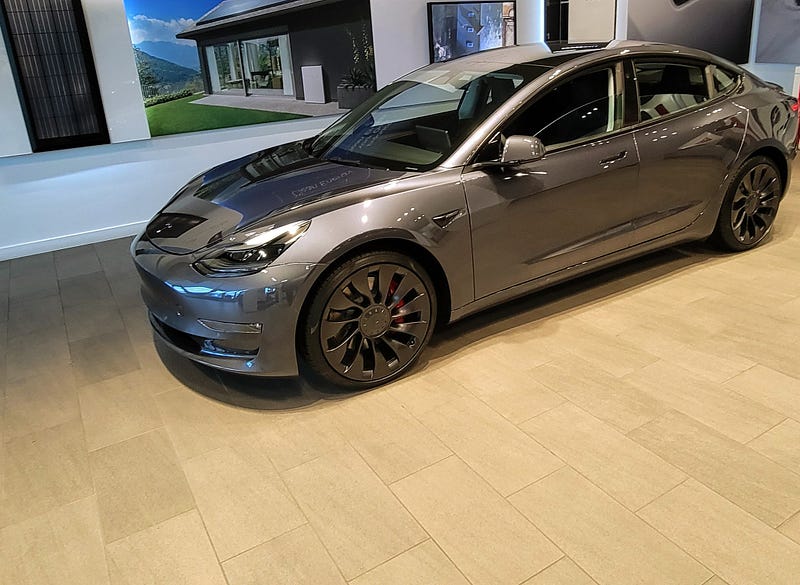
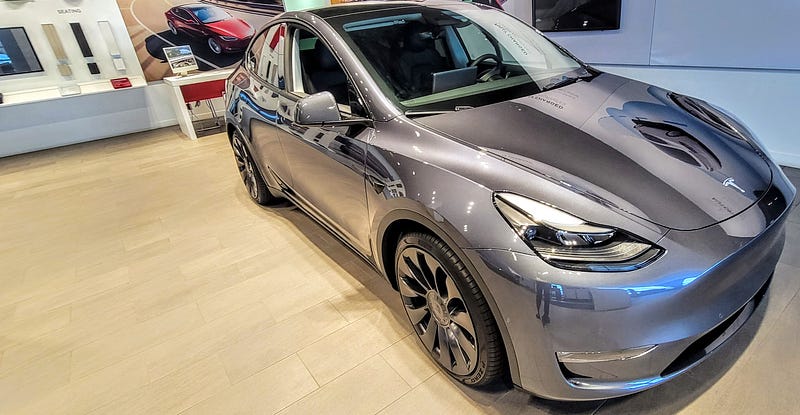
The Model 3 is the most affordable Tesla model you can buy. The Tesla's version of the Toyota Camry or the Nissan Altima, the mid-size five-seater sedan. The Model Y is the family SUV. It is the most popular EV model in the world and is quickly approaching the most popular car model in many automobile markets in many countries. The Model Y makes configuration to a 4, 5, and 7-passenger vehicle possible. Fair warning about the seven-passenger version, a third row is involved and is designed to accommodate small children; adults will not be happy in the third row.
The day had arrived. My wife and I entered the Tesla showroom, and three representatives graciously greeted us. First, Michael introduced himself and asked us, "Are you here to test drive or look at the cars in the showroom?"
I said, "Both. Unfortunately, we arrived a bit earlier than scheduled. I have booked a test drive for the Model 3 at noon and the Model Y at one o'clock. But can you show us the features of both cars?"
Michael answered with a gracious smile and said, "Of course. If you are thirsty or want coffee, please help yourself to the refreshment area." Michael walked us first to the Model 3.
My first impression of the Model 3 was that the sedan looked sleek and sporty. However, getting into the car was a different story. Getting in was cumbersome, and the car felt lower than most sedans. However, once seated, I felt comfortable in the driver's seat. The headroom in the front row was fine; the backseat, for anyone in a six-foot frame, was tight and claustrophobic. I knew I would never be happy sitting in the back seat of the Model 3.
I wondered if this car was built with a low car clearance. I later learned that the vehicle was lower to maximize the aerodynamics of the Model 3. Years ago, I bought a used Mercedes sedan that the previous owner had purposely lowered the ground clearance for aerodynamic efficiency; in other words, he liked to floor the gas pedal. The Mercedes constantly scraped the undercarriage through construction sites, uneven pavements, and steep inclines. I started to get flashbacks. Will I be scrapping the bottom of this car's battery with every speed bump and pothole? I had an uneasy feeling about the Model 3. Will I drag my Tesla Model 3 like a sanding block over highway construction sites? Nowadays, any car trip over 300 miles will have two or three construction zones with torn-up asphalt and uneven pavements. There is always a major construction project in all major cities like Chicago. It just moves down the road six months at a time. My enthusiasm for the Model 3 was fading fast.
I love the large central console. It is so easy to read. And the touch screen is so responsive and quick. One thing that irks me is the reluctance of many ICE automakers to install large navigation panels. It is painful to view a navigation map on a small screen. Also, why bother putting a backup camera on a small screen you can barely see? And the resolution becomes worse at night. Please, ICE manufacturers, use a bigger screen and better resolution cameras on all your vehicles. Safety should be standard on all vehicle types, not the premium and luxury models. Tesla didn't skimp on this.
Michael walked us to the front of the Model 3 and popped the hood to reveal the famous frunk. I liked the fact that there was extra storage in the front. Pop the hood and conveniently store a couple of grocery bags. The space was just right to keep three or four shopping bags together and upright. The frunk was the right size to hold three or four medium pizzas. The dimensions were the perfect fit for one carry-on luggage. I was starting to outline all the possible uses for that frunk.
The Model 3 trunk was spacious but awkward. The sleek aerodynamic trunk looked tight. Any tall packages would be difficult to slide into the trunk. I could not see myself loading tall items like a chair on its side or an office printer. Model 3 had the space, but the opening was narrow. As a result, I became less enthusiastic about the Model 3.
Michael directed us to walk over to the Model Y. The Model Y seemed taller and higher off the ground. I quickly opened the door and sat in the driver's seat. Getting into the car was more accessible and more natural. I didn't feel like I was forcing myself to sit low as if sitting a few inches off the ground. I was sitting in a chair at chair height, not curb height. The central display was the same as the Model 3, big and slightly tilted to the driver at an optimal angle. I had a good feeling about this car's ergonomics. The frunk was somewhat bigger in the Model Y. The trunk space in the Model Y was big and could easily accommodate large and bulky items.
Michael took us outside, where our Tesla vehicles were parked. The Model 3 drive was smooth and comfortable. Michael instructed me that the test drive was limited to twenty minutes. Michael handed me the key card and directed me to place the key card flat in the flat area between the console and coffee cup holders. I took the key card from Michael, and I took the wheel as my wife sat in the passenger seat.
I loved the large 15-inch central display. The software was smooth, snappy, and easy to learn. I was impressed with Tesla's software. Many car manufacturers' software technologies were cumbersome and slow to boot. Not Tesla. The software was on steroids and zipped quickly from one menu to the next. I was falling in love with the console and its zippiness and ease. I loved the camera's view of the blindspot area every time I turned on the blinkers to initiate a lane change. This feature alone would sway me to buy a Tesla. Other automakers had the opportunity to load blind spot cameras, but I suspect they didn't bother because of lowering profit margins and increasing costs. How can you put a price on this valuable safety feature?
Driving Tesla cars was a little different because of the regenerative braking. It takes some time to master it, but I like the concept. Depending on the pressure on the 'gas' pedal, one can accelerate and decelerate the car's speed. A continuous soft let-up on the accelerator pedal can slow your Tesla car to a standing stop without braking. Regenerative braking will save considerable wear and tear on the brakes and make than last much longer before changing the brake pads.
I wanted to test the full self-driving on the Tesla Model 3. Unfortunately, it would not activate for me. It was in learning or booting mode. After a few attempts, the full self-driving mode became available. But by that time, it was time to return to the Tesla showroom because my twenty minutes were up.
I noticed the charging cell phone pads in the middle console. I took out my large Samsung Galaxy S21Ultra and placed it on the charging mat. It wouldn't fit. This irked me. Luckily, after searching the web, my large phone does fit. I have a bulky phone case that makes the phone too large for Tesla's charging cradle. Smaller, slimmer cases can accommodate my large phone in the charging cradle. There are twin charging cradles for both the driver's and the front passenger's phones.
The Model Y was my next test drive. I looked over to my wife and mentioned that the electric cars were great at acceleration. As we left the parking lot of the showroom, I gave a gentle push on the accelerator. The vehicle pushed me into my seat and took off. I got a panic stare from my wife that quickly morphed into a "your f*@king pissing me off" look. I had to drive nice or else. I always hated the lag in ICE cars when I stepped on the accelerator. It was refreshing to have the Model Y respond so agilely.
I drove the car onto the highway and quickly engaged the full self-driving feature. The full self-driving was operational; what a pleasant surprise. It worked like a dream. The car stayed in its lane, even as the highway gently swayed to the left and right. The vehicle stayed centered in its lane. No jittery adjustment or swaying within the road; the Model Y stayed centered. The next test was lane change. We were approaching a bridge up ahead. The lanes were narrower as we crossed the bridge, and a handful of cars surrounded us. I lowered the turn-signal lever to alert the vehicles and the full self-driving that I wanted to change into the left lane. I loved that the blind spot camera video appeared on the consul to show me my left blind spot. The car gently waited for the space to open up and gently crossed into the left lane. Again, I was impressed with the full self-driving.
I let my hands drop off the wheel, and the car stayed in its lane. Then the console lit up in a warning alerting me to put my hands on the wheel. I later learned if you continued to drive with your hands off the wheel, full self-driving would disengage for the rest of the car trip. The car will give you two or three warnings before the full self-driving option becomes deactivated for the rest of the journey. Ultimately, you cannot operate full self-driving without having your hands on the wheel at all times.
My twenty-minute test drive ended as I drove the Model Y back to the Tesla parking lot. Overall, I liked the Model Y. It was bigger and roomier in the rear seats, and the car frame was slightly higher from the road. The full self-driving impressed me, despite the raging debate that many Tesla naysayers feel that Full Self Driving is nowhere close to fulfilling its destiny. I think that Full Self Driving is a lot closer than what many people think. Time will tell.
The story of Tesla reminds me of the story of Apple. Apple was struggling after Apple fired its CEO and cofounder Steve Jobs. Steve Jobs returned and introduced the world to iPod within a few years. Seeing the iPod's success, Microsoft came out with its own version, Zune. Many tech pundits saw the end of Apple once Microsoft came in with its Zune. Zune never took off. Apple later came with iPhone. The iPhone transformed Apple into a Techno Goliath. I see Tesla doing the same thing. First came the roadster, then the Model 3 and the Model Y. Soon, Elon Musk will start the mass production of the cybertruck and semi-truck. I cannot see Ford, GM, or VW catching up. Tesla has a tremendous head start. It will be hard to catch up. And Full Self Driving will separate Tesla from the rest of the pack.
Use my referral link to purchase a Tesla product and get free credits you can redeem for awards like Supercharging miles, merchandise and accessories. https://ts.la/thomas913365


