avatarWill Lockett

Free AI web copilot to create summaries, insights and extended knowledge, download it at here

3278

Abstract

00/1*yT9Mtc1_777qYerSA3p2qw.png"><figcaption>Qilin’s crossbar and rack battery pack — <a href="https://www.catl.com/en/news/958.html">CATL</a></figcaption></figure><p id="a2da">CATL <a href="https://thedriven.io/2022/06/28/1000kms-in-a-breeze-catl-unveils-new-qilin-ev-battery-with-incredible-specs/">took a similar approach</a>, but opted to develop the battery packs in a crossbar shape, rather than retaining the cylindrical form factor. These crossbars are a single cell, and an entire battery pack comprises a relatively small number of them in a rack. This reduces the number of terminals, making it much more thermally efficient in the same way that Tesla’s tabless design does. But the cooling can be more efficient, as the crossbars can have cooling between them, creating a greater surface area to cool. Despite this, the layout actually means that the Qilin has a <a href="https://thedriven.io/2022/06/28/1000kms-in-a-breeze-catl-unveils-new-qilin-ev-battery-with-incredible-specs/">much higher volume utilisation at 72%</a>, which makes the entire battery pack far more energy-dense than one using the 4680.</p><p id="6a64">Tesla has already started producing cars with the 4680. But just as with the initial Model 3 rollout, <a href="https://www.torquenews.com/14335/tesla-disrupted-itself-4680-battery-cells">Tesla is struggling to ramp up production to meet demand</a>. Musk ideally wants the 4680 used in all Model 3s and Model Ys because, once produced at scale, it will be far cheaper than their current pack, but delays at his gigafactories are preventing that from happening. This must be extremely annoying, as the highly anticipated and highly profitable Semi, Cybertruck, and Roadster all depend on the 4680 being produced at scale. Until then, these models can’t be sold, and Tesla can’t see a return on the money it has invested in developing these vehicles.</p><figure id="a70d"><img src="https://cdn-images-1.readmedium.com/v2/resize:fit:800/1*fNl7kMiaZvRyK93B2oiaMA.jpeg"><figcaption>The Cybertruck can’t be delivered yet — <a href="https://www.tesla.com/cybertruck">Tesla</a></figcaption></figure><p id="cc8e">But CATL won’t have these problems. Firstly, the form factor should be much easier to manufacture than the 4680, as it is technologically far more similar to the pouch-type cells that we find in our laptops and batteries. This means CATL can modify pre-existing production techniques, whereas <a href="https://news.metal.com/newscontent/101608849/tesla-4680-battery-breaks-through-the-bottleneck-of-mass-production-the-incremental-logic-of-the-two-links-of-the-industrial-chain">Tesla has to engineer the entire production line from scratch</a>.</p><p id="fc31">Only time will tell if the Qilin production can be ramped up more quickly than the 4680, but all the signs are showing that the company could easily leapfrog Tesla. <a href="https://www.catl.com/en/news/958.html">Production is set to start in 2023</a>, so it won’t be long until we find out.</p><p id="c5e1">However, the 4680 was never meant to deliver a significant jump in range or charge times. Instead, it was meant to allow <a href="https://www.tesmanian.com/blogs/tesmanian-blog/tesla-mind-blowing-next-gen-4680-battery-at-56-lower-cost-could-be-70-per-kwh-or-even-lower"

Options

Tesla to massively undercut their competition in price</a>. So for the Qilin to truly crush Tesla, it needs to be seriously cheap. So will it be?</p><figure id="69e2"><img src="https://cdn-images-1.readmedium.com/v2/resize:fit:800/0*NaiHPxDRv3rEjBee"><figcaption>CATL has an advantage as it supplies batteries to multiple manufacturers Photo by <a href="https://unsplash.com/@matthiasspeicher?utm_source=medium&amp;utm_medium=referral">Matthias Speicher</a> on <a href="https://unsplash.com?utm_source=medium&amp;utm_medium=referral">Unsplash</a></figcaption></figure><p id="f87c">Sadly, we don’t know the price yet and undoubtedly, initial production will be expensive. But a Qilin battery pack is just as simple as a 4680 pack, so if CATL can ramp up production enough then, in theory, it could become just as cheap to manufacture, and this is where CATL has an advantage. CATL is a battery provider for <a href="https://insideevs.com/news/594134/catl-qilin-new-high-energy-density-battery/">Tesla, BMW, VW Group and NIO</a>, which means far more cars could end up having this battery, whereas only Teslas will have the 4680. This means that the Qilin could be produced in far more numbers, which means <a href="https://www.investopedia.com/terms/e/economiesofscale.asp">economy of scale</a> could make it cheaper than the 4680.</p><p id="3f9c">This is why Tesla is about to lose the tech advantage. Suddenly its biggest rivals will have access to a battery that can outperform it in every way, and it has the potential to be cheaper than anything Tesla has. To make matters worse, unlike the 4680, the Qilin is designed to accept different chemistries, such as the more affordable and more eco-friendly <a href="https://www.catl.com/en/news/958.html">LFP chemistry</a>. This makes it far <a href="https://cleantechnica.com/2020/07/23/teslas-efficiency-advantage-cheap-abundant-lfp-batteries-will-power-mass-market-evs/">more flexible and able to power a wide variety of vehicles</a> while being more <a href="https://ihsmarkit.com/research-analysis/electric-vehicles-supply-chain-country-risks-lithium-supply.html">resilient to supply chain issues</a>.</p><p id="eebb">So should Musk be worried? 100% yes! The one thing which has made Tesla a household name is about to disappear and leave them without their main USP (unique selling point). Once other electric cars can go further and charge faster for the same money, why would you choose a Tesla? I hate to say it, but even if Elon can scale up the 4680 battery in time, it seems it won’t be long before it is antiquated. It isn’t just CATL. The entire industry is catching up with technologies like <a href="https://readmedium.com/solid-state-batteries-are-coming-musk-should-be-worried-2a9edde9c0ec">Quantumscape’s solid-state batteries</a>, <a href="https://group14.technology/en/">Group 14’s silicon anode</a>, new <a href="https://www.sciencedirect.com/topics/engineering/lithium-sulfur-batteries">lithium-sulphur batteries</a> and new pack constructions like the Qilin. All EVs are going further, faster and taking less time to charge while Tesla is struggling to maintain their lead. So what’s your next move Musk? How do you keep Tesla on top? Swallow some pride and make Qilin-powered Teslas?</p></article></body>

Photo by Vlad Tchompalov on Unsplash

Tesla Is About To Lose Its Tech Advantage

CATL’s new Qilin battery crushes anything Musk has.

Tesla has been the dominant force in the EV world for over a decade now. Musk has achieved this supremacy through pure technological advantage, as his cars have always been years ahead of the rest in every aspect. This trend seems only set to continue with their 4680 battery (read more about it here), which is cheaper, more powerful, and faster charging than anything else on the market. But CATL, one of Tesla’s battery suppliers, recently unveiled their Qilin battery, and it blows the 4680 out of the water. So how has CATL outgunned Tesla? And should Musk be worried?

Firstly, what makes this battery so cutting edge? Simply put, it is really energy-dense, which means you can easily stuff enough capacity into current EVs to deliver a monstrous 620-mile range. It is also incredibly thermally efficient, meaning higher safety standards, better reliability, and faster charging speeds (from 10% to 80% in only 10 minutes).
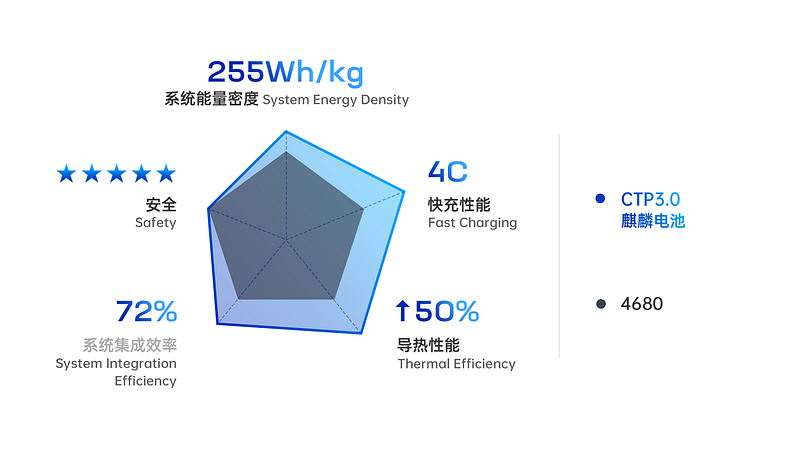
CTP3.0 (the Qilin) vs 4680 — CATL

Ultimately, it charges 50% faster and goes several hundred miles further on a single charge than Tesla’s “groundbreaking” 4680. But how did CATL pull this off?

Well, it did it in a similar fashion to the 4680. CATL’s approach was to reduce the number of cells in the pack, increase cooling, increase the electrical efficiency (and therefore thermal efficiency) and optimise volume utilisation (i.e., how much of the pack is actual battery). Tesla did this by super-sizing each cell from a 2170 form factor (21mm diameter, 70mm height) to a 4680 form factor (46mm diameter, 80mm height) and using a “tabless” design. This reduced the number of cells significantly and made each cell more efficient. It also left more room in the pack for better cooling. Moreover, the reduced cell count means that the production and construction of a Tesla battery pack would be much cheaper than before.
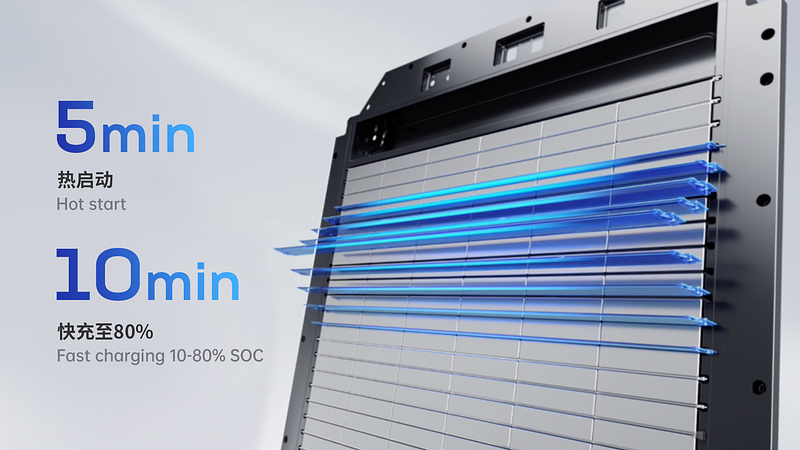
Qilin’s crossbar and rack battery pack — CATL

CATL took a similar approach, but opted to develop the battery packs in a crossbar shape, rather than retaining the cylindrical form factor. These crossbars are a single cell, and an entire battery pack comprises a relatively small number of them in a rack. This reduces the number of terminals, making it much more thermally efficient in the same way that Tesla’s tabless design does. But the cooling can be more efficient, as the crossbars can have cooling between them, creating a greater surface area to cool. Despite this, the layout actually means that the Qilin has a much higher volume utilisation at 72%, which makes the entire battery pack far more energy-dense than one using the 4680.

Tesla has already started producing cars with the 4680. But just as with the initial Model 3 rollout, Tesla is struggling to ramp up production to meet demand. Musk ideally wants the 4680 used in all Model 3s and Model Ys because, once produced at scale, it will be far cheaper than their current pack, but delays at his gigafactories are preventing that from happening. This must be extremely annoying, as the highly anticipated and highly profitable Semi, Cybertruck, and Roadster all depend on the 4680 being produced at scale. Until then, these models can’t be sold, and Tesla can’t see a return on the money it has invested in developing these vehicles.
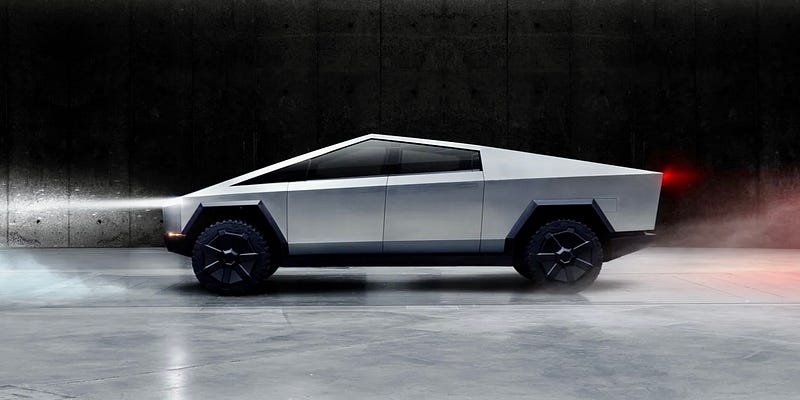
The Cybertruck can’t be delivered yet — Tesla

But CATL won’t have these problems. Firstly, the form factor should be much easier to manufacture than the 4680, as it is technologically far more similar to the pouch-type cells that we find in our laptops and batteries. This means CATL can modify pre-existing production techniques, whereas Tesla has to engineer the entire production line from scratch.

Only time will tell if the Qilin production can be ramped up more quickly than the 4680, but all the signs are showing that the company could easily leapfrog Tesla. Production is set to start in 2023, so it won’t be long until we find out.

However, the 4680 was never meant to deliver a significant jump in range or charge times. Instead, it was meant to allow Tesla to massively undercut their competition in price. So for the Qilin to truly crush Tesla, it needs to be seriously cheap. So will it be?
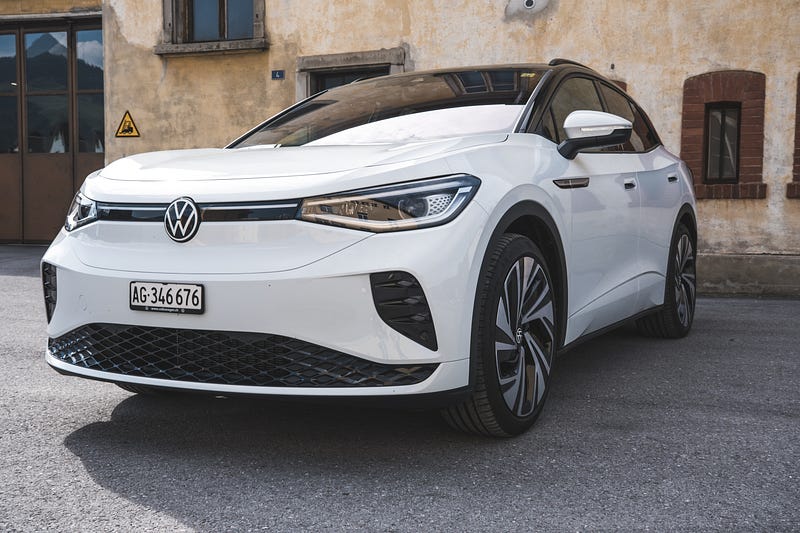
CATL has an advantage as it supplies batteries to multiple manufacturers Photo by Matthias Speicher on Unsplash

Sadly, we don’t know the price yet and undoubtedly, initial production will be expensive. But a Qilin battery pack is just as simple as a 4680 pack, so if CATL can ramp up production enough then, in theory, it could become just as cheap to manufacture, and this is where CATL has an advantage. CATL is a battery provider for Tesla, BMW, VW Group and NIO, which means far more cars could end up having this battery, whereas only Teslas will have the 4680. This means that the Qilin could be produced in far more numbers, which means economy of scale could make it cheaper than the 4680.

This is why Tesla is about to lose the tech advantage. Suddenly its biggest rivals will have access to a battery that can outperform it in every way, and it has the potential to be cheaper than anything Tesla has. To make matters worse, unlike the 4680, the Qilin is designed to accept different chemistries, such as the more affordable and more eco-friendly LFP chemistry. This makes it far more flexible and able to power a wide variety of vehicles while being more resilient to supply chain issues.

So should Musk be worried? 100% yes! The one thing which has made Tesla a household name is about to disappear and leave them without their main USP (unique selling point). Once other electric cars can go further and charge faster for the same money, why would you choose a Tesla? I hate to say it, but even if Elon can scale up the 4680 battery in time, it seems it won’t be long before it is antiquated. It isn’t just CATL. The entire industry is catching up with technologies like Quantumscape’s solid-state batteries, Group 14’s silicon anode, new lithium-sulphur batteries and new pack constructions like the Qilin. All EVs are going further, faster and taking less time to charge while Tesla is struggling to maintain their lead. So what’s your next move Musk? How do you keep Tesla on top? Swallow some pride and make Qilin-powered Teslas?

Science
Future
Technology
Climate Change
Artificial Intelligence
Recommended from ReadMedium