
Ten Different Aspects That Define Portuguese Culture
Are you moving to Portugal or just curious about this European country? This article may help you understand its culture.
Hello dear readers. I have organized this article into ten cultural aspects that perhaps are not well-known about Portugal.
I have written before about Portuguese History early:
But, today, I bring a different article, perhaps more positive, which I hope will be as entertaining as informative for you. So, here we go:
1- Popular festivities and pilgrimages.
There is no shortage of festivals and pilgrimages in Portugal, with every land having its own. Most are linked to the Christian religion, such as the famous saints, which filled with life in both the largest Portuguese cities and the smallest villages in Portugal.
Saint John
In Porto, the city's biggest festival is Saint John's, which takes place from the night of July 23rd to the night of July 24th. This festival, with pagan origins, coincides with the summer solstice and is an extraordinary moment of revelry for all, being one of the largest festivals in Europe.
But other cities also celebrate it like Braga or even my small village where I was born. There is also a clear division between urban and rural Portugal, with festivals being more prominent in more significant places and smaller and cozier in rural areas.
Saint Anthony
In Lisbon, the feast of Saint Anthony happens mainly from the 12th to the 13th of June. Here the party is quite different from Porto's because of the city's well-known contest. In Lisbon, a big parade of traditional dances gathers the so-called popular marches on the city's biggest avenue. Each municipality district triggers the prize for best dance and costume, and people dance like a parade all over the avenue.
Here are two videos of those popular marches, from the preparation, the rehearsals, and the night when they take to the streets. Beware, though, this is only a tradition from Lisboa, and of course, Portugal is so much more than its capital.
But some celebrations have distanced themselves from religion and whose origins, often medieval, have different objectives. In the city where I was born, Viseu, the now centennial São Mateus Fair, or Feira Franca, is a fair during August and lasts until mid-September.
Although it has religious origins, the fair has been, and it is an open market with restaurants, and a stage for concerts, where my childhood memories still revolve around the carousel, bumper cars, and cotton candy:
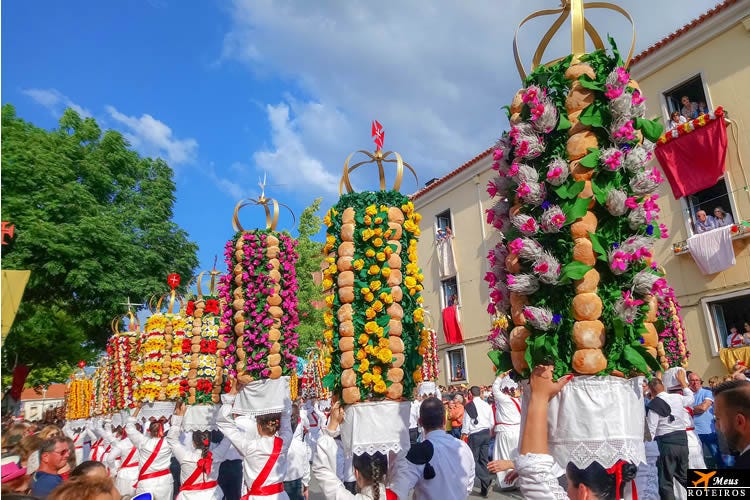
Likewise, in Tomar, a city in central-western Portugal, the Tomar tray festival is a treat for the eyes and flower lovers, although also religious. This festival, held only every four years, is believed to have Roman origins when celebrating the goddess Ceres (the goddess of plants and cereals) and is sometimes held in June or July.
The town stops to see a massive procession of young women, carrying a tray of their height on their heads and where 30 loaves of bread are carried. Besides the bread, the trays are decorated with poppies, marigolds, and ears of wheat.
However, as the Catholic religion is still the main religion in Portugal, several festivals, pilgrimages, and rituals are associated with it, an intrinsic part of Portuguese culture. Some of the most famous pilgrimages in the country include the one in Viana do Castelo, celebrating Our Lady of Agony in the extreme northeast of Portugal.
There, young women also march down the street on August 20th, wearing the typical costumes of the region, which are among the most beautiful in the country. Young single women wear red costumes, gold necklaces, and earrings, making Portuguese jewelry famous.
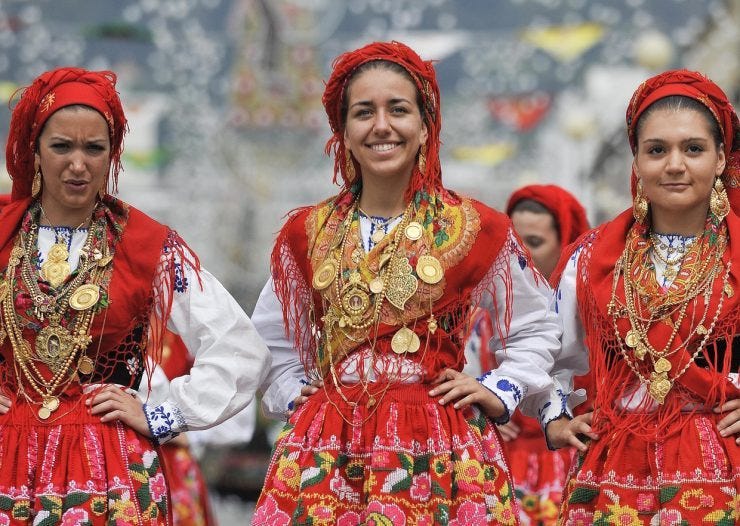
To the married women is reserved the black costume. Nevertheless, gold is still worn and displayed all over town, not without a police escort as you might imagine. But since Portugal is the third most peaceful country globally, it doesn't seem to cross anyone's mind to rob anyone.
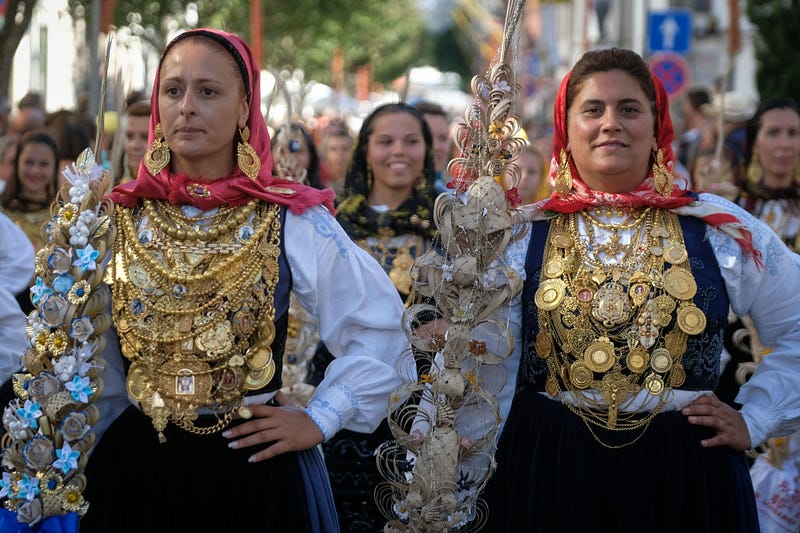
All Portuguese are familiar with these festivities. However, everywhere the parties multiply, in villages, towns, small cities, where sardines with roasted peppers delight those who eat them.
2- Traditional Dances
Although there is an understanding that Europeans don't dance, this is a false perception of those who have never been to these parts.
In Portugal, one of the funniest dances is called "O Corridinho," originally from the south of Portugal, Algarve, where pairs dance in typical costumes in a frantic dance. But better than words, here is a video:
And one of the dances that has stood out in recent years, although it is as old as all the others, is the dance of "Pauliteiros de Miranda," where men in skirts and with sticks in their hands dance together. The origin is not defined. However, some argue that it is a war dance that descends from Greco-Roman times and that men have adapted and transformed it in their own way.
Well, whatever, the truth is that it has survived time and is an intrinsic part of the culture of northern Portugal. And let's just say that seeing men in skirts is always fun.
One of the best-known dances is perhaps the Vira do Minho, and it's the Queen and King of all dances from that area. But besides being dance, it is also music, played with accordions, tambourines, pitchforks, and a lot of joy.
The beautiful costumes help complete the scene. Arranged in a circle, the pairs, men and women, raised arms, slowly turn counterclockwise. The men move forward, and the women move back. The dance continues until one man dancer shouts "out" or "turn." Then, they turn around on the inside and face the woman before them. It is a beautiful, energetic dance and is always accompanied by an accordion.
Just an example:
All these dances can look almost the same. The sound is indeed quite similar, but even though Portugal is a considerably small country, these traditions vary significantly from region to region.
However, watch the video and see how "The Fandango" is different from all the other dances I have talked about here.
As a Portuguese, I can immediately identify how this is part of the Ribatejo area. This is a central-southern region of Portugal, where there are other traditions that I don't like, such as bullfighting, but which are nevertheless still part of Portuguese culture.
3- The Portuguese Carnival
Carnival, a festival perhaps best known in both Venice and Rio de Janeiro, is a festival that is also celebrated in Portugal.
Carnival also marks the date of when Easter will be. Carnival is also known as "Entrudo" from the Latin introitus, "entrance," dating back to the 13th century.
Later, the term Carnival defined a festivity affirmed in the 16th century, evoking the Roman celebrations recovered by Christianity.
The Portuguese Carnival, which happens every year around February or March, or forty days before Easter Sunday, is always on a Tuesday and an optional holiday.
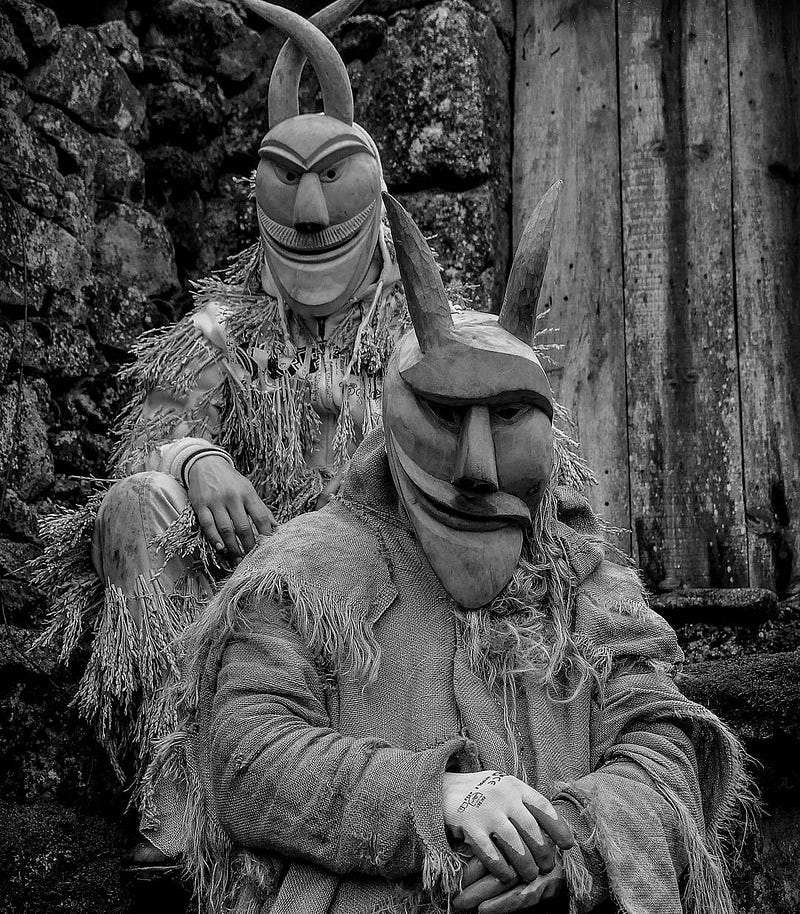
Every village has its traditions. But in Portugal, of the most "Portuguese" carnivals, "Os Caretos de Podence" stands out first. I think this video is well explanative:
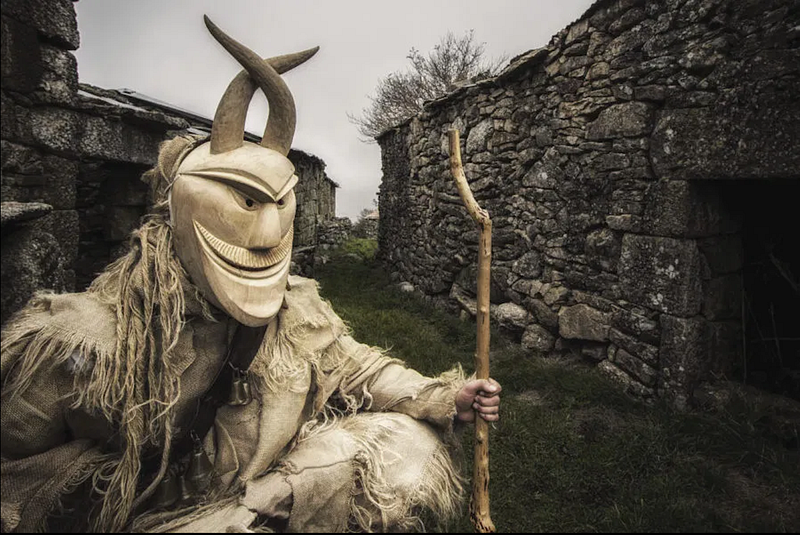
This tradition, located in Trás-Os-Montes in the far north of Portugal, is a celebration of Roman origins. Men dressed up in very Portuguese colors, including red, green, and yellow, with rattles around their waists, jump, and dance as they go around looking for unmarried girls.
To a foreigner, this might be considered offensive or rude, but it is just a party without any pejorative content. Legend has it that this ritual is associated with fertility and the celebration of the coming of spring. Today, the "Caretos de Podence" and "Caretos de Lazarim" are the best known and have become tourist attractions.
These are the "Caretos de Lazarim":
Another alternative Carnival is that of Cabanas de Viriato, in the district of Viseu. Cabanas de Viriato is also the birthplace of a critical man in the History of Portugal, Aristides de Sousa Mendes, an ambassador who saved Jews during World War II by issuing visas to Portugal.
The town is known for hosting an unusual tradition during Carnival, "The dance of the asses."
Yes, you heard it! Strangers dance by bumping their hips… and their asses against each other. It is a party full of joy and a good mood!
Many other carnivals generally use this time for political and social satire. Others, with few resources, are simply a reason for people to dress up and have fun!

The most famous are the Carnaval of Torres Vedras, the Carnaval of Ovar, the Carnaval of Loulé, and the most Brazilian carnaval in Portugal, the Carnaval of Mealhada.
4- Academic traditions
The university world, full of traditions, is a dream for many who, besides wanting to study, want to have the so-called academic life. When entering university, the first-year students, if they so wish, join the "university hazing" or in Portuguese "praxe" from the Latin "praxis." I have a very negative view, but I will leave my opinion aside this time.
Many first-year students want to join this ritual to feel part of a group. For many, this is the gateway to a free life outside their parents' home and with a life full of dreams ahead of them.
Universities welcome first-year students with various parties depending on each institution. Around May, there is always a week without classes at the end of the academic year, the so-called "burning week," "Semana da Queima."
During this week, the students who are about to graduate celebrate the end of their academic life. Others experience everything for the first time in parades through the city and in concerts at night.
A whole dressing code that varies from one university to another is associated with academic traditions. However, at Coimbra, perhaps the most traditional because it is the oldest in the country, women and men wear classic black suits overlaid with a cape touching the ground that is also black.
Our university students inspire J.K.Rowlling's Harry Potter.
This ritual has been increasingly criticized by society, myself included, for having lost the limits of what is appropriate. Many young people are ridiculed, bullied, harassed, and teased by others, and recently, a hazing case led to the death of students at Meco beach in southern Portugal.
It is a shame that students have subverted the actual value of wearing academic attire. They were made to democratize, where everyone would be equal, and ironically today, the opposite happens, as the costumes are not for all wallets.
But one of the beautiful things, at least for us, is the emergence of Fado de Coimbra — Fado is typical Portuguese music declared World Heritage by UNESCO. Young men used to serenade the girls. Although it is harder and harder to find that tradition nowadays, the big serenade during the week of the burning is a solemn moment, especially for the students who finish their academic life start their work life.
As you can see from the video below, it is something quite important, solemn and emotional:
I mean, who wouldn't cry upon feeling that that time of being young and a student is coming to an end?
And one crucial thing, Fado is not applauded! Fado, which also means fate, is sad, full of nostalgia; you feel it, but don't mistake standing up and applauding! Of course, this is the theory; in practice, many forget that this should not, culturally speaking, be done.
5- Wine and Gastronomy
This could be a whole article since there is so much to talk about.
But, let's start with the wine.
In Portugal, almost all Portuguese grew up with the taste of wine in their mouths. Fortunately, children are not given wine to drink nowadays, but it was seen as something normal in the past.
As for the grape varieties, many foreigners only know French, Italian or American grape varieties, think we share the same ones. But Portugal has its own types, making the country unique in flavors. Touriga Nacional is the queen of the house.
Although Portugal is a small country, its different regions produce different wines for everyone's taste. In Alentejo, an area in the south of Portugal, red wines are my favorite, full-bodied, with a strong flavor characteristic of the region.
In the Douro Valley region, north of Portugal, the oldest demarcated wine region globally, the region is known for its natural beauty and mainly for being the region where the famous Port wine is made.
Porto is a city. Of course, it has no vineyards, and these are found in this region, where later, by large companies, the wine is stored in the city of Vila Nova de Gaia. Only the Port Wine Institute is located in the city that gives the wine its name.
There are three types of Port wine, ruby (red), tawny and white, and depending on the years of aging, the older, the better. Port wine is a sweet dessert wine with an alcohol content of around 20 degrees. But those who think that only Port wine is produced in the Douro region should not be fooled. The area also produces excellent table wines.
Vinho Verde — green wine — is a frizzier wine in northwest Portugal. Vinho Verde is only its appellation despite its name, and the wine can be red, white, or even rosé.
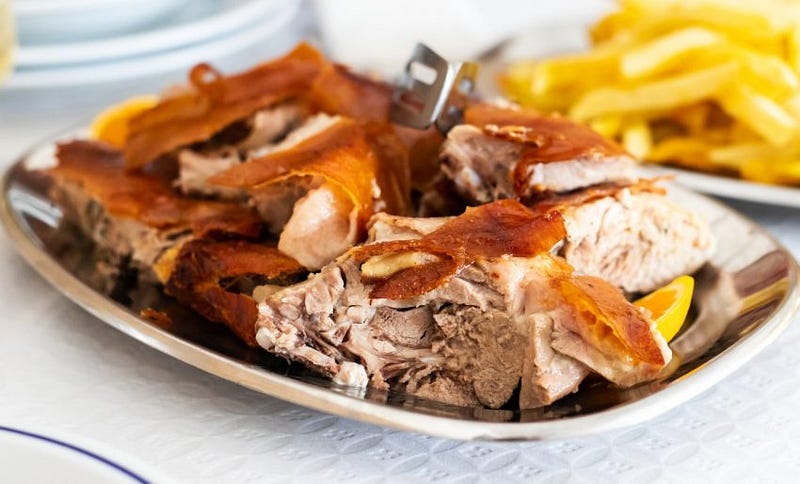
Further down, both in Coimbra and Lamego, sparkling wines are usually accompanied by a suckling pig meal, especially in the Coimbra area.
The suckling pig is typical of Mealhada, near Coimbra, a region not advisable for vegetarians. The meat is served with a spicy sauce and usually fried potatoes.
It's challenging to be a vegetarian in Portugal unless you live in big cities like Porto or Lisbon, where you can find alternative restaurants and products because the Portuguese eat meat or fish at every meal. After the Japanese, we are the ones who eat the most fish in the world.
The king of our dishes is cod, which can be cooked in a thousand and one ways. But please don't think that we eat it every day. Hopefully, we eat it once a month, on particular dates, when we go out to eat, and especially on Christmas Eve.
There are several typical dishes, but unfortunately, they seem to be disappearing.
Among them, Arroz de cabidela, chicken rice made with the animal's blood; Cozido à Portuguesa, a dish for hungry people, with pork, various sausages, beans, boiled potatoes, rice, and whatever else fits in the stomach; Migas, a mixture of kidney beans, cabbage, and cornbread, which usually accompany many dishes. Traditionally accompanied by fried potatoes or rice, grilled or roasted lamb is usually eaten around Easter.
And two of my favorite ones:
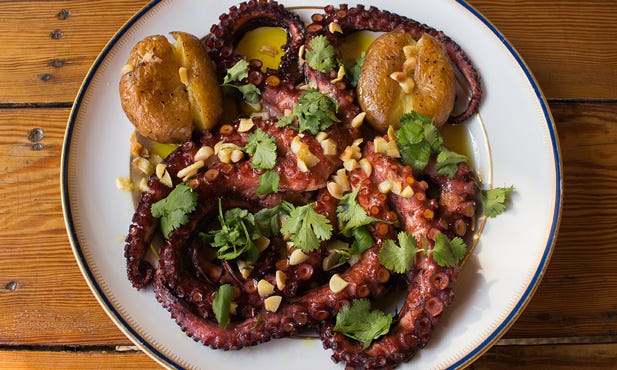
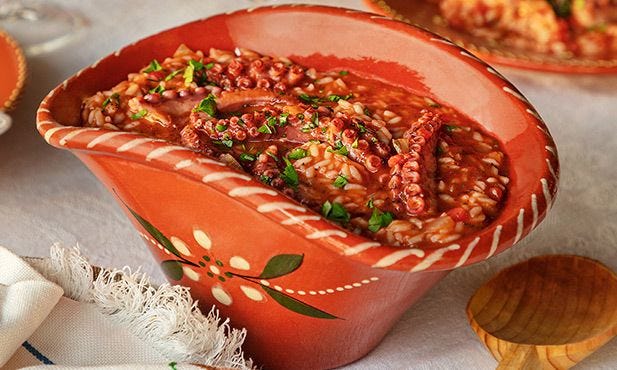
Octopus à Lagareiro and octopus rice.
And for the sweet tooth, there is no shortage of sweets in Portugal. Our bakeries are full of cakes and various bread. Portugal has an ancient tradition of sweets, and many of the pastries were made by nuns in convents. But one thing that usually shocks the foreigner's palate is the egg taste. We Portuguese can't cook sweets without eggs! Don't insist. We put an egg in any sweet!
To those who are superficially acquainted with Portuguese culture, everyone looks for the desired pastel de nata. I understand; they are delicious, hot or cold, with crispy puff pastry and a cream whose ingredients are secret.
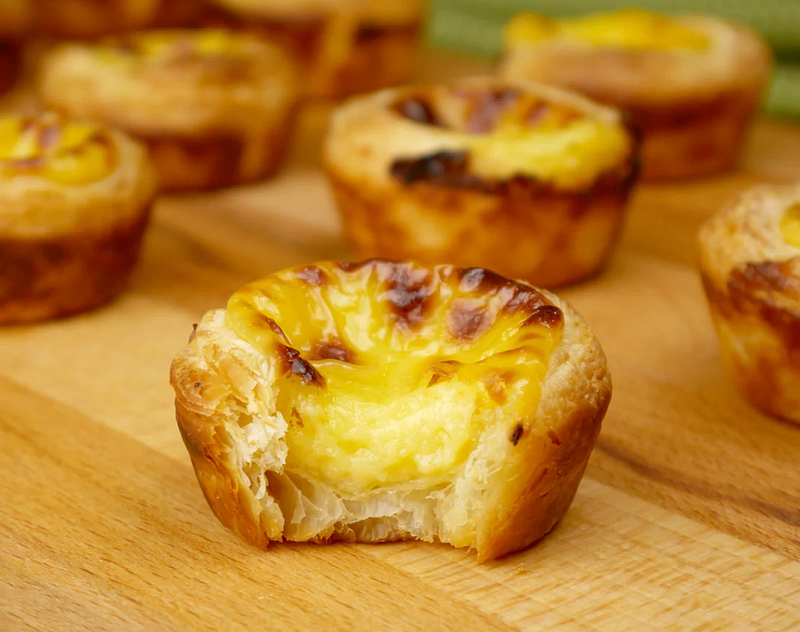
However, I assure you that it does a tremendous injustice to so many other traditional pastries as good or better than this one.
Just to name a few of wich I will ask you to google them:
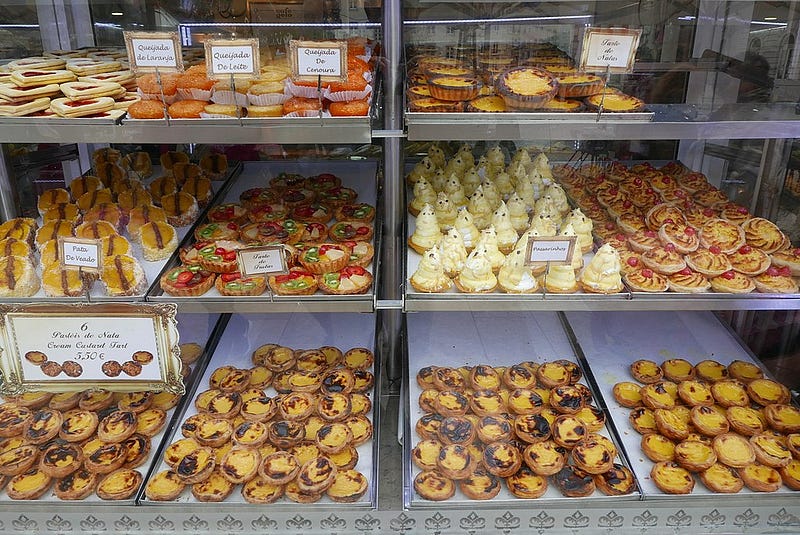
- Caladinhos;
- Pastéis de Vouzela;
- Ovos moles de Aveiro;
- Pão de ló de Ovar;
- Folar de Olhão
- Pudim abade de Priscos
- Papo de anjo;
- Bolo de mel
- And so many others.
6- Tiles
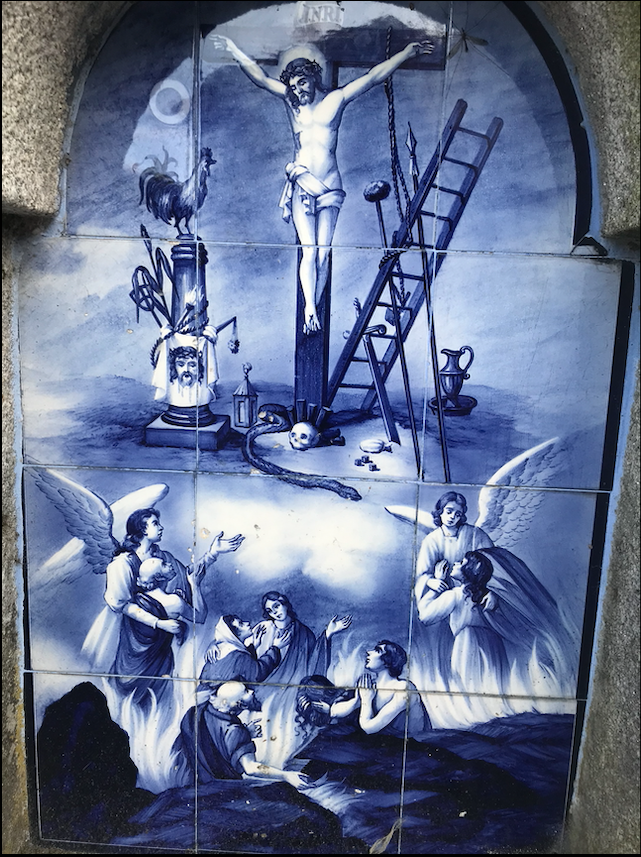
Portugal's most significant decorative feature is the azulejo "tile." A Muslim heritage, tiles are spread everywhere. They exist mainly in religious paintings, but they also exist inside houses, especially in bathrooms and kitchens, where the humidity is higher, and their existence helps combat the wetness.
The tiles can be of various colors, but the main ones are blue and white, usually where religious figures are represented. Mainly in villages, there are the "alminhas" (little souls), which are obligatory stops for those who have the habit of praying or remembering a loved one who has already departed. For foreigners, these symbols spread mainly in the rural world may be very strange, but they are common in people's daily lives.
7- Music: Fado
It's uncertain the origin of Fado. Some say it was born from the Muslim songs, and others say it can date back to the medieval troubadours. Whatever! Who will know? What's important is that this beautiful melody is unique, played with a 12 string guitar, the Portuguese guitar, which is also evidently a Portuguese symbol.
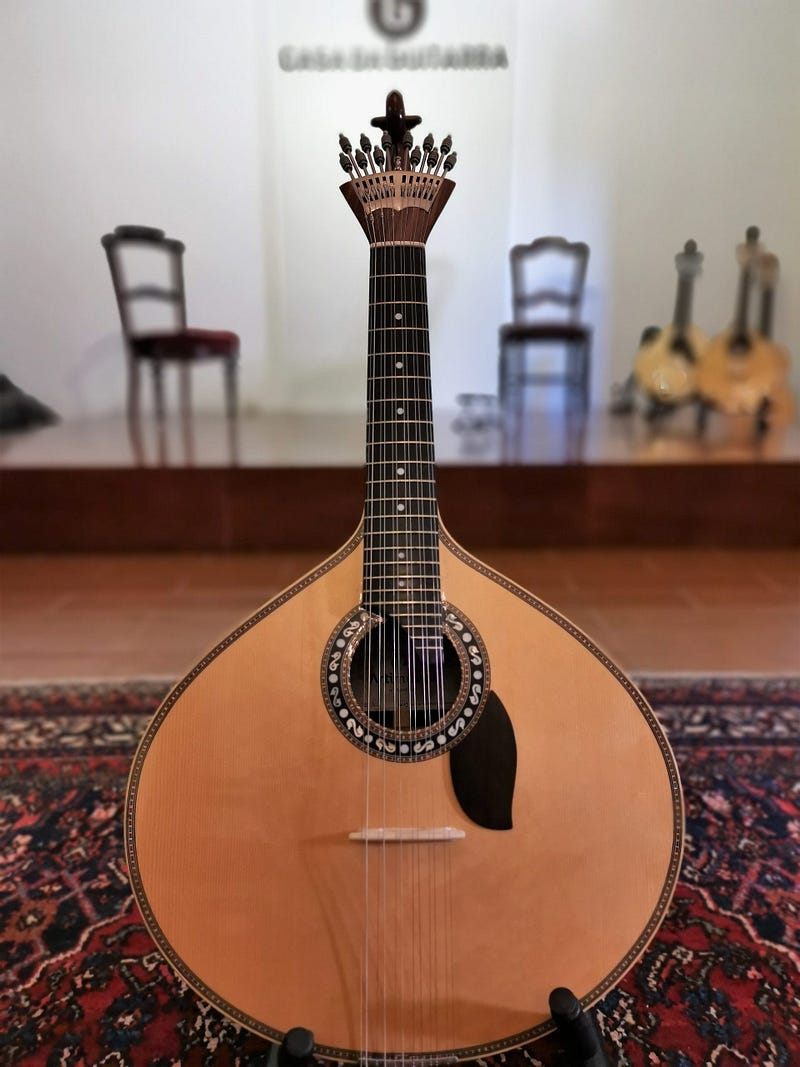
Fado is predominantly from Lisbon, Severa being the first recorded Fado singer.
However, it was the voice of Amália Rodrigues that made Fado eternal and made it considered a World Heritage by UNESCO. That beautiful woman, which for me represents the Portuguese woman's face somehow, also had one of the most beautiful voices ever. But, I know that being so Portuguese is not a type of music that everybody can understand or enjoy. Nonetheless, I'm leaving below a song sung by Amália Rodrigues:
And now, for all the foreigners out there who may be more familiar with this. But I have to admit; I prefer her singing in Portuguese.
8- Religion
Portugal is a strongly Catholic country, although the number of non-believers has grown. Even so, religion is still part of the everyday life of many people, in a more or less intense way. For example, many still insist on getting married in the Church on baptizing their children, even if they do not practice the religion.
Portugal also has many places of worship, the most famous being the Shrine of Fatima, wherein 1917, three shepherd children, Jacinta, Francisco, and Lucia, spoke with the Virgin Mary and where the miracle of the sun happened:
However, there are other outstanding places, such as the Bom Jesus do Monte Shrine, Braga, Santa Luzia Shrine in Viana do Castelo, or the Nossa Senhora dos Remédios Shrine in Lamego.
9 — Distinctive architecture
Every country has its art, and Portugal is no exception, having architectural styles that can only be found in Portugal or its former colonies.
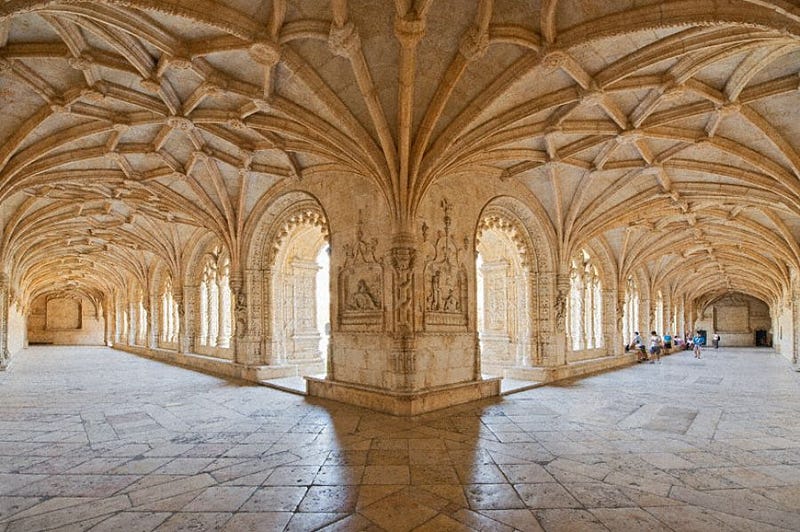
One of the most beautiful styles is the Manueline style, born during the reign of King Manuel the First. During the age of discoveries, the crossing of several cultures brought a new decorative style with traces of that time. The branches, foliage, twisted strings, and strange marine shapes are among its various characteristics.
Possibly the monument with the most Manueline traces is the Jerónimos Monastery in Lisbon, below in the picture:
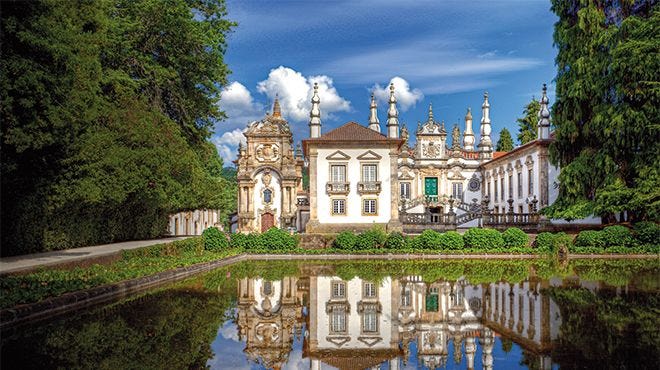
But Portugal is not only filled with Manueline, and the Baroque-Joanine also extends throughout the country.
Near Vila Real in northern Portugal, here is one example of the famous Casa de Mateus, where Mateus Rosé wine is made.
10- Literature
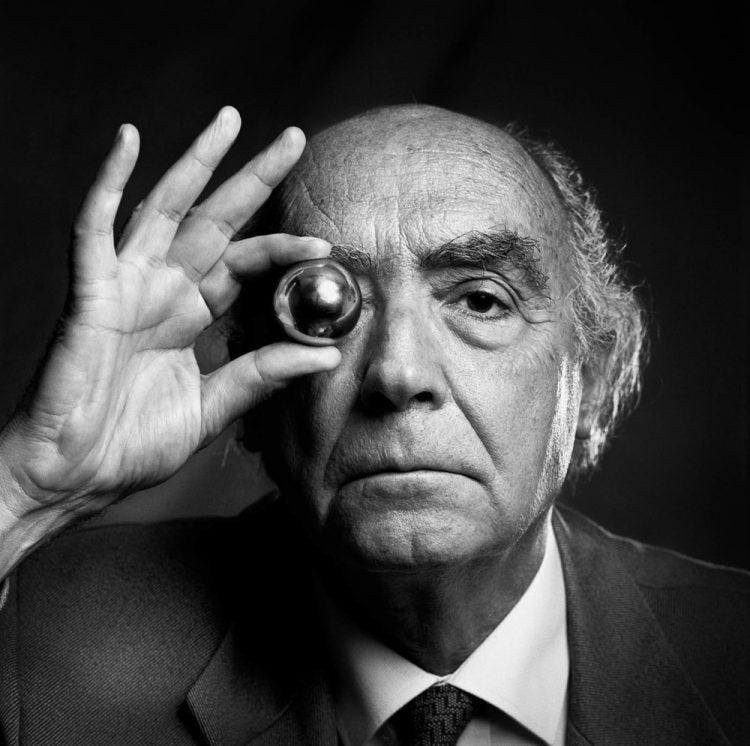
It is so difficult to talk about Portuguese Literature writing these English words. Our ignorance is always greater than our knowledge, which will always be a fact that we will have to deal with.
But so many Portuguese poets and writers are unknown to the world outside the Portuguese sphere that it is saddening.
However, the most recognized of them all must be our only Nobel Prize winner for Literature in 1998, José Saramago.
But our Literature is as old as our borders. In theater Gil Vicente and his "Auto da Barca do Inferno."
In epic poetry, our one and only glorious Luís Vaz de Camões, with his "Lusíadas," released in 1572, depicts the maritime epic of the Portuguese discoveries in ten cantos — note that I am not a supporter of this mentality. Quite the contrary, on the word "discoveries," but I am only, once again, writing about Portuguese cultural aspects and the way of seeing the world at the time the book was written.
In the 19th century, the great Eça de Queiroz, one of my favorite writers, whose works are part of the school curriculum in Portugal. Among several books, "Os Maias" and "Crime of Father Amaro" are the most famous.
In modernism 20th century, the literary canon evokes Fernando Pessoa as the father of Portuguese modernism, and he is without a doubt.
But contemporary women, like Florbela Espanca, of whom a film was made, was one of the most important Portuguese writers.
In prose, female names like Sophia de Mello Breyner filled my childhood imagination.
In adult life, I again name José Saramago as an enlightened, critical writer of Portuguese History, religion, and wit for words such as I have never seen.
These are some of the crucial aspects of Portuguese identity, many are missing, and they are generalizations. However, they are also the main features of the Portuguese way of life, our past, and our present,d which probably also condition our future. Many more are left unsaid, and many names remain unsaid, but these may arouse your curiosity for now.
Hello, I'm Araci, a female writer from Portugal navigating her thirties. If you have enjoyed this article, maybe you would like to buy me a coffee here https://ko-fi.com/joanaaraci
I write on Medium about politics, culture, pop culture, society, feminism, and womanhood. I hope you've enjoyed this article and that it helped you out!
You can also find more about me here:
Are you considering joining Medium for only 5$ a month? If so, consider doing it through my referral link:
Your membership fee directly supports me, Araci Almeida, and other writers you read. This way, you are helping me out while you'll also get full access to every story on Medium.
Thank you for reading me.


