
Ten Common Historical Myths That Simply Refuse to Die
These are stubbornly persistent

“And some things that should not have been forgotten were lost. History became legend. Legend became myth.” — Galadriel, The Lord of the Rings: The Fellowship of the Ring
Myth and history have been intertwined for as long as humans have walked the earth. In ancient times they were often hard to separate, and in several persistent cases we’ve done no better in modern times. Sometimes it’s the result of laziness (on the part of both scholars and students) and sometimes it’s the result of people wanting to believe something so badly that they don’t let facts get in the way (as in the case of a recent American election).
Today I want to dispel ten common myths that have persistently endured, some for centuries and some for millennia. We’ve managed to correct other common myths, like young George Washington chopping down the cherry tree; let’s get rid of these as well.
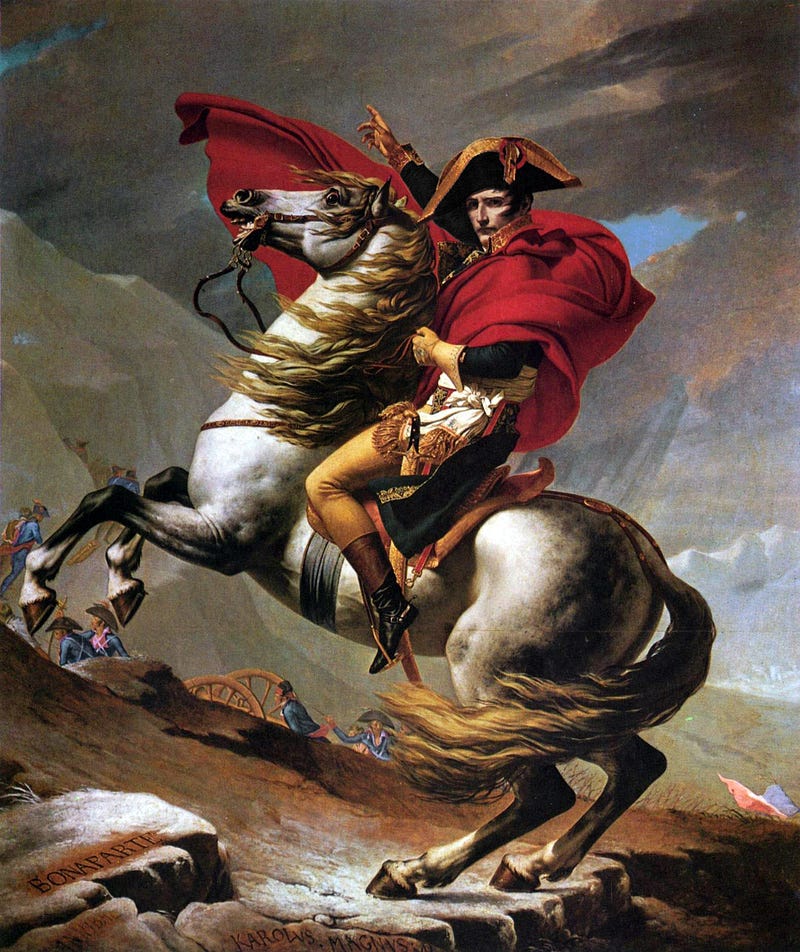
1. Napoleon Bonaparte was short. This seems like a good place to start, as it’s the most enduring of the myths about the French emperor and general; even now we say that a short person with an overinflated ego has a “Napoleon complex.” In reality, Napoleon wasn’t short at all, at least not for the time in which he lived; at 5’7”, he was actually above average height for the time. Part of the myth comes from the fact that his height was reported as 5’2”, but this reflected the French measurement of the era, which was longer than the British one. His British enemies knew this, of course, but highlighted the shorter measurement to mock a hated and feared adversary; diminish the demon and he becomes less fearsome. Another reason he was thought to be short was that he always surrounded himself with his Imperial Guard, who were without exception veterans far taller than average. You don’t project power with tiny bodyguards.
2. Henry VIII beheaded all six of his wives when they didn’t produce male heirs. This may be the most enduring myth about Henry; in point of fact, he “only” executed two of his wives. The best way to remember the fates of his wives is using the old line “divorced, beheaded, died; divorced, beheaded, survived.”
He divorced his first wife, Catherine of Aragon, after unsuccessfully seeking an annulment from the pope; Catherine’s nephew was the Holy Roman Emperor and a crucial ally of the pope, so this was a futile endeavor from the start. But Henry had fallen in love with Anne Boleyn and also needed a male heir, so Catherine was sent away, still very much alive. Anne was not as fortunate, but not because she produced only a daughter (and that only daughter just happened to become Elizabeth I, maybe England’s greatest monarch ever); it was Anne’s alleged infidelity that was her undoing.
Jane Seymour, wife number three, gave Henry the son he so desperately craved, but she died shortly after giving birth. His subsequent marriage to Anne of Cleves was an arranged one that Henry never wanted, and he quickly divorced her; they remained on civil terms. Catherine Howard was beheaded, also because of infidelity, real or imagined. Catherine Parr was queen at the time Henry himself died, and thus survived him. Henry indeed wanted a son to continue the Tudor dynasty, but he didn’t kill off his wives to get one.
3. Shakespeare didn’t write the plays attributed to him. This remains the most persistent myth about Shakespeare and perfectly demonstrates our nearly pathological need to deny that a creative genius could actually be a creative genius. Many times this denial is a simple case of envy, but in Shakespeare’s case the myth that he didn’t write the plays that bear his name comes more from class prejudice than envy.
Shakespeare was a commoner; he was no peasant, but he certainly wasn’t part of the nobility. He was basically middle class, and in England of the 17th and 18th centuries, commoners weren’t supposed to produce works of genius, especially not the volume Shakespeare produced. This is why the names most often put forward as the so-called “real” authors are from the noble class, like Sir Francis Bacon and the Earl of Oxford.
Nearly all scholars today (both historical and literary) agree that William Shakespeare wrote the plays. There are dozens of references to Shakespeare as a playwright — he was also an actor — made during his lifetime, including by Ben Jonson, a fellow playwright who was no friend of Shakespeare. It has been erroneously claimed that he had a knowledge of aristocratic and courtly life no commoner could possess, yet John Dryden, an English poet who lived during the generation following Shakespeare’s and was a member of the gentry, wrote that Shakespeare’s portrayals of the nobility were wildly inaccurate. One humorous aspect of the numerous alternative authors conspiracists have proposed is that many of them were dead before Shakespeare’s writing career ended. These include Edward de Vere, Edmund Spenser, and amazingly Queen Elizabeth I. Never let the facts get in the way of a good story.
4. The Caesarian section was named after Julius Caesar. Though many still believe this today, Julius Caesar was not delivered by Caesarian section, and the procedure is not named after him. The procedure is recorded even before Caesar’s lifetime and, more importantly, was only performed in an attempt to save the child when the mother had died or was clearly dying during childbirth. Historians record that Caesar’s mother not only survived but was still alive until at least his invasion of Britain, and thus the procedure would not have been used.
5. Pirates buried their treasure. As kids we all dreamed of finding pirates’ buried treasure; unfortunately for us (and adult treasure hunters today), while a large number of merchant ships carrying gold and silver from the New World back to Spain and Portugal did sink on the way and thus have been discovered over the centuries since, pirates weren’t really into burying their ill-gotten gains. Much like sailors on shore leave to this day, pirates would spend their loot the first chance they got, most often on gambling, rum, and women. There are only two recorded exceptions to this no-burying-treasure rule: Captain Kidd, who allegedly buried millions in loot on Gardiners Island at the east end of Long Island and was captured and hanged before he could recover it, and Francis Drake, who buried tons of Spanish gold somewhere along the coast of Panama. Since a pirate’s life span was typically short, it makes perfect sense that they wouldn’t stick their money in a hole in the ground.
6. Captain James Cook discovered the east coast of Australia. Contrary to popular belief, Captain Cook was not the first European to discover Australia. I say European because obviously the indigenous peoples beat him by about 40,000 years and the Chinese had been there by the 4th century B.C., but when he reached Australia in 1770, he was also 164 years behind the Dutch explorer Willem Janszoon, who landed at the Gulf of Carpentaria in 1606. Two other Dutchmen also beat him: Dirk Hartog in 1616 and Abel Tasman in 1644; both Tasmania and the Tasman Sea are named after him.
Cook wasn’t even the first Englishman to land in Australia. That honor goes to William Dampier, a British pirate. Cook gets the credit because the victor writes the history. The British were, at the time, in fierce competition with the Dutch and were ultimately victorious. Britannia ruled the waves and much of the world, and Britain wrote the history that made Cook the one who discovered Australia. They could have chosen Dampier, but a Royal Navy captain makes a better hero than a pirate.
7. Ferdinand Magellan was the first man to circumnavigate the globe. Here’s one more myth from the Age of Sail that has persisted for centuries: that Ferdinand Magellan was the first to circumnavigate the globe. In Magellan’s defense, it’s not his fault that he didn’t complete the round-the-world trip; he simply had the misfortune of being killed by natives in the Philippines midway through the journey. However, one of his five ships and 18 of the original 270 crew did finish the voyage, returning to Portugal after three years. The captain of that remaining crew was Juan Sebastian Elcano, but as the voyage was originally planned, organized, and led by Magellan, he’s the one we remember. Sometimes your vision is what gets you the credit.
8. Martin Luther announced his break with the Catholic Church on October 31, 1517, by nailing his Ninety-five Theses to the church door in Wittenberg. This is a foundational myth not only about Luther himself but about the Reformation in general. In reality, there is no proof that Luther ever actually did this; there is no record of the event until more than 30 years later. It is a fact that he sent the Ninety-five Theses to the Archbishop of Mainz for his review, but even if he did post them on the church door as well, it was simply the equivalent of inviting a debate among scholars, much like posting an event on a college bulletin board today. It definitely was not an announcement that he had broken with Rome; that would come later.
Something rarely mentioned is that the majority of the points in his Theses were in line with Catholic doctrine at the time. As to the touchstone point Reformers pointed to both then and now regarding indulgences, the issue was not that he opposed indulgences. Rather, he opposed the sale of indulgences as contrary to church teaching and the idea that indulgences were a suitable replacement for repentance. He also rightly opposed the sale of indulgences as a means for raising funds for the rebuilding of St. Peter’s Basilica in Rome.
It should be remembered that at first Luther’s only goal was a reform of bad church practices, of which there were many at the time; there is no question that Pope Leo X was one of a succession of terrible Medici popes. Had Luther and Johann Eck, the papal representative who opposed him, not gotten into such an intractable battle of wills, Luther might today be seen as a Church reformer in the mold of St. Francis of Assisi rather than as a heretical rebel by Catholics and a savior by Protestants. In fact, there might not even be Protestants. Sadly, events ranging from the pope not grasping the gravity of the situation until it was too late to the German princes seizing the opportunity to break from papal control caused a simple call for reform to spiral out of control.
9. The final song played on the Titanic. It is historically accurate (and portrayed marvelously in both the 1958 film A Night to Remember and James Cameron’s 1997 Titanic) that the ship’s band continued playing on deck as the Titanic went down. What is unlikely is that the final song the band played was the hymn “Nearer My God to Thee.” The passengers who reported this as the last song escaped the ship well before it sank, while survivors who escaped in the final lifeboats said the band was playing upbeat popular tunes in order to calm the passengers; this makes much more sense. The hymn, however, is a more dramatic choice, and it is the one that is erroneously still believed to be the brave band’s last song.
10. Roman gladiators always fought to the death. This final myth has been perpetuated by Hollywood films from Spartacus to Gladiator, and it existed for millennia before the invention of motion pictures. However, historians have calculated that in the first century the death rate among gladiators was roughly 10%, a far lower number than any of us would have probably guessed. The reason should be obvious: like professional athletes today, gladiators were highly trained performers who were also a huge investment for their owners. In short, they were expensive. There are records indicating that if a gladiator died or was disabled other than at the command of the emperor, the venue hosting the event had to pay a fine to the gladiator’s owner. For some gladiators, in fact, it was a lengthy and lucrative career, definitely not what the movies have taught us.
Those are just ten of the countless historical myths far too many people believe to this day. We need to be vigilant in telling the truth about history; we can’t know who we are or where we’re headed if we’re not honest about who we were and where we’ve been.
If you enjoyed this story, you can support my writing directly by leaving a tip below or, even better, joining Medium here. You’ll get access to all of my articles (including my weekly rants and numerous Springsteen stories) as well as those of all the other great writers here.