
Tai Lopez Credits His Viral $100,000,000 YouTube Ad to “Good Copywriting.”
“What’s more powerful than even sex?”

Tai Lopez set the tone for late 2010s marketing.
Standing in his garage in the Hollywood hills, surrounded by books, and his new black Lamborghini, the knowledge-obsessed entrepreneur changed the way self-help gurus do business.
Tai’s infamous 2015 YouTube ad has earned him north of $100,000,000.
Not to mention being the reason why millions more purchased their first ad blocker.
Here’s how Tai Lopez went from trailer park kid to Amish, to Google Ad expert to arguably one of the most important figures of the 2010s.
All of which Tai credits to good copywriting, a great hook, and an even better understanding of human psychology.
Who is Tai Lopez?
Tai Lopez is a California-born entrepreneur who’s most known for his viral 2015 YouTube advertisement. A video that can now be found on Tai’s YouTube channel, with 71 million views, titled “Here In My Garage (Official)”.
But, shortly after going mega-viral, surpassing even the virality of today, he seemingly fell off the face of the Earth.
Tai recently sat down with hosts Graham and Jack from The Iced Coffee Hour podcast to give an update on what he’s been up to. And to finally tell the story of how he came up with the viral $100,000,000 YouTube ad that took his career to the next level.
Here’s a brief history of Tai Lopez — before his garage, Lamborghini, or discovering the key to living “the good life”… knowledge.
Growing up in Long Beach California, Tai’s father was in and out of prison, and he was raised primarily by his mother and grandmother in a mobile home. Without a positive father figure in his life, Tai sought out guidance from mentors.
One of his first, was now famed organic farmer, Joel Salatin. Joe has since gone on to become an author and public speaker, and undoubtedly ignited Tai’s passion for knowledge. After applying for an 18-month apprenticeship, at the age of 19, Tai moved from his trailer park in Long Beach, California to work on Joel’s farm in Swoope Virginia.
It was here that Tai learned the value of hard work — waking up early, doing physical labour, and curing his boredom only with a steady stream of books.
Joel preached the power of knowledge and always encouraged Tai to read as much as possible. And, while living the simple life, Joel’s farm serendipitously presented Tai with his first business opportunity.
After overhearing a neighbouring farmer ask Joel for advice on what to do with his land, and Joel sending him away empty-handed, Tai proposed a partnership.
One that would act as Tai’s first business:
“I’ll work for you all day and at night I’ll go take care of that farm if we split the money.”
Joel agreed and the two went into business together. Joel bought cattle and equipment and Tai managed the farm. After 8 months of work, Tai had made himself $12,000 — the most money he had ever seen.

For the next few years, Tai continued living the simple life. After his apprenticeship ended, Tai spent 2.5 years living with a neighbouring community of Amish, after becoming fascinated with their low levels of depression and genuine satisfaction with life. He shared:
“I was gone from the real world for almost 5 years.”
Then, in a complete pendulum swing, Tai moved back to modern society — now looking to cash in on his newfound business and life experience.
Little did he know that his passion for knowledge would present him with the ability to write one of the greatest and most profitable hooks in modern history.
He traded his tractor for a new skill — copywriting.
Tai used to be a copywriter.
After returning to modern society in his late twenties, Tai was life rich but money poor.
Desperate to make some money, he quickly found a job selling insurance in the back pages of his local phonebook. And, discovered he had a knack for it —raking in $8,000-$10,000 in his first few months on the job.
But sitting in a broom closet cold-calling prospective clients didn’t quench Tai’s thirst for knowledge. And he quickly began looking for new business opportunities.
At the beginning of each day, Tai’s boss would hand him a list of names to cold call. After calling everyone on the list, Tai would surf the internet — one day, coming across a particularly interesting Google Ad.
One written by now-deceased entrepreneur, Corey Rudl.
Today, most people would have scrolled right past the ad — your run-of-the-mill self-help guru sitting on a beach promising financial freedom through an exclusive online course.
But, being the early 2000s, digital marketing was still new, and Tai was captivated by the idea of the good life, the landing page promised. Having not yet received his first commission check, Tai emptied his $300 bank account balance to buy the course.
Within it, he learned about Google Ads — and the power of copywriting.
Following Corey’s advice, Tai began making Google Ads, and fell in love with the process. His first was an advertisement for his current job and leads began pouring in immediately. With his newfound knack for copywriting, Tai continued to use Google Ads to make his first $100,000 and land a job at one of the biggest financial companies in the world, “GE Capital”.
Although this experience would act as a small blip on Tai’s timeline, it taught him 2 important lessons:
- The power of catching trends early
- The importance of taking risks
Lessons that would serve him well as he made the jump from Google to YouTube ads.
The 10-second hook that changed Tai’s life.
Like any overnight success, Tai’s viral YouTube ad was merely the peak of a mountain, built on decades of trial and error.
Now firmly planted in his thirties, Tai had accrued a wealth of diverse life experiences — and skills that came along with them, including:
- How to sell
- How to write
- How to learn
The final piece of the puzzle was understanding human psychology. Something he learned as he moved from Google Ad expert and salesperson into the business of nightlife.
Like most hungry entrepreneurs, Tai not only had a strong desire to make money, but be known as someone who makes money as well. Ironically, his desire to lead a tribe came from the time he spent living with the Amish.
On The Iced Coffee Hour podcast, he shared,
“This is going back to what I learned at the Amish, build a community, build a tribe… that’s basically what social media is… you’ve built your tribe.. everything from YouTube to TikTok to OnlyFans… humans are chasing their tribe.”
So, amidst the glitz and glamour that came with working in nightlife, Tai began analyzing how humans interact, and what allowed an ordinary person to become influential.
Eventually, he pinpointed one key trait — a strong grasp of human psychology. He noticed that almost every influential person in the world, understood one thing — how humans think.
“I think at the end of the day, if you look at the richest man in the world now, Elon Musk, he really is king psychologist… he reads people very well.”
Now, with a little money, status, and the confidence that followed, Tai felt ready to broadcast his message to the world — to finally cash in on the knowledge he had accrued thus far.
He needed “a megaphone”.
Insert YouTube ads.
Any great writer will tell you the beginning of any story is of vital importance. It’s a promise to your reader — either directly or indirectly.
Tai’s unique life experiences gave him a varied perspective on life. From waking up early to tend to his farm to staying up late herding eager party-goers. And from living in an intimate community of a few hundred people to amassing millions of followers he had never met.
Although he’s most known for being a ‘get-rich-quick-preneur’, Tai believes the key to living a healthy and happy life is knowledge. All the glitz and glamour he uses in his social media posts are merely tools to capture his audience’s attention.
According to him, what he’s really selling is knowledge.
Tai’s YouTube ad acted as a key, unlocking the door to “the good life” — something Tai advertises as the knowledge that has allowed him to “make money while traveling and having fun.”
A 67-step course outlining everything Tai had learned about life and business thus far.
His YouTube ad led to the following landing page, in which he offered the first 3 steps for free. Then, charging a total of $67 USD for the entire course:
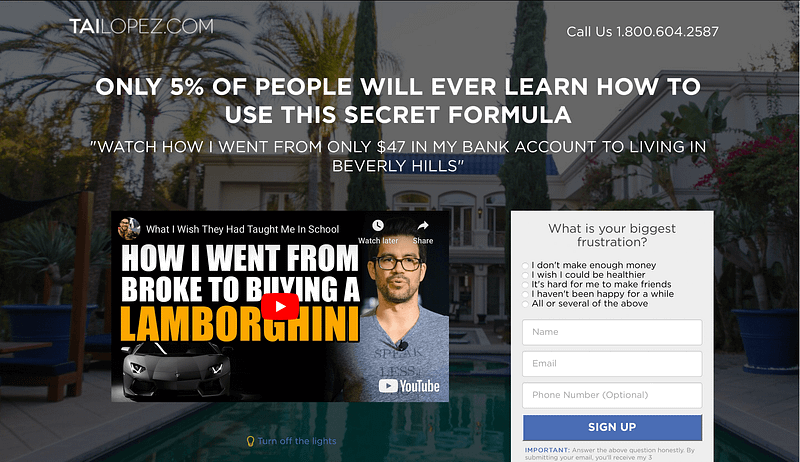
Although the ad now seems derivative — at the time it was quite innovative.
Being relatively new, almost no one was using YouTube ads. And if they were, they weren’t utilizing great copywriting to maximize their results.
Having amassed a small fortune writing Google Ads, Tai understood the power of a good hook.
He admits that he had never actually watched the video in its totality until quite recently, due to feeling awkward about seeing himself on camera. But, upon reviewing the ad, he chalks this up to its success,
“I watched the whole thing and I was like, ‘The reason that works is because it was good copywriting.’”
Today, there’s a free alternative for almost everything — and most people have a way to escape watching pesky YouTube ads. But, before ad blockers and YouTube Premium, viewers simply dealt with watching 5–10 seconds of an ad before promptly hitting the “Skip Ad” button.
But, having previously spent $20,000 on a YouTube ad and having it earn all but a few thousand back, Tai was determined to come up with a hook that would captivate viewers — that would suspend their habitual tendency to skip ads.
He needed a great story.
Specifically, one that would buy him 5–10 seconds of attention.
So, after a trip to Paris to celebrate New Year’s, Tai returned home one fateful Sunday, in January 2015, to write a hook that would go on to fund the next chapter in Tai’s life.
How Tai constructed his $100,000,000 hook.
Tai is often looked at as an overnight success — even a charlatan. Mainly, because he came out of nowhere.
Part of the intrigue of his ad is that nobody knew who he was.
Although it wasn’t too long ago, in 2015, online personalities were received much differently — you were either rich and famous or you weren’t. Although social media had begun bridging the gap, there was little knowledge of the rich and anonymous, such as Tai.
And, very few people were using YouTube ads to get their names out to the masses.
So, when your average YouTube viewer saw Tai’s expressionless face, surrounded by thick-framed glasses nonchalantly talking about his “Lamborghini”, it immediately sparked interest.
“Who the heck is this guy? And how’d he get a Lamborghini?”
Although Tai didn’t script the entire advertisement, he thought meticulously about the elements that would:
- Stop viewers from skipping the ad
- Create enough intrigue to continue watching
- Buy into what he’s selling
All of which, needed to occur within the first 10 seconds — before viewers had the opportunity to hit the “Skip Ad” button.
The following hook would go on to set the internet ablaze, leave it spinning in a daze, and earn Tai a self-reported $100,000,000 in total revenue:
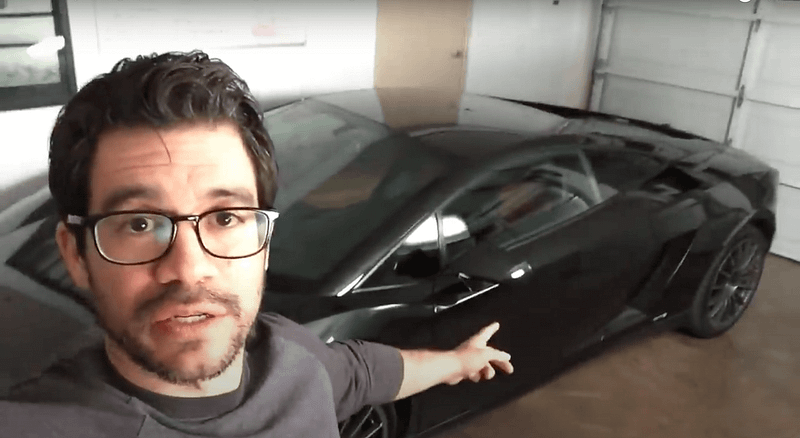
“Here in my garage, just bought this new Lamborghini here, fun to drive up here in the Hollywood hills. But do you know what I like a lot more than materialistic things? Knowledge.”
And, with a quick pan to his sizeable home library, viewers were hooked.
But what makes this such a powerful hook? And why was it so darn effective?
These are questions entrepreneurs around the world asked themselves as they watched Tai move from nobody to somebody to all anybody was talking about, in the blink of an eye. It’s even been used as a case study for lectures at Harvard University.
The video comes across as casual and unscripted, because for the most part, it is. Tai recounts,
“I didn’t script the whole thing, I just kind of put a rough s-line.”
It’s part of the genius of the ad — it gives the impression that Tai is simply a lone-wolf millionaire who spontaneously decided to share his secrets with the world. Perhaps out of boredom or the kindness of his heart.
No big sales pitch.
No urgency.
But, despite its outward appearance, Tai worked tirelessly to create the image. And leaned on a lifetime of experiences to come up with 3 major elements:
- An authority
- A pattern interrupt
- Something of real value
All of which belong to what Tai refers to as “25 cognitive biases”, a piece of knowledge he undoubtedly picked up from one of his thousands of books.
He recounts how each of the elements fell into place…
Element #1: authority
Shortly after Tai’s YouTube ad went viral, the internet turned on him.
Message boards erupted with conspiracies — one of the most popular being that Tai rented the mansion he used to film the video. More specifically, that he rented it for one day to paint an image of wealth.
But, to this day, Tai stands firm that, although the Hollywood hills mansion was a rental, it was his permanent address.
At 38 years old, Tai had amassed an impressive business portfolio and felt confident he could help others do the same with his 67-step program. So, with a personal sense of authority, Tai began brainstorming ways to present as an authority figure on the topic of wealth.
Sitting at his kitchen counter, he thought,
“You know if I’m like, ‘Yo I’m here in Omaha, Nebraska’, it’s not good copywriting. But I was in Hollywood hills and everyone kind of knows it.”
So, he jotted that down as a point to cover.
Element #2: a pattern interrupt
In the book “The Science of Storytelling”, Will Storr talks about the importance of change within a story — particularly the beginning.
“Change is endlessly fascinating to brains. Almost all perception is based on the detection of change…every story you’ll ever hear amounts to, ‘Something changed.’”
Our brains are wired to peak interest at the sign of change — acting as a motion detector of sorts. When life is consistent, are brains remain relatively calm, but when we see or experience change, it acts as an alarm for us to pay attention.
So, understanding this, and the reality that most YouTube viewers habitually skip ads after the required 5–10-second waiting period, Tai knew he needed to introduce as much change as he could, early on.
He needed what he calls, “a pattern interrupt”.
Humans love habits for the same reason we’re fascinated by change — they keep us safe. Tai explains why it’s so important to interrupt the pattern of habitual action when writing hooks:
“There’s 25 scientific cognitive biases… ways that the human brain makes a decision…it’s like a branch set. If you say this (‘yes’), it branches two more times… one of the branches, that’s where you get this concept of a hook or a pattern interrupt.”
Essentially, by introducing change into a story early, it captures readers’ attention. Inherently, we begin paying attention to avoid being caught off guard or attacked.
And Tai knew just the thing that would capture his audience’s attention — “a damn Lambo.”
Tai recounts learning about the power of sexuality from the time he spent working in nightlife. How a beautiful person could turn the heads of an entire room by simply walking by.
He goes on to explain how, being visual creatures, this phenomenon works particularly well on men. But, from his time frequenting popular Los Angeles sushi spot, “Sushiya”, he noticed a pattern.
“When the most beautiful actress woman in Hollywood would walk by… all men’s eyes will follow. But, if a badass car was going by at the same time as the girl, the dudes would override looking at the woman and look at the car.”
Being that YouTube is very forthcoming with its analytics, and Tai was targeting young men, he knew what would be a surefire way to interrupt the pattern of hitting the ‘Skip Ad’ button.
“So that Sunday night I’m sitting in my kitchen and I’m like, ‘What’s a good hook?’ I’m like, ‘You know what’s more powerful than even sex… beauty? A damn Lambo.”
Element #3: something of real value
Tai has a genuine love for books, dating all the way back to his time working as a farmhand.
Even during his 2.5-year stint living with the Amish, Tai admits he would sneak off to the nearest payphone to order books to the farm.
So, although claiming to read a book a day, and keeping a library of thousands of books next to his black Lamborghini is gimmicky — it’s real.
And, not wanting to come off as too materialistic, Tai used them as the perfect Segway from eye-catching pattern interrupt to something meaningful — knowledge.
In fact, the word “knowledge” quickly became a meme of sorts, and something Tai is known for, to this day.
Although the opening line of Tai’s video has become iconic in the meme world, it’s the pan, 10 seconds in, that turns views into dollars.
After introducing himself as an authority, in an authority city, then scrambling viewers’ brains with a pattern interrupt, Tai introduces the product he intends to sell (knowledge) by panning to his library of books.
Moving from his materialistic yet eye-catching black Lamborghini in the Hollywood hills, he introduces something of real value:
“But you know what I like more than materialistic things? Knowledge. In fact, I’m a lot more proud of these 7 new bookshelves I had to get installed to hold over 2,000 new books that I bought.”
From there, anyone still watching is… well, hooked.
Although quick and subtle, the first 10 seconds of Tai’s video act as a hypnotic whirlwind of information.
Nowadays, the idea of health, wealth, and knowledge being combined into a succinct unit is common among marketers. Think of the classic image of an entrepreneur sitting on a beach checking emails — it’s now overplayed. But in 2015, Tai was one of the first to package them together.
And his unique selling point of pushing knowledge rather than a ‘get-rich-quick’ scheme made his YouTube ad a viral success. From there, holding his phone in selfie mode, Tai goes on to explain how knowledge is the key to success, and offers additional free training by clicking a link below.
Thus beginning the funnel that ultimately earned Tai a self-reported $100,000,000 in total revenue.
A near-perfect script that has been used as a case study by colleges, combining all of the elements of human psychology to deliver a simple answer to a complex problem.
How to make money and be happy.
What Tai’s up to now.
After the viral success of Tai’s ad, he seemingly fell off the face of the Earth.
Talking to Jack and Graham of The Iced Coffee Hour, he admits,
“I’ve been off social media… I’ve been busy.”
Feeling an imbalance in his life, shortly after the viral success of Tai’s YouTube ad, he decided to dive into his businesses and expand his portfolio.
“I have a holding company that’s probably going to do $850 million in revenue this year [2022].”
Now, after a break from the noise of social media, and as Tai looks to mount a comeback, he’s promoting a new lifestyle he calls “The Good Life”, focusing on 4 pillars of balance:
- Health
- Wealth
- Love
- Happiness
With a newfound emphasis on physical and mental health, Tai looks to help others achieve an even ratio of all 4.
Final thoughts — knowledge is power.
I must admit, before hearing Tai speak long-form, I too saw him as a charlatan of sorts.
But, hearing about his background, experiences, and how he sees the world, he’s grown on me. When researching polarizing figures such as Tai, I’m always most interested in their early-life experiences.
To see how they shape their minds and what tools these experiences helped them develop.
So, to summarize Tai’s life experiences and how they contributed to his viral success — Tai:
- Learned to learn — from books and mentors
- Spent long portions of his life accruing diverse experiences
- Focused on understanding how humans think rather than algorithms
- Took risks and recognized the value of hitting trends early
And, if you’re looking to construct a viral hook of your own, include the following 3 elements:
- An authority: ask yourself, ‘Why should viewers listen to you?’
- A pattern interrupt: introduce change to stop the scroll
- Offer something of real value: as a rule of thumb, 99.9% of humans can relate to either health, wealth, love, or happiness
Most importantly, life is about balance.
You may never own a Lamborghini, live in the Hollywood hills, or read thousands of books. But, you can always move a little closer to striking an even ratio between health, wealth, love, and happiness.
If you do that, you’ll truly be living the good life.
Hi, I’m Hudson! I hope you enjoyed this story. If you did, consider becoming a Medium member. For $5 a month, you’ll get unlimited access to stories like this one. Plus, you’ll be helping support me as a writer, as I will receive a portion of your membership fee at no extra cost to you. Click here to get started. (+1,000 karma points). ❤️🙏


