avatarWilliam S. Willis

Free AI web copilot to create summaries, insights and extended knowledge, download it at here

2419

Abstract

o be trucked in. Ironically, the weeds did not exist in North America until 1873. They were introduced in a contaminated shipment of flax seeds from Russia sent to South Dakota.</p><h2 id="86cd">A Fire Hazard in the Summer</h2><p id="c776">Like mustard, tumbleweeds can be a fire hazard. People living in locations with snow and wind are familiar with snowbanks. The same thing happens with tumbleweeds. When the tumbleweeds are ready to move, windy conditions such as the “Santa Ana winds” of Southern California can collect large embankments of the weeds, creating a massive collection of fuel for a fire.</p><p id="ec8c">Our property association removed the mustard and tumbleweeds before they became a fire hazard. There was only the pale yellow/gray stubble left where the weeds had been thriving.</p><h2 id="50ec">Then We had a Tropical Storm</h2><p id="33ec">Our area was spared most of the impact, however, we did get an inch and a half of rain. It was a rare event for Southern California. The rain produced another bloom in our arroyo.</p><figure id="0cee"><img src="https://cdn-images-1.readmedium.com/v2/resize:fit:800/1*2kIx1gAL4mANpl64NAk42g.jpeg"><figcaption>Tribulus terrestris in the arroyo. Photo by the author</figcaption></figure><p id="62cc">But this is not a carpet of green to walk on, ride your bike through, ride a horse (note: there are a lot of horses in my town), or set your dog loose. This carpet of green is <i>Tribulus terrestris</i> or as it is commonly called in California, stickers or puncture vine.</p><p id="6074">Puncture vines have taken over the space after the latest rainfall. The rainfall in August was rare, but the puncture vine is not. Members of this genus are common in temperate zones with bad soil, like most of the western US.</p><figure id="3554"><img src="https://cdn-images-1.readmedium.com/v2/resize:fit:800/1*oIT5-0wy0YYypkq0jnuzEA.jpeg"><figcaption>Tribulus terrestris. An immature seed is circled above. Photo by the author.</figcaption></figure><p id="0994">The genus name, Tribulus, refers to the bull-like horns of the seed pod. As the seed matures it takes on the appearance and function of a “caltrop,” the ancient weapon used against calvary from the time of the Romans. Iron caltrops were spread out over the ground to prevent an approach by calvary.</p><figure id="9fee"><img src="https://cdn-images-1.readmedium.com/v2/resize:fit:800/1*NlDuY3Ue6xC159v

Options

V_0Alpg.jpeg"><figcaption>Roman caltrop. By Photographed by User:Bullenwächter — Photographed at Westfälisches Museum für Archäologie, Herne, Germany, CC BY-SA 3.0, <a href="https://commons.wikimedia.org/w/index.php?curid=24486150">https://commons.wikimedia.org/w/index.php?curid=24486150</a></figcaption></figure><p id="43e4">The iron caltrop was called a “denial of area” weapon. It prevented the approach of horses or camels to a particular area.</p><p id="58c0">The same is true for the <i>Tribulus terrestris</i> plant. The seed of the plant denies access. Animals should not walk on this plant when the seed has matured.</p><figure id="de57"><img src="https://cdn-images-1.readmedium.com/v2/resize:fit:800/1*dHYJ2wNxIA6PrOFt77vQYA.jpeg"><figcaption>The bull’s horns clearly visible. Photo by the author.</figcaption></figure><p id="b887">Caltrop is also a common name for the plant in many parts of the world. The name reflects the damage the seeds can do to animals walking on the plants. The caltrop can damage the soft pads of mammal feet in yards, fields, and forests. It can also puncture bike tires and thin-soled shoes.</p><p id="60d7">There might be a silver lining to these natural caltrops at the edge of my garden. Can they guard the garden from the approach of raccoons and rabbits? Then again, I do like to walk barefoot on the patio. I can imagine a wounded raccoon spreading the seeds on the patio in retaliation.</p><p id="35de">This should be the end of the succession of plants growing in the arroyo. I hope that animals in pastures avoid fields of <i>Tribulus terrestris</i>. The hot and dry Santa Ana winds will soon dry the plants to a fire-ready crisp in October. The hard sharp seeds of the plant will remain, waiting for a victim's soft foot to spread, and the next season of rain. As the Mandalorian says, “That is the way.”</p><div id="716f" class="link-block"> <a href="https://readmedium.com/100-human-6a4479dbeef5"> <div> <div> <h2>100% Human</h2> <div><h3>Tired of seeing articles created by bots?</h3></div> <div><p>medium.com</p></div> </div> <div> <div style="background-image: url(https://miro.readmedium.com/v2/resize:fit:320/1*21NhE2jxF2If4_FZGl4x2g.png)"></div> </div> </div> </a> </div></article></body>

Surrounded by Caltrops in the Arroyo

Will this reduce the number of rabbits in the garden?
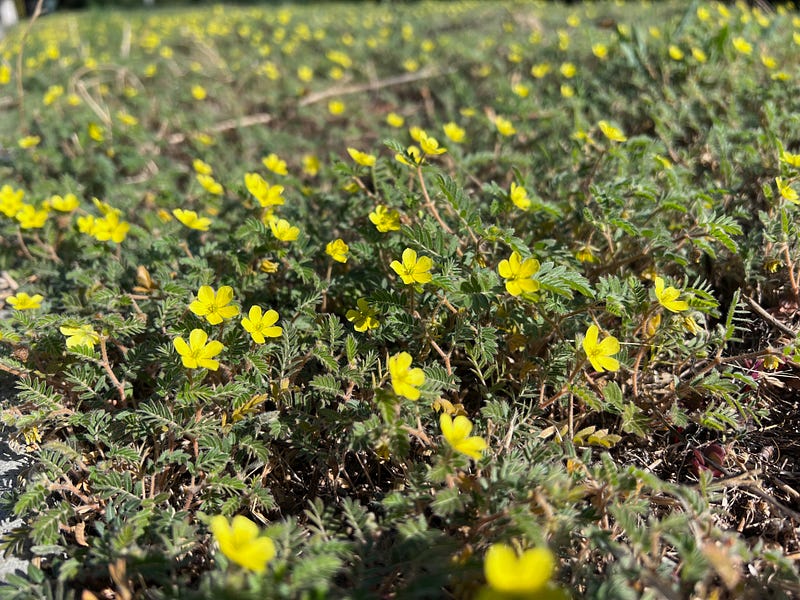
Tribulus terrestris. Photo by the author.

We have had unusual seasons of growth in the arroyo behind our home. Is this the new normal? Is it a result of climate change? I do not know. But after years of drought, we have had a succession of plant growth not seen for a long time. Unfortunately, this is not good news for animal farmers.

After Winter

After the heavy rains of winter, the arroyo behind my house and other fields of California filled with poppies and daisies.
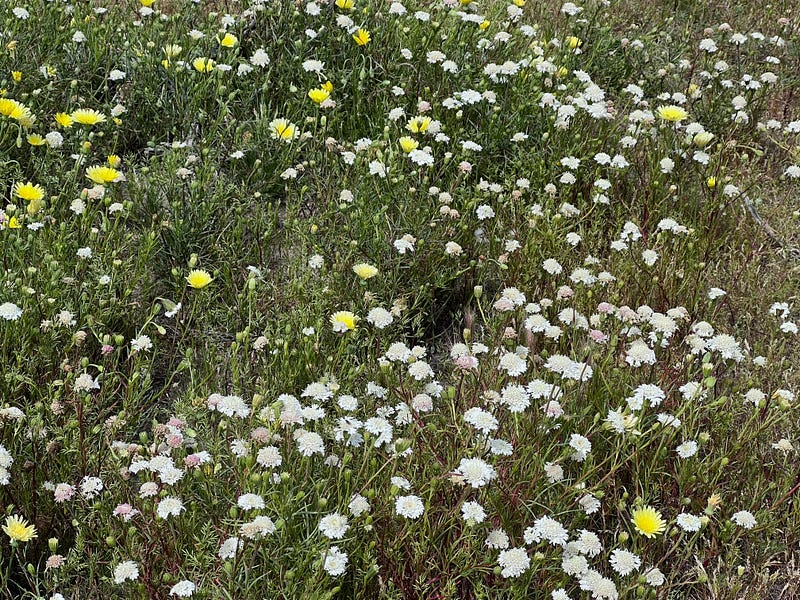
Daisies. Photo by the author.

After Spring

But the rains did not stop. After the spring rains in Southern California, the arroyo filled with mustard and tumbleweeds. Tall plants that grew, stretched to the sky, died, and dried. The plants were a fire hazard and the city required our association to clear the weeds.

Both the mustard and tumbleweeds are invasive species. I wrote earlier this year about the mustard in California.

Tumbleweeds are also an invasive species. Around the world, there are many weeds that “tumble”, dispersing their seeds over a large area. In the United States, the word tumbleweed usually refers to the large annual scrub known as the Russian Thistle. Many western movies featured tumbleweeds, even if the weeds had to be trucked in. Ironically, the weeds did not exist in North America until 1873. They were introduced in a contaminated shipment of flax seeds from Russia sent to South Dakota.

A Fire Hazard in the Summer

Like mustard, tumbleweeds can be a fire hazard. People living in locations with snow and wind are familiar with snowbanks. The same thing happens with tumbleweeds. When the tumbleweeds are ready to move, windy conditions such as the “Santa Ana winds” of Southern California can collect large embankments of the weeds, creating a massive collection of fuel for a fire.

Our property association removed the mustard and tumbleweeds before they became a fire hazard. There was only the pale yellow/gray stubble left where the weeds had been thriving.

Then We had a Tropical Storm

Our area was spared most of the impact, however, we did get an inch and a half of rain. It was a rare event for Southern California. The rain produced another bloom in our arroyo.
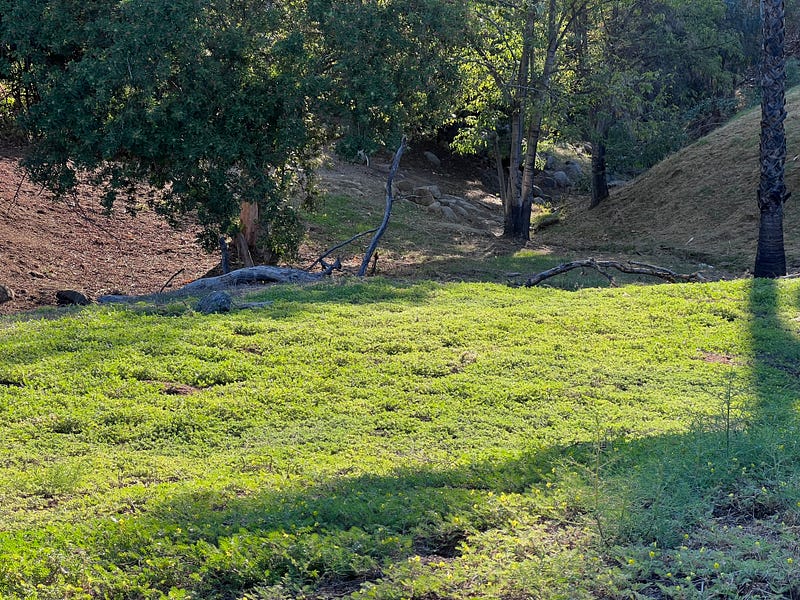
Tribulus terrestris in the arroyo. Photo by the author

But this is not a carpet of green to walk on, ride your bike through, ride a horse (note: there are a lot of horses in my town), or set your dog loose. This carpet of green is Tribulus terrestris or as it is commonly called in California, stickers or puncture vine.

Puncture vines have taken over the space after the latest rainfall. The rainfall in August was rare, but the puncture vine is not. Members of this genus are common in temperate zones with bad soil, like most of the western US.
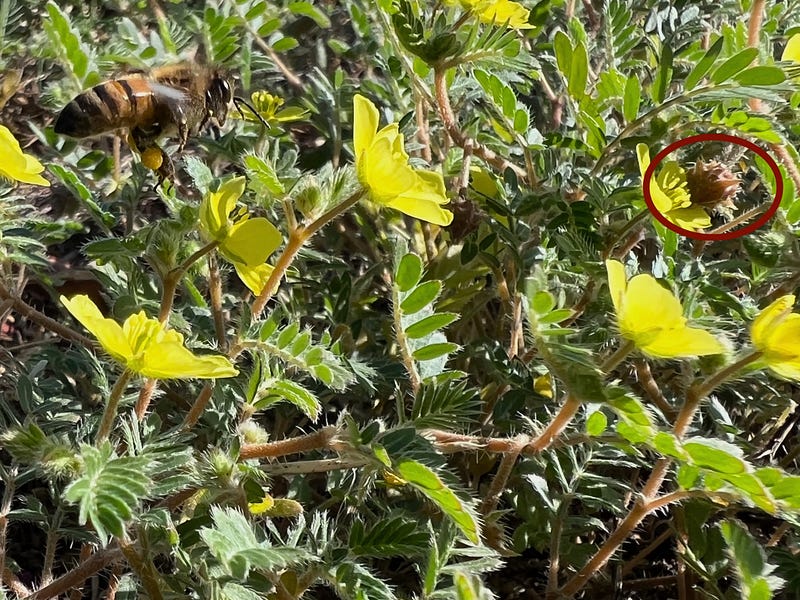
Tribulus terrestris. An immature seed is circled above. Photo by the author.

The genus name, Tribulus, refers to the bull-like horns of the seed pod. As the seed matures it takes on the appearance and function of a “caltrop,” the ancient weapon used against calvary from the time of the Romans. Iron caltrops were spread out over the ground to prevent an approach by calvary.
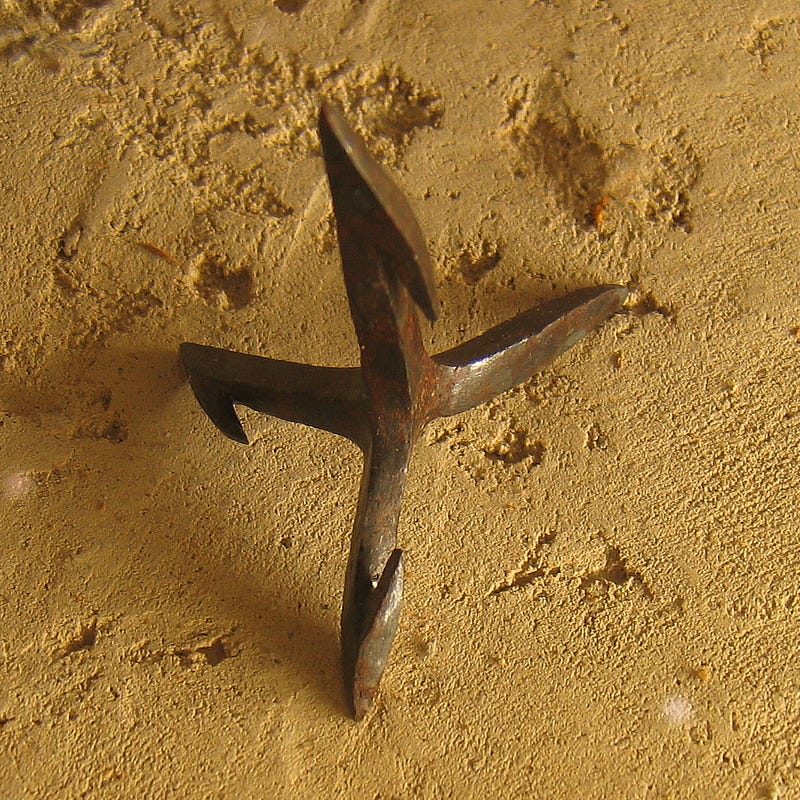
Roman caltrop. By Photographed by User:Bullenwächter — Photographed at Westfälisches Museum für Archäologie, Herne, Germany, CC BY-SA 3.0, https://commons.wikimedia.org/w/index.php?curid=24486150

The iron caltrop was called a “denial of area” weapon. It prevented the approach of horses or camels to a particular area.

The same is true for the Tribulus terrestris plant. The seed of the plant denies access. Animals should not walk on this plant when the seed has matured.
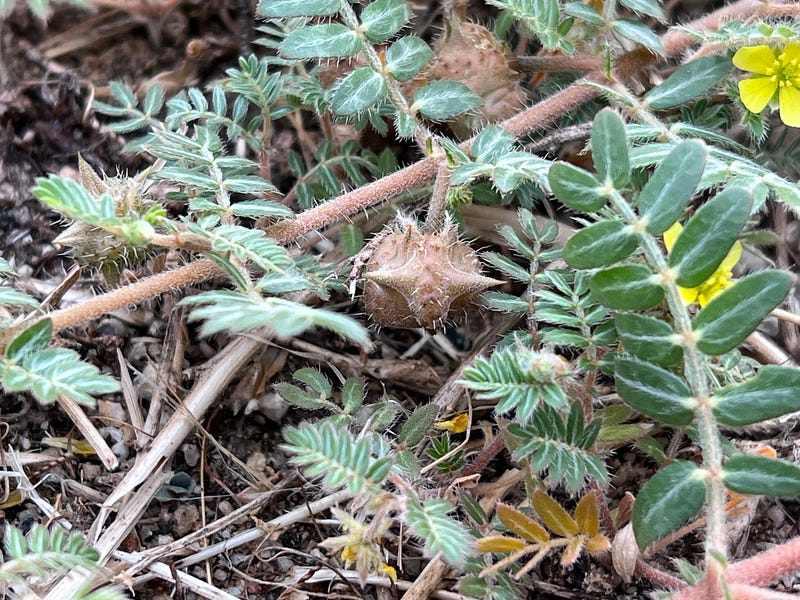
The bull’s horns clearly visible. Photo by the author.

Caltrop is also a common name for the plant in many parts of the world. The name reflects the damage the seeds can do to animals walking on the plants. The caltrop can damage the soft pads of mammal feet in yards, fields, and forests. It can also puncture bike tires and thin-soled shoes.

There might be a silver lining to these natural caltrops at the edge of my garden. Can they guard the garden from the approach of raccoons and rabbits? Then again, I do like to walk barefoot on the patio. I can imagine a wounded raccoon spreading the seeds on the patio in retaliation.

This should be the end of the succession of plants growing in the arroyo. I hope that animals in pastures avoid fields of Tribulus terrestris. The hot and dry Santa Ana winds will soon dry the plants to a fire-ready crisp in October. The hard sharp seeds of the plant will remain, waiting for a victim's soft foot to spread, and the next season of rain. As the Mandalorian says, “That is the way.”

Plants
History
Invasive Species
Climate Change
Illumination
Recommended from ReadMedium