
Surprising hypothesis: the Moon has been secretly stealing water from Earth for billions of years!
Where did the water on the Moon come from? Until now it was assumed that asteroids hitting our natural satellite were its source. Scientists have just proposed an additional explanation: for billions of years the Moon has been sucking water from the upper parts of Earth’s atmosphere.
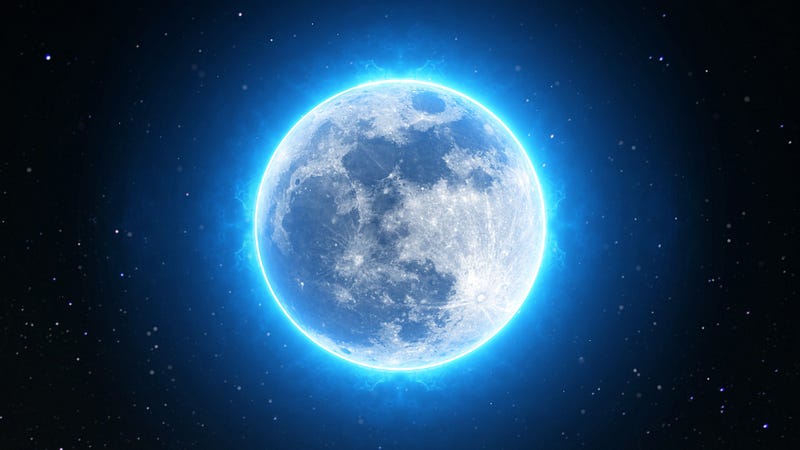
We have known with 100 percent certainty that there is water on the Moon since 2020. At that time, scientists proved this fact using the largest sky-based observatory in the world. The Stratospheric Observatory for Infrared Astronomy (SOFIA) is located on a Boeing 747SP and works at an altitude of 12 thousand meters above the Earth’s surface. Two years ago with its help it was confirmed that there are H2O molecules on the natural satellite of our planet.
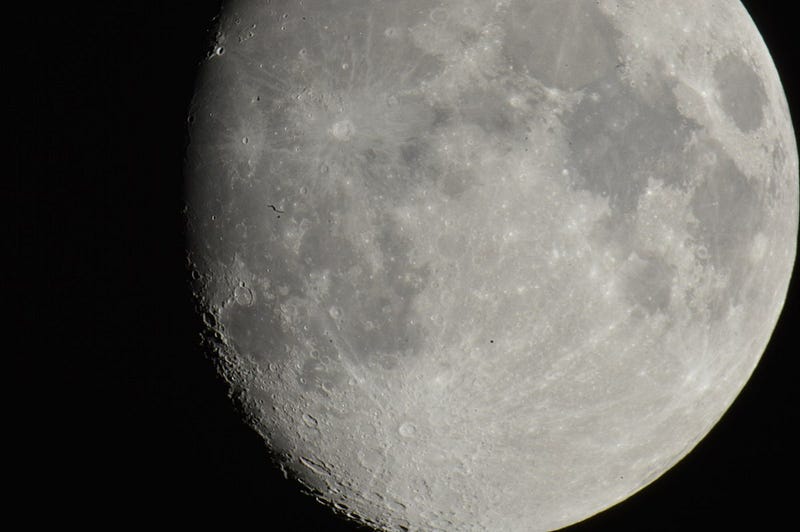
Where to look for them? Scientists have taken a particularly close look at lunar craters. Observations using NASA’s Lunar Reconnaissance Orbiter probe have shown that certain areas on the Moon are in shadow at all times. The Sun never reaches the deep craters created by asteroid bombardment of the Moon.
In the craters the temperature does not exceed -163o C. Scientists have calculated that there can be up to 40,000 km2 of the Moon’s surface in eternal shadow. 60 percent of it is located at the South Pole. That is, in the place that NASA intends to explore as part of the Artemis mission in 2025.
In what form does water exist on the Moon?
Of course, there are no visible seas or lakes on Earth’s natural satellite. At the poles, water is trapped in the ice beneath the lunar surface. It may also be a component of lunar rocks and minerals.
Until now, its source was thought to be asteroid impacts, especially frequent during the so-called Great Bombardment. The Great Bombardment was thought to have occurred shortly after the formation of the Earth: between 4.1 and 3.8 billion years ago. Its cause is not yet known. However, it is believed that this is when most of the impact craters on the Moon were formed.
What does the surface of the Moon look like?
The Great Bombardment made the satellite’s surface irregular. The Moon was pitted with larger and smaller craters with folds, cracks and pores. According to a group of scientists, this shaping of the Moon’s surface meant that the globe was able to capture water from the upper parts of Earth’s atmosphere for millennia.
How exactly did the Moon do this? The researchers described it in a paper just published in the scientific journal Scientific Reports.
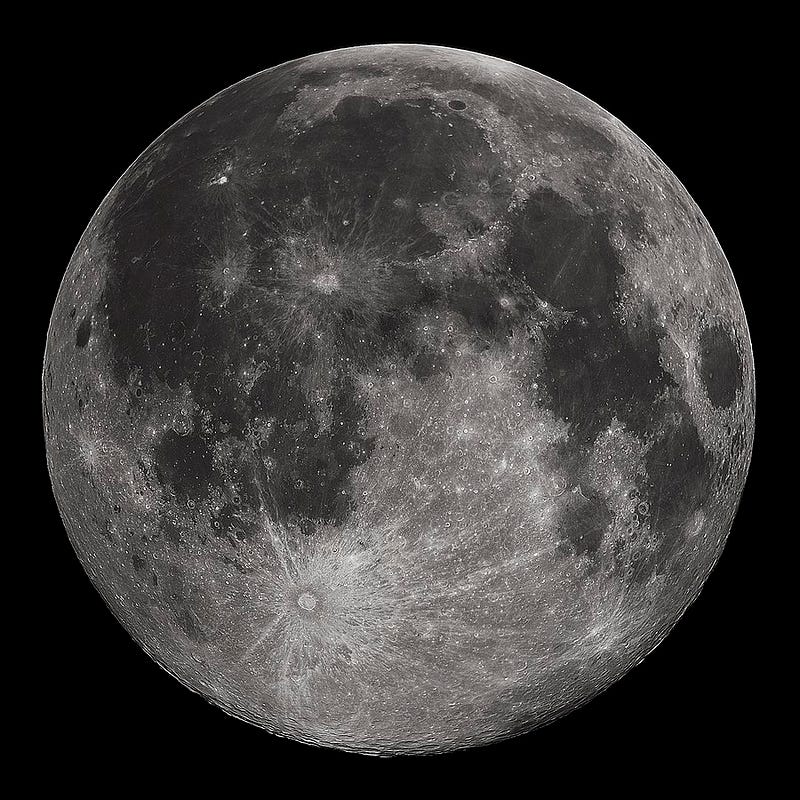
Water is on the moon but how did it get there?
The Earth is surrounded by the magnetosphere, which is the area affected by the Earth’s magnetic field. It has a shape similar to a teardrop. Between the Earth and the Sun, the magnetosphere is flattened by the solar wind. In contrast, the “back” of the Earth extends into a magnetic tail, with magnetic field lines moving away from our planet.
As the Moon orbits the Earth, it alternately enters and exits the region of its magnetosphere. Every month it is in its range for five days, passing through the tail. The researchers pointed out that this is when oxygen and hydrogen ions that have escaped from Earth’s upper atmosphere can fall on the Moon.
“It’s as if the Moon is in a shower,” — explains geophysicist Gunther Kletetschka, lead author of the paper. — “This shower is water ions coming from Earth hitting its surface.”
How much water is there on the Moon?
Since the Moon has no magnetic field of its own, for billions of years water could have fallen on it through obstacles and turned into ice. This was all the more possible because the Moon’s surface remained porous as a result of the Great Bombardment. According to the researchers, various geological processes may have even caused liquid water reservoirs to be found in certain places beneath the Moon’s surface.
How much water could have reached the Moon from Earth over billions of years? As much as 3,500 cubic kilometers, the researchers estimate. That is as much as is found in the American Lake Huron, the fourth largest in the world. Scientists emphasize that this is only a part of the water that is found on the Moon. And which can be used by astronauts from the Artemis mission.
Source: Scientific Reports, Nature Astronomy
Cool that you made it to the end of this article. I will be very pleased if you appreciate the effort of creating it and leave some claps here, or maybe even start following me. Thank you!


