
Second Earth — New worlds for life 35 light years from Earth discovered!
Astronomers report the discovery of the smallest extrasolar planet ever and a couple of others in the same system. One of them could be a second Earth. The planet orbits in a zone where temperatures are favorable for life.
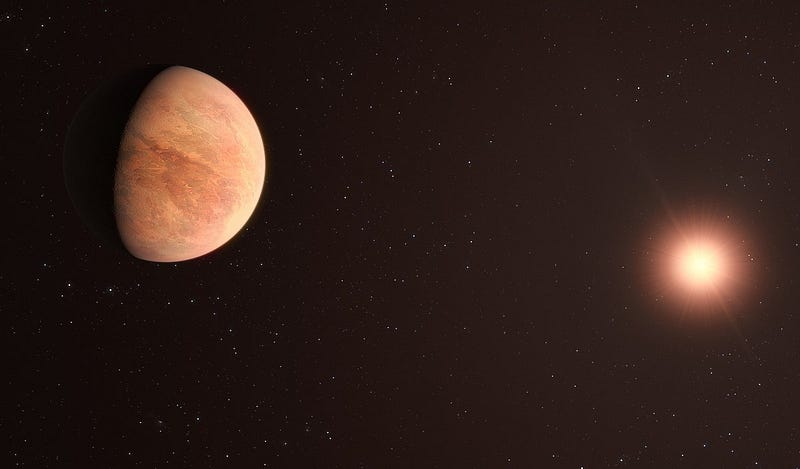
A team of astronomers using the Very Large Telescope (VLT) located at the European Astronomical Observatory (ESO) in Chile observed extrasolar planets around the star L 98–59 in the constellation of Volans (aka the Flying Fish).
This star is only 35 light years from us. On the cosmic scale, that’s very close. In 2018, two methods determined that at least three planets orbit it.
They are denoted by letters added to the star’s name, but omit the letter a. The planet b, orbiting closest to the star L 98–59, is larger than Mars but smaller than Earth. The next ones — c and d — are larger. Probably they are of the terrestrial type, i.e. made up mainly of rocks.
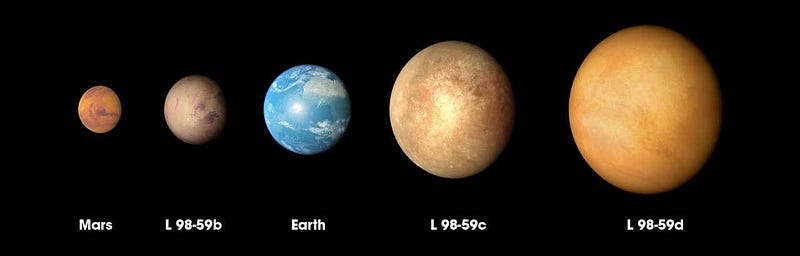
An ocean-covered planet and two planets favorable for life
The astronomers who publish the paper in Astronomy & Astrophysics add some very interesting findings. Indeed, new observations indicate the presence of large amounts of water on planet d. It is probably an ocean world, as it is made up of as much as one-third water.
There is still a fourth planet orbiting the star, and probably a fifth. These would be planets e and f. Both are orbiting in the “zone of life,” that is, far enough from the parent star to keep the atmosphere and water liquid, but close enough not to freeze.
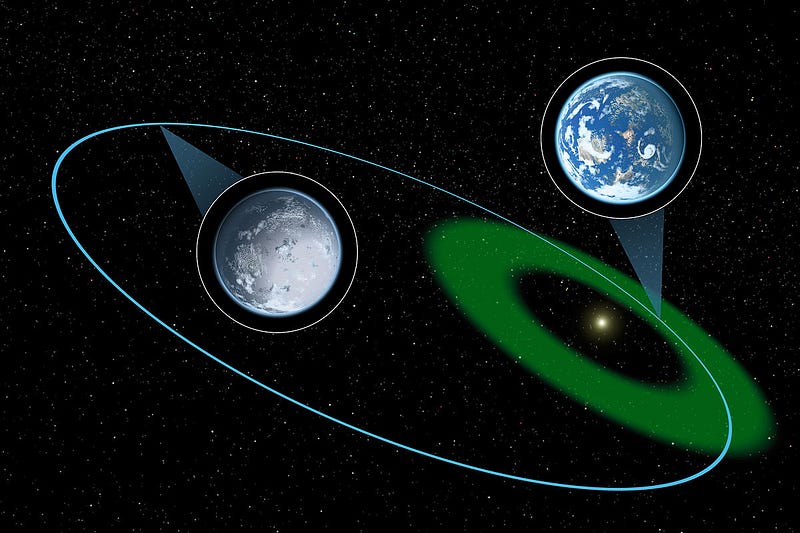
Second Earth as half of Venus
The discovery is also groundbreaking because it is the first time it has been possible to determine the mass of the smallest exoplanet yet detected by measuring the star’s radial velocity (i.e., the perturbation of its motion caused by a planet). The researchers say that planet b, which is closest to the star, has a mass of half that of Venus, which is slightly less than half that of Earth.
“This is a major step forward in our ability to determine the masses of the smallest extrasolar planets,” says Maria Rosa Zapatero Osorio of the Center for Astrobiology at the University of Madrid.
Peeping into the atmospheres of distant planets
The team hopes that the system can be viewed more closely with the Webb telescope, which is due to be launched in the final months of this year. The Extremely Large Telescope (ELT), which will be commissioned at ESO in 2027, will also provide a sneak peek.

Both will have high enough resolution to observe the atmospheres of distant planets and learn about their chemical composition.
“This system gives us a foretaste of that. We have been searching for extrasolar planets since the birth of astronomy. Now we are approaching the moment of discovery of an Earth-type planet in the zone of life, whose atmosphere we will be able to study,” says Olivier Demangeon of the Institute of Astrophysics at the University of Porto and lead author of the paper.
Exoplanets: where to look for them?
In Greek, “exo” means outer. The term exoplanet is used to describe planets that are not part of the Solar System.
By April 2022, scientists had observed more than 5,000 planets, and in fact, almost every day more are discovered. The first planet outside the Solar System was observed and described in 1992 by Polish astronomer Professor Aleksander Wolszczan.
Can there be life on exoplanets?
This is one of the most important questions science has asked itself at least until the discovery that earth-like globes orbit in the closest systems to Earth, such as Proxima Centauri. One of these is Proxima-b, which is only 4.24 light-years (about 40 trillion km) from our planet. On a cosmic scale, that’s a small distance. However, even if we could cross it — do we have any reason to?
It is known that 250 times more X-rays and several dozen times more UV radiation reaches the surface of Proxima-b than reaches the surface of Earth. Its source is its parent star, Proxima Centauri, which is a red dwarf.
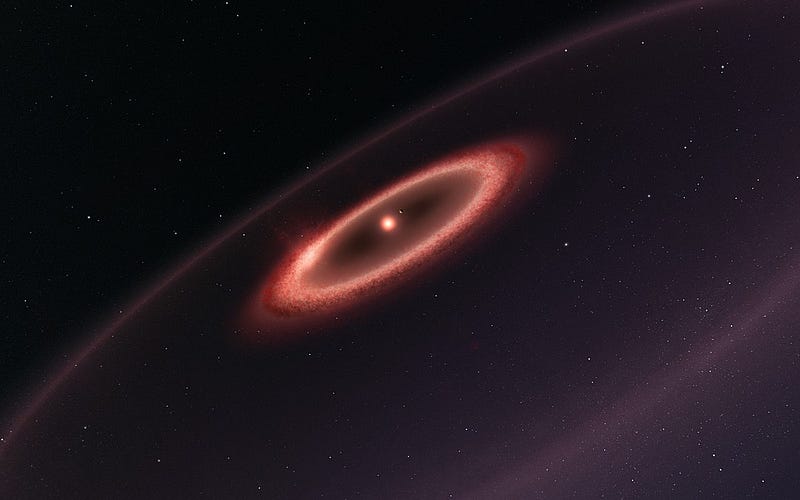
Red dwarfs are the most numerous stars in the Universe. They are smaller than Earth and less bright, but they have one deadly characteristic. They are very active and often flare up, rapidly and unpredictably changing their brightness across the spectrum. Planets that are nearby are then flooded with high-energy radiation. And although the exact conditions on such globes are unknown, there is no doubt that the strong radiation damages nucleic acids, which are the primary carrier of genetic information in all Earth organisms.
Yet that doesn’t mean planets like Proxima-b, TRAPPIST-1e, Ross-128b and LHS-1140b are dead. Lisa Kaltenegger and Jack O’Malley-James ran simulations of UV levels for these four exoplanets. They turned out to be higher than they are on Earth today — but significantly lower than they were on Earth about 3.9 billion years ago, when life began to evolve on it.
“We have shown that UV radiation does not rule out the possibility of life evolving on extrasolar exoplanets,” the researchers concluded in a paper published in Monthly Notices of the Royal Astronomical Society.
Source: ESA, Astronomy & Astrophysics
Cool that you made it to the end of this article. I will be very pleased if you appreciate the effort of creating it and leave some claps here, or maybe even start following me. Thank you!


_(24523346059).jpg)
