avatarMatt Traverso

Free AI web copilot to create summaries, insights and extended knowledge, download it at here

4655

Abstract

ttps://cdn-images-1.readmedium.com/v2/resize:fit:800/0*r_k70UHPgIbvN9ik"><figcaption><b>Figure 2</b>: Regardless of the installed heating equipment, homes lose heat faster when it’s colder outside and warmer inside. NLoC is an equation for modeling heat loss.</figcaption></figure><p id="2f57">Heat loss is modeled by Newton’s Law of Cooling (NLoC). My eyes glaze over when I look at physics equations so I did my best to simplify it here:</p><figure id="6aac"><img src="https://cdn-images-1.readmedium.com/v2/resize:fit:800/0*7TUBbl28sLNli9R4"><figcaption></figcaption></figure><p id="c59b">In this system, heating costs can be reduced by either improving heat retention transfer coefficient (better insulation, properly sealed windows, drawn blinds) or by lowering the thermostat so there’s a smaller temperature difference between the inside and outside of the home.</p><p id="57b3">I wanted to see if I could measure my home’s temperature-dependent heat loss, but there’s too much noise in my data. I’m not surprised that the 1%/1°F DOE guideline was <a href="https://labhomes.pnnl.gov/documents/PNNL_24857_Cellular_Shades_rev2.pdf">measured in a purpose-built</a> experimental house.</p><p id="91c9">For some of my cost calculations below, I had to estimate the NLoC-related temperature drop based on the DOE’s published results and my own imperfect observations.</p><h1 id="c4c3">Heat Pump Physics</h1><p id="fe60">An HP’s transfer of heat into a home slows down as the delta between the inside and outside temperatures increases. This means in HVAC systems with HPs, the home both loses heat faster and generates heat slower (Figure 3):</p><figure id="abcb"><img src="https://cdn-images-1.readmedium.com/v2/resize:fit:800/0*7TNSMlJxjzQPXue4"><figcaption><b>Figure 3</b>: When it’s colder outside and warmer inside, homes with HPs both heat slower <i>and </i>lose heat faster.</figcaption></figure><p id="f30e">The lower heat generation has its own equation to model it, Carnot’s Rule:</p><figure id="5ab0"><img src="https://cdn-images-1.readmedium.com/v2/resize:fit:800/0*GfoFrRuiad8WF7sA"><figcaption></figcaption></figure><p id="da08">When discussing HPs, we often say that they work best in mild weather. I said it, myself, in the second paragraph of this article! This is a simplification. It’s more accurate to say <b>HPs are more efficient when outdoor temperatures are closer to indoor temps</b>.</p><h1 id="1278">Real-World Performance</h1><p id="e753">Reading a Thermodynamics textbook is fun[citation needed], but let’s put it to the test. With my HP, thermostat data logs, and professional background in Statistical Process Control, I can directly quantify the savings.</p><p id="b909">In cold months, my thermostat is set to 65°F (18.3°C) during the day and 60°F (15.6°C) at night. After collecting data through the 2022–23 winter and analyzing it, Figure 4 has the final graph comparing HP function during the day vs. night.</p><figure id="397d"><img src="https://cdn-images-1.readmedium.com/v2/resize:fit:800/0*CaaaVuazZMHLqNwe"><figcaption><b>Figure 4</b>: For a given outdoor temp, the HP heats about 1.85°F/hr (1.0°C/hr) faster when the thermostat is set five degrees (2.8°C) cooler.</figcaption></figure><p id="8832">The electricity draw for the HP is constant (2.4 kW, in my home). With the linear fit of indoor temp change vs. outdoor temp plus an estimated correction factor for home heat loss, I was able to create a model comparing the operating costs at different indoor temperatures (Figure 5).</p><figure id="f18a"><img src="https://cdn-images-1.readmedium.com/v2/resize:fit:800/0*mVLXyVgcqf3xsWaW"><figcaption><b>Figure 5</b>: Throughout the range, I save about 40% on heating by lowering the thermostat by 5°F (3.3°C). This is about 7% per degree (assume exponential savings per degree).</figcaption></figure><p id="2913">One caveat: my home is not a scientifically well-controlled environment. This graph is derived from the HP performance in Fig 4 plus an estimated heat loss correction. This data is noisy so some error is possible.</p><p id="8ab5">Overall, I am very confident that <b>lowering the indoor temperature drastically reduces HP costs</b>. All reasonable estimations gave huge savings. The 40%/5°F (or 7% per degree) is my best-fit estimate, but actual savings may be smaller (or larger).</p><p id="a210">Even with my aggressive thermostat settings, <a href="https://readmedium.com/its-summer-time-to-think-about-your-furnace-2bc5c03b4a26">heating costs are still nearly half of my home utility bills</a>. Anything I can do to reduce the costs has a big impact on home energy use.</p><h1 id="cbb9">Heat Pu

Options

mp + Low Thermostat = Big Savings</h1><p id="3573">All HP observations are home-specific. The implications are huge if my data holds for other homes. It should to some degree.</p><p id="0765">For those with a heat pump, a modest reduction in indoor temperature will save a lot of money.</p><p id="f86e">By my math, reducing indoor temp from 72°F to the DOE-recommended 68°F (20°C) may decrease heating costs by 25% or more, easily worth hundreds of dollars per year. It took me months of data collection, followed by analysis, adjustment, and verification to conclude this. If you don’t want to repeat the same process, I don’t blame you.</p><p id="ba0a">Even without individual verification, I can say with confidence that <b>any decrease in indoor temperature in a home with a heat pump will lead to a sizable reduction in heating bills</b>, much more than the oft-quoted 1% rule-of-thumb for more traditional heating methods.</p><h2 id="45ea">Fewer emissions from decreased furnace use</h2><p id="4c15">The higher efficiency at 60°F has a profound effect on the minimum <i>outdoor </i>temp that the HP functions. I currently set my thermostat to lock out the HP below 30°F (−1°C) based on performance at 65°F.</p><figure id="3b96"><img src="https://cdn-images-1.readmedium.com/v2/resize:fit:800/0*H7VHOzn4RQhiT8Km"><figcaption><b>Figure 6</b>: Thermostat lockout of the HP was set to 30°F based on daytime indoor temps. At nighttime settings, the HP remains a viable heating method down to 20°F.</figcaption></figure><p id="81e3">Figure 6 shows that the HP remains cost-effective down to 20°F (−7°C) when the indoor temperature is set to 60°F. Last year, about 30% of my furnace use was at night when my thermostat was set to 60°F but the outside temp was between 20–30°F.</p><p id="4077">I will have to test a 20°F (−7°C) lock-out at night this winter. I could <b>save hundreds of lbs of CO₂ emissions a year </b>and likely reduce my bills, too.</p><h2 id="09e3">Personal Comfort Dictates Savings</h2><p id="f1fd">In my disclaimer, above, I named a few overlooked aspects of an HVAC system that significantly influence heating costs.</p><p id="a6f3"><b>Add indoor temperature to the TOP of that list</b>.</p><p id="6909">Your personal preference for how warm you keep your home can make the difference between an HP that cuts your bill in half and one that’s less cost-efficient than a furnace.</p><p id="728c">If someone were to move into my home and insist on keeping it at 72°F (22°C), I think that they would see little or no cost advantage from the HP vs. using only the furnace to heat. Again, this is home-specific and HPs still offer a big emissions advantage over combustion heat.</p><p id="4b22">I think that when we discuss HP performance (in the comments, for example), <b>we need to specify usual indoor temperatures</b> in addition to home size and minimum outdoor temperatures as the key parameters that influence efficiency.</p><h1 id="4d25">Final Thoughts and Next Steps</h1><p id="af63">With new heating equipment, we need to rethink guidelines and preferences based on new capabilities. Indoor temperature is critical for HP efficiency, more so than with traditional heating systems.</p><p id="b586">To benefit the most from an installed HP, I recommend:</p><ul><li><b>Reduce your indoor temperature a few degrees</b> and see if you notice shorter HP ON times with each heating cycle. Let me know in the comments.</li><li>If you’re confident working with numbers and have thermostat logs, I would be<b> </b>interested in<b> helping you with a similar analysis</b>. It would give you real-world guidance on how to set your thermostat and help me gauge the repeatability of my numbers.</li></ul><p id="7a2e">For my part, I have some follow-up testing to do this fall and winter:</p><ul><li>Test heating costs at warmer indoor temps (70°F vs. 72°F)</li><li>Explore lower HP lock-out temps at night (25°F or even 20°F)</li></ul><p id="8378">Those who follow me can look forward to that write-up when it’s ready.</p><p id="4608">It seems that those who like or can tolerate cooler temperatures will have much smaller costs and emissions and are less likely to need an auxiliary heat source while those that set their thermostats higher may only see marginal benefits.</p><p id="d5a5"><i>If you enjoyed the article, please consider a clap. Claps on great articles help support the author’s work.</i></p><p id="6b6d">Happy to answer any questions in the comments. Please also check out my <a href="https://medium.com/@MattTraversoPhD/list/hvac-by-matt-traverso-b569e4af98cb">other articles on Heat Pumps and HVACs</a>.</p></article></body>

Supercharge your Heat Pump Savings

A real-world, data-driven analysis of the effect of indoor and outdoor temperatures on heat pump efficiency
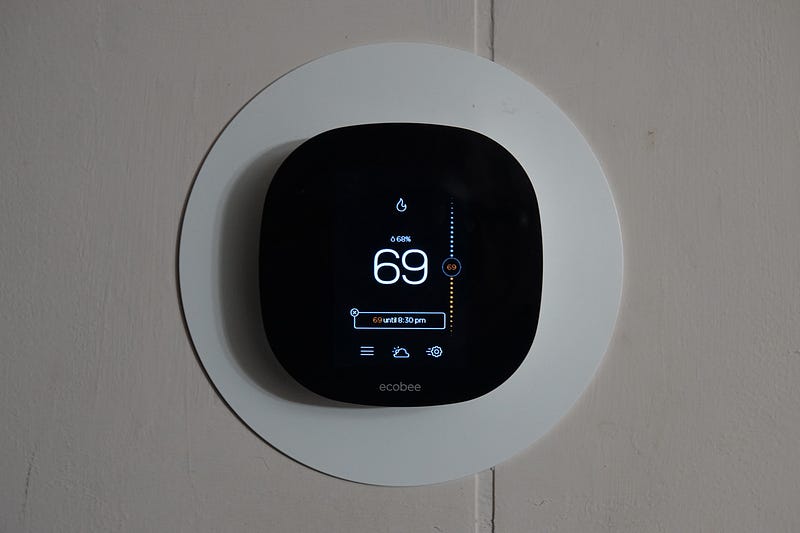
Photo by Sean D on Unsplash

Everyone understands that lowering the indoor temperature should save on heating bills, but did you know that the potential savings may be more than five times higher with a heat pump than with traditional equipment like a furnace, stove, or boiler?

Heat Pumps (HPs) are Air Conditioners (ACs) that also heat. HPs generally have lower emissions and costs compared to traditional heating equipment like furnaces, stoves, and boilers (Figure 1), but they work best in mild weather.
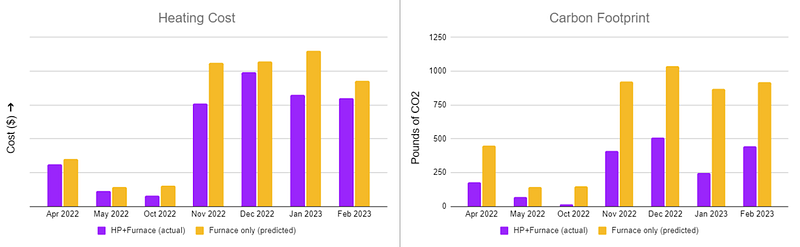
Figure 1: Recap of costs and carbon savings in my home after HP installation.

The technology is fairly new and doesn’t behave the same as traditional home heating methods. I like to use the dawn of the microwave as an analogy: microwaves reheat food faster and easier than traditional methods but are terrible at making toast.

Just as early adopters had to learn the best applications for a microwave, we need to revisit the traditional heating maxims to optimize HP performance.

One common statement is that reducing indoor temperature by 1°F (0.6°C) reduces a home heating bill by 1%. This isn’t much. Most people would probably prefer a warmer temperature on a given day over a few extra pennies.

However, this general rule doesn’t apply to HPs because they are more sensitive to indoor temperatures than traditional heating equipment. This article demonstrates how lowering the thermostat can radically reduce HP costs and increase a HP’s functional range.

Disclaimer

Before I begin, I wanted to acknowledge that many commentators have nearly identical HPs that cool faster and in much lower outdoor temps than mine. Others indicate worse performance.

Home heating is a complex system that is influenced by home size, building material, ductwork, air handling, and insulation. For example, my HP seems to be limited by the diameter of my ducts vs. home size but upgrading would be onerous.

This article is focused exclusively on HPs and assumes that the other components of your system are adequate. An HVAC specialist can help evaluate all aspects of your heating.

The data and analysis in this article are unique to my home! The HVAC system behavior and scale of savings will be a little different for everyone. Little differences can add up to very big conclusions.

Traditional Heating Physics

Traditional heating equipment performs the same in all conditions. Regardless of indoor or outdoor temperature, my furnace heats my home by about 11°F (6°C) in an hour.

In a home with traditional equipment, costs increase in cold weather because heat is lost faster through the walls. It has nothing to do with the heating equipment itself. Instead, colder outdoor temperatures simply mean the heat needs to be on more often to account for the increased heat loss of the home (see illustrated example in Figure 2).
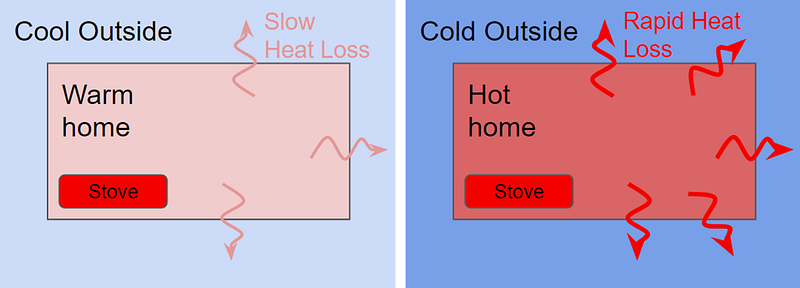
Figure 2: Regardless of the installed heating equipment, homes lose heat faster when it’s colder outside and warmer inside. NLoC is an equation for modeling heat loss.

Heat loss is modeled by Newton’s Law of Cooling (NLoC). My eyes glaze over when I look at physics equations so I did my best to simplify it here:
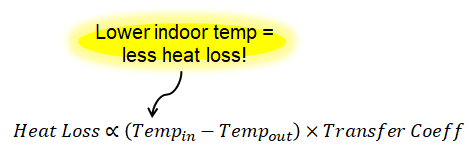
In this system, heating costs can be reduced by either improving heat retention transfer coefficient (better insulation, properly sealed windows, drawn blinds) or by lowering the thermostat so there’s a smaller temperature difference between the inside and outside of the home.

I wanted to see if I could measure my home’s temperature-dependent heat loss, but there’s too much noise in my data. I’m not surprised that the 1%/1°F DOE guideline was measured in a purpose-built experimental house.

For some of my cost calculations below, I had to estimate the NLoC-related temperature drop based on the DOE’s published results and my own imperfect observations.

Heat Pump Physics

An HP’s transfer of heat into a home slows down as the delta between the inside and outside temperatures increases. This means in HVAC systems with HPs, the home both loses heat faster and generates heat slower (Figure 3):
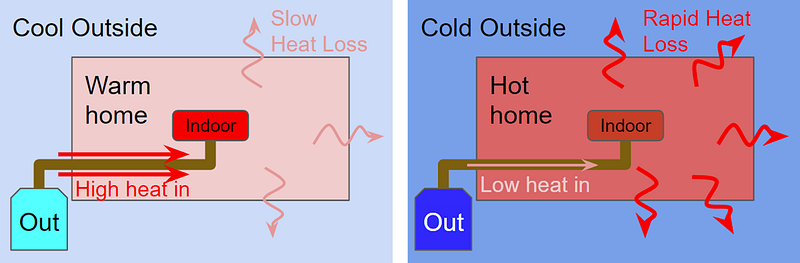
Figure 3: When it’s colder outside and warmer inside, homes with HPs both heat slower and lose heat faster.

The lower heat generation has its own equation to model it, Carnot’s Rule:
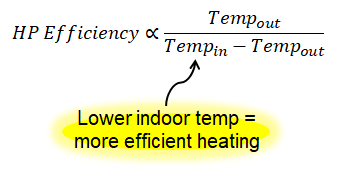
When discussing HPs, we often say that they work best in mild weather. I said it, myself, in the second paragraph of this article! This is a simplification. It’s more accurate to say HPs are more efficient when outdoor temperatures are closer to indoor temps.

Real-World Performance

Reading a Thermodynamics textbook is fun[citation needed], but let’s put it to the test. With my HP, thermostat data logs, and professional background in Statistical Process Control, I can directly quantify the savings.

In cold months, my thermostat is set to 65°F (18.3°C) during the day and 60°F (15.6°C) at night. After collecting data through the 2022–23 winter and analyzing it, Figure 4 has the final graph comparing HP function during the day vs. night.
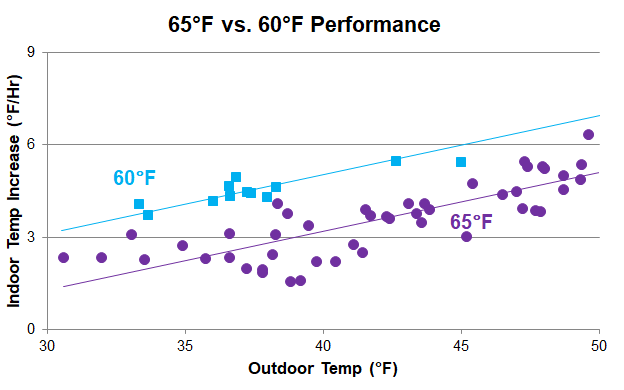
Figure 4: For a given outdoor temp, the HP heats about 1.85°F/hr (1.0°C/hr) faster when the thermostat is set five degrees (2.8°C) cooler.

The electricity draw for the HP is constant (2.4 kW, in my home). With the linear fit of indoor temp change vs. outdoor temp plus an estimated correction factor for home heat loss, I was able to create a model comparing the operating costs at different indoor temperatures (Figure 5).
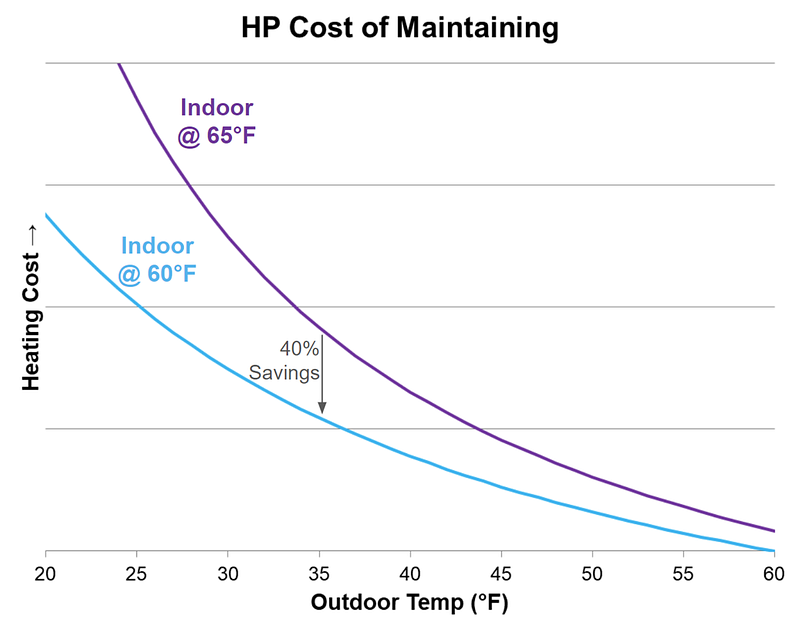
Figure 5: Throughout the range, I save about 40% on heating by lowering the thermostat by 5°F (3.3°C). This is about 7% per degree (assume exponential savings per degree).

One caveat: my home is not a scientifically well-controlled environment. This graph is derived from the HP performance in Fig 4 plus an estimated heat loss correction. This data is noisy so some error is possible.

Overall, I am very confident that lowering the indoor temperature drastically reduces HP costs. All reasonable estimations gave huge savings. The 40%/5°F (or 7% per degree) is my best-fit estimate, but actual savings may be smaller (or larger).

Even with my aggressive thermostat settings, heating costs are still nearly half of my home utility bills. Anything I can do to reduce the costs has a big impact on home energy use.

Heat Pump + Low Thermostat = Big Savings

All HP observations are home-specific. The implications are huge if my data holds for other homes. It should to some degree.

For those with a heat pump, a modest reduction in indoor temperature will save a lot of money.

By my math, reducing indoor temp from 72°F to the DOE-recommended 68°F (20°C) may decrease heating costs by 25% or more, easily worth hundreds of dollars per year. It took me months of data collection, followed by analysis, adjustment, and verification to conclude this. If you don’t want to repeat the same process, I don’t blame you.

Even without individual verification, I can say with confidence that any decrease in indoor temperature in a home with a heat pump will lead to a sizable reduction in heating bills, much more than the oft-quoted 1% rule-of-thumb for more traditional heating methods.

Fewer emissions from decreased furnace use

The higher efficiency at 60°F has a profound effect on the minimum outdoor temp that the HP functions. I currently set my thermostat to lock out the HP below 30°F (−1°C) based on performance at 65°F.
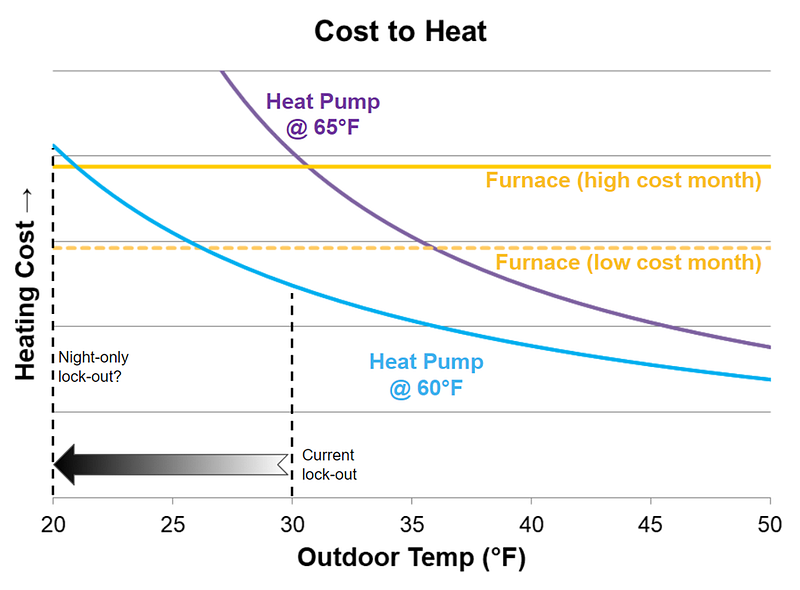
Figure 6: Thermostat lockout of the HP was set to 30°F based on daytime indoor temps. At nighttime settings, the HP remains a viable heating method down to 20°F.

Figure 6 shows that the HP remains cost-effective down to 20°F (−7°C) when the indoor temperature is set to 60°F. Last year, about 30% of my furnace use was at night when my thermostat was set to 60°F but the outside temp was between 20–30°F.

I will have to test a 20°F (−7°C) lock-out at night this winter. I could save hundreds of lbs of CO₂ emissions a year and likely reduce my bills, too.

Personal Comfort Dictates Savings

In my disclaimer, above, I named a few overlooked aspects of an HVAC system that significantly influence heating costs.

Add indoor temperature to the TOP of that list.

Your personal preference for how warm you keep your home can make the difference between an HP that cuts your bill in half and one that’s less cost-efficient than a furnace.

If someone were to move into my home and insist on keeping it at 72°F (22°C), I think that they would see little or no cost advantage from the HP vs. using only the furnace to heat. Again, this is home-specific and HPs still offer a big emissions advantage over combustion heat.

I think that when we discuss HP performance (in the comments, for example), we need to specify usual indoor temperatures in addition to home size and minimum outdoor temperatures as the key parameters that influence efficiency.

Final Thoughts and Next Steps

With new heating equipment, we need to rethink guidelines and preferences based on new capabilities. Indoor temperature is critical for HP efficiency, more so than with traditional heating systems.

To benefit the most from an installed HP, I recommend:

  • Reduce your indoor temperature a few degrees and see if you notice shorter HP ON times with each heating cycle. Let me know in the comments.
  • If you’re confident working with numbers and have thermostat logs, I would be interested in helping you with a similar analysis. It would give you real-world guidance on how to set your thermostat and help me gauge the repeatability of my numbers.

For my part, I have some follow-up testing to do this fall and winter:

  • Test heating costs at warmer indoor temps (70°F vs. 72°F)
  • Explore lower HP lock-out temps at night (25°F or even 20°F)

Those who follow me can look forward to that write-up when it’s ready.

It seems that those who like or can tolerate cooler temperatures will have much smaller costs and emissions and are less likely to need an auxiliary heat source while those that set their thermostats higher may only see marginal benefits.

If you enjoyed the article, please consider a clap. Claps on great articles help support the author’s work.

Happy to answer any questions in the comments. Please also check out my other articles on Heat Pumps and HVACs.

Technology
Energy Efficiency
Data Analysis
Sustainability
Climate Change
Recommended from ReadMedium