
It’s summer! Time to think about your furnace
When I first moved into my house, I spent the first year trying to find a way to make it cooler in summer. I looked into getting a white roof or an attic fan to reduce the heat from the sun's rays. Imagine my surprise when I sat down and determined that my heating costs outnumbered cooling by more than 20 to 1. In fact, I spend more on heating than cooling, cleaning, and cooking combined. For me, my heating costs seem to be a blind spot that took careful analysis for me to observe.
If you’re reading this, your energy use is probably roughly the same — most of the developed world is! This is important because it’s best to concentrate on improving the efficiencies of the largest energy user for the best return on investment while reducing home energy costs or emissions. Here are some questions you may have:
Do I live in a heating environment?
Yes (probably). To understand why, let’s look at Heating Degree-Days (HDD) and Cooling Degree-Days (CDD) to help quantify the heating and cooling needs in an area.
The most common way to measure HDD and CDD is to find the mean temperature for a day and subtract 65°F (18°C). Positive numbers (temps over 65°F) are CDD and negative are HDD.
For example, if the mean temperature in one town on one day is 75°F, the CDD for that day is 10. If that town’s mean temperature was 75°F every day for the summer and 55°F every day for the other seasons, the annual CDD would be about (92 days x 10°F) 920 and the HDD would be about 2730 (273 days x 10°F).
HDD and CDD are helpful for combining both how extreme the temperatures get and the duration of the seasons that you need heating and cooling. Higher HDD likely means higher heating bills and likewise for high CDD. While HDD and CDD are usually inversely correlated to each other and related to latitude, areas with large seasonal weather changes can have both high HDD and CDD.
Below are some maps comparing Heating Degree-Days (HDD) to Cooling Degree-Days (CDD).
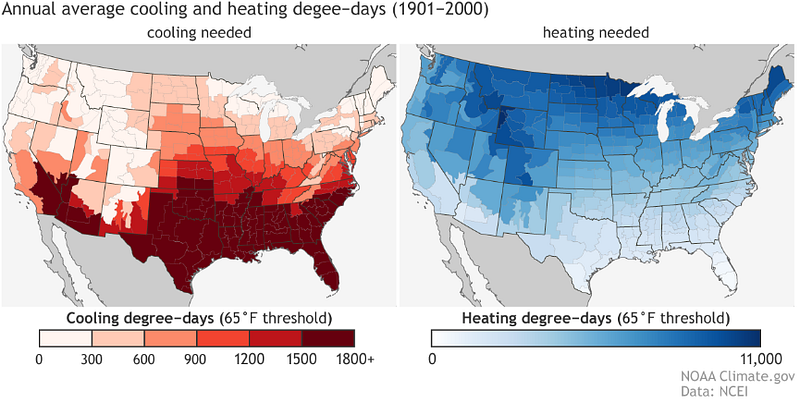
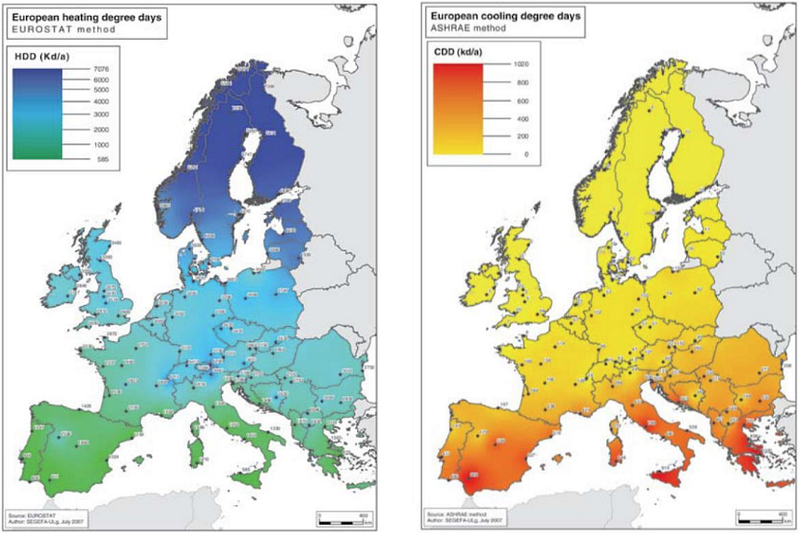
In the United States, everyone outside of HI, southern AZ and the immediate area around the gulf of Mexico is in a warming area. Even Los Angeles had more HDD (1274) than CDD (679) in 2022, according to HUD HDD database. For Europe, the major cooling environments are limited to parts of Spain, Italy and Greece plus a few smaller areas.
If you live in one of these cooling climates, this article may less relevant to you. I will likely write a follow-up dedicated to optimizing cooling equipment. In brief, in a cooling environment a high-efficiency (high SEER value) heat pump is likely ideal as a single device to address all heating and cooling needs.
For the majority of you that live in a warming climate, read on.
Why is heating so important for cost and environment?
Below is a pareto of my combined natural gas and electricity bills for twelve months from May 2022 to April 2023.
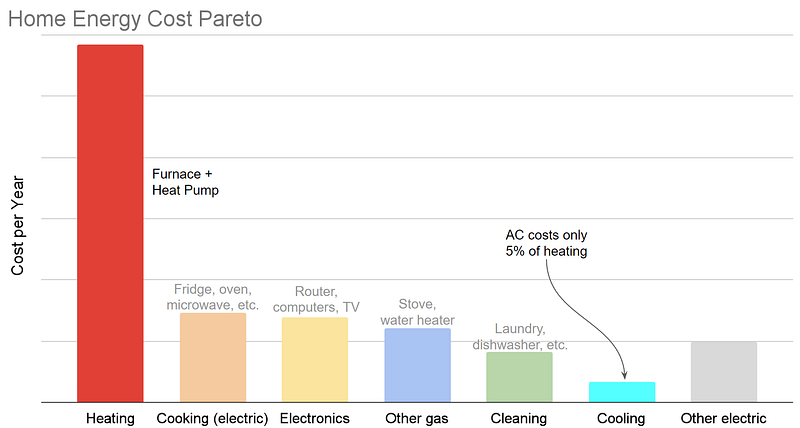
My heating bills represent nearly half of all home energy spending. Any efficiency improvement that I make to any other equipment will have a small impact compared to heating/warming optimization.
Take a look at your own bills and energy use. It should not be too difficult to estimate your total heating equipment use as a percentage of your total bills. I would expect that most of you will actually see a much higher percentage of heating than I do for a few reasons:
- I live in an area with fairly mild winters compared to most of the US and Europe population. (Our winters are warmer than St. Louis, colder than Atlanta).
- I have a very wide range of acceptable temperatures. The thermostat is set to 65°F (18°C) in the winter.
- My home equipment is already optimized with a fairly high efficiency heat pump. My heating bills were higher before the heat pump was installed.
What is the best thing for me to do now?
With summer upon us, we may be tempted to pursue improvements to efficiently cooling our homes. This is wrong. Heating costs are so high that we should do everything to optimize this category before any others. All non-heating categories, including cooling upgrades, are too small for efficiency improvements to save much money or emissions. Instead, treat summer as a brief break in warming needs and an opportunity to optimize your heating system.
Don’t get an air conditioner, get a heat pump.
My area experienced an unprecedented heatwave last year and it was above 100°F (38°C) eight days in a row. I still only needed to use an AC for twenty days last summer. In warming environments, we just don’t get enough use out of our ACs to warrant upgrades for efficiency improvement.
If you are interested in upgrading your AC, instead, look into replacing it with a Heat Pump (HP). In the summer, HPs operate the same as ACs with the same efficiency but can also heat during mildly cold weather usually for less money than furnaces.
While the installation costs of HPs are a little higher than matched-efficiency ACs, government subsidies, increased utility, and reduced warming costs will quickly save money. As an additional bonus, if you have a clean source of electricity, an AC to heat pump upgrade is an easy way to reduce your carbon footprint in cold months.
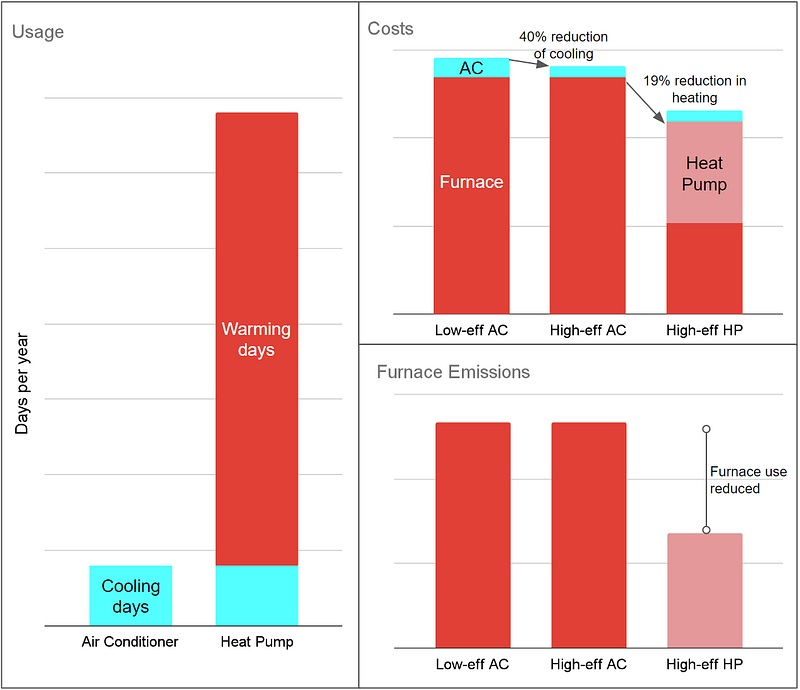
The graphs above show my real-world impact. My area just is not warm enough to justify optimizing my AC, a dedicated cooling device. Instead, I replaced an ailing AC with a more efficient heat pump, which reduced costs and emissions in heating more.
Optimize your house for storing heat, even when you want it cool
Summer is short. You will need heat for the rest of the year. Plan your homes around capturing and keeping warmth. This means painting and roofing in dark colors to capture heat, thicker insulation, and well-sealed windows and doors.
To keep cool in the summer, rely on active management: open your windows during the cool parts of the day. Run errands during the hottest parts of the day. Close sunward window blinds. Avoid using the oven and dryer during hot days.
Final Thoughts
I started by looking for ways to keep my house cooler. Instead, as I learned more about my local climate and utility bills, I optimized my house for warmth. When my house needed exterior work, I painted with a dark slate-blue and got black shingles, instead of white. A contractor evaluated my insulation to confirm it was appropriate and up to code for my area. My new heat pump decreased costs for both heating and cooling. I am still resealing, repairing, or replacing every drafty window and doorframe.
In the summer, it still gets hot. Now that I have a higher efficiency HP and I understand the real cost of using it, I worry a little less about turning it on during those few extreme days.
All told, the changes quantifiably decreased my energy use and gave me peace of mind. With a little observation, evaluation, and action, most people should be able to achieve the same.
Happy to answer any questions in the comments. Please also check out my other articles on Heat Pumps and HVACs.


