
I reduced my carbon footprint by two tons per year without changing my lifestyle. You can too
Over the past year, several of my home appliances have needed replacement. Being mindful of the cost and environmental impacts resulted in a profound reduction of my personal carbon footprint without any detrimental effects.
Baseline of Energy Carbon Footprint
To understand the improvement that I could capture from home upgrades, I first had to understand my current CO2 generation per year. I focused on the energy sources of carbon (other sources are goods, services, and food). Energy sources are easier to measure and adjust.
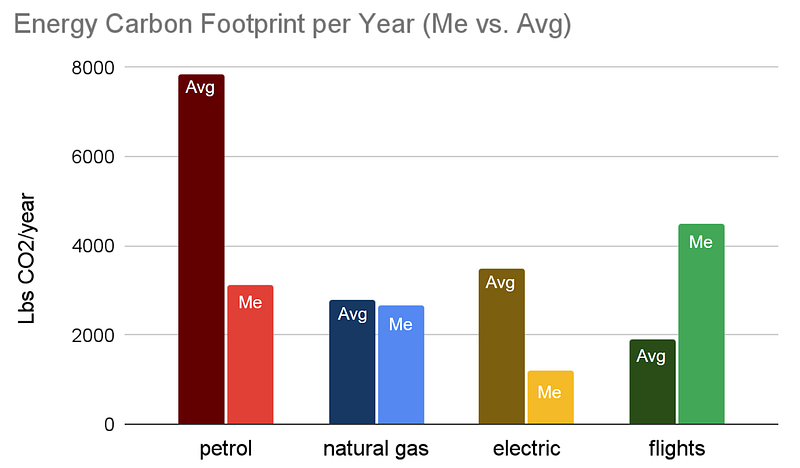
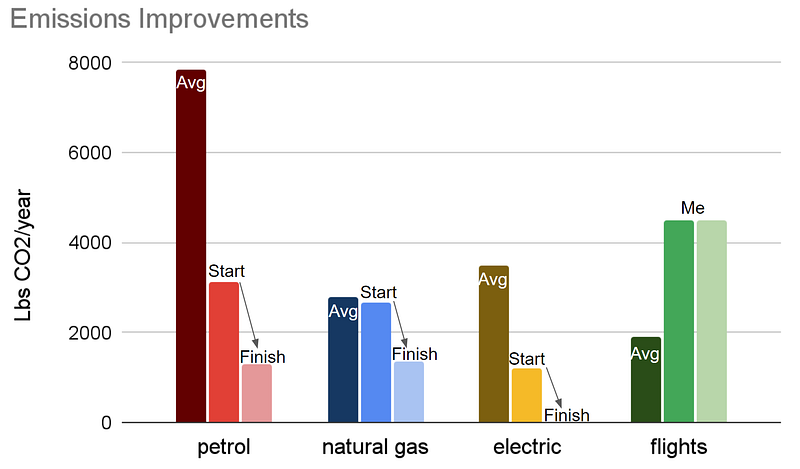
I determined my footprint from utility bills, gasoline (labeled petrol here to distinguish from natural gas) purchases, and google flight data. The averages here are per person per year and based on information from my utilities and EIA.gov.
To summarize, my starting footprint was already better than average. I fly a bit more than most Americans (most Americans did not use an airplane last year), but drive less and my home electric use is low. In total, I started with a little less than 6 tons per year of CO2 from energy usage.
Home Utilities
I have written before about my experience installing a heat pump and its effect on both costs and carbon footprint. In brief, I opted to replace the air conditioner with a heat pump when my HVAC system needed an upgrade. The new unit is twice as efficient as an AC and heats my home for about six months of the year.
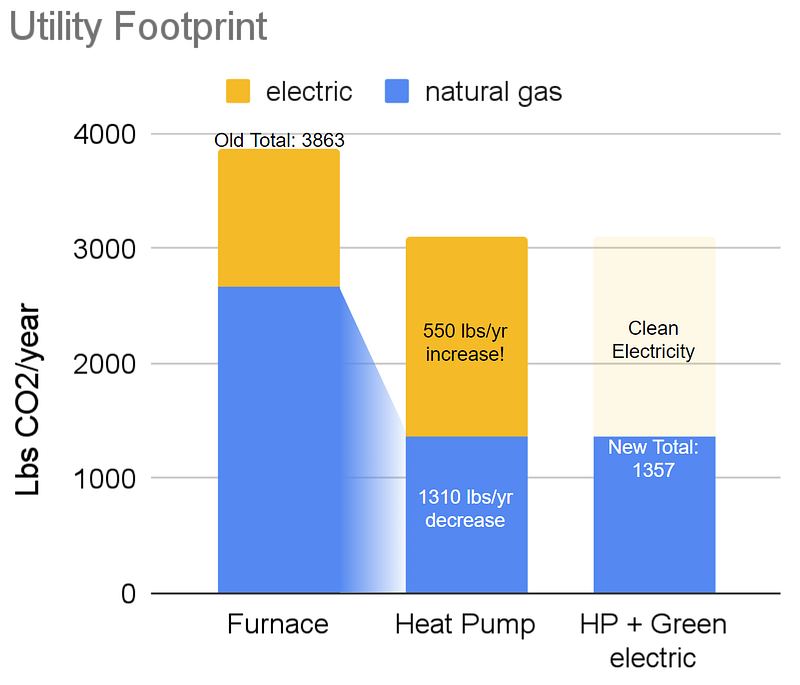
Switching from a furnace to a dual-source (with Heat Pump) heating yields only modest improvement in carbon footprint due added electricity emissions. If you take no other action, electricity is still fairly dirty because it’s often generated with natural gas and coal. Check with your electricity supplier because you may have many options for emissions-free energy including self-installed solar panels or community solar.
I subscribed to a green energy program with my provider that ensures my electricity comes from wind, solar, and hydroelectric for a slight price increase (more on that below). The final result was that I was able to eliminate nearly ⅔ of the emissions of my utilities (2500 lbs/year).
Transportation
I bought my last car in 2010 when I was still on a grad student stipend. Since then, I’ve gotten a lot more adventurous and the car was limiting my access. I wanted a higher clearance vehicle with 4WD, enough room in the back to sleep and the ability to tow a trailer.
While I was initially interested in the Toyota Rav4 TRD, a small SUV with an Internal Combustion Engine (ICE) that fulfilled my needs, I was drawn to the Rav4 Prime Plug-in Hybrid (PHEV) for its matched or better capabilities plus a hybrid engine with 30% better gas mileage and a large enough battery to drive 40 miles on electricity alone (or save for use as a generator at a camp site). WIth current gas and (zero emission) electricity prices, I calculate that it’s about 30–40% cheaper to drive in EV mode than use gas.
I finally got the new car last month. Here is my expected impact to emissions based on initial driving:
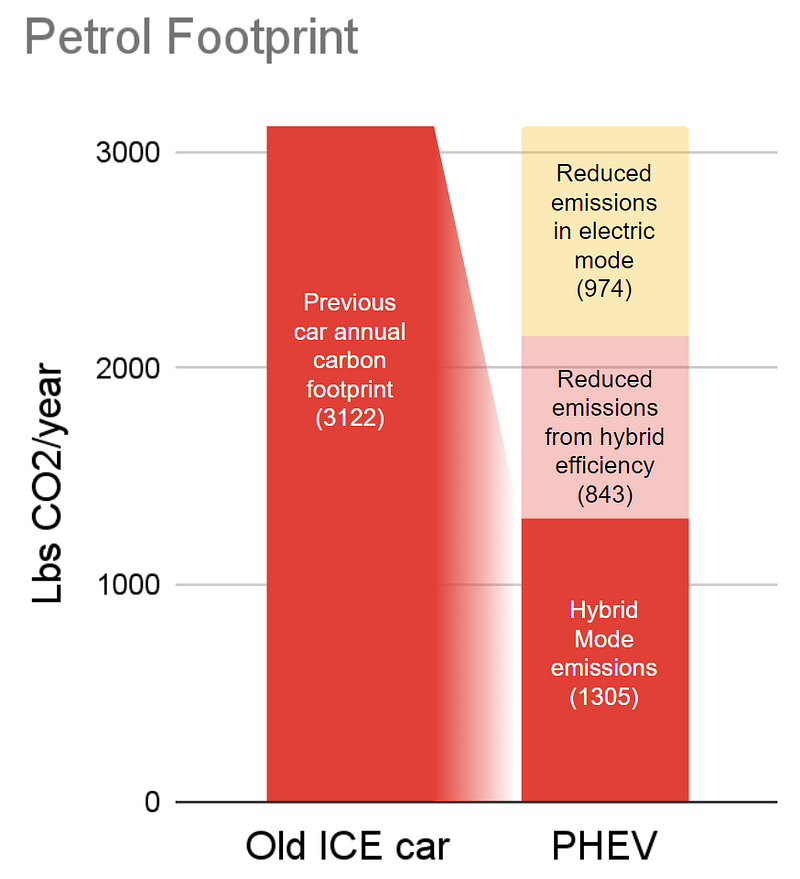
This data is preliminary, but it seems like I’m on track to reduce my car driving emissions by nearly 60%, approximately 1800 lbs/year. The savings is split between increased gas efficiency and emission-free electric driving.
Costs
There are many reasonable ways to calculate costs and break-evens. Government subsidies for this equipment can be highly variable. Unlike me, no PHEV or EV may exist that fits your needs or it may be too expensive compared to the ICE equivalent of your vehicle. The information in this section is debatable and situationally dependent.
In this case, capital cost is the delta between me replacing my equipment with high emission (like the AC unit or ICE car) vs. the low emission variants (HP and PHEV) after tax breaks. The savings per year are affected by the relative costs of petrol and natural gas vs. electricity and calculated based on the last 1 year of prices.
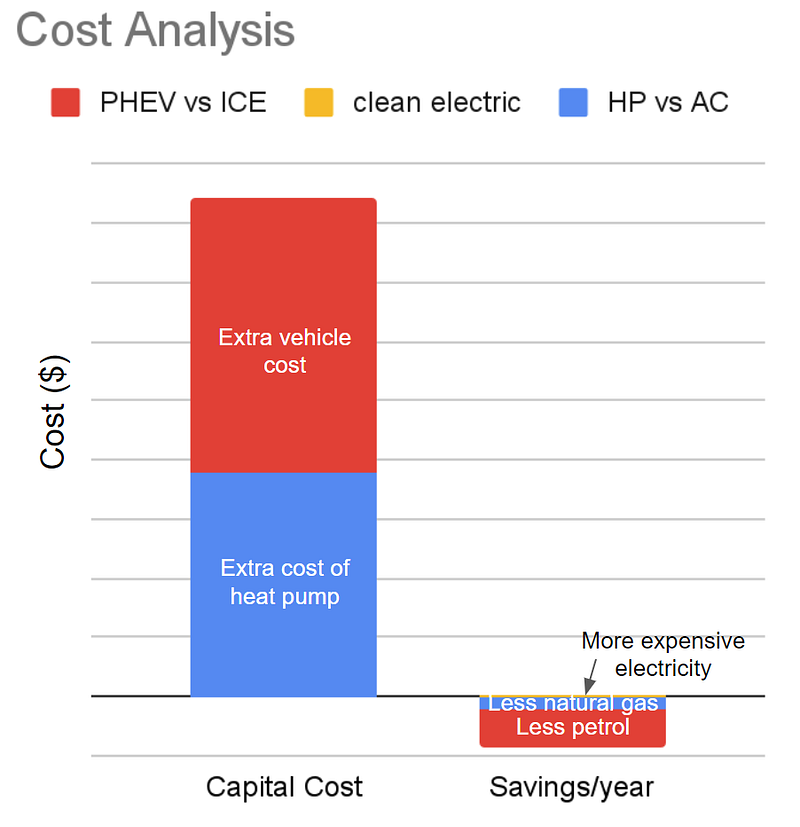
I expect a break-even in about 10 years. Ten years may seem like a long time, but when I started this project, I regarded it to be like a charitable contribution where I was bound to lose money. Bottom line: good for the environment and likely not bad for your wallet.
Next Steps
If you are planning for new HVAC equipment or vehicles, there’s a good chance that you can make a big impact on your carbon footprint that may save you money (long-term) and not negatively impact your lifestyle. Especially as more PHEV and EV vehicles come to market and most people drive more miles than I do, consider low and zero-emissions options. EVs save money for most drivers very quickly.
Finally, I focused on energy emissions in this article because they are straight forward to measure and often non-intrusive to reduce, but most of my carbon footprint has other sources:
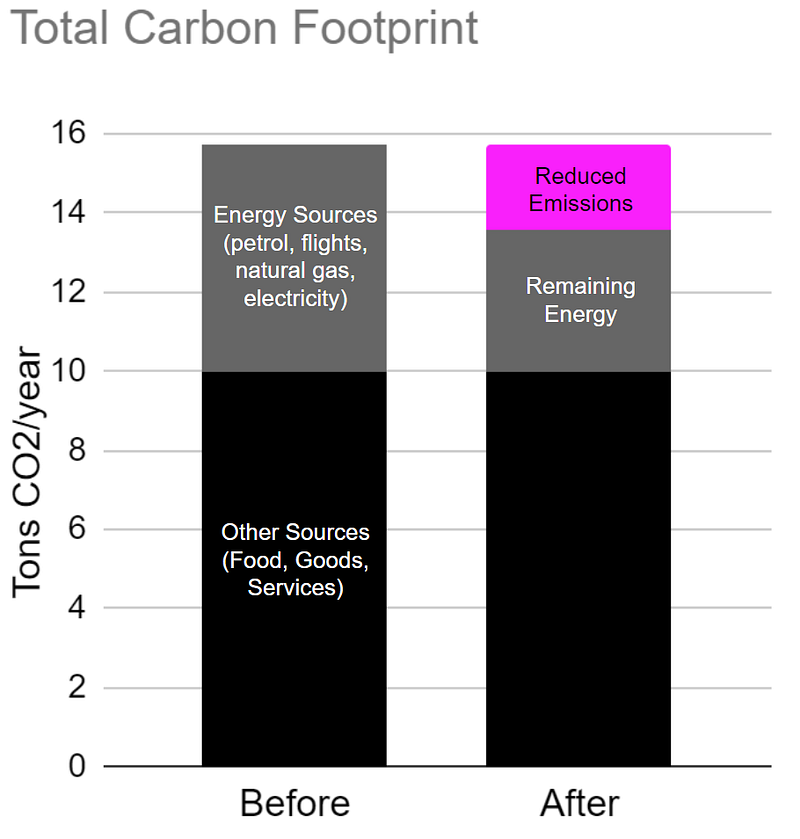
I reduced my emissions by about 13.7% in one year but this is just a first step if I want to have a serious impact. As far as I can tell, paths forward for future improvements will have diminishing returns or will definitely impact my lifestyle.
Happy to answer any questions in the comments. Please also check out my other articles on Heat Pumps and HVACs.