
Sunken cities. 7 lost cities flooded by the waves of the seas and oceans
Beneath the surface of the ocean is a world full of secrets and mysteries. Sunken cities once teemed with life and were centers of highly developed civilizations.
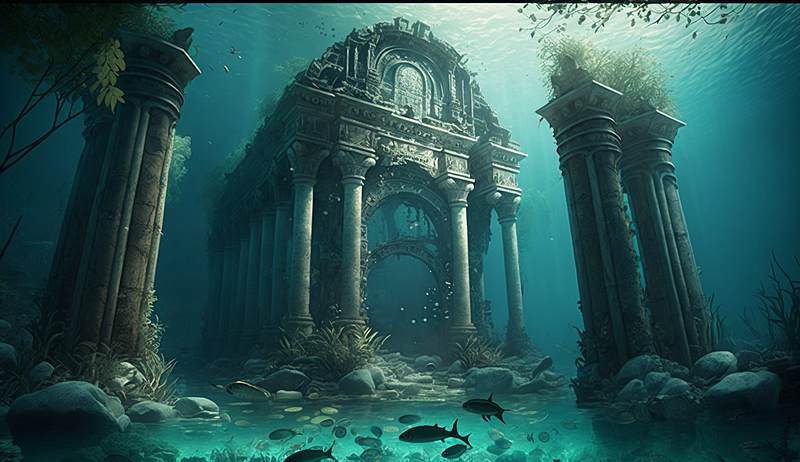
Sunken cities and their mysteries have captured people’s imagination for centuries, as they offer a glimpse into the past and history of ancient civilizations. The work of underwater archaeologists, in turn, is one of the most passionate professions. Here are 7 famous urban centers that, as a result of natural disasters and natural forces, were covered by the waves of the seas and oceans.
What are the most famous sunken cities?
- Alexandria (Egypt). Founded by Alexander the Great in 331 BC. Alexandria was one of the most important cities of the ancient world. In the 8th century AD, a series of earthquakes and tidal waves caused much of the city to go under the surface of the Mediterranean Sea.
- Herakleion (Egypt). The ancient port on the Mediterranean Sea was called Thonis by the Egyptians. The name Heracleion was given to the city by the Greeks. For more than 1,000 years archaeologists were unsure of its ancient location. It was not until 2000 that traces of the ancient port were encountered.
- Pavlopetri (Greece). An ancient Greek city whose origins date back to the Bronze Age. The port is believed to have been sunk in the 2nd millennium BC. Probably as a result of an earthquake.
- Port Royal (Jamaica). Port Royal was considered a nest of pirates in the 17th century, and one of the most important ports in the Caribbean. In 1692, an earthquake caused much of the city to sink underwater.
- Dwarka (India). Dwarka is an ancient city located off the coast of Gujarat state in western India. Local residents believe it was the capital of the kingdom of the god Krishna. Dwarka disappeared beneath the surface of the Indian Ocean thousands of years ago.
- Atlit Yam (Israel). This Neolithic village on the shores of Israel is considered the oldest settlement in the eastern Mediterranean. It was discovered in 1984 and was most likely inhabited between 6,900 and 6,300 BC.
- Baia (Italy). The former Roman resort located on the Bay of Naples still captures the imagination today. The town was known for its luxurious villas and hot springs. Much of Baja was destroyed by volcanic activity and earthquakes. Today it lies beneath the surface of the sea.
The sunken city of Alexandria (Egypt)
Alexandria was one of the most important cities of Mediterranean antiquity. Founded in 331 AD, the city was famous for its impressive architecture, magnificent library and vibrant culture. Over time, the city gradually submerged into the Mediterranean Sea. Today, part of ancient Alexandria is 6 to 8 meters below the surface of the water and is a popular attraction for divers.
There are several theories explaining why Alexandria was flooded by the waters of the Mediterranean Sea. One suggests that rising sea levels and frequent earthquakes caused the land to sink into the sea. Another theory suggests that the city’s location on a low-lying coastal plain exposed the port to extremely frequent flooding and erosion.
Whatever the cause, the sinking of the city was a gradual process that lasted for centuries. Once Alexandria was under water, many of its buildings and monuments were destroyed in the sea. Interestingly, elements of some structures, such as the famous lighthouse at Faros — one of the 7 wonders of the ancient world — can still be found underwater.
Despite the sinking of ancient Alexandria, the modern city of the same name remains an important cultural and historical center of Egypt. The new city was built on the same site as the ancient port.
The sunken city of Herakleion (Egypt)
Herakleion, also known as Thonis-Herakleion, was once a prosperous city located in the Nile Delta. It was a thriving commercial center that served as a gateway to Egypt. Over time, the city slowly sank beneath the waters of the Mediterranean Sea. The exact cause of the city’s sinking is still debated among archaeologists and historians.
Some theories suggest that the city was hit by a powerful earthquake that caused the sea to flood with waves. Whatever the cause, trace of the city was lost for thousands of years until it was rediscovered by archaeologists in the early 21st century. Reaching the sunken city is considered a breakthrough in the study of ancient Egyptian civilizations and culture.
Today, the underwater city is still being thoroughly investigated by a team of archaeologists and scientists. Another range of artifacts and structures have recently been discovered, including temples, statues and even a shipwreck.
The sunken city of Pavlopetri (Greece)
Pavlopetri is an ancient Greek city. The former port is today completely submerged under water off the coast of southern Laconia in the Peloponnese, Greece. The city is believed to be one of the oldest underwater archaeological sites in the world, with submerged ruins dating back to the Bronze Age, some 5,000 years ago.
The city was first discovered in 1967 by oceanographer Nicholas Flemming. While studying the tectonic activity of the area, the British researcher noticed unusual formations on the seabed. However, it wasn’t until 2009 that the first systematic underwater analysis of the area was conducted, revealing the extensive remains of the ancient city.
There are several theories explaining how Pavlopetri was sunk. One theory suggests that the city was destroyed by an earthquake and then a tsunami, which caused the land to sink into the sea. Another theory is that the city was gradually submerged due to rising sea levels. Despite the uncertainty about how the city was submerged, the archaeological remains found at Pavlopetri are remarkably well preserved. The city was built using a sophisticated engineering system, with buildings formed from large stone blocks and complex drainage systems. The city also had a complex network of roads, courtyards and open spaces.
The discovery of Pavlopetri provides important information about the ancient world and sheds new light on the development of early urban civilizations. The well-preserved sunken ruins of the city give archaeologists and historians a rare glimpse into the daily lives of the era’s inhabitants and provide valuable information about ancient Greek society, including architecture, technology and social organization. Today, Pavlopetri is under the protection of the Greek government and is accessible only to trained archaeologists and researchers.
The sunken city of Port Royal (Jamaica)
Port Royal was a well-known center of trade and piracy in the Caribbean Sea in the 17th century. Located on the southern coast of Jamaica, the port was a strategic stopping place for ships and replenishment on their way to and from the New World. The city was famous for its lawlessness, which attracted pirates, buccaneers and merchants. Until…
In 1692, Port Royal was hit by a powerful earthquake that caused much of the city to sink into the sea. The 7.5 magnitude earthquake was one of the most severe in modern history. According to estimates, the death toll resulting from the incident is at least 2,000 people. The ground beneath the city of Port Royal consisted of fine limestone. When the region was hit by an earthquake, the limestone turned to liquid, causing buildings to sink into the sea.
The destruction of Port Royal was so dramatic that witnesses described it as “the ground opening up and engulfing people and homes.” The destruction was so massive that the town was abandoned for many years. Today, much of Port Royal still lies underwater, making it a popular destination for divers and historians alike. The sunken city is now a UNESCO World Heritage Site, and efforts are underway to protect the remains of the former port.
The sunken city of Dwarka (India)
Dwarka, located in the western Indian state of Gujarat, is considered one of the oldest cities in the world. The center is known for its belief in the god Krishna — one of the main deities in Hinduism. The story of how Dwarka became a sunken city is steeped in legends and myths. According to Indian mythology, the god Krishna, who was said to reside in Dwarka, predicted the city’s demise. He said that after his death, the port would be sunk into the sea.
Fortunately, there are also scientific explanations for this phenomenon. One theory suggests that the city’s sinking into the sea was caused by a massive earthquake. This theory is supported by archaeological evidence, which shows that Dwarka was destroyed by a major seismic event around 1500 BC. Another theory is that rising water levels are responsible, which is made plausible by geological studies of the area. And the fact that the level of the Arabian Sea, which lies off the coast of Dwarka, has been rising steadily for several thousand years.
Whatever the cause, the sinking of Dwarka contributed to some extent to the city’s sacred status for Hindus today. Many followers of Hinduism believe that Dwarka still exists beneath the waves and that it is still inhabited by gods and goddesses. As a result, the area has become an important pilgrimage site.
The sunken city of Atlit Yam (Israel)
Atlit Yam is an ancient sunken city located off the coast of Israel. A Neolithic settlement developed around 7,000 BC. Over time, the city was submerged and today lies about 300 meters offshore at a depth of about 8–12 meters.
The reasons why Atlit Yam was submerged are not entirely clear. It is believed that the city was gradually flooded by rising sea levels caused by the melting of glaciers at the end of the last ice age. Some experts believe the flooding may also have been caused by an earthquake or tsunami that hit the region.
Despite being thousands of years underwater, the city is very well preserved. Underwater research has revealed a wealth of artifacts, including houses, burial sites and religious structures. Among the most interesting finds are the remains of a stone circle that probably served as a temple, as well as a burial site containing the remains of 65 people.
One of the most fascinating aspects of Atlit Yam is that it provides a glimpse into ancient life in the Mediterranean. Artifacts recovered from the site indicate that the city was a center of trade and culture, with evidence of the exchange of goods with other Mediterranean civilizations. The city also had an extensive religious system and was likely an important center of social and cultural activity. Today Atlit Yam is a popular destination for divers and archaeologists interested in exploring ancient ruins.
The sunken city of Baia (Italy)
Baia, located near Naples, Italy, was once a popular seaside resort for wealthy residents of the Roman Empire. The reasons for Baia’s sinking are complex and multifaceted. First, the city was located in a very geologically active area, with frequent earthquakes and volcanic eruptions. These natural disasters caused the ground to collapse and the coastline to retreat. In addition, the region was prone to coastal erosion, which further contributed to the sinking of the city.
Another factor that caused the city’s destruction was the Roman practice of erecting buildings over natural hot springs. These constructions, which included baths, villas and public buildings, caused the ground to sink even further, accelerating the city’s descent into the sea.
Today, Baia’s underwater archaeological site contains urban villas, public baths and a temple to the goddess Venus. The marine environment has also helped preserve many mosaics, frescoes and sculptures that provide insight into ancient Roman art and culture. The sinking of Baja also had a significant impact on the local marine ecosystem. The ruins became an artificial reef, providing habitat for a variety of marine organisms, including fish, octopus and other sea creatures.
Cool that you made it to the end of this article. I will be very pleased if you appreciate the effort of creating it and leave some claps here, or maybe even start following me. It would be nice if you also left a tip! Thank you!


