
Successful People Are Not Necessarily Smarter. They Just Do More Of This.
This is how you build world-class expertise in any field.

Author’s Note: This article was written over 60 hours with love and care using the blockbuster mental model. If you like my writing style, and you want to create high-quality viral content using the blockbuster approach, you’ll love my Blockbuster Blueprint newsletter, which delivers three in-depth articles every week.
Imagine this…
You’re playing speed chess… with a blindfold… with multiple games going at once.
At the 2015 Sohn conference, the highest-ranked chess player in history, Magnus Carlsen, did exactly this, and it’s a feat to behold.
Carlsen quickly makes his moves (navigating 60,000+ possible chess moves in his mind) while his opponents flounder.
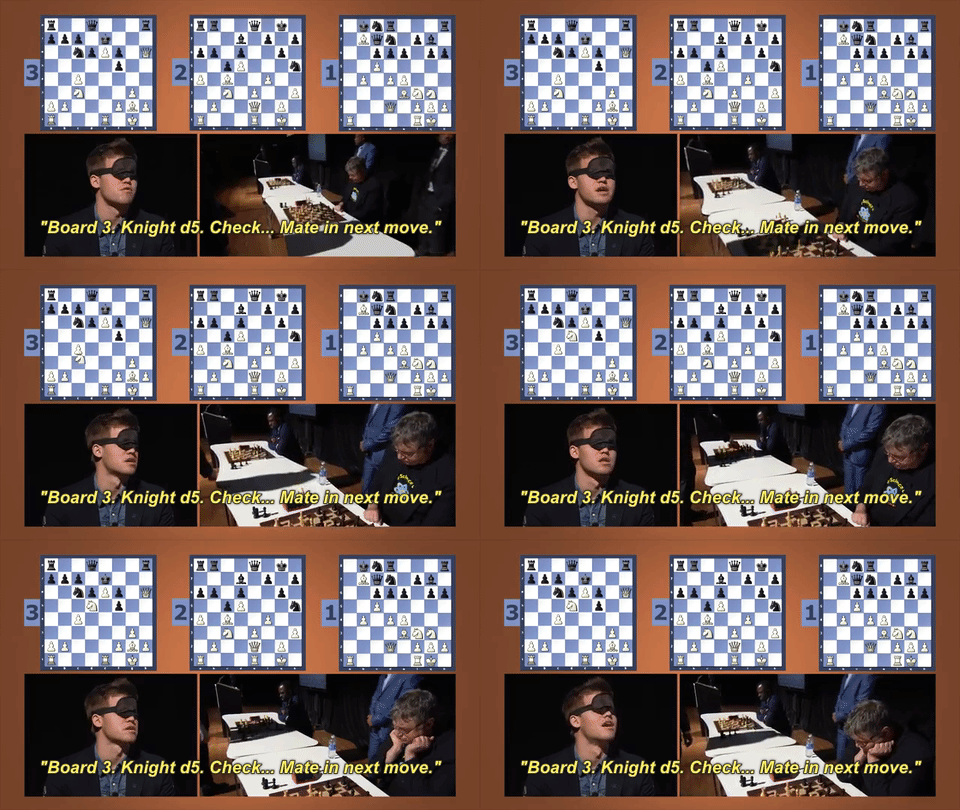
Carlsen’s first win is a checkmate. His second is a resignation. The final opponent loses on time!
If you’re like me, when you see feats like this, you wonder:
How can I perform like this in my own field?
This article answers that question.
You can use the same principle that Carlsen uses to master chess, to master your field and become more successful.
How is that possible? The short answer is chunking. Professor Barbara Oakley, co-instructor of Learning How To Learn — the largest course in the entire world in any subject — has this to say about chunking: “I’m becoming increasingly convinced that ‘chunking’ is the mother of all learning — or at least the fairy godmother… Creating neural patterns — ‘neural chunks’ — underpins the development of all expertise.”
Experts like Carlsen learn how to harness this power through thousands of hours of deliberate practice.
Here’s the full breakdown on why chunking is one of the most important parts to becoming a world-class expert.
Explainer: How Chunking Happens
Think about when you first started learning to read (or when you see a child learning to read). Although you didn’t realize it, you were chunking!
The first phase was learning that these random shapes you were seeing were actually a new concept called letters. You combined multiple things into one new thing. That is the essence of chunking. In this case, you combined shapes into a new chunk called letters.
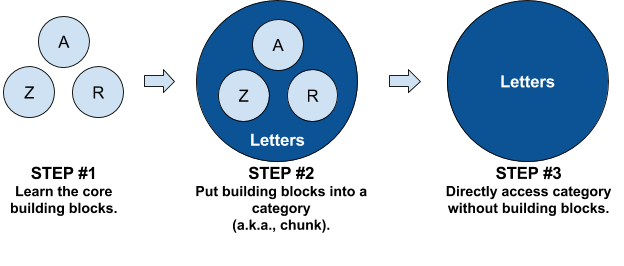
As you developed mastery of letters, you learned that they could be combined into a new concept called words and that these words could be accessed automatically.
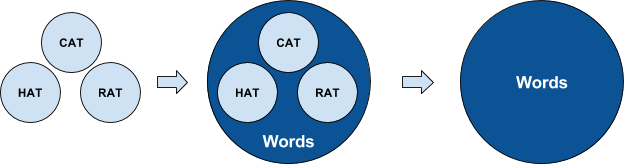
Over time, you continued additional levels of chunks. You realized that words could form word groups, which could form clauses, which could form sentences, which could ultimately form stories.
And voila! You suddenly had a new magical ability: the ability to read. You no longer had to sound out each letter. Where there used to be randomness, you now saw order.
When you build more and more complex chunks upon chunks, you gain new abilities. The only reason that reading isn’t considered magical is because so many people can do it. World-class experts, on the other hand, follow the same process, but they just focus on areas of expertise that few other people have mastered and they spend more time in the mastery process.
How Magnus Carlsen Chunks
This takes us back to Magnus Carlsen and his no-longer-magical ability to play blindfolded speed chess.
Carlsen isn’t memorizing each individual piece on each individual square on each chessboard, which would mean memorizing millions of possibilities. That would be truly magical. Instead, he’s using an ability that we all have: the ability to form and use complex chunks. Through years of deliberate practice and chunking, Carlsen:
- Has memorized tens of thousands of complex chunks: still a large number, but much more tenable!
- Is able to automatically and rapidly access those chunks through his intuition.
This explains why he can move fast while his opponents are brooding over where to move next. They haven’t built up enough chunks yet, so they need to consciously examine each possible move and go through all of the implications.
Just how important chunking is was discovered in a landmark study. The researchers had novice and expert participants view a chess position for a few seconds and then reconstruct it from memory.
In the first experiment, the position was one that could appear in a real game, and experts far outperformed novices. In the second experiment, the chessboard was arranged randomly in a way that would never happen in a real game. The grandmasters immediately lost their edge. They could no longer use their saved chunks.
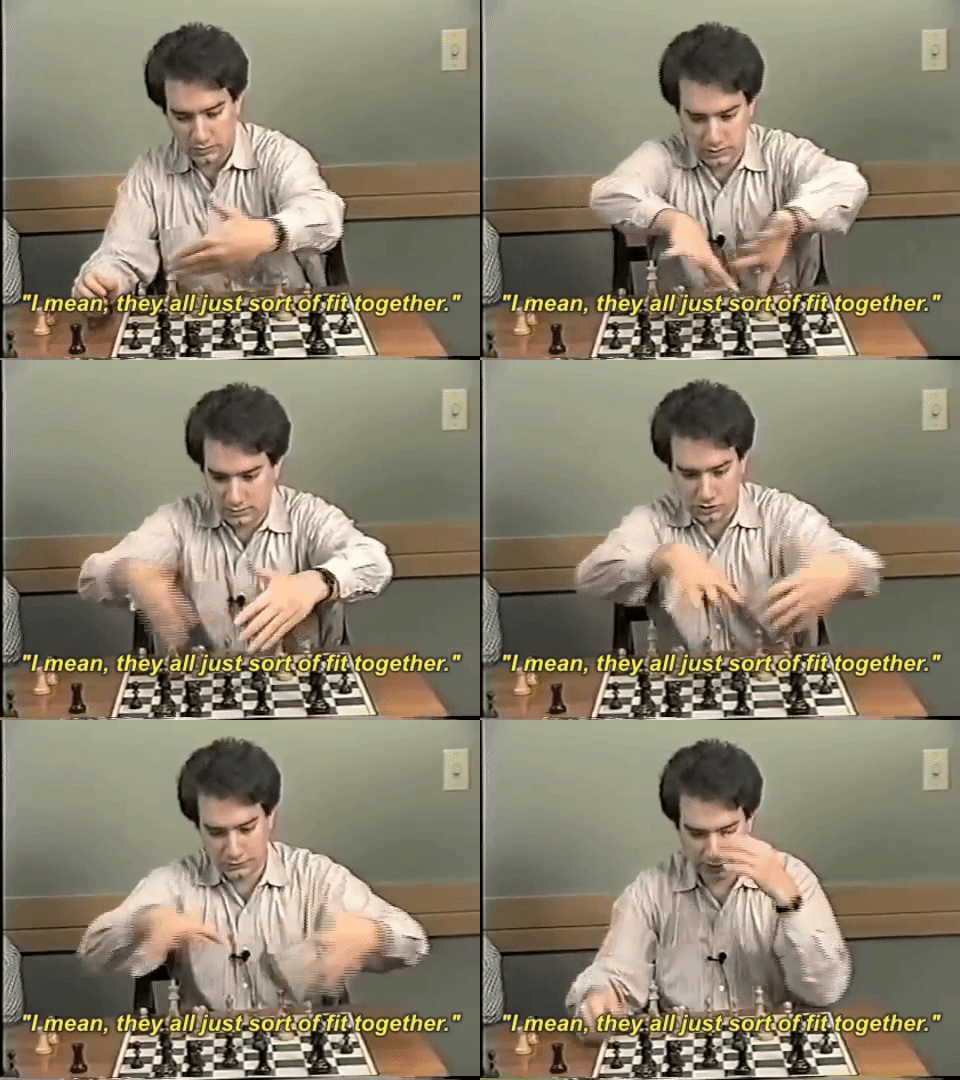
More recently, researcher Daniel Simons replicated the experiment with chess grandmaster Patrick Wolff and posted it on Youtube. Wolff’s attempt in the random position is almost pathetic. In the real position, it is a miracle. Only two pieces are misplaced, and they’re only misplaced by one square.
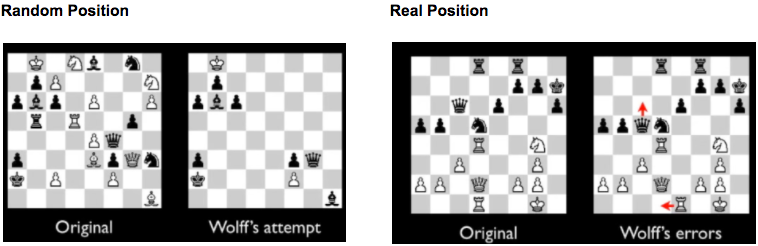
Also, notice how Wolff describes the feeling when he’s chunking. Rather than describing the process of working with chunks as difficult, mechanical, or deliberate, he describes it as flowing and unconscious. This is a hallmark of mastery.
Chess grandmaster Josh Waitzkin further unpacks what this process feels like in his seminal book, The Art Of Learning:
… over time the intuition learns to integrate more and more principles into a sense of flow. Eventually the foundation is so deeply internalized that it is no longer consciously considered, but is lived.
He later adds…
[A] great pianist or violinist does not think about individual notes, but hits them all perfectly in a virtuoso performance. In fact, thinking about a ‘C’ while playing Beethoven’s 5th Symphony could be a real hitch because the flow might be lost.
What It Means For Us: Why Mastery Takes So Long
Learning the concept of chunking is both exhilarating and disheartening.
It’s exhilarating because it shows us how we can develop superpowers in our field if we stay committed. With just one building block at a time, we become an expert over time.
It’s disheartening because it shows us why building world-class expertise is a process that takes thousands of hours of practice in most fields. Just like a pyramid is built with individual bricks, starting from the foundation and moving up, so too is our expertise. Every chunk is one brick.
In order to learn a single chunk, we must:
- Understand what its building blocks are.
- Understand how they connect into a new concept.
- Practice using the concept so much that it becomes automatic.
Sure, it’s possible to increase the speed at which we build our mental pyramids. Also, some people are hardwired to learn these chunks faster. But either way, if we bypass the process and don’t build a strong foundation, the overall pyramid becomes weaker.
How To Build Chunks In Your Daily Life With The 5-Hour Rule
Dedicating time to chunking is not as hard as it sounds. Simply setting an hour aside per day for deliberate learning compounds over time. I call this the 5-hour rule, and I learned it by observing the deliberate learning rituals of some of the world’s top entrepreneurs.
I may never attain the level of performance of a true prodigy like Carlsen, but because I am building up chunks of expertise every day, I’m able to see my performance constantly improve. Maybe one day, I will be a grandmaster in my field. This is potential that chunking gives us all.
Interested in creating a learning ritual in your life?
I created a free learning how to learn webinar you might like. It’s based on the learning best practices of the world’s top entrepreneurs and performers.
*** Michael Simmons is a serial entrepreneur and writes at MichaelDSimmons.com, and Ian Chew is a director at Empact.
This article was written with love and care using the blockbuster mental model.
If there’s a link to an Amazon book, it’s an affiliate link, which means I get a small amount of compensation when you buy the book. This compensation does not influence the specific books I recommend, as I only recommend books that I read and love.


