
Blockbuster: The #1 Mental Model For Writers Who Want To Create High-Quality, Viral Content

Learn how I went from zero to tens of million views in 5 years… and how to make your best ideas go viral in an age of information overwhelm.
Will this article be read by anyone?
That was the #1 question going through my mind as I pressed ‘Publish’ on my first Forbes article in April of 2013.
As someone with no email list or journalism background, my insecurity felt overwhelming. I feared my words would die the silent death of obscurity.
So, I made a crucial decision… I would go all in. I would improve each article until I couldn’t anymore. This meant that I would spend more than 50 hours per article.
The results of doing this over and over for each article have surprised me.
My articles have been viewed tens of millions of times with the average article now being viewed 150,000+ times. One article even got well over 2 million views in just one publication it was syndicated on:
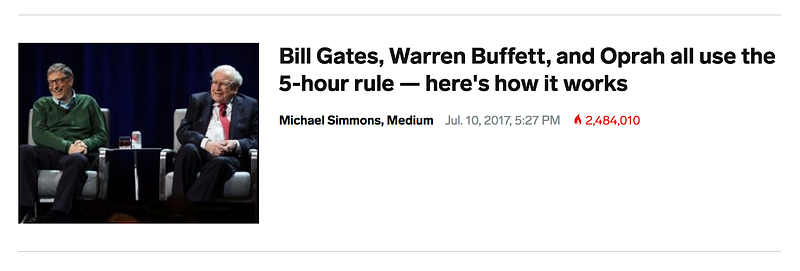
How did this happen?
How did I go from almost no experience, no email list — in a world of information overwhelm — to having articles consistently seen by stadiums full of people in just a few years?
It all comes down to one mental model, which I will dissect in this article.
In my experience and from my research, collecting and learning the most valuable mental models in the world is a key strategy of world-class entrepreneurs and leaders. Because, the better our mental model of any domain is, the more likely we are to be successful in that domain. Even one mental model, like the one in this article, can be a complete game-changer.
But, before I dive in, let me give some context on why I’m writing an article on thought leadership when everything else I write is about learning.
Here’s why…
- When other writers I follow have shared their underlying mental models, it has really helped me understand all of their writing better. So, I hope this article helps you understand mine.
- Second, over the years, many people have asked me how they can write articles that are read millions of times and shared in top publications. Now, I can send this article as my answer. A longform article is the culmination of thousands of little decisions, and almost all of the decisions I make can be traced back to this mental model.
- Finally, for the first time, I’m going to coach a handful of people on how to write blockbuster articles that inform and inspire. I’ll show you how to get hundreds of thousands of views, thousands of subscribers, and thousands of dollars from each article you write. If you’re interested in learning more, you can click here to complete a short survey.
With that said, let’s dive in…
The Story Of The Long Tail And Fat Head
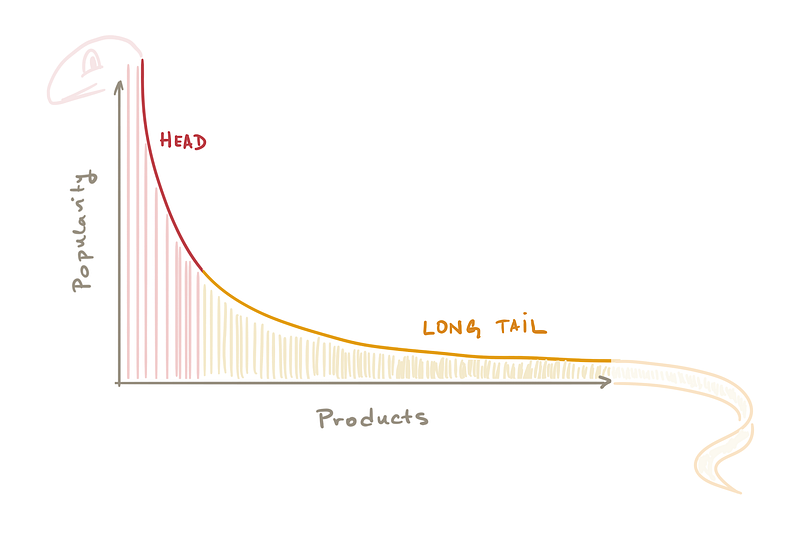
In 2008, Chris Anderson, editor-in-chief of Wired Magazine, wrote the New York Times bestselling book, The Long Tail: Why the Future of Business is Selling Less of More. The premise of the long tail theory is that content consumption is increasingly shifting away from a relatively small number of ‘hits’ at the head of the demand curve toward a huge amount of content in the tail.
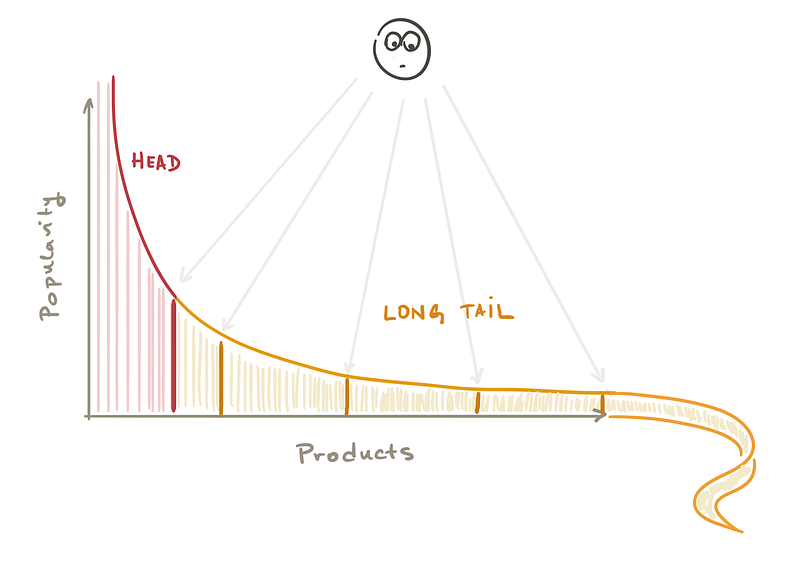
In other words, there are more books, articles, movies, music, apps, and TV shows than ever. Therefore, rather than people watching a few things because that is their only choice, people will spread out their attention over all of the content. They’ll focus on the small, niche topics that are the most interesting to them.
The book was rated as one of the top business ideas of 2008.
Here’s the problem with it…
It was wrong — or at least half wrong.
The long tail theory is right because there are now more options in every category. There is more media of all types being produced than ever before.
The long tail theory is wrong because most of the overall attention is being concentrated in the blockbusters in every medium.
Research of the data by Harvard Business School professor Anita Elberse shows that blockbuster content is receiving a larger percentage of the attention pie than ever in all entertainment categories including publishing, TV, music, sports, movies, comedy, and opera:
“Rather than bulking up, the tail is becoming much longer and flatter… Meanwhile, our research also showed that success is concentrated in ever fewer best-selling titles at the head of the distribution curve.”
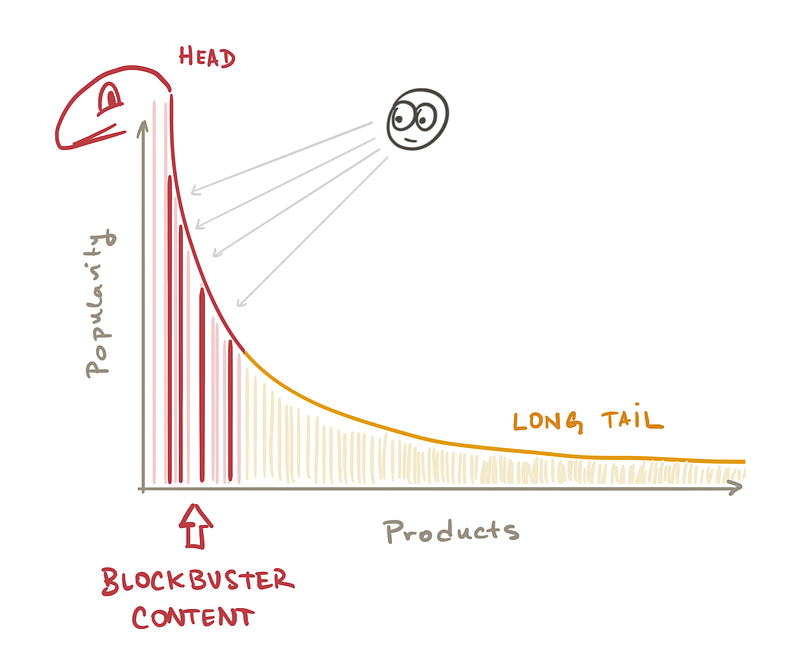
Increasingly, the top media companies are focusing on fewer, high-quality titles and those titles are monopolizing attention and being enjoyed more.
The early pioneers of the Internet thought that it would be a great democratizer. 30 years later, the Internet appears to be the greatest centralizer in human history (read Attention Merchants for more on this).
What happened here?
Below are the 7 reasons why blockbusters are taking over, and why you as a thought leader should adopt the blockbuster mental model as the center of your strategy.
#1: The Web Operates On A Rich Get Richer Basis
This is the central reason that the blockbuster model is so powerful. In markets where there is a winner-take-all dynamic, it’s best to have a model that focuses on becoming a winner, because winners receive disproportionate rewards.
Below are charts that show the top 100 most shared articles for a variety of niches (Source: Buzzsumo). Do you notice any commonalities? These are not normal bell curves where most of the content has roughly the same number of views.
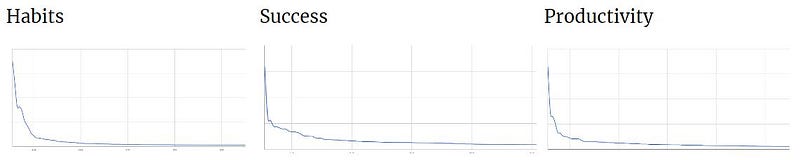
Rather, a small amount of content accounts for a large majority of the traffic. And 50% of articles get 8 shares or less.
The higher quality something is in terms of the underlying ideas and how it is packaged, the more likely it is to be shared over and over, which then makes it more likely that other publications will syndicate it, republish it, promote it through their social media and email channels, write about it, and feature it on their frontpage.
Furthermore, there is a growing body of curated newsletters, message boards, apps, and sites that look for the best content on the Internet to feature. Take Pocket for example. Every day, they send a newsletter to their tens of millions of subscribers and recommend articles online.
Finally, we humans are fundamentally designed to consume things that are popular. In other words, we make decisions based on social proof. The more our friends read an article, the more likely it is that we will read it. In one particularly surprising study, researchers created a fake “music market” where study participants listened to songs from unknown bands. Simply by changing the initial leaderboard, researchers were able to change what songs became most popular.
In other words, the Internet is just one giant positive feedback loop…
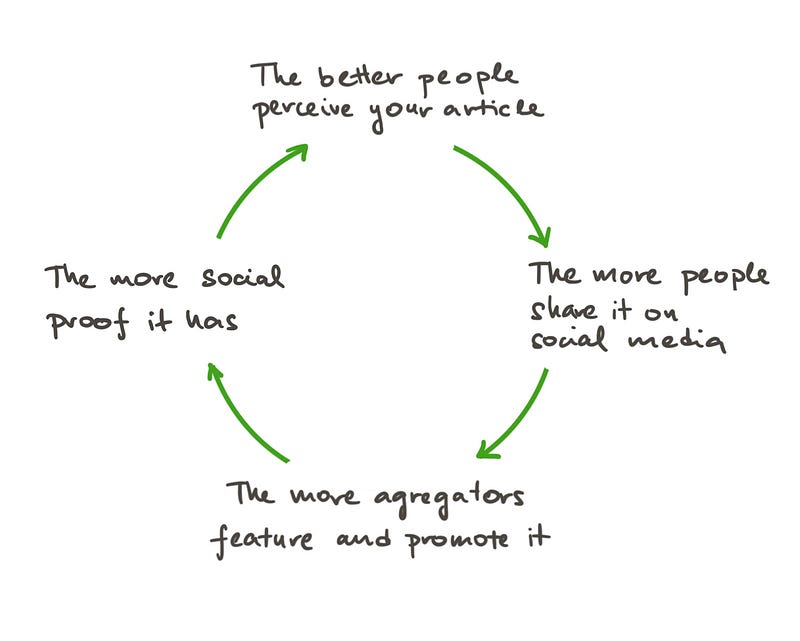
By understanding this phenomenon, I made the decision to focus on quality over quantity. With each article, my aim is to write the best article that has ever been written on the subject. And, we’ve designed our process over the years from the ground up to make this happen.
Now, I spend over $1,000 per article on researchers, illustrators, editors, and proofreaders. I also spend dozens of hours of my time, which is split between reading several books, writing the actual article, and editing it 15–20 times.
Side note: Because of the impact mental models like the Blockbuster model have had on my own life, I co-founded the Mental Model Of The Month Club last year. Every month, we provide a 15,000 word mastery manual and masterclass on the most important mental models in the world. If you want to learn faster and make better decisions, you can try out the club free for 7 days.
#2: There Is Much Less Competition From People Creating Blockbusters
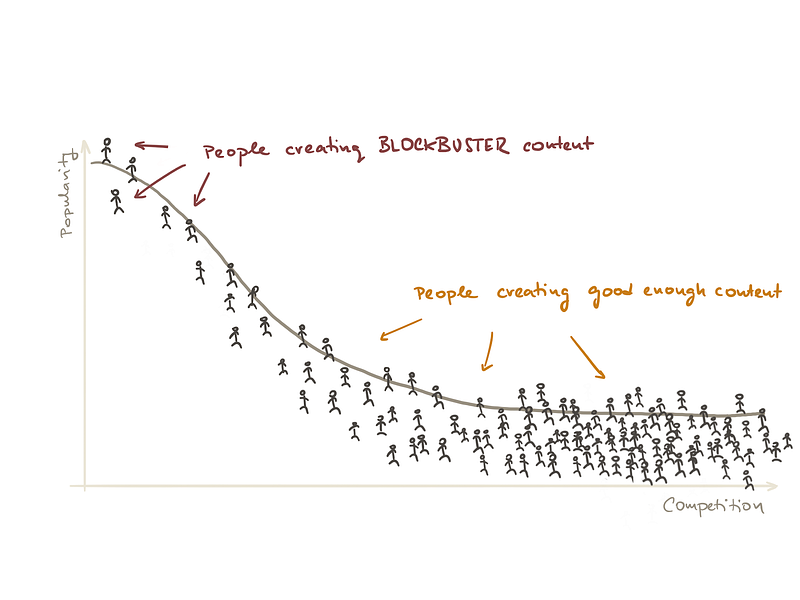
At first glance, attracting attention online feels impossible.
There are millions of other people creating content daily. How can you possibly stand out?
Here are the two secrets I’ve learned that answer this question. First…
- There is a lot of competition for mediocre articles. Almost all article writers dash off their content in an hour or two. You know these articles… ones that give a list of life tips like “get sleep,” “eat well,” and “be nice” without really bringing anything new to the table.
- There is almost no competition for blockbuster articles. Almost no one spends dozens of hours on every article to make it the best article on that topic in the world.
Second, in the world of movies where the blockbuster approach is considered a best practice, it is almost impossible to create a blockbuster hit starting from scratch. You need $100M+ dollars, A-list celebrities, and the most talented people in the world.
In the world of online content creation, the blockbuster approach has not yet become a standard practice. Therefore, the barrier to creating blockbuster content is very low. You can create a blockbuster article in 50–100 hours, at zero financial cost, and be a mediocre writer. 50 hours is doable at the same time that it is enough to deter almost all competition.
This gap is your opportunity. And, this unique opportunity will not be open for a long time, as more and more people figure out how powerful the Blockbuster mental model is.
#3: Blockbuster Articles Build Your Reputation
A large part of the success of any given article is the name of the author. The same exact content will have a wildly different level of success based purely on who wrote it. In other words, the messenger is the message.
For example, I just saw that Kanye West tweeted the following recently:
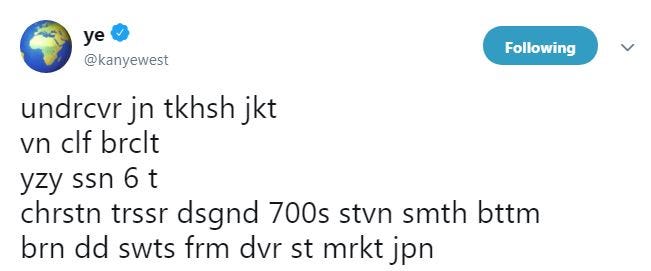
Nearly 3,000 people saw this seeming gibberish and resonated with it so much that they decided to share it with everyone that follows them. On the one hand, this is funny. On the other hand, it says something deep about how the human psyche works.
This phenomenon has been widely studied in the academic world. Research shows that with any given academic article, the reputation of the authors have a big impact on the article’s initial success. The same holds true for content in general.
For example, every time I see a new Malcolm Gladwell or Nassim Taleb article in my newsfeed, I feel a rush of excitement. I immediately stop whatever else I’m doing to read it, because I’ve loved all of their past writing. In fact, I’ve even shared their article before I read it. Why would I do this? The answer is in the status update I made at the time:
Just saw that Malcolm Gladwell’s latest article came out, and I’m really excited to read it.
On the other hand, if I see an article from someone I’ve never heard of, I’m probably not going to click over, unless there is a really compelling headline or it was shared by multiple people in my network. Even worse, if the article is by someone who has written mediocre content consistently, it will take even more to get me to click over. In other words, if you write mediocre content, you are digging yourself a ditch.
Every time you share content online, you’re training your readers to either ignore you or stop what they’re doing and read you.
Malcolm Gladwell, one of the most successful nonfiction authors ever, has built his brand through the blockbuster model. Rather than focusing on writing an article a week, he’s focused on writing seminal articles and books, which means he only writes a few articles per year and two books per decade.
As a result, Gladwell releasing an article is an shareable event unto itself.
#4: Blockbuster Articles Create True Fans
All shares are not created equal.
It’s one thing for people to share an article on Twitter, because it passes some minimum threshold of interestingness.
It’s a whole other thing when a blockbuster article completely flips someone’s reality on its head and changes the way they see and interact with the world. When an article does this, a few things happen:
- They share your article with much more passion.
- They keep referring back to it for years.
- They will tell everyone they can over and over.
- They even write you to tell you about the impact it had on their life.
- They will be likely to buy a book or course from you in the future.
Bottom line: One true fan is worth 1,000 social media followers.
#5: You Will Develop An Amazing Body Of Work
If every article you write is a blockbuster, then when someone discovers one of your articles, they’ll want to devour all of your others as well.
On the other hand, if you have hundreds of mediocre articles, people won’t spend their precious time going through each one. To show the power of a body of work, Shane Snow’s brilliant book, Smartcuts, contrasts two videos that went viral:
Paul Vasquez’s Double Rainbow (45M+ views)
Michelle Phan’s Bad Romance Makeup Video (55M+ views)
At the time that these videos went viral, Paul only had ‘made-at-home’ style videos while Michelle had a whole library of videos just as high quality as the one that went viral. After the videos, Paul continued to make videos, but none of them went viral. On the other hand, Michelle’s career took off as people discovered her body of work. Several years later, Michelle has a multimillion-dollar enterprise. Her Youtube channel has 9M subscribers while Paul’s has 44,000.
#6: The Blockbuster Model Makes You A Better Writer And Thinker
“I write because I don’t know what I think until I read what I say.” ― Flannery O’Connor
Which do you think is going to make you a better writer:
- Dashing out articles and pressing ‘Publish,’ or…
- Being very deliberate with each article, learning from the masters, breaking down the writing process into its core components, getting honest feedback from multiple people, and doing everything you can to make the article great.
By having a blockbuster strategy where you invest time in research and deliberate practice, each article makes you smarter. It also makes you a better writer. So, even if your initial article doesn’t take off, your future ones have a higher chance of blowing up.
Top thought leaders invest the time to build a solid and unique foundation of ideas, and they reap the rewards. Each article is a stepping stone for future articles.
#7: People Spend More Time Reading Blockbuster Articles Than Other Articles
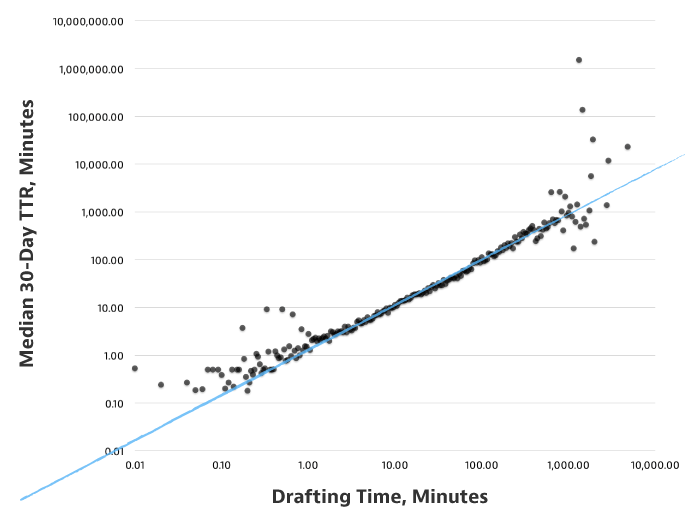
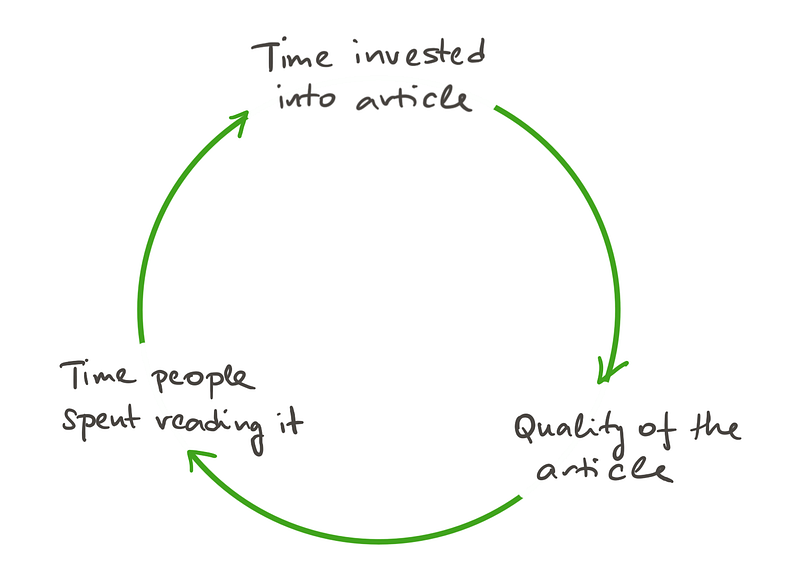
The more time you put in, the better the article becomes. The better the article becomes, the more time people will spend reading it.
The data proves my point…
According to Medium’s Datalab division, doubling the time spent drafting articles corresponds to an 89% increase in Total Time Read.
It’s another feedback loop:
To Create Blockbuster Articles, Think Like Warren Buffett
No matter how obvious or proven the blockbuster mental model is, following it is hard. Almost everyone I tell the approach to nods as if they get it. But very few people actually do the hard work.
And, I get it. Even as I write this article, I fear that all of the time and money I invested will not pan out. It’s scary to spend so much time on something that might be a complete dud.
Putting all of our eggs in a few baskets feels more risky than spreading them out. In other words, it feels less risky to write five mediocre articles than to write 1 blockbuster article.
But, the reality is that mediocrity is more risky.
So how do we train our minds to be OK swinging for the fences on each pitch?
I think we should think like investors, and more specifically like the best investor in history — Warren Buffett.
Early in his career, Buffett discovered the power of the blockbuster mental model and adopted the strategy of only making 1–2 investments per year. In other words, Buffett only swings at pitches when he thinks he can hit a homerun.
The following quote from Buffett captures the essence of how we can use the Blockbuster model:
“I could improve your ultimate financial welfare by giving you a ticket with only twenty slots in it so that you had twenty punches — representing all the investments that you got to make in a lifetime. And once you’d punched through the card, you couldn’t make any more investments at all. Under those rules, you’d really think carefully about what you did, and you’d be forced to load up on what you’d really thought about. So you’d do so much better.”
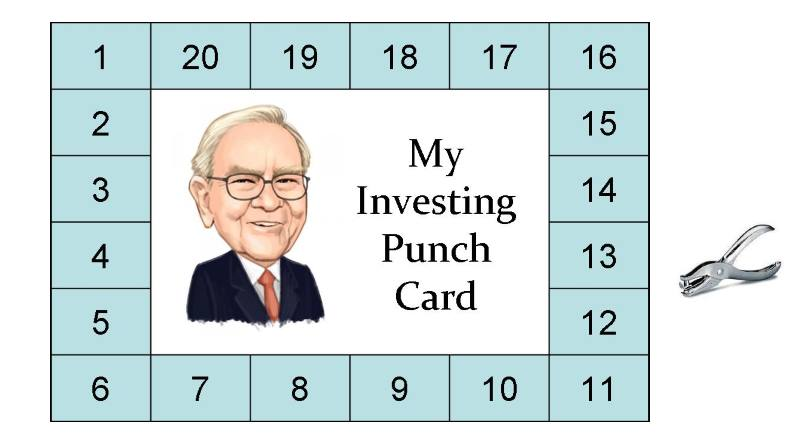
As a writer following the blockbuster mental model, I’m aware that I can only write 1–2 blockbuster articles per month. So, at the beginning, middle, and end of each article, I constantly ask myself and others, “Does this have the potential to be a blockbuster?” As a company, we’ve designed our whole process around that answer being yes!
We live in a media world with winner-take-all dynamics. In this world, a strategy that doesn’t maximize your chances for a home run is the most risky.
Now, if you see the power of the Blockbuster model, and you want to go viral consistently…
Over the last seven years, my team and I have spent hundreds of thousands of dollars and thousands of hours of time perfecting how we apply the blockbuster model to article writing.
To create this system, we studied the deeper patterns of blockbuster articles, hired some of the best writers and marketers in the world, and then tested everything with our own articles and our clients’ articles (we did over 4,000 tests in various niches).
The result? Apart from my own results (30M+ views), we’ve helped folks write articles that are viewed hundreds of thousands of times and published on top-tier websites like the Harvard Business Review, Fortune, Inc., Forbes, and TIME. One article alone even generated $100,000.
If you want to “copy and paste” our entire system — so you don’t have to learn from years of painful trial & error — this is your chance:
Our next small group, year-long, live coaching program will start on September 2023. I’ll be personally leading this cohort of coaches, consultants, entrepreneurs and other experts to help them break through the noise and build their audience online with blockbuster articles.
This is the last time I’m teaching a live cohort.
To learn more and apply, fill out this form.
If there’s a link to an Amazon book, it’s an affiliate link, which means I get a small amount of compensation when you buy the book. This compensation does not influence the specific books I recommend, as I only recommend books that I read and love.


