
COVID-19
Study Finds Cannabis Compounds Prevent Infection By Covid-19 Virus
But I have some bad news for marijuana enthusiasts
This recent article went viral last week and a lot of people suggested marijuana prevents COVID-19 from entering human cells. Unfortunately, this is not the case.
I’m sorry to disappoint the 4/20 lovers but I’ll explain why.
New Antiviral Drug
First of all, the findings of a new study led by Oregon State University were published in the Journal of Natural Products.
This study investigated if cannabinoids (hemp compounds) can block cellular entry of SARS-CoV-2 and the emerging variants.
Hemp (Cannabis sativa) is a source of fiber, food, and animal feed. Moreover, multiple hemp compounds and extracts are added to cosmetics, dietary supplements, and food.
Hemp refers to cannabis plants or materials derived thereof that contain 0.3% or less of the psychotropic tetrahydrocannabinol (THC) and typically have relatively high cannabidiol (CBD) content.
Van Breemen and colleagues identified hemp compounds via a novel chemical screening technique that shows the ability to prevent the virus causes COVID-19 from entering human cells.
The compounds are:
- cannabigerolic acid (CBGA)
- cannabidiolic acid(CBDA)
This pair of cannabinoid acids — produced by the hemp plant as precursors to CBG and CBA — bind to the SARS-CoV-2 spike protein, blocking a critical step in the process the virus uses to infect people.
“They are not controlled substances like THC, the psychoactive ingredient in marijuana, and have a good safety profile in humans.”
Van Breemen said.
“And our research showed the hemp compounds were equally effective against variants of SARS-CoV-2, including variant B.1.1.7, which was first detected in the United Kingdom, and variant B.1.351, first detected in South Africa.”
Those two variants are also known as the alpha and beta variants, respectively.
The spike protein is the same drug target used in COVID-19 vaccines and antibody therapy. Drug target means any molecule critical to the process a disease follows, meaning its disruption can thwart infection or disease progression
Any part of the replication and infection cycle is a potential target for antiviral interventions, in this case, CBGA and CBDA act as cell entry inhibitors.
This means these compounds bind to the spike proteins, present in virus particles, so those proteins can’t bind to the ACE2 receptor, present on the membrane of human cells in the lungs and other organs.
In the later research, lab tests showed CBGA and CBDA prevented human epithelial cells by the coronavirus spike protein and prevented the entry of SARS-CoV-2 into cells.
Van Breemen said:
“Resistant variants could still arise amid widespread use of cannabinoids but that the combination of vaccination and CBDA/CBGA treatment should make for a much more challenging environment for SARS-CoV-2.”
CBD
The findings of the antiviral mechanisms of hemp compounds are confirmed by another study, highlighting primarily CBD and its active metabolite 7-OH-CBD.
This preprint study is a preliminary report and needs to be peer-reviewed.
The findings of this study are:
- CBD can block SARS-CoV-2 infection at the early stages of infection
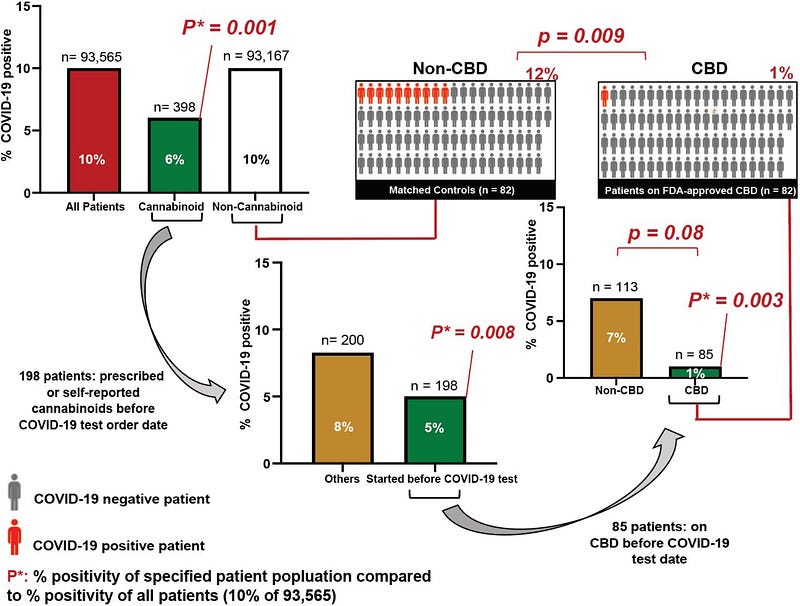
- CBD administration is associated with a lower risk of SARS-CoV-2 infection in humans
- The active compound is likely to be 7-OH-CBD, the same metabolite implicated in CBD treatment of epilepsy
- The reduction in SARS-CoV-2 infection risk of roughly an order of magnitude highlights the potential efficacy of CBD
- The ability of CBD to inhibit replication of mouse hepatitis virus (MHV) raises the possibility CBD may have efficacy against new pathogenic viruses arising in the future
CBD has a few mechanisms of action.
- CBD induces induction of the interferon pathway both directly and indirectly, following activation of the host immune response to the viral pathogen
Interestingly, interferons have been tested clinically as potential treatments for COVID-19.
- CBD also suppresses cytokine activation in response to viral infection, reducing the likelihood of immune cell recruitment and subsequent cytokine storms within the lungs and other affected tissues
These results complement previous findings suggesting CBD suppresses cytokine production in recruited immune cells such as macrophages.
Thus, CBD has the potential not to only act as an antiviral agent at the early stages of infection but also to protect the host against an overactive immune system at later stages.
The researchers suggest CBD has several advantages as a potential preventative agent against SARS-CoV-2.
- There are multiple means of ingestion, including the potential for inhalation and nasal delivery
- CBD blocks viral replication after entry into cells and, thus, is likely to be effective against viral variants with mutant spike proteins
- Unlike drugs such as remdesivir or antiviral antibodies, CBD administration does not require injection in hospital settings
- CBD is associated with only minor side effects
- Finally, CBD is widely available without restricted access if the content of THC is <0.3%
THC
Besides CBD, the researchers also analyzed other structurally related cannabinoid compounds:
- Cannabidiolic acid (CBDA)
- Cannabidivarin (CBDV)
- Cannabichromene (CBC)
- Cannabigerol (CBG)
- Tetrahydrocannabinol (THC)
“Remarkably, only CBD was a potent agent, while limited or no antiviral activity was exhibited by the structurally closely related congeners that share biosynthesis pathways and form the biogenetically determined residual complexity of CBD purified from C. sativa.”
So, only purified CBD can act as an antiviral agent if the THC content is < 0.3%. Unfortunately, this means marijuana — refers to C. Sativa materials with more than 0.3% THC by dry weight — can not act as an antiviral agent.
THC acts through binding to the cannabinoid receptor, and CBD potentiates this interaction. The authors stated:
“The purity of CBD and, in particular, the composition of the materials labelled as CBD are also important, especially in light of our findings suggesting that other cannabinoids such as THC might act to counter CBD antiviral efficacy. This essentially eliminates the feasibility of marijuana serving as an effective source of antiviral CBD, in addition to issues related to its legal status.”
Future studies need to explore the optimal means of CBD delivery to patients along with clinical trials will be needed to fully test the promise of CBD as a therapeutic to block SARS-CoV-2 infection.
Thank you for your interest in science! Feel free to put questions, comments, and suggestions for future articles in the comment section.
If you want to support:
- If you are not a Medium member yet, you can use my referral link so I can get a part of your fees from Medium, you don’t pay any extra.
- Subscribe to my Newsletter to get best tutorials, research, education, and scientific-based tools for everyday life directly in your email inbox.
While you’re here, check out one of my other articles.


