avatarRuben Bouma

Free AI web copilot to create summaries, insights and extended knowledge, download it at here

3647

Abstract

n-images-1.readmedium.com/v2/resize:fit:800/1*4m-9Lcbx2Yv6_j5hsJmQcg.png"><figcaption>KARE Treatment Protocol. From <a href="https://awaknlifesciences.com/phase-ii-a-b-results">Awakn Life Sciences</a>.</figcaption></figure><p id="826e">Analysis of the results revealed several interesting outcomes.</p><p id="cbac"><i>Primary outcomes</i></p><ul><li>The <b>first</b> group significantly increased abstinence over all other groups</li><li>The odds ratio of relapse was reduced with the KARE therapy</li></ul><p id="f64a"><i>Secondary outcomes</i></p><ul><li>Ketamine groups showed increased liver function across several markers</li><li>Ketamine groups saw reduced depression and anhedonia (inability to experience pleasure) at 3 months</li></ul><p id="1f0a"><i>Exploratory analysis</i></p><ul><li>Heavy drinking days were reduced in the KARE (first) group compared to all other groups</li></ul><p id="4682"><i>Safety</i></p><ul><li>Ketamine was well tolerated and had a good safety profile, adverse events were predominantly mild and only reported by 8/96 patients. No serious adverse events happened.</li></ul><p id="9817"><b>Primary outcomes</b></p><p id="89da">The findings demonstrated that ketamine combined with proprietary manualized therapy (KARE) resulted in total abstinence in 162 of 180 days in the following six-month period. This was an increase in abstinence from around 2% prior to the trial to 86% post-trial.</p><figure id="7e6b"><img src="https://cdn-images-1.readmedium.com/v2/resize:fit:800/1*zOBzESsa_gnSEKoC1I8t0A.jpeg"><figcaption>Percentage days abstinent across the four treatment conditions. From <a href="https://ajp.psychiatryonline.org/doi/10.1176/appi.ajp.2021.21030277">Grabksi et al., (2022)</a>.</figcaption></figure><p id="f8b6">Moreover, relapse results at 6 months showed that the ketamine plus KARE group’s risk of relapse was 2.67 times less than the placebo plus alcohol education group.</p><blockquote id="ae02"><p>“We found that controlled, low doses of ketamine combined with manualised psychological therapy can significantly increase post-treatment abstinence rates.”</p></blockquote><p id="13d1">Professor Morgan added.</p><blockquote id="75ce"><p>“This is extremely encouraging, as we normally see three out of four people returning to heavy drinking within six months of treatment. With the data we’ve collected from this study, along with emerging data from other studies of ketamine to treat AUD, they strongly suggest that further trials of this treatment are warranted.”</p></blockquote><h2 id="0ff5">Secondary outcomes</h2><p id="7045">The secondary outcomes also identified encouraging results.</p><p id="0104">These include improved liver function across several different markers and a statistically significant decrease in depression after 3 months and a decrease in anhedonia.</p><h2 id="f28a">Exploratory analysis</h2><p id="bb20">There were only 12 heavy drinking days in the KARE (first)group at the 6-month follow-up. This is a steep reduction compared to other trials.</p><p id="4b41">There was also a 10-fold decrease in the risk of mortality. 1 in 8 patients would have died within 12 months without treatment, a number which decreased to 1 in 80 following the treatment.</p> <figure id="856a"> <div> <div> <img class="ratio" src="http://placehold.it/16x9"> <iframe class="" src="https://cdn.embedly.com/widgets/media.html?src=https%3A%2F%2Fwww.youtube.com%2Fembed%2F5kgaLay-xJA%3Fstart%3D93%26feature%3Doembed%26start%3D93&amp;display_name=YouTube&amp;url=https%3A%2F%2Fwww.youtube.com%2Fwatch%3Fv%3D5kgaLay-xJA&

Options

image=https%3A%2F%2Fi.ytimg.com%2Fvi%2F5kgaLay-xJA%2Fhqdefault.jpg&key=a19fcc184b9711e1b4764040d3dc5c07&type=text%2Fhtml&schema=youtube" allowfullscreen="" frameborder="0" height="480" width="854"> </div> </div> </figure></iframe></div></div></figure><h2 id="b624">Conclusion</h2><p id="3c1d">In short, the trial demonstrated that 3 subanesthetic infusions of ketamine support abstinence from alcohol. Moreover, abstinence may be further enhanced when ketamine treatment is combined with therapy.</p><p id="ef3d"><a href="https://www.nature.com/articles/mp2016122">Neurotrophic</a>, <a href="https://academic.oup.com/scan/article/11/8/1227/2413794">modulatory</a>, and even <a href="https://www.sciencedirect.com/science/article/abs/pii/S016503271400055X?via%3Dihub">psychological</a> mechanisms have all been proposed to account for the sustained antidepressant effect of a single dose of ketamine. Hence, these downstream effects on diverse neural circuits may have relevance to addiction treatment as well.</p><blockquote id="d81a"><p>“We are so pleased to see such encouraging results in an area of treatment that has been stagnant for so long, leaving so many people with little or sub-par options available to them.”</p></blockquote><p id="c5bd">Anthony Tennyson, Awakn’s chief executive, commented.</p><blockquote id="e1b2"><p>“We will continue to support this research and future clinical trials as we push to bring a radical shift in the alcohol addiction treatment industry.”</p></blockquote><p id="4a6d">Thank you for your interest in science! Feel free to put questions, comments, and suggestions for future articles in the comment section.</p><p id="f760"><b>If you want to support:</b></p><ul><li>If you are not a <b>Medium</b> member yet, you can <a href="https://r-bouma98.medium.com/membership"><b>my referral link</b></a><b> </b>so I can get a part of your fees from <b>Medium</b>, you don’t pay any extra.</li><li>Subscribe to <a href="https://r-bouma98.medium.com/subscribe"><b>my Newsletter</b></a><b> </b>to get best tutorials, research, education, and scientific-based tools for everyday life directly in your email inbox.</li></ul><p id="54c7">While you’re here, check out one of my other articles.</p><div id="b81f" class="link-block"> <a href="https://readmedium.com/safety-of-group-psychedelic-sessions-confirmed-by-psilocybin-clinical-trial-76bc9dcf90e5"> <div> <div> <h2>Safety of Group Psychedelic Sessions Confirmed by Psilocybin Clinical Trial</h2> <div><h3>New psilocybin trial data explores group psychedelic sessions.</h3></div> <div><p>medium.com</p></div> </div> <div> <div style="background-image: url(https://miro.readmedium.com/v2/resize:fit:320/0*ZagEx_o6Sj-soIbF.jpg)"></div> </div> </div> </a> </div><div id="4916" class="link-block"> <a href="https://readmedium.com/dmt-the-spirit-molecule-that-keeps-amazing-us-d8ebd2dea220"> <div> <div> <h2>DMT: The Spirit Molecule That Keeps Amazing Us</h2> <div><h3>Research suggests that this powerful psychoactive chemical could be produced within our brains.</h3></div> <div><p>medium.com</p></div> </div> <div> <div style="background-image: url(https://miro.readmedium.com/v2/resize:fit:320/1*mnU5IoJdyw05DM1XmMGwtA.jpeg)"></div> </div> </div> </a> </div></article></body>

Ketamine-Assisted Therapy for Alcohol Addiction Could Save Lives

Findings from the world’s first controlled study exploring the use of ketamine-assisted psychotherapy for alcohol addiction has shown positive results
Photo by Marco Verch via Flickr

Results from the Awakn Life Sciences’ Phase IIa/b study investigating ketamine-assisted therapy for the treatment of alcohol use disorder (AUD) have shown 86% abstinence for six months following treatment. According to the study’s lead author, the therapy has the potential to save lives.

The double-blind placebo-controlled clinical trial, which included 96 patients with severe AUD. The primary and secondary endpoints of the trials were days abstinent and relapse at six-month follow-up.

The study’s results have been published in the American Journal of Psychiatry.

Psychopharmacology professor Celia Morgan, who led the trial conducted by the University of Exeter, said:

“Alcohol Use Disorder is pervasive and persistent public health issue, affecting at least 390 million people globally. Treatment rates are low and relapse rates post-treatment tend to be high. We urgently need new and more effective treatments.

Ketamine

Ketamine is a dissociative anesthetic drug that acts on the central nervous system chiefly through antagonism of the N-methyl-D-aspartate receptor. Therefore, ketamine is a promising candidate therapy in AUD for several reasons.

  • Substantial evidence supports the rapid-acting antidepressant properties of subanesthetic doses of ketamine
  • Ketamine might aid alcohol abstinence by providing a window during which psychological therapies can be more effective via increased synaptogenesis and neurogenesis, known to be disrupted with addiction
  • Several studies have directly investigated the effect of ketamine on patients with problematic alcohol use and revealed promising results

Study findings

Participants in the trial were randomized into four groups.

  • First group, three ketamine infusions plus KARE
  • Second group, three saline infusions plus KARE
  • Third group, three ketamine infusions plus alcohol education
  • Fourth group, three saline infusions plus alcohol education.
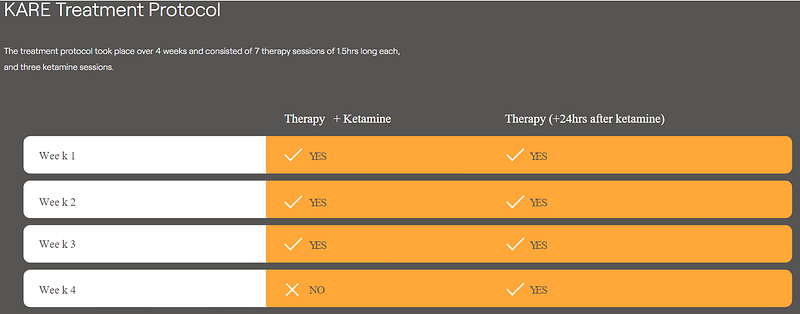
KARE Treatment Protocol. From Awakn Life Sciences.

Analysis of the results revealed several interesting outcomes.

Primary outcomes

  • The first group significantly increased abstinence over all other groups
  • The odds ratio of relapse was reduced with the KARE therapy

Secondary outcomes

  • Ketamine groups showed increased liver function across several markers
  • Ketamine groups saw reduced depression and anhedonia (inability to experience pleasure) at 3 months

Exploratory analysis

  • Heavy drinking days were reduced in the KARE (first) group compared to all other groups

Safety

  • Ketamine was well tolerated and had a good safety profile, adverse events were predominantly mild and only reported by 8/96 patients. No serious adverse events happened.

Primary outcomes

The findings demonstrated that ketamine combined with proprietary manualized therapy (KARE) resulted in total abstinence in 162 of 180 days in the following six-month period. This was an increase in abstinence from around 2% prior to the trial to 86% post-trial.
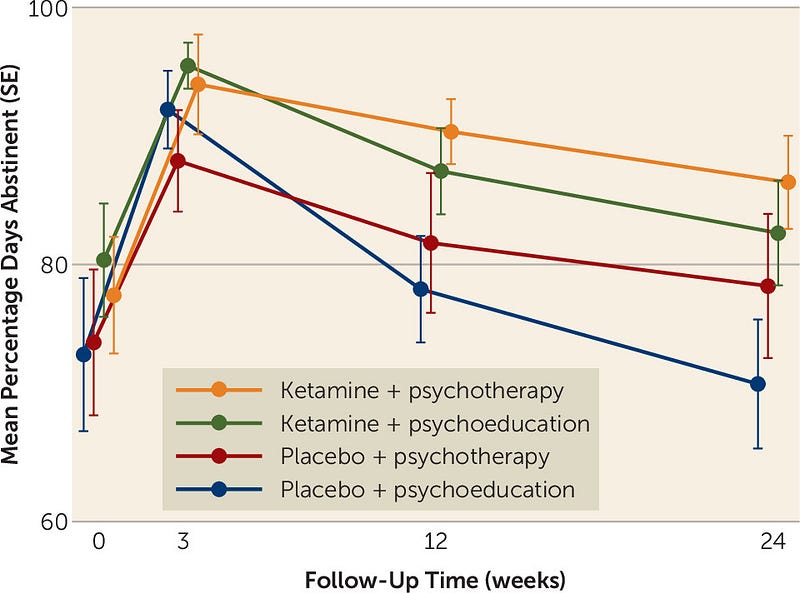
Percentage days abstinent across the four treatment conditions. From Grabksi et al., (2022).

Moreover, relapse results at 6 months showed that the ketamine plus KARE group’s risk of relapse was 2.67 times less than the placebo plus alcohol education group.

“We found that controlled, low doses of ketamine combined with manualised psychological therapy can significantly increase post-treatment abstinence rates.”

Professor Morgan added.

“This is extremely encouraging, as we normally see three out of four people returning to heavy drinking within six months of treatment. With the data we’ve collected from this study, along with emerging data from other studies of ketamine to treat AUD, they strongly suggest that further trials of this treatment are warranted.”

Secondary outcomes

The secondary outcomes also identified encouraging results.

These include improved liver function across several different markers and a statistically significant decrease in depression after 3 months and a decrease in anhedonia.

Exploratory analysis

There were only 12 heavy drinking days in the KARE (first)group at the 6-month follow-up. This is a steep reduction compared to other trials.

There was also a 10-fold decrease in the risk of mortality. 1 in 8 patients would have died within 12 months without treatment, a number which decreased to 1 in 80 following the treatment.

Conclusion

In short, the trial demonstrated that 3 subanesthetic infusions of ketamine support abstinence from alcohol. Moreover, abstinence may be further enhanced when ketamine treatment is combined with therapy.

Neurotrophic, modulatory, and even psychological mechanisms have all been proposed to account for the sustained antidepressant effect of a single dose of ketamine. Hence, these downstream effects on diverse neural circuits may have relevance to addiction treatment as well.

“We are so pleased to see such encouraging results in an area of treatment that has been stagnant for so long, leaving so many people with little or sub-par options available to them.”

Anthony Tennyson, Awakn’s chief executive, commented.

“We will continue to support this research and future clinical trials as we push to bring a radical shift in the alcohol addiction treatment industry.”

Thank you for your interest in science! Feel free to put questions, comments, and suggestions for future articles in the comment section.

If you want to support:

  • If you are not a Medium member yet, you can my referral link so I can get a part of your fees from Medium, you don’t pay any extra.
  • Subscribe to my Newsletter to get best tutorials, research, education, and scientific-based tools for everyday life directly in your email inbox.

While you’re here, check out one of my other articles.

Psychedelics
Health
Self Improvement
Mental Health
Addiction
Recommended from ReadMedium