
Struggling to Make Your First Online Course?
7 proven steps to conquer your fears & make successful online courses
Sweat trickled down my pants.
Who the f*ck am I to teach? I only started outsourcing this year. Other people are more qualified.
Doubts flooded my brain as I sat in front of the laptop. I stared into the camera but the words wouldn’t come out.
This is the stuff you don’t see. The struggles, the turmoil. The less glitzy side to course creation. Even now — nine courses and $500 a month later — I face these fears.
It has gotten easier, though. When you make your first sale, you get a shot of confidence. I can do this. I can make money online.
You’ve done it once and you can do it again.
If you’re struggling to make your first online course, here are 7 proven steps to help conquer your fears.
They work for me. They may work for you too.
#1: Choose Your Topic
Getting this right is 80% of the game.
What would you feel comfortable talking to a stranger about on a two-hour flight?
This could be the topic for you.
If you’re not sure, ask your friends and family. You may have a skill you don’t even recognise.
Here’s the thing. You don’t need to be an expert. You just need to be further ahead than your target course-taker.
If you’re only a little further along, this can be a strength. Those far ahead forget what it’s like to start from scratch.
Once you’ve got a few ideas, look around. Has your topic been taught before? I host my courses on Udemy and Skillshare, so this is where I look.
If your topic has been taught before, how can you do it better? Are there details they’ve missed?
In my case, most outsourcing courses didn’t have resources. They were also complicated. I simplified the process and created documents.
#2: Keep It Simple
My tech consists of a laptop and a Blue Yeti mic.
That’s it.
If you’re going to invest in anything, make it a mic. Sound is king. Otherwise, a few well-placed lamps will do the trick.
As long as you’re providing value, people are forgiving.
Screencast-O-Matic is the software I use to record my videos. (Google it.) When it comes to editing, I use Free Movie Maker which came with my laptop.
For my next online course, I’m using Camtasia. It’s a more fancy version of Screencast-O-Matic. The only reason I’m using it is that I get it for free with Zero to Mastery.
Let me repeat: fancy isn’t necessary.
#3: Mess up Often & Quickly
“F*ck!”
I mess up a lot. If only you saw my outtakes.
This is normal. I’ve spoken to experienced course creators who mess up all the time.
Don’t believe me? Watch Ali Abdaal’s editing course on Skillshare: Editing with Final Cut Pro X — From Beginner to YouTuber.
Start at video eight.
You’ll see.
#4: Imagine You’re Having a Conversation With a Friend
I treat recording like Zoom calls.
It’s a conversation where I’m the only one speaking. This is okay. I’m speaking with a friend.
It sounds silly but it’s surprisingly effective.
#5: Record in Private
Take the pressure off as much as you can.
You don’t want to increase it by recording somewhere public. Where someone could barge in mid-sentence.
Talking to yourself will feel strange enough without the fear of looking weird.
Record in private where you won’t be disturbed.
#6: Zero Time Pressure
Give yourself a full morning/afternoon to record videos.
Don’t do it in small bites. 20–30 minutes might not be long enough for a video, even if it’s five minutes long.
For your first course, you’ll feel nervous. Don’t rush the process. Give yourself time.
Time pressure works in exams — not video-recording.
#7: Accept It Won’t Be Great
No one gets it perfect the first time.
The recording of my first course was a shambles. It was bloated and anemic. I had to re-do the whole thing.
Produce, improve, repeat.
The Benefits of Creating Online Courses
Making money is an obvious benefit. It’s the reason I started. However, there are others.
Collaboration Opportunities
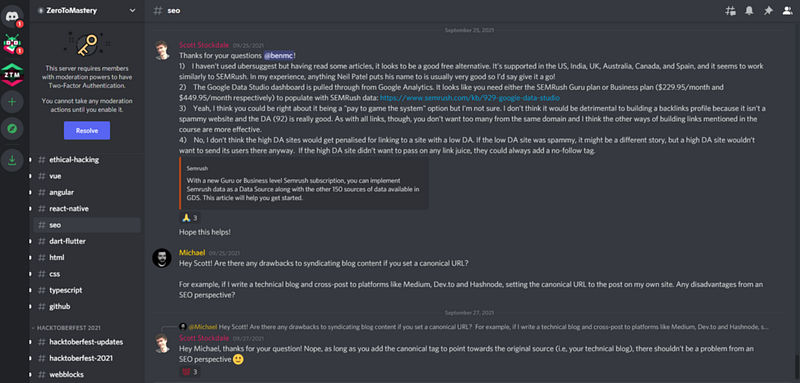
I’ve co-created three courses to date, and I’m working on a fourth. The most recent is an SEO course with Zero to Mastery — a global academy of 500,000+ developers.
(NB: This is an affiliate link.)
The head of product found my courses on Udemy. He said he was impressed by my teaching and wanted to collaborate.
Our first course went live in September and made $436 in its first month.
Punchline?
Creating online courses can lead to unexpected opportunities.
Improving Communication Skills
I kept hearing “erm”.
Fillers are a pain to edit, and I wanted to make it easier. This is one of the reasons my conversation skills have improved.
If you’re trying to explain something, you also need to know the topic. Not just know, but really know. If I hesitate during a recording, it’s a sign I don’t know what I’m talking about.
Filming videos for courses forces me to learn more. I have to go deeper.
Delivering Value
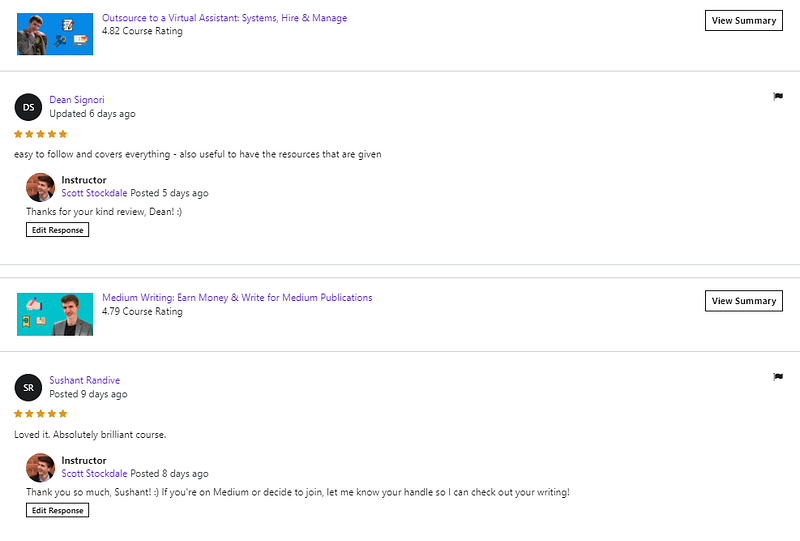
I receive kind reviews on a regular basis, with people thanking me for my courses.
It never gets old.
Takeaways
Online courses have changed my life.
They generate income as I sleep, and they’ve given me the opportunity to connect with people from all over the world.
Here are 7 proven steps that have helped:
#1: Choose your topic. This is 80% of the game.
#2: Keep it simple. You don’t need fancy equipment. It’s a distraction.
#3: Mess up often & quickly. I do all the time.
#4: Imagine you’re having a conversation with a friend. There’s nothing to be scared of.
#5: Record in private. Talking to yourself feels strange enough without other people listening in.
#6: Zero time pressure. This isn’t a test.
#7: Accept it won’t be great. No one gets it perfect on their first go.
One of my goals for 2022 is to make $5,000 a month from online courses. If you want a course-creation roadmap, check out these articles: