
Stop What You’re Doing and Start Investing Right Now
Income doesn't equal wealth — here’s how to get wealthy regardless of how much money you make.

(I am not a licensed Financial Advisor. Please conduct your own due diligence and consult a professional before investing in volatile assets.)
Table of Contents ∘ Introduction
∘ Step 1: Calculate Your Monthly Expenses
∘ Step 2: Where to Keep Your Savings
∘ Step 3: Repeat!
∘ How to Increase Your Savings Rate
∘ Final ThoughtsEveryone wants to be comfortable financially, but many do not understand how to get away from living paycheck to paycheck and are instead stuck in a never-ending cycle of working, paying their bills, and spending whatever little they have left.
Whether you have an exorbitant 6-figure salary or you are making minimum wage, if you do not understand your finances and fail to plan for the future, you will never break that cycle.
If you haven’t gotten there yet, you are not alone. In fact, a survey by tech company Highland Solutions indicates that nearly 63% of American adults are living paycheck to paycheck.
It is necessary for everyone to set aside a portion of their income to save, invest, or otherwise keep set aside for themselves down the road. By building up this “money reserve,” we essentially create a safety net for our income.
More specifically, it guarantees a baseline level of wealth in case someone loses their job, decides to retire, or otherwise experiences a sudden drop in income.
In the long term, the goal of saving these vast amounts of wealth is to reach a point where we can pull a portion of our savings each year to substitute, or at least supplement, our income, a.k.a retirement.
Luckily, creating a financial plan is easier than most people think and just requires some meticulous planning. I’m going to take you step-by-step through making a thorough plan to reach all of your financial goals.
Step 1: Calculate Your Monthly Expenses
When beginning to think about saving, the first goal that should be in mind is to start saving something. No matter how little you can put aside, it’s critical to start compounding your money and building the right financial habits.
The first step to this is finding out exactly how much of your monthly income you are spending.
This is pretty simple, but it might take a while. You’ll have to go through your bank statements and figure out exactly what you are spending your money on.
Try to include all of your expenses, not leaving anything out. The key to this is being honest with yourself. For example, are you really going to stop buying coffee from Starbucks or Dunkin? Maybe for a little.
Don’t try to start cutting certain items from your expenses yet. You don’t know if it’s sustainable, so it’s better to account for your current spending habits.
Step 2: Where to Keep Your Savings
If you have already found some spare cash from your monthly income that you have decided to save each month, good job! If not, it's perfectly fine; just keep reading until the end.
It’s time to start saving that money each and every month. Make sure to automate the transfer through your bank so that you never have to see the money in your checking account.
Now, the question is what to do with the money you want to save. There are a few options, and I’ll go over each one in-depth.
Emergency Funds:
Emergency funds are just what they sound like: an account set up to hold your money in case of an emergency. Whether you’re laid off, injured, have a car accident, or anything else, the purpose of an emergency fund is to cover your living expenses while you are out of work.
Most advisors recommend that people aim to save up to six months of their living expenses in an emergency fund. However, I think that it’s better to save for one to two years. In light of the pandemic, it has become abundantly clear that there are times where people may be unemployed for substantially longer than just six months.
I wouldn’t recommend aggressively saving money to reach your target in your emergency fund. Instead, you should take around half of your disposable income for the month and dump it here.
With the other half, invest it into appreciating assets which will give you a consistent, low-risk ROI.
The Stock Market:
The stock market is by far my favorite investment tool. By buying “shares” of a company, you essentially own a tiny fraction of the equity of that business. As a result, if the company’s valuation grows, so does the value of your equity.
However, it’s time-consuming to constantly research stocks. Luckily, there are what are known as “Exchange Traded Funds,” or ETFs, to help you out. ETFs are a compilation of shares from different companies, meaning that when you invest in an ETF, you are investing in a pre-built portfolio of companies.
You can choose funds that track entire indices, different industries or choose funds that target low volatility, high growth, etc. The point is, there’s a ton of options.
These ETFs lower your risk in the stock market by mitigating the volatility of individual companies’ share prices.
What I would consider the safest investment for those looking to make investing as passive as possible has to be a fund that tracks the S&P 500. The S&P 500 is a price index meant to gauge the overall health of the stock market, composed of the top 500 valued American companies.
The S&P has returned an average of around 7% annually, adjusted for inflation.
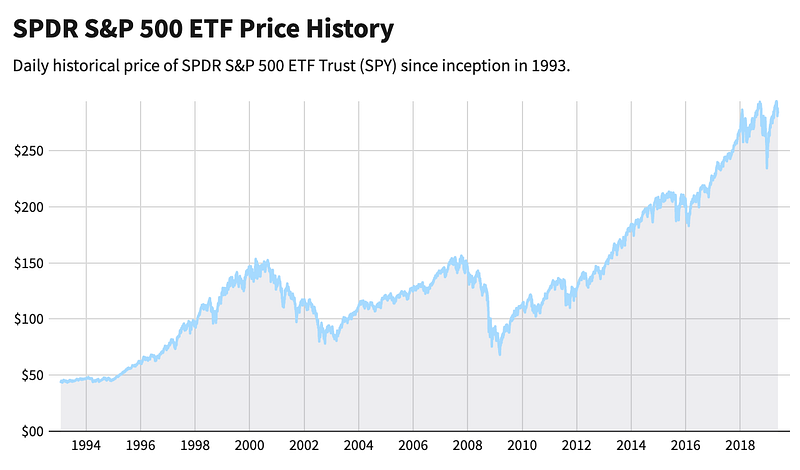
This is the best asset return you are ever going to get for the amount of work you have to do. Whereas typically, investing in assets that may or may not even return 10% annually takes hours of research whether it's on the best stocks to buy, buying the best properties, or building a successful business; investing in a passive S&P 500 fund requires absolutely zero research, and takes minutes to actually execute.
To invest in one of these funds, you just need your own brokerage account, which, if you don't have one already, only takes minutes to set up and is almost always free to open and operate.
When you are ready to invest in one of these funds, the ticker symbols for some of the common ones are:
- $SPY- SPDR S&P 500 ETF Trust
- $VOO- Vanguard 500 Index Fund ETF
These 2 S&P funds are by far the most common and are virtually identical. The choice is up to you as to which one you will invest your money into.
Step 3: Repeat!
At this point, you are pretty much set. Now you just need to determine your long-term financial goals and calculate how much money you need to accumulate in order to execute them.
Then, you’re on autopilot to whatever your endgame is. As long as you are able to hit your monthly savings target month after month, you will get there.
If you are not fiscally able to save enough money to reach these goals, here’s how to fix that:
How to Increase Your Savings Rate
While many people tend to overcomplicate the subject, there are only two fundamental ways to increase your savings.
First: Cutting Your Monthly Expenses
There’s no easy way around this. It’s impossible to save more money with a constant income without reducing how much you are spending.
Everyone’s financial situation is different, so I’ll do my best to make a simple list that should highlight some areas where most people can save some money:
- Car Insurance
- Food and Drinks (Buy more groceries, eat out less)
- Monthly Subscriptions (You don’t need a subscription to Disney+, Netflix, HBO Max, Hulu, and Prime Video)
- Cable TV
- Clothes Shopping
I hope that something on this list helps you out and that you have found some area of your finances where you could be spending less. If so, congrats!
However, there still is another option available to you.
Second: Raising Your Income
Raising your income is probably the most difficult thing to do in this entire article, but like all things, with enough hard work and time, it is definitely possible.
There are multiple avenues to pursue when looking to increase your pay. You could go the traditional route and ask for a promotion at your job, or you can explore the endless stream of different part-time jobs and side hustles.
Some of these include:
- Driving for a mobile app (Uber, Doordash, etc.)
- Freelancing
- Opening an e-commerce store (Shopify, Amazon FBA, etc.)
- Content Creation (Medium, Youtube, etc.)
- Reselling hot commodities (Shoes, Gaming Consoles, etc.)
- Social Media Marketing for Small Businesses
- Day Trading
Nowadays, anything you are passionate about and interested in can make you money online. However, it often requires you to generate immense traffic on a webpage. This is incredibly difficult and often takes years to build, but many people have earned enormous sums of money by creating an online presence.
In fact, I am looking to start my own Shopify e-commerce store in the near future to add another revenue stream to the mix. (But that’s a story for a different day)
Regardless, it is 100% possible to grow your income by engaging in different side hustles and if you are looking to save more money you should definitely give something in the list above a try.

Even though both of these fixes are much easier said than done, they are 100% possible if you are willing to dedicate enough time and effort. Especially after working on raising your income over the span of years, it will start to pay off eventually, and you will begin to reap the rewards.
Final Thoughts
While saving enough money to either fully or partially retire is a mammoth task, it is possible to build a financial pathway that will guide you towards your goals on autopilot with enough careful planning and hard work.
Even for those who currently lack the income to save the amount of money necessary to hit their financial goals, with enough dedication (ex: taking part-time jobs, learning about different assets to safely make more profitable investments), your goals are within reach.
As long as you are committed to lifelong learning, there is an endless array of income streams at your disposal.
I wish you the best of luck in all of your financial endeavors.
If you found this piece interesting and/or informative, please be sure to leave your feedback. Also, here are some other articles you will definitely enjoy: