
The Myth That is Ruining Your Stock Portfolio
Diversifying your investments to reduce risk is probably holding back your profits in the stock market.

Before I begin, let me make one thing very clear. I am a proponent of diversification; I believe it plays a critical role in minimizing your risk in the stock market, and I use it in my own portfolio. Diversification is one of the most fundamental, basic, and praised investment principles used by just about every investor ever.
The problem lies in that many individuals do not understand how to diversify efficiently and are destroying their total returns by over-diversifying.
In principle, diversification makes a ton of sense. Diversify your investments as much as possible to reduce the potential losses which would occur if one of your investments tanked.
However, diversification does not mean owning shares in 20+ companies and always researching the next company to invest your next paycheck into.
Chances are, you aren’t an expert stock picker like Warren Buffet or Cathy Wood. Especially for someone who invests as a hobby or side job, this means that you will more than likely fail to correctly pick even 10 different companies which all outperform the market or even perform at the market’s average for an extended time period.
If you are trying to build wealth safely, you are likely better off picking your favorite 5 or 6 large-cap growth companies while investing the majority of your savings into broad market index funds like $SPY. These funds invest your money into a portfolio that attempts to track the stock market's performance as a whole.
There are a few factors that go into why you would do this.
First: The S&P 500 is the Only Diversification Tool You Will Ever Need
Why would you waste your time and energy picking individual stocks to diversify when there are simple tools you can use to do just that?
Inherently, each different company you choose to invest in adds more unnecessary risk to your portfolio. With every company you invest in, you run the risk that said company will lose you money.
However, the S&P 500 tracks the performance of the largest 500 companies in the stock market, effectively reducing your risk by diversifying you throughout the biggest companies in each sector of the market without the risks of holding each company.
Historically, this has been an excellent bet. Since the inception of its current portfolio structure in 1957 (before 1957, the index only held 90 companies), the S&P has an annualized average return of about 8%. The rapid growth of big business as of late has increased this return even more: in the last 30 years, the S&P averaged around 9.4%/year.
In reality, this means that every $1 invested in an S&P index fund like $SPY during 1991 would be worth about $16.20 today, not adjusted for inflation.
By pretty much every metric, this is an amazing return in the stock market. This is why individually picking stocks is almost certainly unnecessary for most investors and definitely unnecessary for individuals who only invest to protect their wealth.
This leads me to my next point.
Second: Beating The Market Consistently is Pretty Much Impossible
Top hedge fund managers have extensively studied the stock market for decades to get where they are today. As such, they likely know significantly more about the market than you do.
Unfortunately, not even these experts can outperform the S&P over an extended duration. For example, in 2008, Warren Buffet placed a bet with the CEO of Protégé Partners LLC, a hedge fund that manages almost $3 billion in assets, on the premise that Protégé could not beat the market index over 10 years.
Over those years, the S&P 500 gained an average of 7.1%/year, compared to Protégé’s return of just 2.2% annualized.
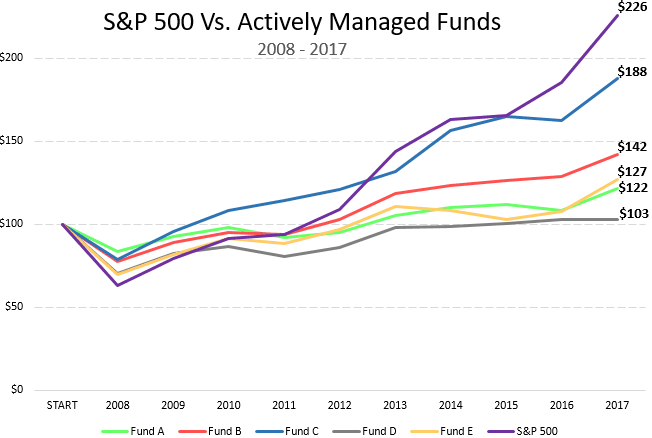
My theory as to why some of the best stock pickers in the world cannot outperform the market is twofold. (I’m probably simplifying)
- Hedge Funds chase short-term growth to please investors. As a result, the majority of their assets are placed in the fastest growing companies and sectors. This typically leads them to significant growth in the fund’s first few years, then to underperform the market in the long term as these stocks’ growth reverts to the mean.
- Although all major business industries tend to grow at around the same rate in the long term, the rate at which each sector grows each year varies dramatically. Because of this, it is usually difficult for hedge funds to predict the winning companies and sectors on a year-by-year basis (hence why diversification is important). The S&P index accounts for this by holding the largest companies in every single sector of the market.
Regardless of the reason why, if these hedge funds cannot outperform the market in the long term, you probably can’t either.
Even if you were theoretically smart and/or lucky enough to beat the market consistently while diversified over various companies in different sectors, it would only reduce the concentration of equity in your favorite and best picks while also adding unnecessary risk.
This brings me to my final point.
Third: Diversification is for Protecting Wealth, Not Building It
If you are someone who is okay with taking risks in order to build a significant sum of wealth, diversification shouldn’t have been your goal in the first place.
Diversification fundamentally reduces your maximum return because as you buy more shares in more companies, you reduce the concentration of your best-performing holdings.
For example, if you invested $10,000 evenly among 10 companies and one of your holdings gained 20%, you would only make $200 profit. However, if you had only spread your investment among 5 different companies, your profit would have doubled.
Investors should not dilute their best holdings in the name of diversification. This only induces more risk while diminishing profits.
These reasons are why I recommend that to build wealth in the stock market without exposing your money to unnecessary risk, a portfolio mostly split between the S&P 500 and large-cap growth stocks is the best option.
As mentioned above, the S&P 500 is capable of delivering all of the diversification you need and is also one of the safest investments in the stock market. Thus, this is where the majority of your wealth should be locked up to safely grow in value.
As for individual stocks, if you are not interested in thoroughly evaluating companies on a weekly or monthly basis, I would suggest just sticking with the S&P. Beating the market is an insanely hard task for people who are not willing or interested enough to do the work.
However, if you are interested in picking your own stocks, large-cap growth companies are the way to go, in my opinion.
The large-cap growth tag designates companies valued at over $10 billion who expect the fastest growth in terms of earnings, sales, and cash flow.
While they aren’t immune, these companies tend to be much less prone to significant, long-term downturns due to their size and market influence while still offering a significant return on your investment.
Although these stocks tend to experience significantly more volatility than their other large-cap counterparts, I am willing to ride the lower lows in return for higher highs. Additionally, I would argue that higher volatility only grants investors more opportunities to lower their cost basis in the fastest growing companies as long as it is played correctly.
I hope this article teaches you the dangers of holding shares in too many companies and gives you the tools to boost your returns.
The stock market has the potential to be a life-changing wealth-building tool, and it’s my goal to make sure that everyone is able to use it as such.
If you found this piece interesting and/or informative, please be sure to leave your feedback. Here are some other articles you will definitely enjoy: