
Stop Checking Off that Diversity Box
Ask yourself first, are you really diverse?

Picture this.
In front of us is a white-looking guy. He is able-bodied. He introduces himself as John, tells you he was born and raised in New York. He speaks English fluently with no hint of an accent. He attended a combination of public and private schools, studied at a university in the vicinity, obtained his bachelor's degree, and works at a global consulting firm.
He has had the average opportunities as anyone else, he was raised in a loving home, has heterosexual parents, privileged to have never worried about food, education, money or family support. A ‘normal’ New Yorker.
Would you view this individual as a diverse candidate? Would you tick the box of ‘diversity’ as you consider him for promotions? Understanding each of us is a collection of experiences, let’s just keep it simple here though and stick with these facts as a basis.
Do you have your answer in mind? Okay good.
Now let me give you two more pieces of information.
- He has a Muslim background.
- His second language is Arabic, which he speaks at home with his parents.
Now, I ask you, do you view John as a diverse candidate?
Did your response change?
Should it?
To be honest, I do not know the right answer. I know it will be controversial to argue both angles of this sensitive topic. Luckily [I think?], I am willing to take this risk.
After all, I am an Arab woman. I am diverse.
Aren’t I?
No, John is not diverse. He does not belong in the ‘diversity’ bucket.

What is a diverse candidate? Or, let me phrase this differently, why do we want to support diverse candidates?
One clear answer is: for equity.
Equity is to ensure everyone has access to the same opportunities. Irrespective of where they started from.
I have always loved this image as an illustration of equity.
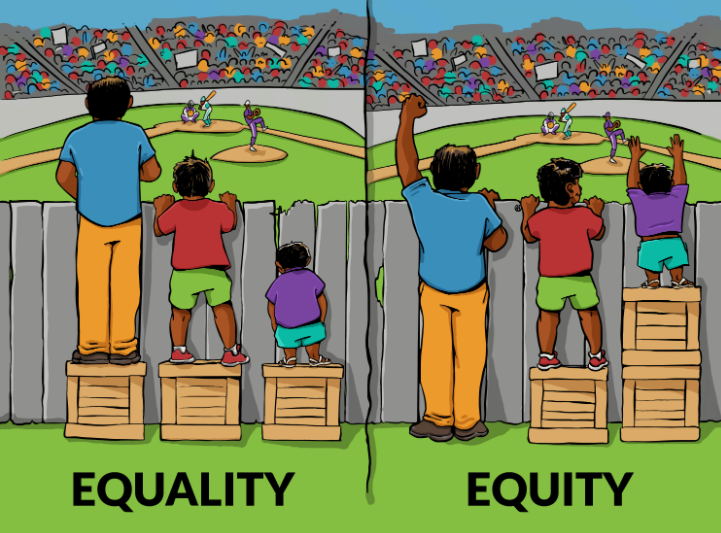
Equity does not mean to give the same opportunities, i.e. # of boxes, to everyone. Equity is to allow everyone to access to the same opportunities, i.e. view and enjoyment, by giving the # of boxes each person needs to get them there. To have an equal chance to view and enjoy the game. Or equal chance at getting the job opportunity, school admission, or healthcare.
Equity recognizes that advantages and barriers exist, we don’t all start from the same place. It begins by acknowledging unequal starting places, and makes a commitment to correct and address the imbalance. — Blog.
In our example, John appears to have access to the same boxes as the ‘average white male’. John’s home environment does not appear to put him at a disadvantage, John had access to average education levels, and John looks like and appears to be an average white guy.
Note I am making a conscious effort at using the term ‘appears to be’. I acknowledge we will never have full knowledge of each individual’s invisible diversities. This however applies to every single one of us.
Using the above as a basis, it would appear John would not qualify as a diverse candidate;
- John likely did not have to deal with the inequity of a guy of a similar background whose name is, say, Mohammed. In looking at hiring processes, a study found that candidates with “white” names, i.e. one similar to John, were 50% more likely to be selected for a first interview.
- John was unlikely to be treated differently by his appearance, despite being of Muslim Arab background, given he appears to be a white guy.
The Maverick Files shares a good definition of diversity hiring in his article.
It is difficult to argue that John would have had a problem being hired fairly, that John would need to be given a ‘leg up’. Or that his situation would be akin to one of a black man — very visibly diverse.
This would be my argument to “no, he is not a diverse candidate”.
The process of identification of diverse candidates is intended to give the ‘advantage’, or more accurately, mitigate the disadvantage, which comes from the unfair disadvantage one has due to their background. This would be an unfair advantage to be given to John.
Yes, John is diverse. Slot him into that diversity bucket.

On the other hand, let’s look at the goal of having a diverse community.
It is true, we select diverse candidates to ensure all candidates are provided equitable access to opportunities presented.
However, there is another key advantage and product of diversity — the diversity of thought and of leadership styles. The acceleration of growth it presents. Having a group of individuals with a variant set of mental backgrounds is crucial to creating an inclusive environment at work.
Multiple perspectives and experiences expand a group’s range of understanding & methods. At the organizational systems level, diversity of thought is fundamental to the value proposition — Susan Woods, Thinking about Diversity
In our example, John did attend schools and receive an education akin to an average white male. He also grew up in a Muslim household, speaking Arabic at home. What this provides John is a different lens and perspective than an individual who grew up in an English-speaking non-muslim environment.
As a team member and a leader, John might be able to connect with others in a different way. John’s ability to speak a second native language allows him access to a different cultural experience, an understanding of cultural norms which others might not have. It can allow for new ideas within a team, or vary leadership methods.
In this case, I would say John should be considered a diverse candidate.
Allowing John the ‘advantage’ of being diverse, might be encouraging a more diverse-of-thought team.
In Conclusion?
I do not necessarily intend to make up your mind one way or another.
It is true I am an arab woman, I am also racially-ambiguous in that I have a fair mediterranean complexion and speak English as a first language.
Hence the question.
What I did intend out of this article, is to ensure we question our diversity decisions — that we do not automatically check someone as diverse because their last name is non-white-sounding, or automatically check one as non-diverse because they look and sound like a white male.
There is more to diversity than meets the eye.