
Stop Being a Pushover and Stand Up for Yourself
A detailed guide to how I prepared to volley verbal insults.

I was naturally shy and awkward in public gatherings. As you can guess, bullies love this type. If I heard someone laughing at me, I would walk away and then be upset about it for weeks. That means I was almost always feeling sorry for myself.
A study shows that verbal bullying and harassment are very common in the US, and many people make drastic changed in life after these experiences. And I am sure that not all changes brought positivity in their lives.
As for me, I wanted to ignore them and hope that they would forget about me. I thought if I didn't react, they will lose interest and look for someone else. But even though it works for some people (had once worked for me too), it didn't work for me with my new circumstances in my new college.
If you hear enough jokes with no way to stand up for yourself, it can get depressing. Gradually, you’d start to believe those things about yourself. So, I decided to stand up for myself and prepared myself to give quick and witty comebacks. That way, I was proud of myself and no one could make me upset with their words again.
“When you are verbally assaulted, do not counterattack. Instead, disarm your counterpart by asking a calibrated question.” — Chris Voss, Never Split the Difference
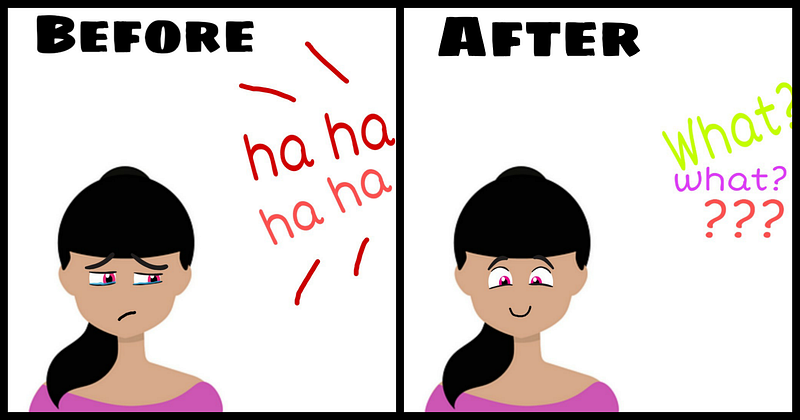
Level 1: Beginner stage
Being quick and witty doesn't come to me naturally. I used to avoid the ones who normally tried to insult me and stayed out of their way because I didn't like confrontations and also didn't want to embarrass myself. By staying away, I gave myself a piece of reprieve. But as you can see, avoidance is never the answer. So my journey to building a more active and confrontational mindset began.
1. Listen
- This is what you never want to do. If someone is laughing at you over some lame joke, you want to disappear from the earth. But try listening to what they mean, what the issue is, where they are coming from. It will help you be more impersonal in receiving the insult and give you a good base to come up with it.
- I started my listening technique by seeking them out, the ones who have the best insults. Then I started listening intently. The funny thing is: they became quite spooked by my behavior and couldn't understand what prank I was playing. It was very satisfying as a bonus, too.
- Listen to famous people come up with the best lines to deflect unwanted phrases, almost instantly. That way, you have a better idea of the tone of voice to use while in unwanted situations.
- Watching stand-up comedians also helped me to learn about inserting pauses for the best effect. My suggestion for the easiest path to this is: watch talk shows and see how people interact with confidence. I love watching shows by Stephen Colbert and Ricky Gervais, they are great to watch — for research, or otherwise.
Remember, the most important thing about a good comeback is timing.
2. Keep notes
Most of the time, we take the insults personally and become angry or hurt. That keeps us from making the best reply. You can either storm out crying, or you probably say something insulting right back in anger that never helps.
- So I decided to write down the incidents and which part really hurt me the most.
- Then I kept writing down all the ideas I was having afterward that I could've said but didn't.
- Keep the note in the person's name and notice the pattern. Most haters aren't that creative to come up with new and creating snark.
- Find the pattern per each person and see the weakness in them. Each negative thought comes from a space of insecurity.
- Use these well thought out retorts the next time they use the same insult. Works every time, and it'll give you a sense of being above those jerks — because you are.
3. Never get angry
No other emotion plays such a disruptive role in our lives as anger. While angry, our reasoning, which is necessary for thoughtful decision-making, is impaired. — — Carl Semmelroth, Donald Smith in Anger Habit
Anger will lose the effect your words are having. Try feigning boredom and become less passionate while dealing with bullies. As the haze of my anger wasn't there, I realized that most of those insults are more on them than on me. Research shows that expressing disappointment works far better than expressing anger. They also found that anger is almost always reciprocal. My tips on not showing anger:
- Figure out and then you can attack the loopholes in their insults.
- Never bring up any curse words, they’ll only lessen the effect.
- Don't give them the finger. It means you couldn't come up with anything good.
- Don’t cut yourself short when you’ve already started a comeback, even though it’s not very good. I've seen it makes them more gleeful. Don’t stutter.
4. It’s all in the expressions
Non-verbal comebacks are the best type…if you can do it properly.
As I was new in this, my comebacks always fell short. But even though it can instigate the other person more, I was strangely okay with it. I was on a mission and they were my research guineapig. But, gradually, I realized that your eyes and face are very good players in the game of comebacks.
- Perfect the technique of eye-rolling. This I couldn't do. My eyes used to just get closed when I tried it. I suggest you practice in the mirror if you have a problem with it like me. Get a reference — mine was Freaky Friday, the 2003 movie.
- If you can't find any witty thing to say back, roll your eyes and walk away. It’s childish, but it worked for me.
- Try raising only one of your eye-brows. This has become my most favorite output. Some insults are so stupid that you know it and even they know it.
- If they were from a group, better to keep eye contact with each of them. So just raise one brow and look them straight in the eye. Let them pick up the rest.
- People say that my face is like an open book. I cannot keep my thoughts from my face. That’s why probably I was a target of bullying in the first place. So I had to practice my cool and disdainful expression in front of the mirror quite a lot.
5. Memorize some good ones
There are some evergreen witty insults that you can always keep in your arsenal that will help you shut your harasser up. I figured the trick is getting them surprised enough to shut up for a few seconds so that I could leave, having said the last words. So I created a list of fun comebacks that work with my personality. here are some:
- This one is pretty good for any character-driven insults: “Takes one to know one.”
- Use this one for people who are always nagging about the same thing, over and over: “Try something more… original next time.”
- Ask them to repeat what the said. They won’t do it…if they're smart. “Sorry I didn’t quite catch that. Would you care to repeat it?”
- I’ve seen this one work on colleagues and seniors like magic! “Your insults don't have any bite today. Did you forget your morning coffee?”
- Showing kindness always throws them off: “Are you okay? I hope everything’s okay at home.”
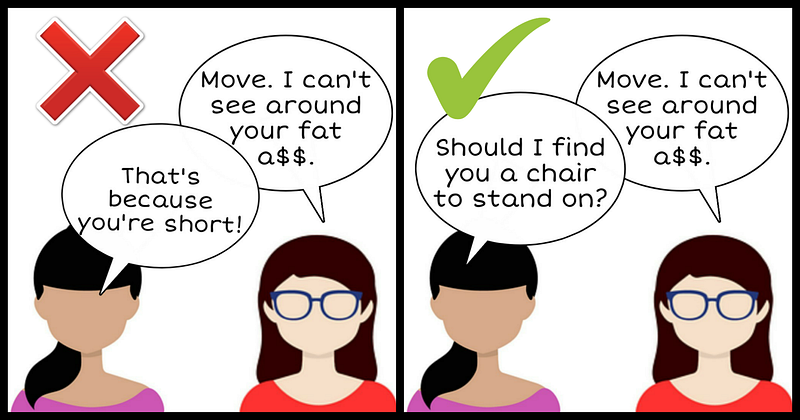
Level 2: Moderate stage
When I was doing my preparation period, one day I heard a unique insult and was genuinely surprised. I said, “That one was actually pretty good!” And I did say it in an appreciative way, but the other party was so rattled that she froze, trying to figure out is I was being sarcastic or not. Then I was so proud of myself and decided it was time for the next phase.
1. Try sarcasm
- This is a skill that needs to be perfected, otherwise, it won't work. I found the best type that works for me is agreeing to what they're saying.
- In case of sarcasm, what you say doesn't matter as much as how you say it. For example, if someone picks on a character flaw, I started saying, “You know me so well.” The slight way of throwing them out of their own game is what you need in the verbal ping-pong.
- But try not to use sarcasm if you're not that good at it yet. Also, keeping the sarcasm light and simple is also important, otherwise, it might go over their head.
2. Use self-deprecating jokes
This always helps in shutting up a hateful conversation. By doing this, you show them that they'll never know you as well as you know yourself and their insults don't affect you in any way.
- My go-to line when someone tries to drag my personality is: “I have been saying that for years! Did you just figure it out?” Or “Aww, that’s what all my best friends say!”
- Give a hearty laugh while you are at it. Practice your smile and try to convey all the disdain you feel for them in your laugh, not your words.
- In his book The Six Pillars of Self-esteem, Nathaniel Branden talks about finding individual self-esteem.
“No one — not our parents, nor our friends, nor our lover, nor our psychotherapist, nor our support group — can ‘give’ us self-esteem,” he writes. “If and when we fully grasp this, that is an act of ‘waking up.’”
— Nathaniel Branden, The Six Pillars of Self-esteem
3. Don’t laugh at your own jokes
- I started having a friend close to me when I had to approach these bullies.
- It can be good for your confidence to have confidence with you who’ll always take your side. Say something witty in return of the insult and let your friend laugh at your joke, and just walk away with a silent smirk.
4. Find a friend to practice with
- Try to convince a friend to run lines with you and check your facial expressions and timing with different situations.
- If the friend is good at these things, that's even better. For me, my friend and I were both the same type of pushovers so we helped each other as spotters.
5. Dare to shock
By this point, you should notice that most of your usual bullies have backed off. They don’t want to insult you to get shut down in return. Your colleagues would stop picking on you to save their won face in front of others.
I was reading The Snark Handbook by Lawrence Dorfman, a collection of witty comebacks and taunts. As well as it is hilarious, it gave me the mental juice I needed to try something shocking for any situation.
One of my favorites in this book is: “Do you want people to accept you as you are … or do you want them to like you?” Or if the situation is less formal, “Don’t piss me off today, I’m running out of places to hide bodies.”
6. Be confident
At this point in your personal challenge, you are a winner. Remember that. As I was always lacking in confidence, this achievement gave me a feeling of victory and it was a type of victory.
Praise yourself when you can. Because no one else will, and you deserve all the praise in the world.

Level 3: The Final Stage
At this stage, you are already an expert at handling yourself in strange and unfriendly situations. The first two levels are the hard ones and take time. But, in this period, you will have earned your confidence and self-esteem. So, what is left is learning to be gentle with your words.
“Be careful when you fight the monsters, lest you become one.” — Freidrich Nietzsche
1. Choose words carefully
Think before what you say. When we gather enough confidence to stand in our own defense, there is a chance of becoming overconfident. This causes you to stoop to as low a level as your harasser. Remember that our main goal is to bring ourselves up, not drag someone down. At least not more than they themselves do. No matter what we say, words can hurt you forever.
What happened with me was my feeling of freedom gave me too much of a loose tongue. I learned it the hard way, and so I tell you this now — choose your words by the person you're saying them to.
2. Be considerate
Be considerate of people going through rough times. We often say things we don't mean when were hurting. So give people the benefit of the doubt. Especially people who are close to us. Hurting them is easy, as we know them so well.
“Be sure to taste your words before you spit them out.”― Oscar Auliq Ice
Also, be nice to people who are sensitive. Try simple non-verbal comebacks for them. No need to get ugly when the playing field isn't even.
3. Don’t hold grudges
Holding grudges for a long time can become toxic. It becomes fumes that will suffocate you. And bringing issues up from years ago while in a fight is just petty and mean. This has been very tempting for me to try and humiliate them for all the things they've said and done for a long time. But that cannot be the way to do this.
Use things they've said and done in recent times. Don't persecute them for things they said when they were little. If they haven't changed and still behave the same way… I say, go for it, then.
4. Leave to fight another day
Don't say anything when you're angry. It shows them how much you care about what the say. Be cool and calm. Practice deep breathing techniques to help control what you say.
“The best fighter is never angry.” — Lao Tzu
I know it's hard but walk away. Leave, so that you can fight again. If you get angry, all this effort will be ruined, and there will be nothing you could do again.
Conclusion
The target is to be someone they will never try to harass in the first place. If you can portray your confidence, you will be left alone. Your reputation will precede you and that way, you'll be able to help others who can't stand up for themselves yet. But if you are a subject of this type of verbal misuse, I say, speak up. If you just ignore them and hope they will just go away, this will never happen. Those who pick on others, they normally do so to bring some fun in their life. If we don’t stand in their way, they will never understand that it’s not okay. I owe my confidence to this effort I put on myself to become someone better.
More from Nusrat Nisa in ILLUMINATION: