
Stock Markets from Gaia’s Perspective.
A Curious Speculative Exercise in Gaian Thinking by Dr John Rose.
Genesis.
Does it make sense to think about the Stock Market as a Gaian ecosystem?
This lateral thinking exercise could help in unifying my thinking and encourage the cross-fertilisation of ideas between my researches. I hope this story inspires you to apply different perspectives to your thinking and open new avenues to explore over a smiling cup of coffee.
Since my story concerns the stock market, I wanted to make sure that it is understood that I assume no liability for any damages, direct or otherwise, resulting from the use of my thought exercise, and no warranty is made regarding its usefulness, accuracy or completeness. Use of my ideas is at your own risk. The ideas in this story are curious conjectures provided solely for educational purposes in critical thinking. Using these ideas does not guarantee that you will make profits, increase profits or minimise losses.
My thesis is that the Stock Exchange is a part of the Human Ecosystem and thus a component of Earth’s total ecosystem. If so, my next question is: how can I apply Gaianism concepts to the stock market?
My Trading Experience.
During the early lockdowns of 2020 I was looking around for other long term pursuits that would entail research and perhaps some income. It sounds trite, but I came across Tradestation on my first Google enquiry. The more I looked into Tradestation the more I liked it. The analytics development environment with community help and documentation was a deciding factor for me.
Tradestation became my excuse to start trading (so much for obtaining sage advice, planning, business plans, risk analysis and such). It just suited my style of research which is, “have-a-go” and “learning by doing” supported by rigorous analysis. Works for me, last time I ended up with a PhD.
Importantly, for my sense of security, Tradestation is registered in Australia. Tastyworks has also opened a branch in Australia and I added that to my toolbox. I like Tastyworks and I have been comparing it with Tradestation to understand their different approaches to trading and analytics.
Trading in my first month was one steep, onerous, frustrating, learning curve. I did not understand terms, jargon, explanations or analyses. I wasn’t getting the whole picture. It seemed many published explanations relied on previous explanations and an assumption of expertise that I didn’t have. Some publications were more sales pitches than educational documents. Wow, was this different from my academic closet!
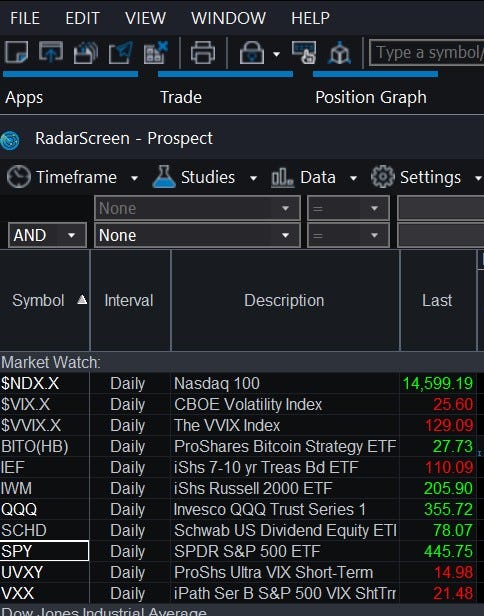
When confusion reigns, I do what I have always done over my years of research, go back to first principles. My first step was using Tradestation’s radarscreen to experiment with their analytic studies (indicators) and see if I could write my own analyses using the Easylanguage development environment. Fortunately, I do have a financial data environment based on Anaconda’s tools that are focussed on Python, for validating my results using data triangulation.
Two years later and I am enjoying my research, I am getting comfortable with trading option spreads. I utilise the Black Scholes model (Easylanguage and Python) to help in calculating trade placements and targets. Recently I started an analysis of volatility and implied volatility in options and that led to this story.
What is an Ecosystem?
National Geographic has an excellent description of an Ecosystem. They explain that an “ecosystem is a geographic area where plants, animals, and other organisms, as well as weather and landscape, work together to form a bubble of life. Ecosystems contain biotic or living, parts, as well as abiotic factors, or nonliving parts. Biotic factors include plants, animals, and other organisms. Abiotic factors include rocks, temperature, and humidity.” Furthermore “every factor in an ecosystem depends on every other factor, either directly or indirectly”.
The whole surface of Earth is a series of connected ecosystems including the Human Ecosystem.
Human Ecosystem
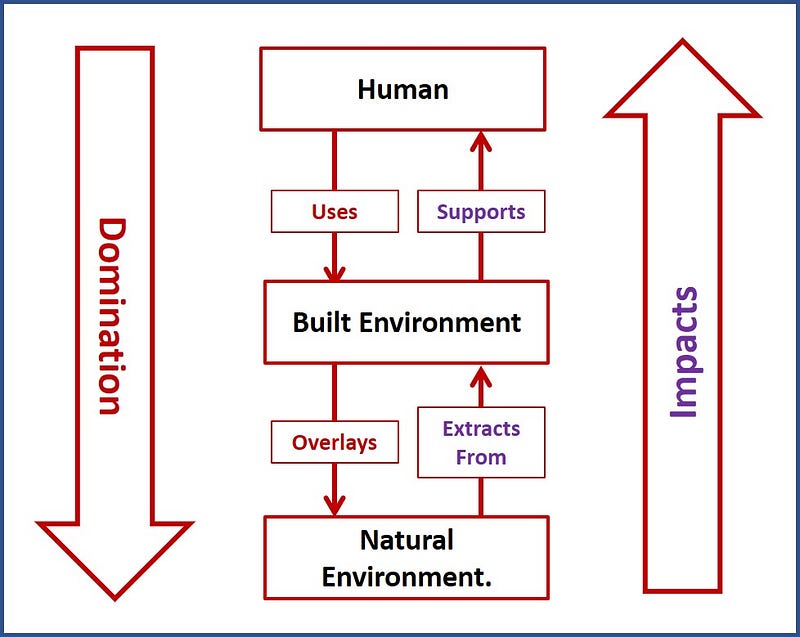
I see a human ecosystem as being an eco-system that is dominated by humans. In this light, the human ecosystem is made up of the natural environment, human constructed (buildings, roads, and so on), and humans with their social interactions including the conscious exercise of free-will. The picture shows resources flowing from the natural component to sustain the human component.
Today, humans are pervasive and linked by technology so that collectively humans dominate all of Earth’s ecosystems.
Gaia.
Gaia is a complex adaptive system that emerges from the connections, interactions and feedback cycles between all of Earth’s ecosystems. The Earth’s environment has been remarkably stable to the extent of supporting life over billions of years.
James Lovelock in his original Hypothesis of Gaia proposed Gaia as a “self-regulating system made up of the totality of organisms, the surface rocks, the ocean and the atmosphere, all tightly coupled as an evolving system”. Furthermore, Gaia has the goal of the “regulation of Earth’s surface conditions so as always to be as favourable as possible for contemporary life”. Before humans, Gaia emerged from the complex non-sentient connectedness of Earth’s ecosystems. We humans have impacted Gaia’s ability to regulate the Earth’s surface conditions. The result is global warming.
Songlines.
I wanted a thinking framework to guide my analysis of the interactions between documented Gaian eco-systems, such as the Great Barrier Reef. Fortuitously, I came across Lynne Kelly’s 2017 book “The Memory Code” that described how cultural memory was passed down through countless generations of indigenous Australians through intensive memory training and dissemination techniques called Songlines.
A Songline is literally a path in the landscape linking sacred locations. Songlines are bound to the progression of seasons. Tribal elders carefully co-ordinate the timing of travels between sites to ensure correct timing of ritual performances. Elders perform the rituals in recitation, song and dance: they literally sing the landscape.
“Ritual” in the context of a songline has no religious connotation, rather it stresses the careful repetition of time honoured performance. Equally, the term “sacred site” should be understood as an honoured and revered location of special cultural significance. The performance order of a Songline’s rituals is dictated by a site’s location, since the tribe must walk between locations.
How can I apply the concepts and tools of Gaianism discussed above to the Stock Market and Trading?
The Stock Market As an Ecosystem.
The Adaptive Markets Hypothesis (AMH) uses evolutionary biology to understand financial transactions. The central tenet of AMH is “that financial markets are governed more by the laws of biology than the laws of physics”. According to AMH in adaptive markets: “(1) People act in their own self-interest; (2) people make mistakes; (3) from those mistakes, they learn, adapt, and innovate; (4) as they experiment and fail or succeed, the process of natural selection operates on individuals, institutions, and markets just as it operates on bacteria, sea slugs, and chimpanzees; and (5) this evolutionary process is what determines financial market dynamics”.
In my view, AMH encourages me to treat the stock market’s dynamics as being an aspect of the behavioural component in the human eco-system and by extension as being part of Gaia. As a thought experiment I wondered if it made sense to apply Songlines to trading?
Option Trades as Songlines.
This is one of those “boldly goes where angels fear to tread” speculative exercises. I have used the diagram below to help visualise a Songline:

The virtual (that is, in my mind) Option Songline starts when I perform my analysis to justify an option trade (strike price, option type, number of contracts, cost, commissions, risk and expected profit, and so on). The option trade is a negotiated buy/sell of rights to control an underlying entity — such as stocks, futures, and commodities. It is a negotiation involving future behavioral choices over a fixed period of time.
In this songline, the first site is a portal giving access to an on-line brokerage service. A process “ritual” is performed to place the option trade. Placing the trade establishes expectations of the trade in interactions between traders in the ecosystem of the exchange.
I check the state of my option trades once every trading day usually around 3pm to 4pm New York time. Songline sites represent these daily assessments. I keep detailed daily records. In this way I establish a time sequence of event causations. I adapt to prevailing market conditions by making buy/sell decisions and modifying appropriate option trade parameters.
The last day of the trade (buy/sell/expire) ends with an assessment of value outcomes and lessons learnt during the songline journey. In this way I adapt to changing circumstances and take these lessons into account in placing and manging my other trades.
My songline approach to trading is compatible with AMH. The Songline naturally organises my analyses over time and provides excellent support to trade behaviour analysis.
Example of Applying My Gaian Analysis to the Stock Market.
It is one thing to use a descriptive framework like Songlines for trades. It is quite a different kettle of fish (that metaphor horrifies me) to apply a meaningful quantitative analysis.
In evolutionary biology, fitness landscapes or adaptive landscapes have been used to visualize the relationship between genotypes and reproductive success. I used them in my PhD research for considering the evolution or adaptation of ideation strategies.
Lately my trade research has been centered on volatility and specifically implied volatility skew in option pricing. Based on AMH, I started looking into doing a fitness landscape based on an implied volatility skew analysis over the course of the option trade. My objective was to see if this landscape could be an indicator of trade efficiency. I thought it may help in optimising buy/sell strikes, prices and expiry times. So far, it looks interesting, but I need to do more work before making any decision on usefulness. I will say one thing, it’s “fascinating!”
Next Steps.
Bringing together my Gaianism and trading research was a natural step in my thinking. I must admit I was gratified to see the publication of AMH that supports this direction.
I firmly believe that understanding behaviours in the stock market will underpin the commercial success of my trading. I’ve taken the first steps with my volatility skew analysis, but there are many perspectives that can be followed for a deeper analysis such as performance comparisons between related stocks and option types. It is a matter of small steps, carefully validated.
Perhaps in the future, I could apply some stock market analysis techniques to my Gaian ecosystem studies?
In short, I’m just going to keep on keeping on exploring.
Acknowledgement.
I want to thank Dr Mehmet Yildiz for encouraging me to write this story.
I also want to acknowledge fellow writers for their helpful comments, support and encouragement on my Gaian stories and particularly my Technology of Songlines story.
I value your feedback.


