
Dr John Rose and Technology.
Technologies I have Studied, Researched and Used.
Genesis.
I’m a casual academic, meaning hourly pay. It sounds a lot worse than it is. I have great flexibility in accepting work….please….please. I love lecturing and tutoring at weird times and of course, there is nothing like late night marking of student research proposals to stir the old blood.
I have been asked by my readers, one reader anyway, to describe my work experience. I think that question was prompted by one of my more vaguer than usual remarks. I did write some notes on my technological background for editors at the request of Dr Mehmet Yildiz.
So here is my technical background. For my loyal band of sceptics my current research is about looking at the stock market as a Gaian Ecosystem. I think this idea came about through eating too much curry.
Writing
During my years as an engineer and academic, writing and presentation have been critical skills for developing and sharing my ideas. These skills came sharply into focus during my PhD candidacy as I struggled to reach the standards required for publishing in academic journals and conferences. I did make the grade when I received an award from Vine Magazine at the 24th Australasian Conference on Information Systems in 2013 for my paper on knowledge management.
Engineering.
After many years in Engineering and IT, I graduated with a PhD in 2016 from the Faculty of Engineering and IT (FEIT) at The University of Technology Sydney (UTS). During my PhD, I gave a guest lecture on ethical choices and subsequently became a casual lecturer at UTS from 2012 to 2017. I currently work as a casual academic in postgraduate and final year UTS engineering courses. From 2019, I have been a casual academic in the Faculty of Engineering and IT at Sydney University. In 2016 I started as a casual teacher at the Northern Sydney Institute, part of TAFE (NSI) in their Bachelor of IT (Network Security) degree and Higher Education studies.
I developed and taught courses in programming; distributed and embedded systems; professional issues; critical thinking; and knowledge management during my time at NSI. Currently at UTS I continue as a lecturer and tutor in their Technology Research Preparation course. Also at UTS, I developed an on-line course on Personal Contributions for engineering students. I have provided student support services at both UTS and NSI.
In 2018, I began a personal research project in the application of Artificial Intelligence to facilitate ideation collaborations and help improve the usefulness of outcomes. I then undertook a funded project to examine the feasibility of applying AI modelling within the Professional Engagement Program at Sydney University.
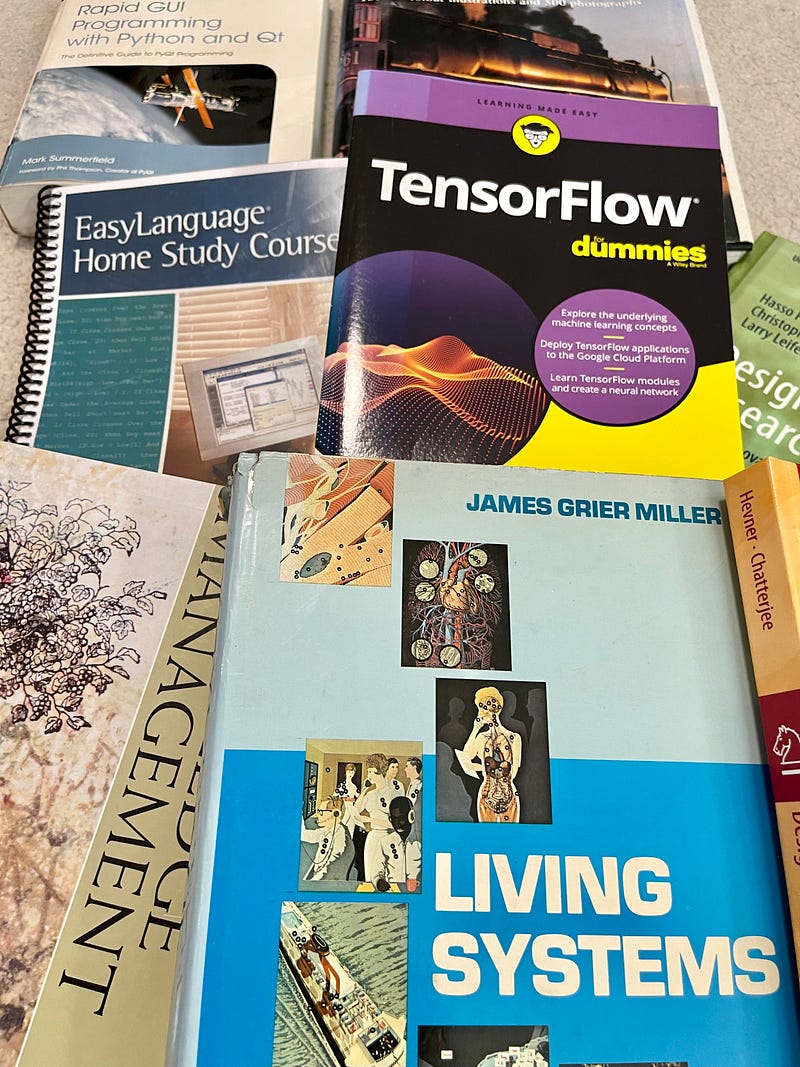
My research platforms are based on Microsoft Windows, Ubuntu and cloud platforms. I taught the use of the Anaconda suite in setting up data analysis studies in MS Windows. I have used and taught open source architectures and tools including Python, Postgres database, SQLITE3, scikit-learn, Keras and TensorFlow.
Carbon Abatement Experience.
Between 2008 and September 2012, as a founding member of Hewlett Packard’s Green Practice, I had the role of Chief Consultant Architect. I invented new ways of reducing the impact on the environment of business processes and improved data centre sustainability. My system was used in over 20 studies both in Australia and overseas for HP clients. Green initiatives must make business sense. Cost reduction and efficiency initiatives are all about “doing more with less”.
In November 2007, I began work on developing methodologies to track application performance and power utilisation in large distributed IT environments with a view to identifying application tuning and modernisation opportunities. This work led to US and EMEA HP patent applications in 2010/11.
While at HP, I was a registered inventor and continued contributions as I developed architecture for tracking, analysing emissions, devising/accessing emission plans and managing emissions until departing from HP in September 2012.
In my role of Chief Consultant Architect at HP Green Practice, I conceived and developed an application called “C-Counter” that implemented my architecture to support Green abatement engagements. C-Counter was first used commercially in 2008. Based on its early success it was deployed for use by clients in Asia, EMEA and the US to identify carbon abatement projects that when implemented would reduce clients’ IT asset carbon (and energy) reporting baseline over a period of 3 years by between 30% and 45%. HP Green Practice reports were routinely audited by clients and their external auditors.
A formal technology transfer agreement was put in place in 2009 by Hewlett Packard Labs (HPL) to support my work in integrating embedded carbon measures and analysis developed by HPL into my software architectures. This work was successfully concluded in April 2010. I co-authored papers on data centre sustainability and energy dashboards with HPL. I authored a paper on knowledge management in optimisation of application development environments and worked with HPL on a study for one UK client covering embedded carbon and its business implications in two new data centres.
In addition to my R&D activities within HP Green Practice, I worked on demonstrating concept systems for leadership, mentored developers and training Carbon Emission Management Practitioners from Japan, Australia and the UK.
Education
Educated at Scots College, Bellevue Hill in Sydney. In 1969 I started a dual degree in Science (graduated 1972) and Engineering (graduated 1974) at the University of Sydney. I majored in Mechanical Engineering and Computer Science. In 2011, I started a PhD candidacy at the University of Technology Sydney. I graduated with a PhD on the 2nd May, 2016. My research outcome was the “Collaborative Wellness System (CWS)”. CWS focussed on the analysis and improvement of human-centric knowledge creation processes.
Now in Illumination.
I continue my research to extend my CWS in thinking about Gaian ecosystems.