avatarJeremy Roberts

Free AI web copilot to create summaries, insights and extended knowledge, download it at here

10791

Abstract

ueen make any movies strictly for the money?</b></p><p id="7cca">Yes and no. In some cases he claimed that was his motivation, but often there was something underneath. Also, in some instances it might have been the case that he would be attracted by the money initially but then sink his teeth into the character, seeking a greater goal.</p><p id="9e47">Remember that he was a struggling actor at the start of his career and, as many actors are forced to, he took some roles for the money. He was living in poverty in a shared flat with no hot water when he arrived in New York in the 1950s.</p><p id="16a0">By contrast, if we look at his later work, a good example is <i>The Towering Inferno.</i> It offered him the biggest pay day of his career and would set him up financially for the remainder of his life. So he approached this project with a commercial mind.</p><p id="4a1e">However, he also saw what a great opportunity it could be. This is clear in how he selected the smaller role of “Fire Chief Michael O’Hallorhan” but had it upgraded and overhauled to be the top billed co-star with Paul Newman.</p><p id="9975">Quickly, this role became less about the money and more about reputation and status as McQueen became focused on proving that he was a bigger star than Newman. This is typical as he was fiercely competitive on and off-screen.</p><figure id="eb1f"><img src="https://cdn-images-1.readmedium.com/v2/resize:fit:800/1*Wm475l8IzVx27K4zSy8pHQ.jpeg"><figcaption><b>Director-writer Mike Siegel proudly holds Ernest Borgnine’s Oscar from 1955’s “Marty” inside the legendary tough guy’s Beverly Hills, California estate, in December 2002. Borgnine, who valiantly portrayed outlaw Dutch Engstrom in director Sam Peckinpah’s “The Wild Bunch,” finally agreed to an on-camera interview for Siegel’s celebrated 2005 documentary, “Passion & Poetry: The Ballad of Sam Peckinpah.” Image Credit: The Mike Siegel Collection / Amazon</b></figcaption></figure><p id="a1f6"><b>How did you meet coauthor Mike Siegel?</b></p><p id="5b3f">I knew of Mike through the <a href="http://www.mcqueenonline.com/forum/">McQueen Online forum</a> where fans can get in touch. Mike and I have a shared interest in that we collect vintage film posters and memorabilia.</p><p id="008c">In 2010 I edited my good friend Marshall Terrill’s superb biography, <i>Steve McQueen: The Life and Legend of a Hollywood Icon</i>. By way of a thank you, he put me in touch with his publisher with a view to doing what eventually became our book, <i>Steve McQueen: The Actor and His Films</i>.</p><p id="4ebf">I met the publisher and went to visit Mike who lives in Germany. The premise was broadly that I would do the writing and Mike would contribute the images. When we arrived in Germany I was blown away by just how vast and impressive Mike’s collection of unseen stills and posters were.</p><p id="b8be">He had everything. Consequently, we have many images in the book that are being seen for the first time. That trip to Germany was tough on the publisher though, because Mike and I spent the whole time looking at his collection. We weren’t especially worried about the formalities of the book deal.</p><p id="2a55">I have to say it was a great working partnership with Mike and the publisher — thanks Glyn and Jean Morris! Ultimately our vision was the same: to create the best book on McQueen ever produced.</p><p id="7121">That meant the biggest — 500 pages — the most comprehensive — 120,000 words — and to show fans something new — 1,000 images. We did not want to just make another coffee table book, but to make the definitive book on McQueen for hardened fans and casual admirers alike.</p><figure id="af79"><img src="https://cdn-images-1.readmedium.com/v2/resize:fit:800/1*8KdcDpDN_Gb2rmsdjxtYzQ.jpeg"><figcaption><b>Steve McQueen is caught casually carrying a coffee cup in a rare color photo taken on the set of “Baby the Rain Must Fall” in Southeast Texas. The underwhelming drama was released to theaters on January 15, 1965. Image Credit: Sony Pictures Entertainment / Courtesy of Dalton Watson Fine Publishing / appears in “Steve McQueen: The Actor and His Films”</b></figcaption></figure><p id="03a3"><b>Is there a reason[s] why <i>Baby the Rain Must Fall</i> receives scant attention today? And why was McQueen attracted to the role of a head strong, down on his luck rockabilly singer?</b></p><p id="8ccf">I think there are many reasons why it is not widely regarded or well known. It is a very challenging movie with challenging subject matter, following the life of a man recently released from prison trying to rebuild his family life.</p><p id="94d8">The tone of the film is downbeat, from the sweeping shots of dusty landscapes to the tattered lives of the characters. Everyone seems to lose something. The ending is also very depressing as all the characters end up worse off than at the film’s opening — McQueen’s character is returned to prison and his family is torn apart.</p><p id="3ea6">So from a story telling perspective it was never going to be a “feel good” film for the whole family. Add into the mix that it was shot in black and white — when color filming had become the norm — and the backdrop of the assassination of JFK — when the country needed entertainment, not depression.</p><p id="2e35">The sad tone of the film is not a flaw. It simply made it less commercially viable. The film does have problems though; for McQueen fans it is probably his attempt to sing. All his performances are dubbed, so it is jarring for fans expecting to see this tough action guy performing heroics, when instead he is lip-syncing with a guitar in his hand.</p><p id="ecbd">In McQueen’s favor was his ability to put himself into the mind of his characters. He knew exactly how his character, Henry Thomas, felt about prison and putting his life on the right track, because McQueen had also been incarcerated when he was sent to reform school — Boys’ Republic — as a teenager.</p><p id="6c10">McQueen was able to draw on his experiences to embellish his performances with authenticity in a way not many actors of his stature could. Perhaps it was this that attracted him to the role, so that he could confront his issues. It is these complexities that I wanted to explore and what compelled me to write a book on Steve McQueen’s films.</p><p id="c308"><i>Baby the Rain Must Fall</i> has continued to fail to get wider spread acknowledgment, as it is not as widely available as say <i>Bullitt</i> or <i>The Great Escape</i>. The film seldom appears on television and is not as widely released in home video markets, though it can be obtained if one looks hard enough.</p><p id="a63d">With these hurdles it is hard to gain a cult following. Despite this, it has been rediscovered and recognized for its quality, both in McQueen and Lee Remick’s acting but also the quality of direction and cinematography [In <a href="http://www.amazon.com/Steve-McQueen-Life-Legend-Hollywood/dp/1600783880/ref=sr_1_1?ie=UTF8&amp;qid=1324305882&amp;sr=8-1"><i>Steve McQueen: The Life and Legend of a Hollywood Icon</i></a>, Terrill uncovered the revelation that Elvis Presley expressed interest in doing the picture but was vetoed by controversial, domineering manager Colonel Tom Parker].</p><figure id="b0e6"><img src="https://cdn-images-1.readmedium.com/v2/resize:fit:800/1*nkfvTBvWnXtq_UDWZTNIvA.jpeg"><figcaption><b>Steve McQueen and soon-to-be second wife Ali MacGraw wash hands together in a nondescript bathroom between takes of director Sam Peckinpah’s “The Getaway,” a grand slam at the box office when distributed on December 19, 1972. Photography by Mel Traxel / Warner Bros. / Courtesy of Dalton Watson Fine Publishing / appears in “Steve McQueen: The Actor and His Films”</b></figcaption></figure><p id="45bd"><b>Why did McQueen not unleash any movies when he was literally at the top of his game in 1967?</b></p><p id="82aa">That’s a good observation, though we have to remember that the release date of a film balances on many factors, most of which are dictated by the studio and outside of an actor’s control. However, he did take a break during this period.</p><p id="ee6d">The reason for the gap was that that he was exhausted and, according to his first wife Neile, he was prescribed enforced rest by his doctor when he returned to U.S. soil after filming <i>The Sand Pebbles</i>.</p><p id="7c60">That film had a long shooting schedule in terrible conditions. Working on this really had an impact on him, not least because of the strain it put on his young family, so much so that it put him off the idea of films requiring exotic location shooting for quite some time.</p><p id="b3cf">Steve had made tremendous strides in getting to this point in his career, and I think that he also wanted to soak it all up and plan his next move. After all, he had built up some great momentum and his next film had to be carefully selected.</p><figure id="26ef"><img src="https://cdn-images-1.readmedium.com/v2/resize:fit:800/1*T6_YeIUdB8CdiSb2wPjuug.jpeg"><figcaption><b>Captain Virgil “The Cooler King” Hilts is placed in solitary confinement but refuses to be defeated, defiantly tossing his baseball in director John Sturges’ epic “The Great Escape,” released to widespread acclaim on Independence Day 1963. Photography by Lothar Winkler / Metro-Goldwyn-Mayer / Courtesy of Dalton Watson Fine Publishing / appears in “Steve McQueen: The Actor and His Films”</b></figcaption></figure><p id="aeab"><b>Of the dizzying array of movies turned down by McQueen, which one[s] do you wish he would have accepted?</b></p><p id="3f4b">I think the obvious answer would be <i>Butch Cassidy and the Sundance Kid</i>, but that would not be my choice. Sure it made Redford a star, but it was more Newman’s project, so it may not have done McQueen’s ego or career as much good as he had less control.</p><p id="89be">By that point he was at the apex of his career and beyond just sharing the limelight, and he was right in commanding that all by himself. Also it saved the showdown between McQueen and Newman for <i>The Towering Inferno</i> in 1974 and that was a battle of the titans, where McQueen emerged victorious.</p><p id="ac68">In truth, of all the films he turned down, I am not sorry he passed on them. McQueen made a career of being the main star of a film. Even when he was just a supporting actor, he always shone through.</p><p id="e99f">Lots of the early roles he missed would have had him as the co-star, such as <i>Breakfast at Tiffany’s</i>. As his career progressed he turned down major leading roles, but many would have been unsuitable, such as <i>Superman</i> or Kurtz in <i>Apocalypse Now</i>.</p><p id="3ccd">If I was forced to pick one, I think he would have been great in <i>One Fle

Options

w over the Cuckoo’s Nest</i>. However, it would have been a very different film. Jack Nicholson played the role to the hilt in terms of being an extrovert. By contrast McQueen’s performance would have been very different — understated and subtle. Now that would be interesting to see.</p><p id="11b9"><b>Is there a McQueen film that you didn’t like, but after watching again you experienced a change of heart?</b></p><p id="0475"><i>Le Mans</i> is the most obvious one. When I saw it for the first time I was disappointed because it is very non-linear, and I was expecting something with a little more action off the racetrack. However, I know it is cherished by racing enthusiasts and rightly so.</p><p id="35c6">After many viewings I have come to admire it greatly. Once you come to accept that it is not a conventional film and essentially a superb account of racing, you start to see the qualities. <i>Le Mans</i> is a paradox, since its flaws are also its strengths.</p><p id="2ba4">The lack of story, the absence of characterization and back story as well as McQueen’s virtual silence are, in some people’s mind, major problems with the film. However, they are also what make it so special and unique. The absence of character development and story leave the film free to play out a narrative on the racetrack where the cars are the stars.</p><p id="389c">As for McQueen’s performance and lack of dialogue, this provides a master-class in non-verbal communication. Steve was a master of this, saying more with his body language through stares and gestures then rival actors could with endless script pages. He didn’t need words to create atmosphere, he emanated it [Terrill offers further insight of <a href="https://readmedium.com/how-a-military-brat-got-hooked-on-the-razor-sharp-mystique-of-quintessential-hollywood-outsider-2cc632f95bc1"><i>Le Mans</i> here</a>].</p><figure id="7f16"><img src="https://cdn-images-1.readmedium.com/v2/resize:fit:800/1*uCFW1akjoDKOl4Iys3z4DQ.jpeg"><figcaption><b>Andrew Antoniades, first-time author of the unabashed labor of love that is “Steve McQueen: The Actor and His Films,” poses along a gorgeous English countryside lake in 2011. Image courtesy of Dalton Watson Fine Publishing / appears in “Steve McQueen: The Actor and His Films”</b></figcaption></figure><p id="cfc4"><b>Have you got a new project in mind? And are you finished writing about the King of Cool?</b></p><p id="5b3b">Well, first and foremost, I’m a McQueen fan. I’ll never be finished on the subject as I’m always watching his films, researching and collecting. So it never ends, nor would I want it to!</p><p id="6d13">One of the things that prompted me to write a book was that I saw so many books on the market written by people that just chose a subject and it happened to be McQueen. Such authors would then move onto another entertainment figure.</p><p id="0680">Those books lack passion in my opinion, mainly because the authors are not as passionate as someone who is a genuine fan. I was inspired by my friend Marshall Terrill because he was the exception to this rule — a fan and dedicated biographer. I wanted to do a one-off book as a fan for new, old and future admirers of McQueen.</p><p id="d4b3">Yes, I have ideas in my head for other McQueen projects. However, I really think that what I have released is the definitive account of his films as well as his life and legend. So a new project would need to be fresh and offer readers something new and original.</p><p id="b50c"><i>Steve McQueen: The Actor and His Films</i> took a major part of my life and the only way I can describe it is as a labor of love. So the project and timing would need to be right as people deserve quality.</p><figure id="a1d4"><img src="https://cdn-images-1.readmedium.com/v2/resize:fit:800/1*6fB7xWKSxR1EOjWNj7K8SQ.jpeg"><figcaption><b>Steve McQueen is the consummate raconteur to two teenagers between takes of 1968’s “Bullitt” on location in San Francisco. The King of Cool possessed a unique kinship with kids, perhaps remembering how tough his own upbringing was. Image Credit: Warner Bros. / Courtesy of Dalton Watson Fine Publishing / appears in “Steve McQueen: The Actor and His Films”</b></figcaption></figure><figure id="c792"><img src="https://cdn-images-1.readmedium.com/v2/resize:fit:800/1*edNuWTsVowwIXgHckAFRVg.jpeg"><figcaption><b>The back and front cover of “Steve McQueen: The Actor and His Films,” a massive coffee-table tome co-written by Andrew Antoniades and Mike Siegel and published on December 15, 2011. Both images of the King of Cool are taken from his 15th film, director Henry Hathaway’s “Nevada Smith.” Image courtesy of Dalton Watson Fine Publishing</b></figcaption></figure> <figure id="1414"> <div> <div> <img class="ratio" src="http://placehold.it/16x9"> <iframe class="" src="https://cdn.embedly.com/widgets/media.html?src=https%3A%2F%2Fwww.youtube.com%2Fembed%2FX4v1ahx2-Do%3Ffeature%3Doembed&amp;url=http%3A%2F%2Fwww.youtube.com%2Fwatch%3Fv%3DX4v1ahx2-Do&amp;image=https%3A%2F%2Fi.ytimg.com%2Fvi%2FX4v1ahx2-Do%2Fhqdefault.jpg&amp;key=a19fcc184b9711e1b4764040d3dc5c07&amp;type=text%2Fhtml&amp;schema=youtube" allowfullscreen="" frameborder="0" height="480" width="640"> </div> </div> </figure></iframe></div></div></figure> <figure id="b901"> <div> <div> <img class="ratio" src="http://placehold.it/16x9"> <iframe class="" src="https://cdn.embedly.com/widgets/media.html?src=https%3A%2F%2Fwww.youtube.com%2Fembed%2FA1mbAG9WIDA%3Ffeature%3Doembed&amp;url=http%3A%2F%2Fwww.youtube.com%2Fwatch%3Fv%3DA1mbAG9WIDA&amp;image=https%3A%2F%2Fi.ytimg.com%2Fvi%2FA1mbAG9WIDA%2Fhqdefault.jpg&amp;key=a19fcc184b9711e1b4764040d3dc5c07&amp;type=text%2Fhtml&amp;schema=youtube" allowfullscreen="" frameborder="0" height="480" width="640"> </div> </div> </figure></iframe></div></div></figure><div id="5c6a" class="link-block"> <a href="https://readmedium.com/a-little-girls-dream-being-on-the-tom-horn-film-set-with-steve-mcqueen-a00107746049"> <div> <div> <h2>A little girl’s dream: Being on the ‘Tom Horn’ film set with Steve McQueen</h2> <div><h3>Tom Horn was Steve McQueen’s penultimate film and perhaps the project closest to his heart. Based on the life of the…</h3></div> <div><p>medium.com</p></div> </div> <div> <div style="background-image: url(https://miro.readmedium.com/v2/resize:fit:320/1*Oqty2gPxsc3mgDlrp_yo3Q.jpeg)"></div> </div> </div> </a> </div><div id="8b2a" class="link-block"> <a href="https://readmedium.com/a-rose-among-the-thorns-faith-and-healing-with-steve-mcqueens-widow-1e35ff65c839"> <div> <div> <h2>A rose among the thorns: Faith and healing with Steve McQueen’s widow</h2> <div><h3>An interview with Steve McQueen’s salt of the earth widow Barbara Minty covers Christianity, paparazzi, marriage, Santa…</h3></div> <div><p>medium.com</p></div> </div> <div> <div style="background-image: url(https://miro.readmedium.com/v2/resize:fit:320/1*slROej482V2M_4Qto1OuhA.jpeg)"></div> </div> </div> </a> </div><div id="e105" class="link-block"> <a href="https://readmedium.com/the-relentless-dilemma-of-the-fake-steve-mcqueens-d54746da741a"> <div> <div> <h2>The relentless dilemma of the fake Steve McQueens</h2> <div><h3>“I live for myself and I answer to nobody.” Steve McQueen’s defiantly heroic words essentially summarize his genuine…</h3></div> <div><p>medium.com</p></div> </div> <div> <div style="background-image: url(https://miro.readmedium.com/v2/resize:fit:320/1*chXeISutvwaj-VHOYsJyew.jpeg)"></div> </div> </div> </a> </div><div id="5487" class="link-block"> <a href="https://readmedium.com/how-a-military-brat-got-hooked-on-the-razor-sharp-mystique-of-quintessential-hollywood-outsider-2cc632f95bc1"> <div> <div> <h2>How a military brat got hooked on the razor sharp mystique of quintessential Hollywood outsider…</h2> <div><h3>“I don’t believe in that phony hero stuff.” Steve McQueen’s rebel attitude probably ruffled quite a few feathers among…</h3></div> <div><p>medium.com</p></div> </div> <div> <div style="background-image: url(https://miro.readmedium.com/v2/resize:fit:320/1*FFgayrPbIYSqrFMEjWG9Ng.jpeg)"></div> </div> </div> </a> </div><div id="992b" class="link-block"> <a href="https://jeremylr.medium.com/the-complex-contradictory-steve-mcqueen-was-one-of-cinemas-greatest-icons-5832ab3df19"> <div> <div> <h2>The complex, contradictory Steve McQueen was one of cinema’s greatest icons</h2> <div><h3>“Steve McQueen: In His Own Words” compiler Marshall Terrill sheds light on romantic rendezvous, politics, death bed…</h3></div> <div><p>jeremylr.medium.com</p></div> </div> <div> <div style="background-image: url(https://miro.readmedium.com/v2/resize:fit:320/1*a0i57ouENuCWPL8LmFcP6A.jpeg)"></div> </div> </div> </a> </div><div id="c5f4" class="link-block"> <a href="https://readmedium.com/when-the-dillards-bumped-into-steve-mcqueen-on-a-hollywood-street-c645967168d3"> <div> <div> <h2>When the Dillards bumped into Steve McQueen on a Hollywood street</h2> <div><h3>The Dillards are to bluegrass what Steve McQueen was to film cinema — supreme innovators during a decade when…</h3></div> <div><p>medium.com</p></div> </div> <div> <div style="background-image: url(https://miro.readmedium.com/v2/resize:fit:320/1*1SYG6X31-SDD98TB5QPIgA.jpeg)"></div> </div> </div> </a> </div><p id="1b84"><i>© Jeremy Roberts, 2011, 2017. All rights reserved. To touch base, email <a href="mailto:[email protected]"></a></i><a href="mailto:[email protected]">[email protected]<i></i></a><i> and mention which story led you my way. I appreciate it sincerely.</i></p></article></body>

Steve McQueen took a major part of his life — In step with passionate wordsmith Andrew Antoniades
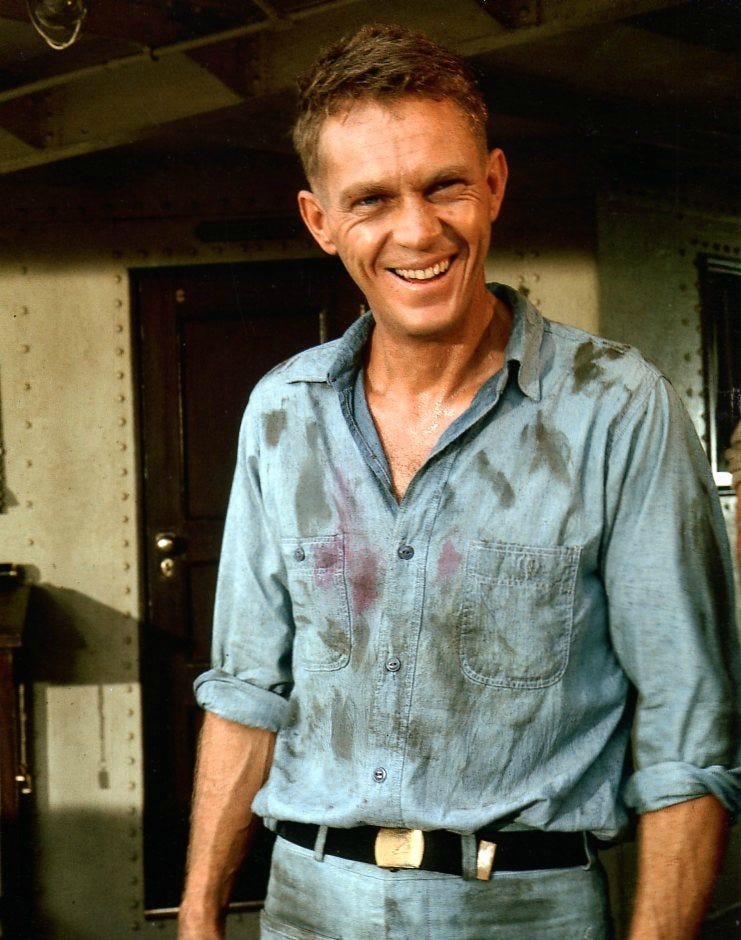
Andrew Antoniades, a London accountant by day and the co-author of the skillfully crafted 492-page coffee table book “Steve McQueen: The Actor and His Films,” unearths his driving passion for the King of Cool in a fascinating, exclusive profile. McQueen’s 1,000-watt smile permeates the chiseled star’s characterization of Machinist’s Mate 1st Class Jake Holman in director Robert Wise’s “The Sand Pebbles,” distributed to robust box office receipts on December 20, 1966. The King of Cool deservedly received his sole Oscar nomination but lost to Paul Scofield in “A Man for All Seasons.” Image Credit: 20th Century Fox / Redford McQueen and Newman Tumblr

Andrew Antoniades accomplished what many of us can only dream — he realized his lifelong ambition of publishing his debut book. Matter-of-factly titled Steve McQueen: The Actor and His Films, the tremendous coffee table tome places the spotlight squarely on the late Steve McQueen’s impressive film oeuvre.

McQueen was a selective oddball when choosing roles — often with the recommendation of first wife Neile Adams —appearing in just 27 films between 1956 and 1980 during an era when corporate studio policy usually dictated employees make two or three films annually.

But what memorable movies they are — The Magnificent Seven, The Great Escape, The Cincinnati Kid, The Sand Pebbles, Bullitt, The Thomas Crown Affair, The Getaway, Papillon — and still the list could go on.

A London accountant by day and author by night, Antoniades wrote the book with McQueen memorabilia collector and Sam “Wild Bunch” Peckinpah documentarian Mike Siegel. Nearly 500 pages in scope, 9" x 12" in size, and featuring over 1,000 illustrations of vintage movie posters, lobby cards, and excavated stills from set locations, the hardcover book offers McQueen fans the complete package.

A biography of McQueen opens the text, followed by chapters devoted to each Hollywood project, starting with the Western TV series that launched the actor into household name status — Wanted: Dead or Alive — and his ace 1971 motorcycling documentary On Any Sunday.

The Actor and His Films doesn’t get bogged down with listing every cast and crew member, instead highlighting major players only. Run times, distribution dates, filming location[s], studio credit, and a page synopsis of film plots are briefly mentioned. The meat of the text is devoted to behind the scenes stories, interviews, trivia, historical perspective, critical assessment, and analysis of a key scene.

An exploration of McQueen’s life and career relative to each movie is a welcome addition. At the book’s finale, “The Legacy” chapter presents a compelling argument as to why McQueen remains relevant in the twenty-tens and what made him unlike any other star of the 1960s or 1970s.

Antoniades is a foremost McQueen fan, which infuses his prose with a fair and balanced angle. However, the author doesn’t shy away from criticizing a performance or film if warranted. One of the reasons that prompted Antoniades to undergo the massive challenge of writing a book is because he noticed so many books on the market seriously devoid of passion, written by people that chose a subject which happened to be McQueen. For more information, including sample images, visit Dalton Watson’s official website.

Keep reading as the natural born raconteur engagingly weaves anecdotes of growing up with his father and being enthralled with Papillon, the reason McQueen temporarily quit making movies at the height of his fame in 1967, why the stodgy Le Mans deserves a second chance, if McQueen was wrong to turn down One Flew Over the Cuckoo’s Nest, whether the actor only made movies for the money — think The Towering Inferno — and loads more.
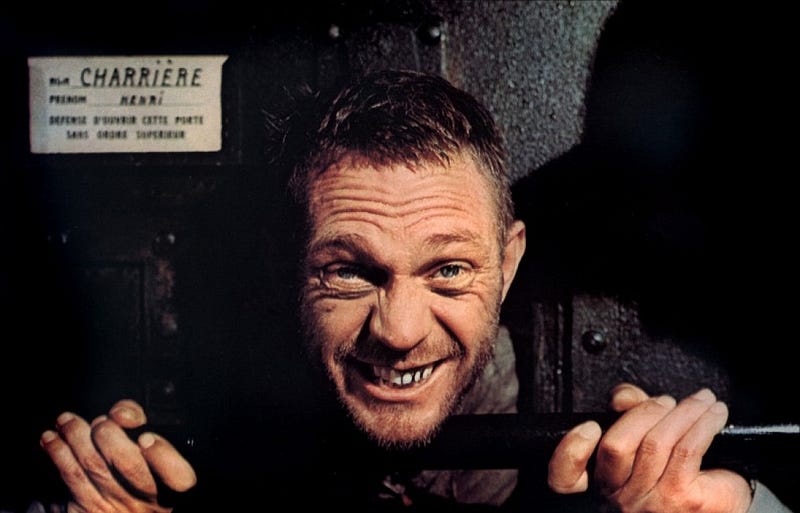
Mistakenly sentenced to life on Devil’s Island for murdering a pimp, safe cracker Henri Charrière experiences a sadistic guard’s billy club when he pokes his head outside solitary confinement at the 1930s-era French Guiana prison. Steve McQueen’s bravura, gut-wrenching performance as “Papillon” shocked Hollywood insiders when it did not garner Oscar consideration upon its December 16, 1973, premiere in New York City, although the Golden Globes rightly nominated the King of Cool. Image Credit: Warner Bros. / Taste of Cinema / appears in “Steve McQueen: The Actor and His Films”

The Andrew Antoniades / Steve McQueen Interview

Your father introduced you to Steve McQueen as Papillon. What exactly piqued your interest?

It was really the whole package, a film on an epic scale with amazing acting. The brutality of the film was shocking as well; it was really like nothing I had seen before with scenes where the beauty of nature was offset by the horrors that the men have to endure [Marshall Terrill, author of Steve McQueen: The Life and Legend of a Hollywood Icon and six additional King of Cool tomes, concurs exclusively here].

As a film it has everything from action and suspense to beautiful cinematography and thrilling escape scenes. So when I saw it for the first time and although I was very young, I felt very strongly that I was watching something very unique and special.

As far as Steve McQueen though, seeing him on the screen commanding every scene, I could tell he was different to other actors. He had that special star quality that made him larger than life.

This was compounded by the fact that the film was on such a large scale yet it never overwhelmed him. He took charge of the film. This was no small feat since it is populated by many memorable characters, but it is unmistakably McQueen’s film.
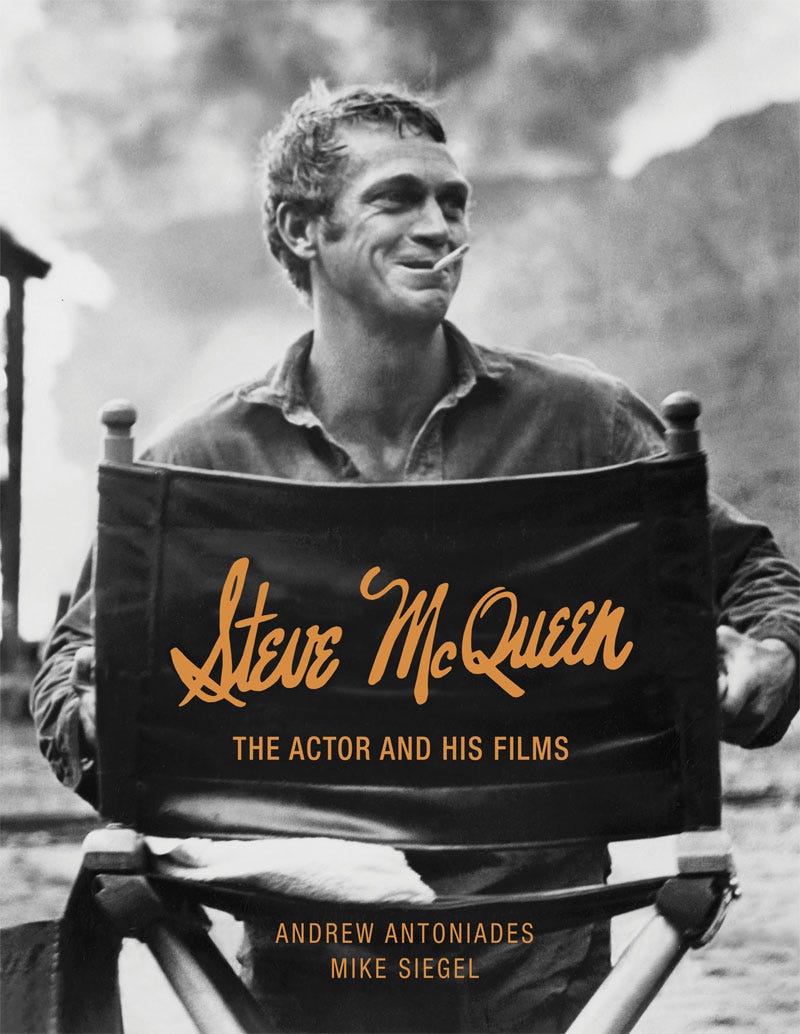
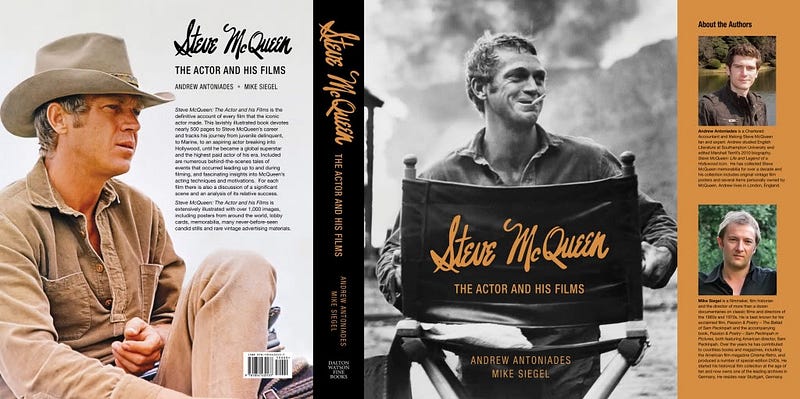
The cover of the definitive 492-page coffee table tome, “Steve McQueen: The Actor and His Films,” co-written by Andrew Antoniades and Mike Siegel and distributed on December 15, 2011. Image courtesy of Dalton Watson Fine Publishing

Do you appreciate McQueen’s Western roles?

Absolutely, Steve always looked like a genuine cowboy through the way he handled his guns and horses on screen and the energy he put into his characters. On The Magnificent Seven, he was surrounded by many other high caliber actors and in some cases, more established stars. It was his magnetism and ability to look believable as a cowboy that made him emerge as the star of that film.

Steve’s career included three films that show the journey of the Western hero. In Nevada Smith he plays “Max Sand,” the young half-breed orphan who must quickly learn to be a man in a dangerous Western landscape. In The Magnificent Seven he played the fully grown mercenary gun for hire. By the end of his career with Tom Horn, Steve played an aging Western figure coming to terms with life at the end of an era as America was changing.

In my book I treat the three movies as a sort of unofficial trilogy and as these films progress so too does Steve’s acting. This also has much to do with Steve’s Western series Wanted: Dead or Alive, where he honed his skills in a Western medium.

Name three undiscovered jewels in McQueen’s film canon.

Hell Is for Heroes [1962] is the one that immediately comes to mind. This is McQueen at his darkest. Once again he was surrounded by a talented ensemble cast, but it was clear that he saw himself as the only true star of the film. As “Reese,” the hardened soldier, McQueen took his loner and anti-hero to the extreme.

The character as McQueen plays him is very ambiguous. He does heroic things but is ultimately a very war-hungry and damaged individual. McQueen used this role to experiment and refine his persona of the rebellious loner.

After this film he perfected it with The Great Escape, finding the perfect balance of nonchalance and rebellion, but it is interesting to watch this evolution from film to film.

Next, Baby the Rain Must Fall [1965] is not as well-known as some of McQueen’s other films because after it, he hit megastar status with some huge box-office hits. However, the film is very underrated and an atmospheric piece. It’s a final chance to see him in a black and white film, too.

Third, Tom Horn [1980] was sadly overlooked at the time of its release, but it is slowly being rediscovered and appreciated. It is a very understated character study as McQueen plays an aging frontiersman at the turn of the century [Widow Barbara Minty McQueen spent countless hours on the set of Tom Horn. Her exclusive, at times poignant reminiscences are available here].

It really showed just how much McQueen had progressed as an actor and how comfortable he had become with himself. The cinematography is beautiful in places also.
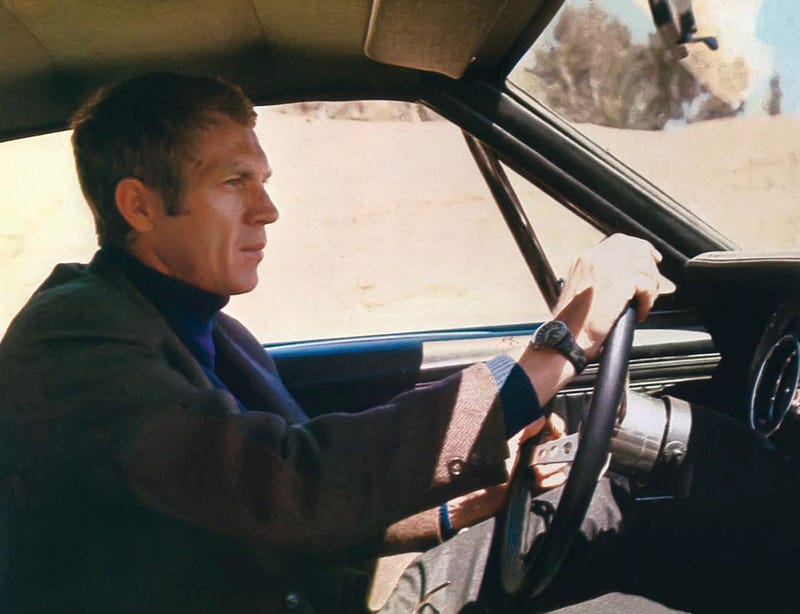
Circa April 14, 1968, a rare shot clearly shows Steve McQueen behind the wheel of the Ford Mustang immortalized in director Peter Yates’ action-packed “Bullitt.” Image Credit: Warner Bros. / Courtesy of Dalton Watson Fine Publishing / appears in “Steve McQueen: The Actor and His Films”

Did McQueen make any movies strictly for the money?

Yes and no. In some cases he claimed that was his motivation, but often there was something underneath. Also, in some instances it might have been the case that he would be attracted by the money initially but then sink his teeth into the character, seeking a greater goal.

Remember that he was a struggling actor at the start of his career and, as many actors are forced to, he took some roles for the money. He was living in poverty in a shared flat with no hot water when he arrived in New York in the 1950s.

By contrast, if we look at his later work, a good example is The Towering Inferno. It offered him the biggest pay day of his career and would set him up financially for the remainder of his life. So he approached this project with a commercial mind.

However, he also saw what a great opportunity it could be. This is clear in how he selected the smaller role of “Fire Chief Michael O’Hallorhan” but had it upgraded and overhauled to be the top billed co-star with Paul Newman.

Quickly, this role became less about the money and more about reputation and status as McQueen became focused on proving that he was a bigger star than Newman. This is typical as he was fiercely competitive on and off-screen.
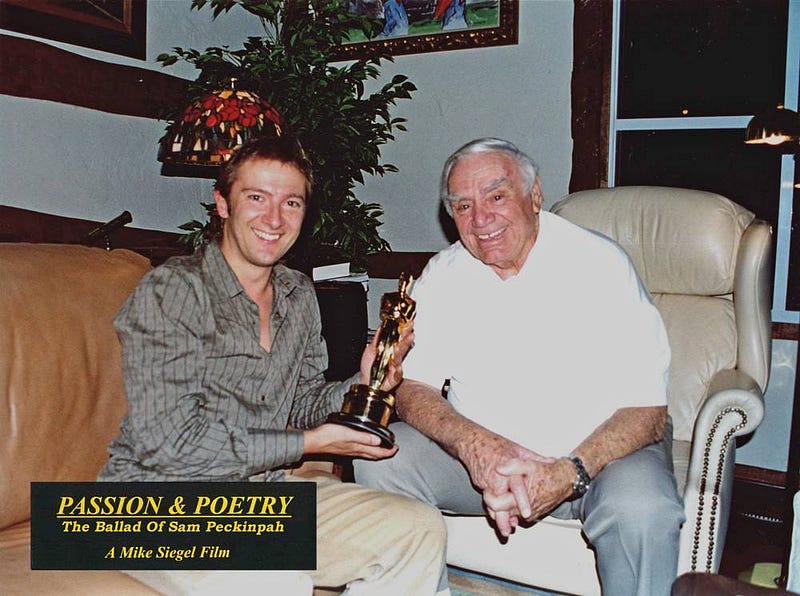
Director-writer Mike Siegel proudly holds Ernest Borgnine’s Oscar from 1955’s “Marty” inside the legendary tough guy’s Beverly Hills, California estate, in December 2002. Borgnine, who valiantly portrayed outlaw Dutch Engstrom in director Sam Peckinpah’s “The Wild Bunch,” finally agreed to an on-camera interview for Siegel’s celebrated 2005 documentary, “Passion & Poetry: The Ballad of Sam Peckinpah.” Image Credit: The Mike Siegel Collection / Amazon

How did you meet coauthor Mike Siegel?

I knew of Mike through the McQueen Online forum where fans can get in touch. Mike and I have a shared interest in that we collect vintage film posters and memorabilia.

In 2010 I edited my good friend Marshall Terrill’s superb biography, Steve McQueen: The Life and Legend of a Hollywood Icon. By way of a thank you, he put me in touch with his publisher with a view to doing what eventually became our book, Steve McQueen: The Actor and His Films.

I met the publisher and went to visit Mike who lives in Germany. The premise was broadly that I would do the writing and Mike would contribute the images. When we arrived in Germany I was blown away by just how vast and impressive Mike’s collection of unseen stills and posters were.

He had everything. Consequently, we have many images in the book that are being seen for the first time. That trip to Germany was tough on the publisher though, because Mike and I spent the whole time looking at his collection. We weren’t especially worried about the formalities of the book deal.

I have to say it was a great working partnership with Mike and the publisher — thanks Glyn and Jean Morris! Ultimately our vision was the same: to create the best book on McQueen ever produced.

That meant the biggest — 500 pages — the most comprehensive — 120,000 words — and to show fans something new — 1,000 images. We did not want to just make another coffee table book, but to make the definitive book on McQueen for hardened fans and casual admirers alike.
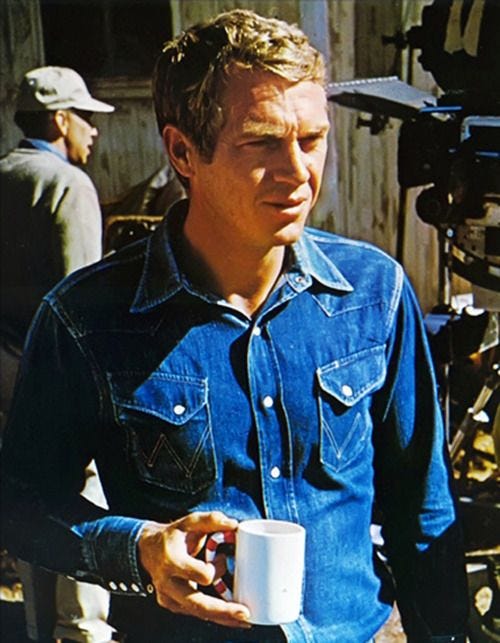
Steve McQueen is caught casually carrying a coffee cup in a rare color photo taken on the set of “Baby the Rain Must Fall” in Southeast Texas. The underwhelming drama was released to theaters on January 15, 1965. Image Credit: Sony Pictures Entertainment / Courtesy of Dalton Watson Fine Publishing / appears in “Steve McQueen: The Actor and His Films”

Is there a reason[s] why Baby the Rain Must Fall receives scant attention today? And why was McQueen attracted to the role of a head strong, down on his luck rockabilly singer?

I think there are many reasons why it is not widely regarded or well known. It is a very challenging movie with challenging subject matter, following the life of a man recently released from prison trying to rebuild his family life.

The tone of the film is downbeat, from the sweeping shots of dusty landscapes to the tattered lives of the characters. Everyone seems to lose something. The ending is also very depressing as all the characters end up worse off than at the film’s opening — McQueen’s character is returned to prison and his family is torn apart.

So from a story telling perspective it was never going to be a “feel good” film for the whole family. Add into the mix that it was shot in black and white — when color filming had become the norm — and the backdrop of the assassination of JFK — when the country needed entertainment, not depression.

The sad tone of the film is not a flaw. It simply made it less commercially viable. The film does have problems though; for McQueen fans it is probably his attempt to sing. All his performances are dubbed, so it is jarring for fans expecting to see this tough action guy performing heroics, when instead he is lip-syncing with a guitar in his hand.

In McQueen’s favor was his ability to put himself into the mind of his characters. He knew exactly how his character, Henry Thomas, felt about prison and putting his life on the right track, because McQueen had also been incarcerated when he was sent to reform school — Boys’ Republic — as a teenager.

McQueen was able to draw on his experiences to embellish his performances with authenticity in a way not many actors of his stature could. Perhaps it was this that attracted him to the role, so that he could confront his issues. It is these complexities that I wanted to explore and what compelled me to write a book on Steve McQueen’s films.

Baby the Rain Must Fall has continued to fail to get wider spread acknowledgment, as it is not as widely available as say Bullitt or The Great Escape. The film seldom appears on television and is not as widely released in home video markets, though it can be obtained if one looks hard enough.

With these hurdles it is hard to gain a cult following. Despite this, it has been rediscovered and recognized for its quality, both in McQueen and Lee Remick’s acting but also the quality of direction and cinematography [In Steve McQueen: The Life and Legend of a Hollywood Icon, Terrill uncovered the revelation that Elvis Presley expressed interest in doing the picture but was vetoed by controversial, domineering manager Colonel Tom Parker].
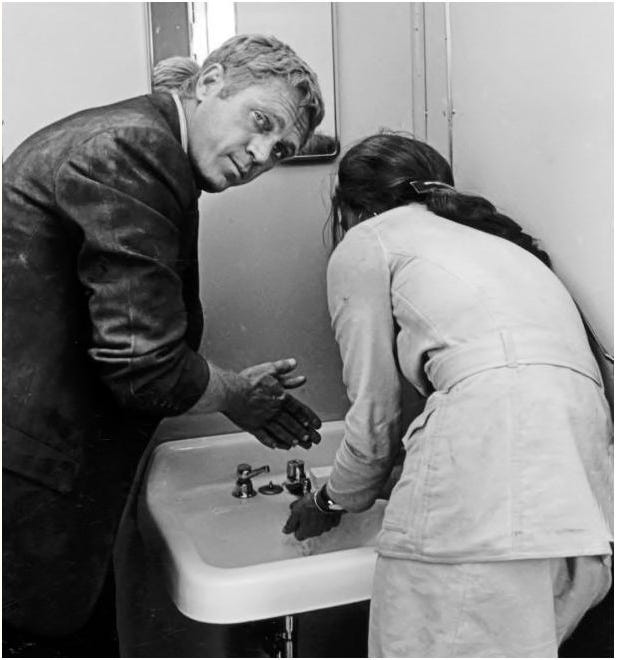
Steve McQueen and soon-to-be second wife Ali MacGraw wash hands together in a nondescript bathroom between takes of director Sam Peckinpah’s “The Getaway,” a grand slam at the box office when distributed on December 19, 1972. Photography by Mel Traxel / Warner Bros. / Courtesy of Dalton Watson Fine Publishing / appears in “Steve McQueen: The Actor and His Films”

Why did McQueen not unleash any movies when he was literally at the top of his game in 1967?

That’s a good observation, though we have to remember that the release date of a film balances on many factors, most of which are dictated by the studio and outside of an actor’s control. However, he did take a break during this period.

The reason for the gap was that that he was exhausted and, according to his first wife Neile, he was prescribed enforced rest by his doctor when he returned to U.S. soil after filming The Sand Pebbles.

That film had a long shooting schedule in terrible conditions. Working on this really had an impact on him, not least because of the strain it put on his young family, so much so that it put him off the idea of films requiring exotic location shooting for quite some time.

Steve had made tremendous strides in getting to this point in his career, and I think that he also wanted to soak it all up and plan his next move. After all, he had built up some great momentum and his next film had to be carefully selected.
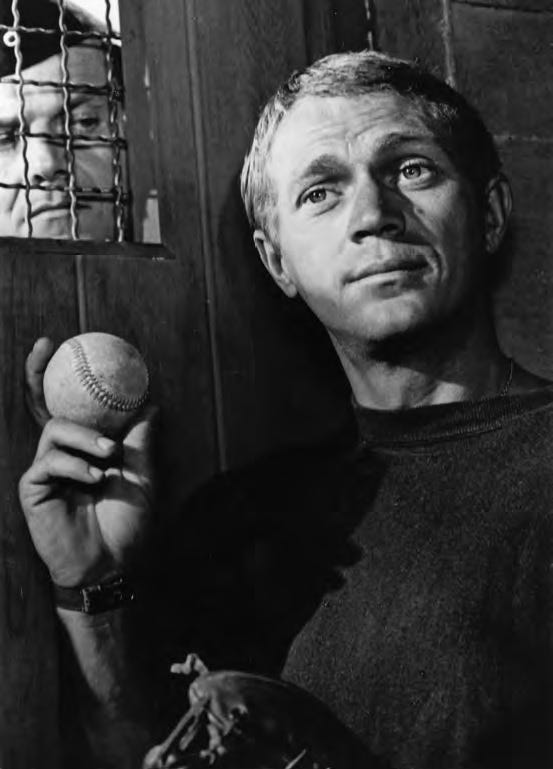
Captain Virgil “The Cooler King” Hilts is placed in solitary confinement but refuses to be defeated, defiantly tossing his baseball in director John Sturges’ epic “The Great Escape,” released to widespread acclaim on Independence Day 1963. Photography by Lothar Winkler / Metro-Goldwyn-Mayer / Courtesy of Dalton Watson Fine Publishing / appears in “Steve McQueen: The Actor and His Films”

Of the dizzying array of movies turned down by McQueen, which one[s] do you wish he would have accepted?

I think the obvious answer would be Butch Cassidy and the Sundance Kid, but that would not be my choice. Sure it made Redford a star, but it was more Newman’s project, so it may not have done McQueen’s ego or career as much good as he had less control.

By that point he was at the apex of his career and beyond just sharing the limelight, and he was right in commanding that all by himself. Also it saved the showdown between McQueen and Newman for The Towering Inferno in 1974 and that was a battle of the titans, where McQueen emerged victorious.

In truth, of all the films he turned down, I am not sorry he passed on them. McQueen made a career of being the main star of a film. Even when he was just a supporting actor, he always shone through.

Lots of the early roles he missed would have had him as the co-star, such as Breakfast at Tiffany’s. As his career progressed he turned down major leading roles, but many would have been unsuitable, such as Superman or Kurtz in Apocalypse Now.

If I was forced to pick one, I think he would have been great in One Flew over the Cuckoo’s Nest. However, it would have been a very different film. Jack Nicholson played the role to the hilt in terms of being an extrovert. By contrast McQueen’s performance would have been very different — understated and subtle. Now that would be interesting to see.

Is there a McQueen film that you didn’t like, but after watching again you experienced a change of heart?

Le Mans is the most obvious one. When I saw it for the first time I was disappointed because it is very non-linear, and I was expecting something with a little more action off the racetrack. However, I know it is cherished by racing enthusiasts and rightly so.

After many viewings I have come to admire it greatly. Once you come to accept that it is not a conventional film and essentially a superb account of racing, you start to see the qualities. Le Mans is a paradox, since its flaws are also its strengths.

The lack of story, the absence of characterization and back story as well as McQueen’s virtual silence are, in some people’s mind, major problems with the film. However, they are also what make it so special and unique. The absence of character development and story leave the film free to play out a narrative on the racetrack where the cars are the stars.

As for McQueen’s performance and lack of dialogue, this provides a master-class in non-verbal communication. Steve was a master of this, saying more with his body language through stares and gestures then rival actors could with endless script pages. He didn’t need words to create atmosphere, he emanated it [Terrill offers further insight of Le Mans here].

Andrew Antoniades, first-time author of the unabashed labor of love that is “Steve McQueen: The Actor and His Films,” poses along a gorgeous English countryside lake in 2011. Image courtesy of Dalton Watson Fine Publishing / appears in “Steve McQueen: The Actor and His Films”

Have you got a new project in mind? And are you finished writing about the King of Cool?

Well, first and foremost, I’m a McQueen fan. I’ll never be finished on the subject as I’m always watching his films, researching and collecting. So it never ends, nor would I want it to!

One of the things that prompted me to write a book was that I saw so many books on the market written by people that just chose a subject and it happened to be McQueen. Such authors would then move onto another entertainment figure.

Those books lack passion in my opinion, mainly because the authors are not as passionate as someone who is a genuine fan. I was inspired by my friend Marshall Terrill because he was the exception to this rule — a fan and dedicated biographer. I wanted to do a one-off book as a fan for new, old and future admirers of McQueen.

Yes, I have ideas in my head for other McQueen projects. However, I really think that what I have released is the definitive account of his films as well as his life and legend. So a new project would need to be fresh and offer readers something new and original.

Steve McQueen: The Actor and His Films took a major part of my life and the only way I can describe it is as a labor of love. So the project and timing would need to be right as people deserve quality.
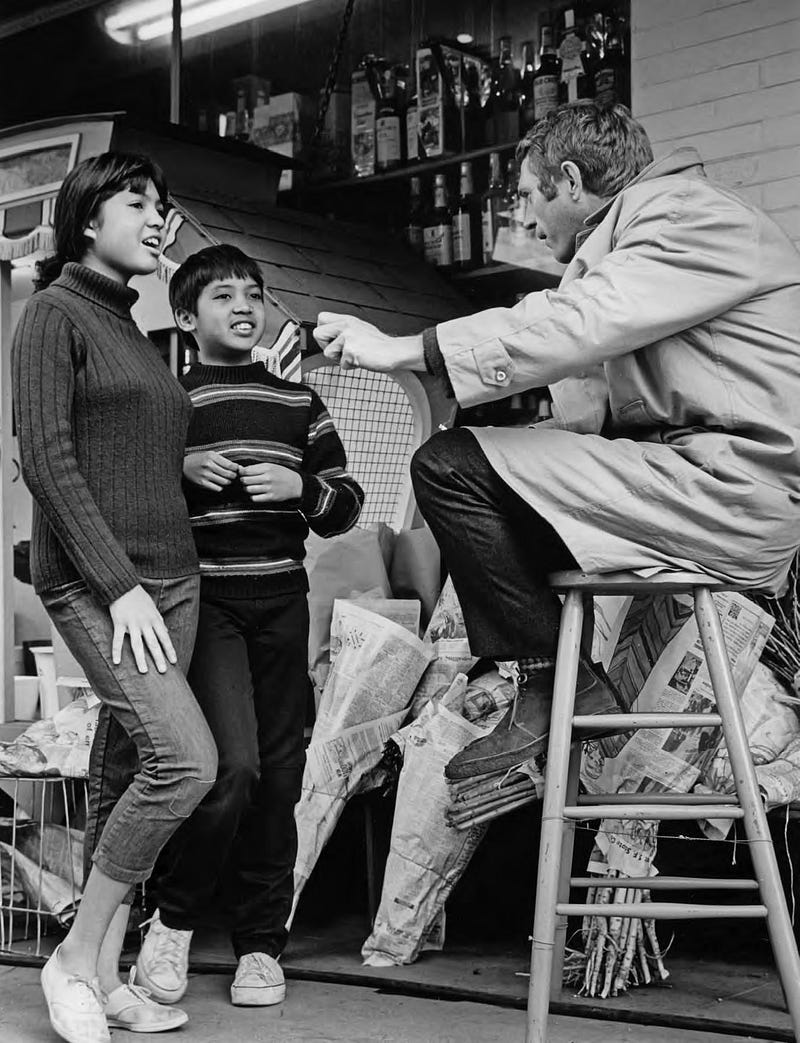
Steve McQueen is the consummate raconteur to two teenagers between takes of 1968’s “Bullitt” on location in San Francisco. The King of Cool possessed a unique kinship with kids, perhaps remembering how tough his own upbringing was. Image Credit: Warner Bros. / Courtesy of Dalton Watson Fine Publishing / appears in “Steve McQueen: The Actor and His Films”
The back and front cover of “Steve McQueen: The Actor and His Films,” a massive coffee-table tome co-written by Andrew Antoniades and Mike Siegel and published on December 15, 2011. Both images of the King of Cool are taken from his 15th film, director Henry Hathaway’s “Nevada Smith.” Image courtesy of Dalton Watson Fine Publishing

© Jeremy Roberts, 2011, 2017. All rights reserved. To touch base, email [email protected] and mention which story led you my way. I appreciate it sincerely.

Movies
Steve Mcqueen
Acting
Hollywood
Film
Recommended from ReadMedium