
Step-By-Step Guide to Product-Market Fit Research
What questions should you be asking?

Do you have Product-Market Fit (PMF)?
If you aren’t sure, the answer, sadly, is usually no. Either way, there is no harm in checking.
But how do you check?
How do you start to improve your PMF?
You don’t. Your customers do. Finding PMF all comes down to talking and understanding your customers. And if you don’t have PMF, there is no excuse to wait.
So buckle up; if you want to understand your PMF, you will be doing a lot of qualitative research in the coming weeks. Quantitative analysis can be a powerful tool for analysing certain events and their correlation with retention. Still, I won’t focus on that here as it requires a wealth of data and doesn’t apply to every business. So instead, the focus is on how to approach PMF when you lack data but have an initial audience (so post-launch).
Here is my recommended approach:
Step 1: Send out a PMF survey
There are two classic questions for PMF:
1. How would you feel if you could no longer use XYZ?
- Very disappointed
- Somewhat disappointed
- Not disappointed
- NA — I no longer use XYZ
2. Could you explain your answer?
These questions aim to understand whether you have PMF or not. The questions are intentionally negative to get people to think critically about their answers.
When discussing PMF, the usual definition is if at least 40% answered “Very Disappointed”. This may not sound like a lot, but trust me, not everyone has to love your product. I’ve found this does differ for vitamin vs painkiller products:
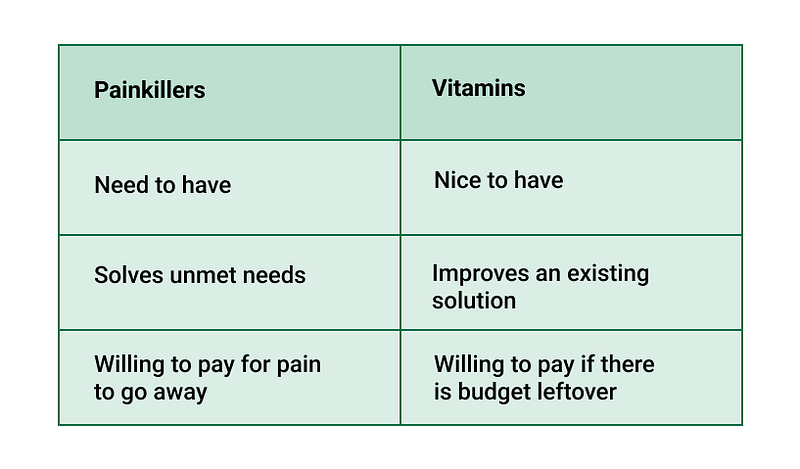
Painkiller products tend to have a higher PMF (a higher % say very disappointed). The highest PMF I’ve ever seen was 78% for a previous client who did a gastric bypass survey which is definitely a painkiller for their customers. So with vitamin products, you might be happy if you have 30%, but it will still be harder to scale. One way to solve this is to find more customers for who your product is a painkiller, not a vitamin.
Minimum sample size
This approach only works if you have a big enough audience to send it. You’d want a few hundred responses for valid data, but truth be told, that isn’t always possible. So I’d aim for 80 responses to get a rough estimate. I usually email the survey to customers and offer a reward for their time.
If you are far off having PMF, your response rate will be low (this would also be an interesting signal). If you didn’t get 80 responses, I would skip this stage and focus on step 3: conducting user interviews.
Additional questions
I would recommend adding a few questions often; a PMF challenge is the result of:
- You know your audience, but the product/service not quite being right (Product challenge)
- You have a strong product/service but aren’t sure who the best market to target (Market challenge)
- You know your market, and they love your product once they get to use it, but you struggle to convince them to try it (Communication challenge)
Feel free to check the earlier part of this series if you aren’t sure what type of PMF challenge you are struggling with.
Here are some specific questions depending on the reason you don’t have Product/Market Fit:
Product questions
If you feel your product isn’t a match for your market, I’d advise Jobs to be Done questions, focusing on what they want to achieve rather than your product. You are trying to understand the following for your product/service:
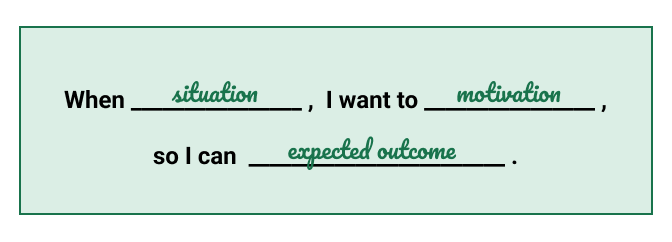
To do this, you need to understand what they are trying to solve and whom they see as alternatives. Here are some potential questions to ask:
1. What other solutions did you try before deciding on [xyz]?
2. What did, and didn’t you like about other solutions you had tried?
3. What led you to try out [xyz]?
4. How did you go about finding a new solution?
5. Did you have any questions or concerns before trying out [xyz]?
6. If you could no longer use [xyz], what would you now use instead?
7. Have you set aside a budget for [xyz] or some other solution?
Market Questions
If you feel like you don’t know who your market is, you can focus the extra questions more on that. It is tempting to stick to demographic questions, but they won’t always tell you much. My favourite question is:
1. Could you tell us a bit about yourself?
Usually, they will write a few sentences containing the most relevant input to their use of your product.
To be honest: this question is best asked in interviews. You can go quiet and let them talk away in an interview. You’ll get a far better idea of who they are. For example, at Heights, we found that a group of customers in their 50s identified themselves as “a menopausal woman”. I would never think to describe them as such, but menopause has a significant impact on their health and they were actively trying to relieve those symptoms.
Other questions you could ask:
1. How does XYZ fit into your daily workflow?
2. What is important to you?
3. What drives you when making a purchasing decision?
You can ask the more typical demographic questions but only ask them when they are relevant. For example, you want to know if they have kids if you are trying to sell them a car; it is far less relevant in the case of shampoo. So try only to find relevant demographics that impact their purchase decisions or behaviour.
Communication Questions
With communication challenges, the most significant impact will be organising your customers’ words into a swipe file and using their words to communicate. I have a step-by-step guide as to how to do this. The idea is that you don’t try to translate what they are struggling with into your words but focus on what words they use precisely and what pains they focus on. There are questions you can ask in your PMF survey to understand this better too:
1. Why do you use XYZ?
2. How would you explain XYZ to a friend or family member?
3. Why did you start using XYZ?
4. What is the main reason you decided to try out XYZ?
5. What would you miss if you could no longer use XYZ
Often a communication issue is a lack of an understanding of what drives value. For this, I love to focus on creating a Value Proposition Canvas based on the surveys, interviews (more on that later) and reviews of customers. I also like to map out how competitors perform in these areas vs what the customers find essential to try to identify gaps in the market.
So your survey will typically contain:
- The two standard PMF questions
- Additional questions focused on Product / Market / Communication
- Any other data that you find useful to understand or have, e.g. relevant demographics to segment by, contact details
I aim to make it no longer than 8–10 questions to ensure I get a high enough response rate. Be very critical of every question you ask.
Step 2: Analyse the data
Next, export your PMF data into a Google Sheet and organise it per answer. The goal of this step is to start to understand better the why behind why you do or don’t have PMF. Even if 40%+ say Very Disappointed, it is worth taking the time to understand this further.
Focus on the “Very Disappointed” and “Somewhat Disappointed” responses.
Your “Very Disappointed” will start to hint at what drives PMF or who you have PMF with. If you have a few 100 responses, you can also organise them by the length of the answer to the second question (the formula =LEN(cell) will tell you which answer is the longest). Often the most extensive answers provide the most insight. I’ve also used R scripts to analyse and understand the language used and more objectively identify trends.
The “Somewhat Disappointed” is the group that you could potentially drive PMF for if you have a product or communication challenge, as it will often tell you:
1. What are they missing from your offering?
2. How could you communicate the value more clearly?
They are the group you most likely convert to “Very disappointed”.
Sometimes you won’t have PMF overall, but you will have it for specific groups. For example, at Heights, we didn’t have PMF for 25–44-year-old customers, but we did have it for 50+ female customers because they were using the product for a very different reason.
Step 3: Interview your customers
The final step of research is interviewing customers. The survey has told you who is “Very Disappointed” and “Somewhat Disappointed” and some initial details as to why. It is worth diving deeper to hear it first-hand from them and understand their customer journey in more depth. These interviews will often give you so much more additional insights.
Recruiting customers
I tend to email them, offer a reward and include a Calendly link to schedule in. I try to show them what is in it for them, e.g. improve their experience. They care much more about this than any reward.
What if no one replies? If you are emailing only “Very Disappointed”, don’t be afraid to follow up; people are busy. If there are still no replies or no one wants, try to ask specific follow-up questions via email or try a personal one-on-one approach.
Starting the interview
Start by making them very comfortable that they can tell you anything. My introduction tends to be like this, “I’m Daphne, and I work in the growth team. It is my job to constantly look at what we can do better, so nothing you can say will offend me. If anything, I love walking away from these interviews with tons of ideas of what to improve on.”
I also ask permission to record just the audio and share this internally (in Zoom, if you record, you’ll get a separate video and audio file, I only keep the audio). I use this as an internal podcast to ensure everyone is listening to these sessions and that I don’t have to take insane notes if I’m conducting the sessions alone. I keep the recordings anonymous for the privacy of the users.
What to cover in a PMF Interview
So what to ask? You want to dive deeper into what you asked before and understand its why.
I advise walking through their customer journey with them. Then, focus on the Jobs to be Done. Even if it isn’t a product challenge, you need to get out of the mindset that only similar products are your competitors.
I talked to this exciting company Concept3D. They create 3D maps of offices, universities, hotels, etc. They have a fantastic product but are exploring new target markets and seeing whether they can find a PMF here. Take the example of offices, no Head of Human Resources wakes up in the middle of the night, calls their boss and goes, “I’ve got it; we should get a 3D map of our amazing office to attract more talent…. Jess? Jess? Are you there?” Slight exaggeration, but you get what I mean; most will not be looking for a 3D map. What are they looking for instead? Ways to attract the best talent, ways to differentiate from competitors. Maybe, even a way to give candidates a feel for the company without flying them over to the office. These are very different Jobs to be Done. That is what you are trying to uncover in the interview.
You want to understand how customers found them in the first place and what they are looking for will help them find a Product-Market Fit with more customers.
I will go through the specific questions related to where the PMF problem is as well as always starting with these general ones:
1. Before diving in, could you tell us about yourself? (Intentionally vague to see how they identify themselves)
2. What is your experience so far with [product/service]?
3. Can you tell me about your journey to [company] and what led you to start using [product/service]?
4. I appreciate this may be some time ago now, but what was your first impression of [company]?
5. Do you remember having any concerns about the [product/service] while purchasing? Or perhaps any questions you felt weren’t answered on your way to purchasing?
6. Did you use an alternative previously?
Then I tend to focus more on the pains and benefits of the product:
1. What would you change about [product/service] if you could? What do you dislike?
2. What are 3 things that are important to you about [product/service]?
3. What would you miss if you could no longer use [product/service] and why?
Some of the questions are similar to the survey, but it is about diving that one step deeper. After ten interviews or so, you’ll get a better idea of what is driving PMF.
I would also recommend:
- Interviewing the “Somewhat Disappointed”. To dive deep into what is missing in those cases to drive PMF.
- You are interviewing your target audience (non-customers). Do a user test to walk them through the experience and see where hiccups might be occurring, e.g. if solving a specific pain is driving PMF, are you communicating this clearly?
Interviewing non-customers is crucial as otherwise, you end up focusing on the positive, which leads to a confirmation bias, basically PMF denial “but everyone loves us”.
Time to get started
I’ve intentionally kept this simple because it is often knowing where to start that gets in the way. Finding Product-Market Fit is an ongoing process; you’ll need to keep measuring and learning from it. It begins with figuring out the Problem-Solution and then that Product-Market Fit:
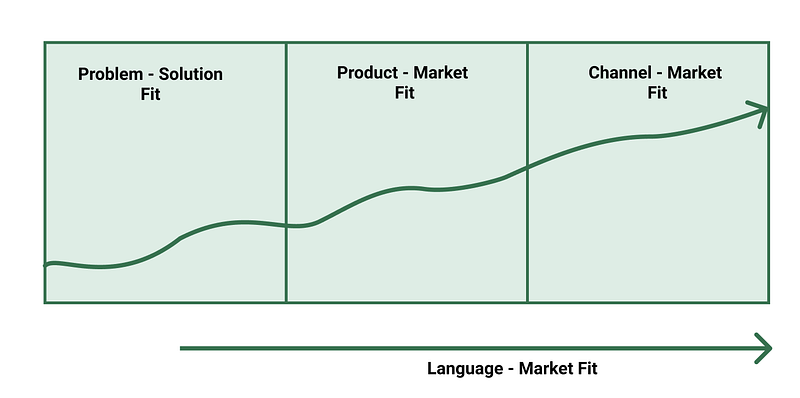
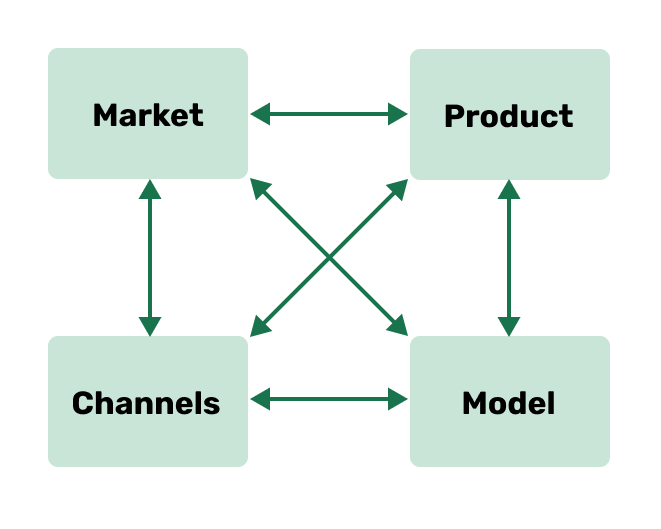
Once you understand that, you can also redefine your business model and channels according to why you have PMF and with whom. True PMF means you also have found the suitable business model and channels to scale:
Doing this research will result in a massive list of potential improvements, focus on the most common ones first, and continue to validate and test each change. I’m excited for you to get started, as I know that this is the best investment there is to scale up your growth.