
Don’t be Just Another ‘Askhole’
The next level of being customer-centric

Are you customer-centric?
Most companies these days would answer hell yes. Yet, why is it then that we are still fundamentally bad at listening to our customers? That our ‘customer intuition’ is too often based on gut feeling.
It is easy to be one of the two extremes:
- You ask for loads of feedback but don’t do much with it, aka an ‘askhole.’
- Customer insights are essential, but you don’t always have time for gathering new ones.
So how do we make it easier to use that feedback?
How do we make the most of the research we have?
There are four main challenges when it comes to customer feedback. Per challenge, I’ll also share small ways to get better at becoming a proper customer feedback native.
Challenge #1: Feedback is a Reactive Process
This is the ‘askhole’ camp; you have a ton of data: an NPS survey, reviews, cancellation survey, customer care data, check-in surveys and another twenty sources. However, combing through the data is an extensive one-off occurrence. Maybe every month or two, you go through all the data, or only when you have a specific question you need to be answered.
That makes it time-consuming to do, and sometimes, you may even need someone else to get the data for you, which adds to the delayed reaction to what customers are saying.
Solution: Feedback Feeds
Set up a place where live feedback gets pushed, e.g. Slack or E-mail. You can even automate this to ensure frequent push of new feedback.
A feedback feed also ensures you see a variety of feedback sources in one place to get a more holistic view. For example, if you have one source dominating the stream (e.g. a specific survey with a high response rate), you can set it only to take every Nth response.
Also, this allows for regular emersion, which beats the occasional deep dive. Of course, you don’t have to read all feedback but dipping into the feedback frequently (almost like a feedback twitter feed) trains your customer intuition.
Challenge #2: Only Reading Summarised Feedback
The people who benefit the most from customer insights are often the busiest: management, developers and growth hackers. Unfortunately, as a company grows, less and less feedback comes directly from the horse’s mouth. Instead, the busy people (pretty much everyone these days) only go through reports and summaries of the findings. This leads to a less nuanced understanding of what customers think and feel.
Let’s take “high quality” as a reason a customer buys a product like Bower Collective, eco-friendly home products. What does that mean? Why is quality important? You may assume it is just the cleaning products themselves but actually looking at direct reviews show you it is also about the quality of the refill packaging that makes people love Bower:
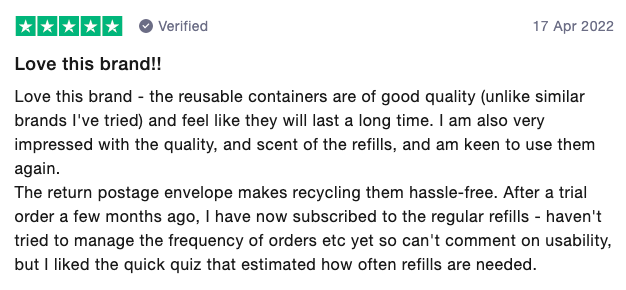
This tells you so much more than just “high quality”.
Solution: Quotes and a Podcast
The feedback feeds already go a long way to solve this, but there will still be moments where you need an overview of all input to identify trends and patterns. So a quick solution for this is always to ask whoever is consolidating the data to include quotes. While this will allow you to select a few pieces of feedback, it will still bring the customer feedback far better than only sharing the summary and helping you feel what the customer is feeling.
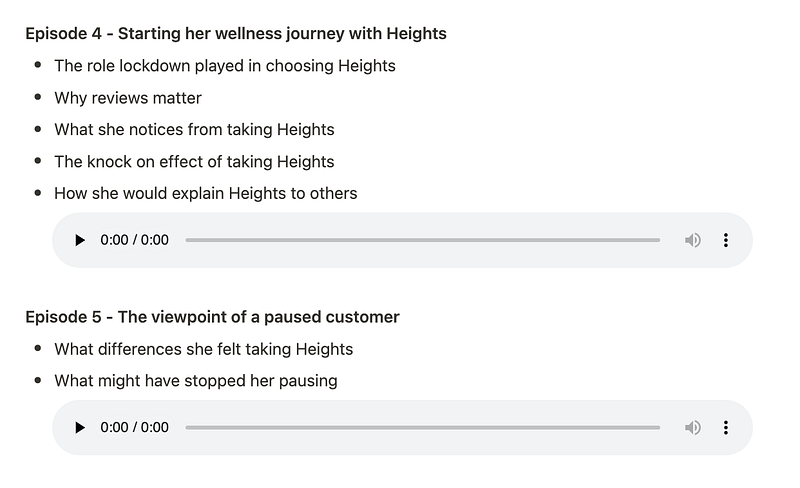
Beyond that, I am also a big fan of recording customer interviews and turning them into an internal podcast that you share. It is helpful to have one individual or team responsible for maintaining this and communicating the episodes internally. Make sure you tag and highlight the focus of each episode so that people can easily see which ones would be relevant to them.
Challenge #3: Focusing on the Positive
Too many companies fall in love with the positive, the praise that customers sing for them, but this is only one side of the coin. If you only listen to happy customers, you’ll never challenge yourself to keep looking critically at what can be done better; you’ll end up shrugging off the negative.
One of my biggest mistakes when starting at Heights as Head of Growth was only interviewing customers with Product-Market Fit (PMF). I was convinced that understanding what drove PMF would help me find it. In the beginning, that meant I missed a lot of reasons people won’t convert. When I started interviewing and user testing with non-customers, only then did I find a myriad of reasons for what was holding them back.
Solution: Two Feedback Feeds
Only negative feedback will get you down; there is a reason we loved the great feedback; it made us feel warm and gooey inside beyond providing valuable insights too. So set up two feedback feeds, one for positive and one for improvement feedback, e.g. Reviews below 3 out of 5 go to the improvement channel.
When summarised, the feedback again includes quotes; you need to push the researchers creating them to share the good, the bad and the ugly.
Challenge #4: Recency Bias and Loud Voice Bias
Ok, only the first one is an actual bias. Yet, both happen when it comes to user research.
Firstly, we place too much weight on more recent feedback; this is easier to remember. However, it can be just a small segment of users or a certain trend or change that sparks the reaction.
The loud voice bias is that more vocal customers are often better at sharing their feelings (these are the lovers and haters of your product), but they aren’t necessarily reflective of the broader group.
Solution: Quantified Measures of Feedback
Beyond having your positive and improvement feedback stream, it is worth setting up a quantified metric of the feedback. For example, this could be tagging customer care tickets every week and sorting them based on features and bugs.
I love it when a company’s customer support says to me, “I will flag this as a feature request” it suggests they have an organised structure for gathering and sharing that feedback.
This isn’t something you track in Slack but Airtable / Google Sheets / Trello. Where you score and track all the different feedback points. You need to choose a time frame that avoids recency bias but is also not too long that requests are no longer relevant. An alternative to this is to look at the requests per area per month.
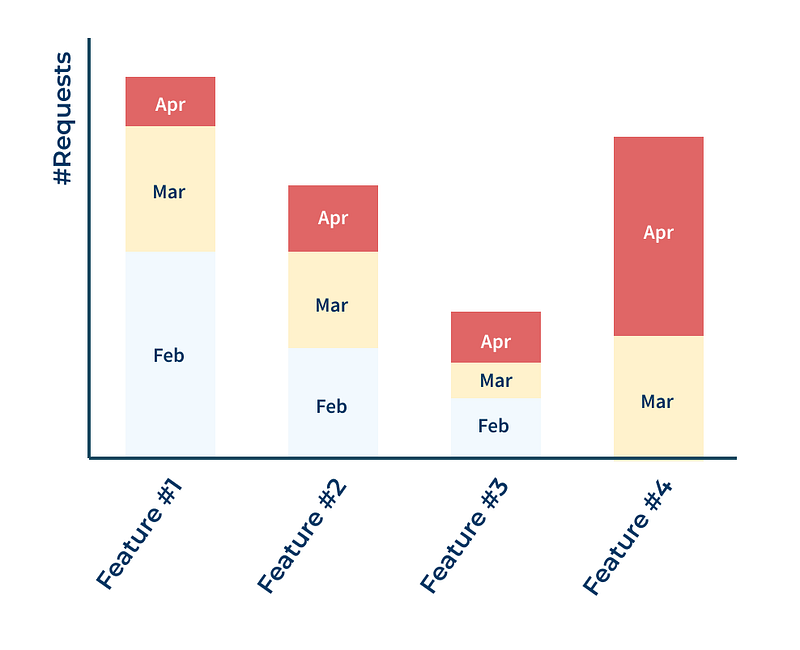
Here you see that if you look per month you might actually prioritise Feature #4 over Feature #1 because of how frequently it was requested in the last month.
Time to be a True Listener
I love the customer-centric movement, but I still think we can be more thoughtful about using all the possible data points to empower our organisations. To avoid being big ‘askholes’ and barely using all those valuable insights.
A few changes in processes and approaches go a long way in allowing those customer insights to become clearer action points to drive our customer intuition and decisions.


