
Step 44: Know Well More Than Two Programming Languages ~Russel Winder
This is the 44th Step towards gaining the Programming Enlightenment series. If you didn’t learn the 43rd Step, read it.

Why learn a new programming language?
It may be wise to say being proficient in one domain will specialize you in that category. Similar, if we focus on one language for work than over time it will standardize the workflow and there will be no learning burden. Which is almost true.
On the contrary, what it also means is the more one is adept at doing things, s/he will be more one dimensional towards problem-solving. It constrains the way they try to solve engineering problems.
C, Pascal, Fortran, all have the same fundamental computational model.Switching from Fortran to C introduces a few, but not many, challenges. Moving from C or Fortran to C++ or Ada introduces fundamental challenges in the way programs behave. Moving from C++ to Haskell is a significant change and hence a significant challenge. Moving from C to Prolog is a very definite challenge.Besides we are entering a period of Polyglot Programming, which can be easily understood by the job description published everywhere.
What really affects when we learn different languages?
Different languages surface out to solve numerous problems that their predecessors didn’t.
Moving between languages will teach us paradigms of computation: procedural, object-oriented, functional, logic, reactive-programming, lambdas, data-structures in each language etc.
These movements might be the greatest challenges of all. It might just change the way we approach the problem. Like doing Procedural — > Object-oriented — > Functional programming, it teaches the different approach to work the same problem.
How to do it?
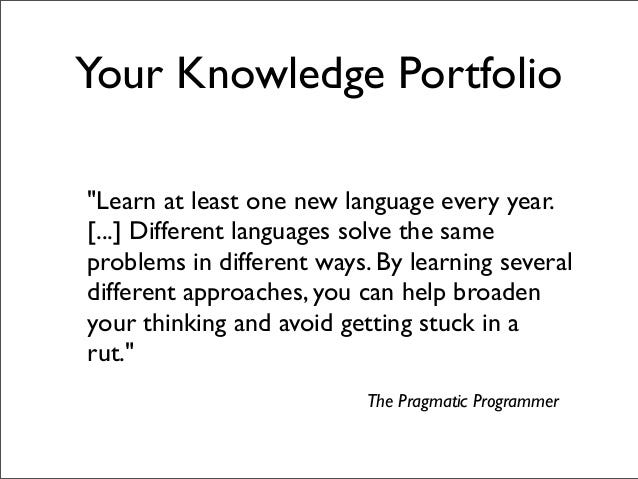
“Although it is suggested that developers should learn at least one new programming language per year to evolve (Hunt and Thomas, 1999).”
Both the advice from “The Pragmatic Programmer” and the statement by Hunt and Thomas, suggests that for us to grow as a programmer, we should try to learn new programming language each year.
But beware, the learning shouldn’t be just for learning sake. We should try to understand the history behind it. Why people architected the new language? What problem did it solve? How did it solve the problem? Learn it’s idioms, it’s use-case. Try experimenting with a simple Calculator or ToDoList application.
Last but not the least, as an engineer, we try to solve a problem, we love solving the problem. There might be overhead that might deter us from learning a new language. And in some cases, huge learning curve even to understand the basics of it.
Keep in mind that 365 days is too long even one can travel around the world in 80 days.
TL;DR Learn a new thing every day. Learn a new programming language each year.
Go to 43rd Step
Go to the next path (Coming soon).
References:
- 97 things Every Programmer Should Know ~ Git Book
- 97 Things Every Programmer Should Know ~ Paperback
- One Language ~ martinfowler.com
- Being a developer after 40 ~ medium blog


