
THE DRAMA OF EVERYDAY SURVIVAL
Standoff in the Serengeti
One Cape buffalo against a 20-member pride of lions
The lion cubs rolled, tumbled, and played just like our domestic house cats. But these kitties you wouldn’t want sprawling around in your family room.
It wasn’t yet 7:00 AM and on our morning game drive in Tanzania’s Serengeti National Park we’d already seen a pack of hyenas feasting on their recent kill, as well as yellow-billed storks, hamerkops, martial eagles, and a swarm of vultures picking at a wildebeest carcass.
We were on another camera safari — the only game we ever shot was with our simple nonprofessional cameras.
Godson, our guide, peered into the distance without the aid of binoculars and declared there was a pride of lions ahead that looked like they were in a standoff with a large Cape buffalo.
The six of us squinted at the horizon and even with our Eagle Optics binoculars had difficulty before we finally spied the lions in the distance.
It was the end of August, and our fifth day in the African Serengeti. We’d carefully chosen these weeks to correspond with the peak of one of the oldest and last great land migrations on Earth.
Yearly over two million wildebeest, antelopes, zebra and other herd animals cross the plains of Tanzania’s Serengeti to the Masai Mara in Kenya. In the dry temperate season animals are easier to spot since they concentrate around rivers and waterholes, where vegetation is sparse.
We began this year in Kenya, and had just returned from Naibor, a luxurious tented camp patrolled by guards armed with AK-47 assault rifles and night vision goggles.
This was for our safety we were told. Not from animals like lions or cheetahs — which occasionally stroll through the camps late at night — but in the event of poachers who might be brave or stupid enough to enter this highly protected area.
Throughout the 5,700 square-mile Serengeti National Park it’s the animals that need protection. Elephants, dark-maned lions, and the rapidly diminishing black rhino are protected by heavily armed, military-trained park rangers who patrol on foot, in helicopters, and in unmarked trucks.
On this morning, Godson drove our vehicle — a customized 4x4 Toyota Landcruiser with a pop-up roof — near the area where the lions formed a wide, loose circle around the Cape buffalo.
From our safe vantage point — about half a football field away — we saw the immobile buffalo standing a short distance from the pride of lions. We counted almost twenty, which included several lionesses, a group of sub-adults and a few litters of cubs.
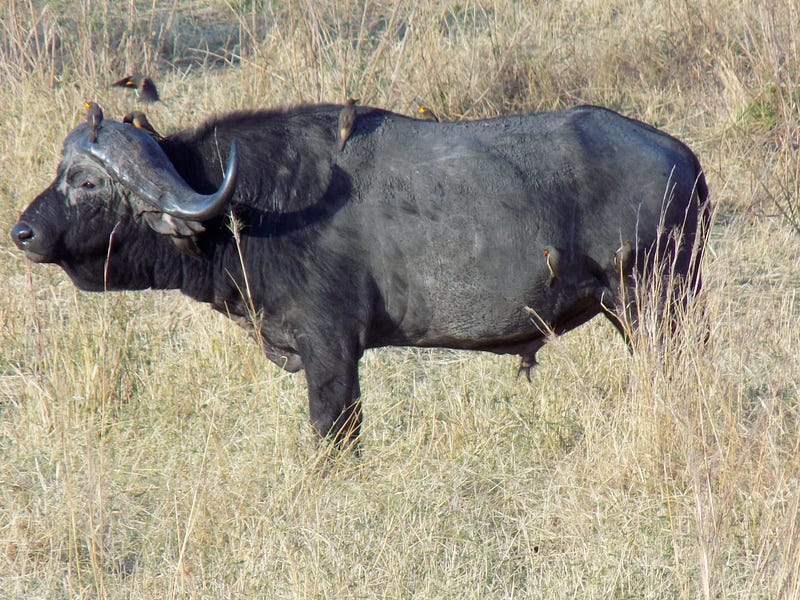
The tiny cubs frolicked, oblivious to the tense drama caused by the bovine’s unwelcome presence. This one was an old male that looked to have dentition problems — a “survivor buffalo” — Godson described him as he studied the animal through binoculars.
The buffalo wasn’t looking for trouble. Most likely he stumbled upon the playing cubs which swiftly drew out the rest of the pride.
As one of Africa’s so-called “Big Five,” Capes reportedly kill more hunters yearly than any other animal. With their large heads and massive bodies, the horns growing from their thick foreheads give them an ancient, prehistoric look.
The old adage “an elephant never forgets” is matched by “the Cape buffalo never forgives.”
They’ve been known to attack people who tried to harm them — years after the incident. A hostile buffalo will stalk and circle its prey. It will then wait for the right opportunity to gore its victim with its wide, deadly horns.
Through our binoculars, we watched the standoff for almost an hour. The sub-adults, aged between one and three years, yawned nonchalantly and strolled back and forth as if taking a break between classes.
The babies rolled and chased innocently but were quickly cuffed if they moved too far from their mother’s side. The protective instinct of a lioness is legendary.
The buffalo stood stock-still, contemplating his predicament. It was unlikely the lions would attack the buffalo for a meal, Godson explained. During the annual migration, millions of wildebeests, zebras, antelopes, and Thompson’s gazelles provide a living supermarket — a spectacular all-day buffet.
What the lions wanted was for the buffalo to leave. That’s what he wanted, too.
However, each time the creature moved slightly toward a point of exit, the sub-adults charged excitedly toward him, crouching, stalking, and feinting fancy attack moves.
Our guide laughed at the sight. “Look at them cheeky fellows! They’re communicating to their mums….look at me, see what a brave hunter I am!” We could faintly hear their snuffling sounds and pint-sized roars that seemed to confirm what Godson said.
The young lions did look like they were showing off. The problem was, it confused the old buffalo who didn’t know if they planned to attack or not.
Eventually, the situation was resolved when the buffalo finally inched his way carefully from the danger zone.
The pink-nosed youngsters continued to vocalize and posture each time the animal tentatively looked back at the imposing view of the pride.
But finally, after enough distance was between them, he broke into a trot and then into a run. Soon after, all we saw was the reddish-yellow dust rising from his exit.
© Deborah Camp, 2021
If you liked this story and want to read more of my stuff, please use my referral link! Your $5 monthly membership fee supports me and all other Medium writers. https://medium.com/@deborah.camp/membership
Or, maybe you’d like to write for Medium (release your inner writer!). Get started by using my link at: https://medium.com/@deborah.camp/membership