
NOVEL
Stand Up for Myself and My Dreams
The Love We Had, Chapter 34
A writing challenge
Write and publish a book review of the novel The Love We Had, based on freely chosen chapters published on medium.com.
The book review can be a comment of 100 to 200 words, or a longer article, and should be published on medium.com.
Everyone who publishes a book review will receive a link with free access to the e-book when the e-book is published on KDP. Please tag me Øivind H. Solheim at the end of the review to get free access to the e-book.
34
I can believe what does not seem to exist. I can believe in what is missing today if I am capable of imagining it.
I need to believe that it can go well, anyway, despite those things that can look disappointing. And if it seems almost hopeless, I should never give up, never stop waiting on what will not come of themselves. I have to believe in what will come if I don’t give up. I must believe that it helps to hold out, to endure, never give up, stand up in defiance.
I have to believe that I can achieve what is not given to me. Take what I do not get in my hands. Take what is mine. It is never too late to get up for myself and my dreams, to stand safely in gusts that want to tear me over.
To believe that something does not exist is the same as to deny. It can easily be something very similar to nihilism.
“Lars,” I said.
“Yes.”
“Do you believe in us, do you?”
“Believe, what do you mean?”
“Either you believe or you do not believe.”
“But what then?”
“In us, Lars. You and me.”
“What nonsense. No, I do not understand what you’re talking about!”
“How we are. Our life.”
“Our life is what it is, obviously!”
“But do we have it the way we want it, do you think?”
“No, that’s enough. Can’t stand such talk!”
To have a vision is to have faith that something is possible, that something can be different in life, in our reality. That’s the most important thing I have to remember, I say to myself. And reality and life, it’s not just what it looks like now. Change can happen. I must not forget. Things can change. I have to think about how it can be and how I want it to be. This is the dream I always carry.
I cannot remember the last time he and I talked about it, about our dreams, about what we should achieve together and all that we should create. Great things we should be proud of.
I do not want to pretend that I myself am not wrong. I struggle, and sometimes I’m not the way I should be. I know I need to be better at listening, and seeing those who need it most. And I have to be patient.
“You mom, can you look at this?”
“Yes, dear, but not now.”
“But you, I must — .”
“No, not right now.”
“He says I have to -:”
“Do not have time right now.”
I think it’s a mistake we’re making. We do not talk together, we do not talk to the young people about our dreams, their dreams. And we do not have a joint project either. That is why we go for ourselves, as isolated islands, and we lack everything: we lack community, closeness and goodness, we come up with meaningless statements, and we do everything we can to avoid talking about the important things.
We long for change, because change is needed, we agree on that. But we hesitate to take on what is important, and we rarely take real action to create movement and create something new.
To move forward, we must take new steps. We must see each other, and then we must have the will to forgive, be good and generous to each other. We must take the chance that the one we have in front of us actually has something important to say, or to share with us.
We have to take a chance on each other. I have to take a chance, because I can never know what others may have that they want to share with me. If we are to achieve this, we must say something that can open up in us so that we clearly show that we are willing to accept what someone wants to say to us, something that we may not want to hear.
If we do not do that, there will be no movement, no development and no change.
What happened was very difficult, and I got a severe headache. It was a bad conversation. I probably could not convey to him how I felt, I could not answer him. I became impatient and annoyed.
“You overreact,” he said, “you are out of balance.”
I said to myself: You have to think, you have to think a little rationally.
I have to think sensibly, and right now it’s completely impossible for me.
While he was out, I managed to calm down more, and I managed to think a little.
I feel the black comes rolling over me. I miss the little one who did not live. I crawl together inside my shell, I cry to him that he does not care, that he doesn’t understand me.
He says that I overreact, that I am in imbalance. He puts his hand on my shoulder and takes it away again a little too fast and I get annoyed that he is so unrelenting, that he’s done so quickly, that he does not dwell a little more, he does not listen to the unsaid words, doesn’t listen to my needs.
He walks out of the house and I can close my eye. I find that I can dream again and that one of the dreams may be to lull me away, to dream of another fortune, maybe later too, dream about another man.
It is still far there — very far because I have chosen this man many years ago. He is the one I have become accustomed to; he is the one I am used to. He is the father of the boy, father of the two little girls and to her who didn’t live.
We have three small humans that we together bear responsibility for. Therefore, I must think reasonable.
And how can I manage to think sensibly when I am annoyed, angry — yes, upset because he cares so little because he doesn’t care about showing me quite ordinary, decent respect?
He comes home far too early. He has only gone for a walk, and then it became too much for me. I cannot bear to see him. I have to go out. Will not and cannot be here in the house when he returns.
I put on my jacket and went downstairs. I walked across to the river. I stopped up on the bridge to look at the cascading, white bouldering water below me. There was a gust of wind from further up that pulled in my jacket. Then I went on. I was deep in my thoughts. Did not notice the time that passed.
I walked a long way, I walked so long that several hours had passed when I walked back and up towards our house. I could see that the light was off in the kids’ rooms, but there was light in the living room and kitchen windows.
It was over eleven o’clock and I made up my mind. I walk past our house. I’m going to go and see him, because I cannot bear to go home now, after what happened. I go to him because that’s how it is, not because I have to go to him. I have to get away from the other, he who is my husband. And this was the start of what happened later. It was the start of something nice. It started ugly. But it turned out fine.
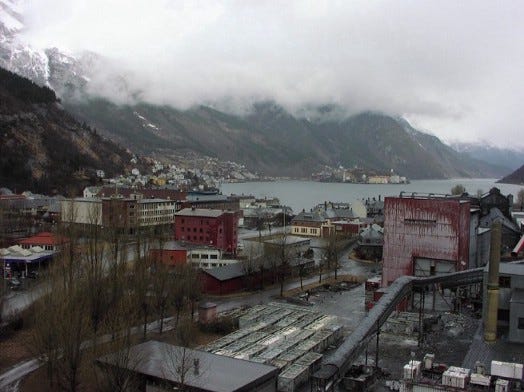
The story that the novel tells takes place in a small industrial town at the end of a fjord in western Norway. The story being told and the characters are fictional.
The photos included in the chapters are taken on location in Odda and in the Odda Smelter (Odda Smelteverk, 1906–2003), the carbide factory that is part of the story.
The Love We Had
Part 1 The Longest Night -chapters 1–3, told by Lars. Part 2 The Light Inside -chapters 4–17, told by Aslak. Part 3 Save Our Secret Love -chapters 18 — XX, told by Eira.
For quick access to all chapters, go here.
Previous chapter: Chapter 33 The Distance Between Us
Next: Chapter 35 The Next Thing in Life
Øivind H. Solheim writes fiction, essays and articles aiming to help others understanding life, other humans and themselves. He has published five novels, two non-fiction books and a poetry book.
Visit Øivind H. Solheim’s profile
Become a Medium member, read thousands of writers and support my writing.


