
Spiritual Stirrings: Odd Occurrences at the Close of the 1800s
By the end of the 19th century, human minds were taken over by encounters with spirits. The foolish superstitions of the theosophists later served criminal ideologies.
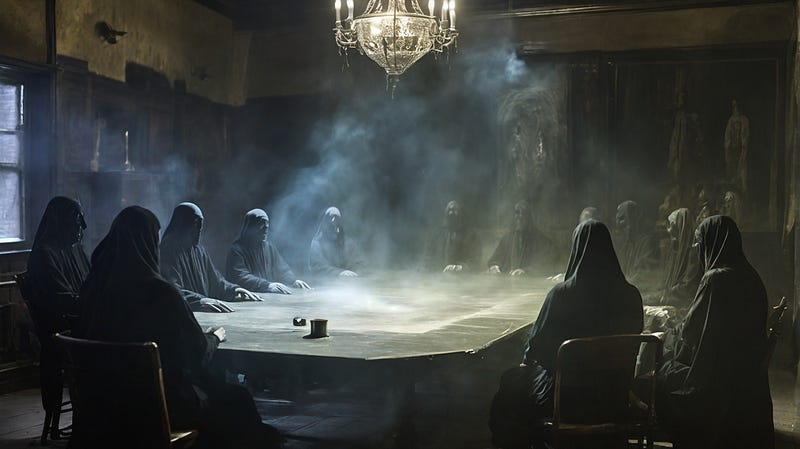
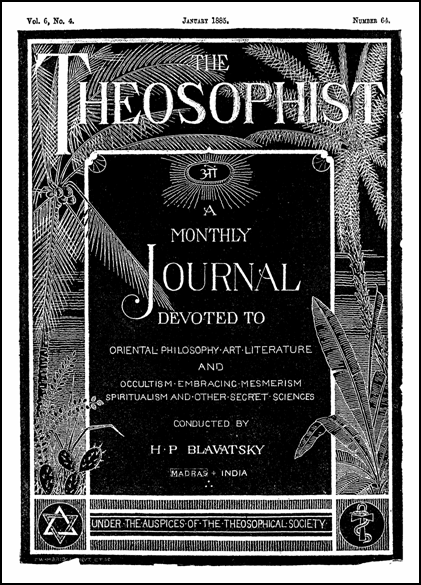
Above the door, a stuffed bat loomed. Leaves imitating a jungle hung from the walls. In the green thicket, silhouettes of a snake, tiger, and statues of Buddha shimmered. On September 7, 1875, 19 people entered the oddly adorned New York apartment at 47th Street. They gathered to initiate a new era in human history. They knew each other well, so without unnecessary formalities, they enacted statutes, elected authorities, and announced to the world the establishment of the Theosophical Society.
The association’s name, derived from the combination of Greek words: theos and sophia, means ‘divine wisdom.’ Its members had no doubts that they had discovered the deepest truth about the world, the cosmos, and humanity. They did not intend to conceal it. On the contrary, they wanted to disseminate it so that brotherhood and justice would finally prevail on Earth.
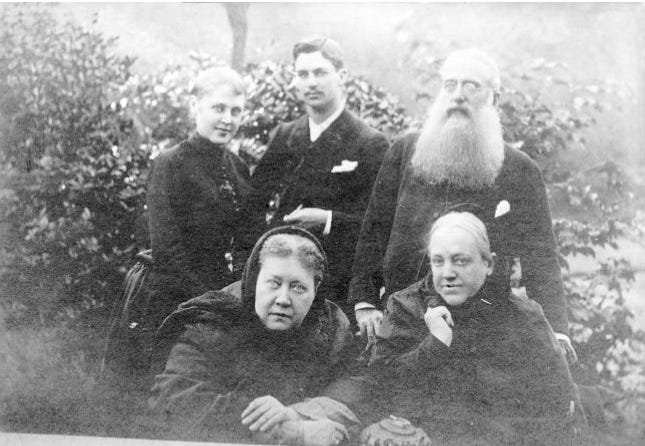
Specifically, the hostess of the meeting, Helena Blavatsky, a corpulent 44-year-old lady with hypnotizing blue eyes, discovered this truth. It wasn’t yet the time for gender equality, so alongside her in the board sat lawyer William Judge and retired Colonel Henry Steel Olcott.
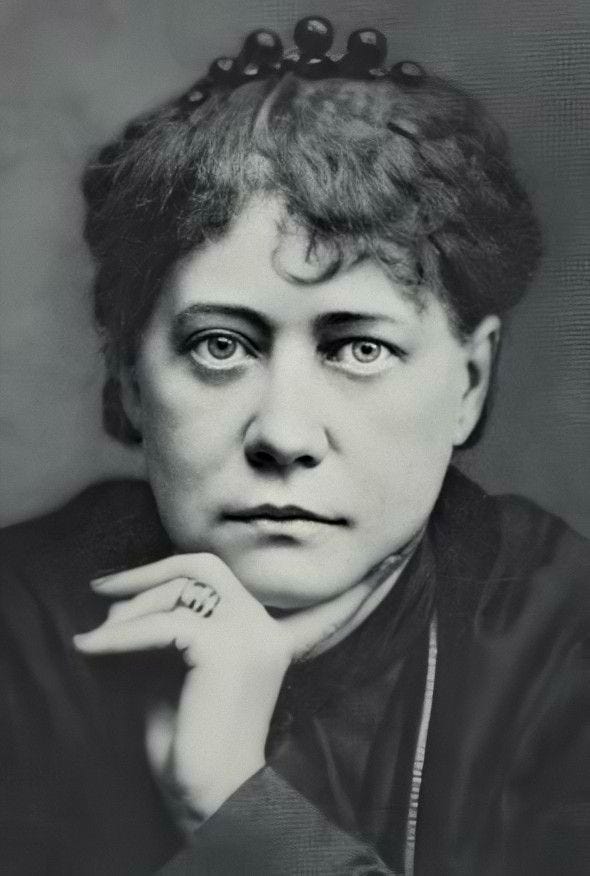

Who was Helena Blavatsky
About Blavatsky, only as much is known as she revealed herself. And because she had an exceptional ability to mix fiction with reality, it is very difficult to separate them. She was born in Yekaterinoslav. She was the daughter of a Russian noblewoman, Elena Fadeyeva, and a German officer in the Tsar’s army, Peter von Hahn. In her later fabrications, her parents were promoted to the rank of princes.
After her mother’s early death, Helena was raised by her grandparents, who quickly found her a husband. At the age of 17, Miss von Hahn became Mrs. Blavatsky, the wife of the vice-governor of Erivan. Her husband, nearly three times her age, failed to evoke even a hint of affection in the teenager. She didn’t allow him to touch her, and a few months after the wedding, she left for Egypt. According to her version, she fled. However, she had no problems financing the expedition, so she probably obtained her husband’s permission. He deluded himself that the journey would change her attitude towards him and, above all, calm her frayed nerves and restore her mental balance. He had reasons to worry because the young wife spent long hours conversing with invisible sages. They imparted secret knowledge to her. She called them mahatmas.
The expedition to Egypt changed nothing, but it marked the beginning of years of wanderings. Blavatsky reached Lebanon, Syria, Iraq, Turkey. She claimed that everywhere she met spiritual masters who introduced her to the world of their beliefs and mysteries. She learned about the doctrines of the Druze, the Dervishes, the Copts. It’s rather hard to believe that mystics who don’t reveal secrets to anyone except faithful disciples shared them with an unknown person, especially a woman. However, she narrated her adventures so convincingly that her enthralled listeners never even thought to question her credibility.
After two years, she returned to Europe, obtained a divorce, and during her stay in London, met an incarnate mahatma. He assumed the form of a ‘tall Hindu’ who recognized her and invited her to Tibet, to the Center of Masters’ Wisdom. Although Tibetologists unanimously claim that she never went there, Blavatsky insisted until the end of her life that in disguise, she reached monasteries where old Lamas, incarnations of mahatmas, imparted secret knowledge to her. She named the salon where the Theosophical Society was constituted in their honor as the Lamasery.
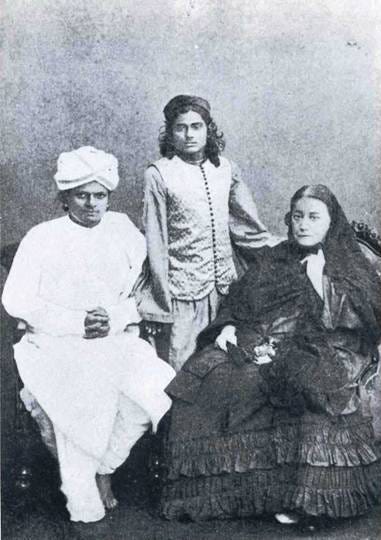

Theosophy and Alleged Spirit Knowledge
Just a few years after its inception, the organization had branches in Europe, both Americas, and Australia. Blavatsky then moved its headquarters from America to India to be closer to the spiritual masters. She not only received verbal transmissions from them but also written ones that spontaneously appeared on sheets of paper. The situation became somewhat complicated when servants discovered a pneumatic mail-like system and boxes resembling those used in trickery. Experts from the London Society for Psychical Research, after analyzing the handwriting, concluded that the texts were produced by the theosophist.
It had little impact on her followers, as they believed she had fallen victim to the vengeance of disgruntled employees. Nonetheless, Blavatsky ceased the written séances and henceforth claimed that, thanks to the invisible sages, she possessed the ability to read the Akashic Records — a cosmic archive in which, through the magnetic force of every individual, all events from the beginning of the world were inscribed on “the waves of the astral light.”
What she gleaned from this, she shared in her life’s work — published in 1888 as “The Secret Doctrine.” This two-volume book, written in convoluted language, spans over fifteen hundred pages. Blavatsky argued that the first humans were ethereal, invisible, and sexless beings. They were destroyed by a cosmic cataclysm, after which they reincarnated as a less perfect race, possessing, in addition to the spirit, the so-called astral body. History repeated itself five times, each annihilation giving rise to a worse, more corrupted race. The third existed in Lemuria, the fourth in Atlantis, and from its remnants, who survived in the far north, the Aryans were born.
The Ice Age compelled them to migrate southward, laying the foundations for great civilizations: Egypt, India, Persia, Greece. Due to various upheavals and the corruption of pristine nature by sex, further sub-races emerged, increasingly attached to matter, forgetting the divine spark imprisoned in their bodies. The task of the Theosophists was to halt this degradation of humanity and reverse evolution towards the spirit. This mission was entrusted to them by the hidden masters, who — as it turned out — were incarnations of ancient Atlanteans and Aryans, living in the Tibetan realm of Shambhala. There, from generation to generation, they passed down the ancestral knowledge: the secret doctrine.
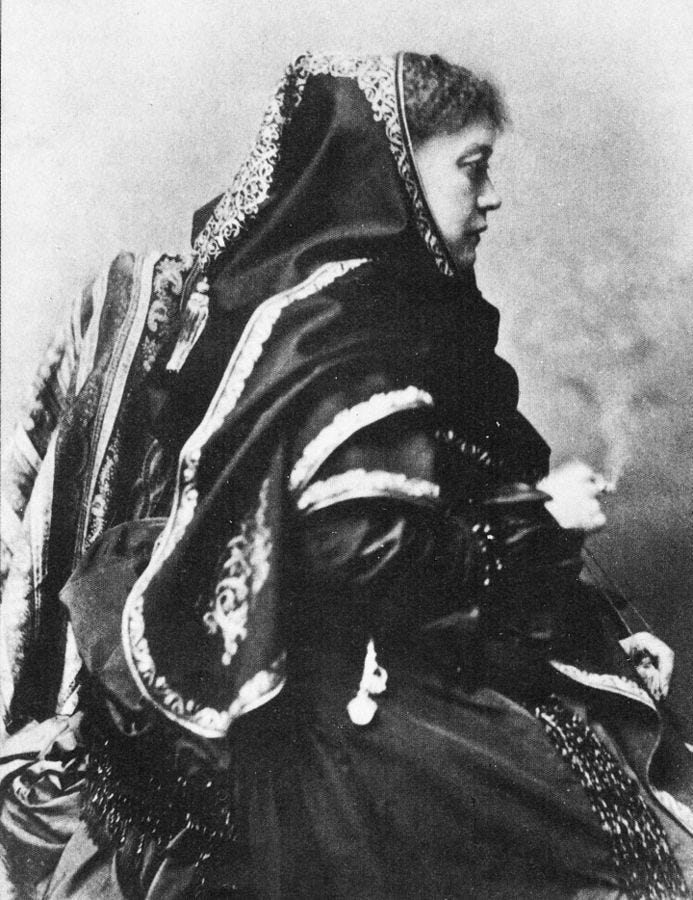

A Religious Substitute
From a scientific standpoint, it was pseudointellectual gibberish; from a religious perspective, it was a new version of old Gnostic heresies, resurging during every Christian crisis. Since the Reformation, the Church had been losing its monopoly on ultimate truth; in the Age of Enlightenment, secular competition began to emerge — from secret societies like the Rosicrucians to Freemasonry. In the mid-19th century, the foundations of religious worldview were further shaken by the theory of evolution and the Industrial Revolution.
However, the triumph of rationalism and materialism gave rise to a romantic yearning for grand mystery. Occultists everywhere, from New York to Siberia, gathered in clandestine meetings, rediscovering the secret texts and mysteries of ancient Egyptians, Persian magi, Greek mystics, and Jewish Kabbalists.
Theosophy fit remarkably well into this climate. On one hand, it rejected religious dogmas conflicting with science; on the other, it reminded people of religions older than Christianity: Buddhism and Hinduism. The secret doctrine borrowed much from them, which lent it gravitas, and the exotic element increased public interest. For many people leaving Christian Churches for various reasons, Theosophy became a religious substitute, and the “Secret Doctrine” — their Bible. The bulky, obscure book could be interpreted by everyone in their own way. For those put off by fairy tales of Atlantis, they could focus on reincarnation and spiritual self-improvement. Hence, Theosophy found followers not only among eccentric esotericists. One of its advocates was the Nobel laureate in literature, William Butler Yeats, who even adopted the mystical name Diabolus est Deus Inversus (Devil is God in Reverse).

Respected People Believed in Spirits
An eminent Dutch painter and art theorist, Piet Mondrian, was a member of the Society. The paintings he created with arrangements of straight lines and geometrical spots in three colors were Theosophy translated into the language of art. The Russian artist Nicholas Roerich, in search of Shambhala, traversed the Himalayas, India, and the deserts of Central Asia. Later, he founded the international Society of Agni Yoga, propagating a mystically saturated variant of Theosophy within Orthodoxy.
Not only lofty artists succumbed to Theosophy, but also down-to-earth individuals. William Gladstone, the four-time British Prime Minister, became so absorbed in thoughts about Atlantis that he asked the government to finance its search during a cabinet meeting. In Poland, General Michał Tokarzewski-Karaszewicz was involved in Theosophy, commanding the clandestine Service for Poland’s Victory and serving as General Anders’ deputy in the Polish Army in the East. Ironically, as one of three Polish Theosophists, he had the right to wear the symbol of the highest initiation: a silver swastika. For obvious reasons, he never wore it.

The Trend of Spiritualism
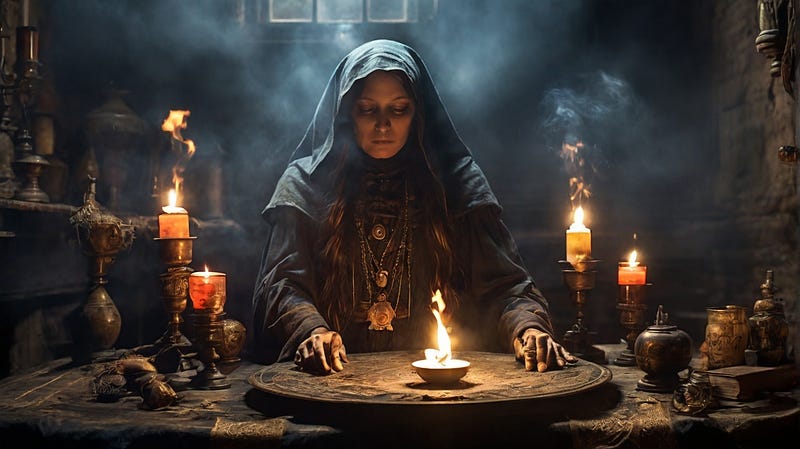
In 1848, American newspapers published sensational news from Hydesville. Excited reporters reported that three sisters — Kate, Leah, and Margaret Fox — established contact with spirits and could communicate with them using a special code. The invisible entities responded to questions through raps or by moving objects. Since photography was not yet widespread, articles were illustrated with drawings of tables and chairs levitating in the air. This captured people’s imaginations, and the need for the extraordinary was so prevalent that, after a few months, the Fox sisters found imitators. Summoning spirits no longer required laborious study of esoteric texts; candles, a table, and a medium sufficed.
The world went literally mad for spiritualism. The keenest minds of the era, with deadly seriousness, claimed to converse with spirits. President Lincoln consulted with his deceased son, Lord Balfour, the British Prime Minister, “established contact” with a lover who had passed away years ago. She conveyed messages to him through automatic writing and speech. So beguiled was he by her that he eventually abandoned politics and, in the twilight of his life, devoted himself entirely to the esoteric.
Among the notably committed spiritualists was Arthur Conan Doyle, the creator of the most rational literary character — Sherlock Holmes. Privately, he was the complete opposite of the master of deduction. He regularly conversed with his deceased wife and, after World War I, with his fallen son. Following their advice, he remarried and, along with his spouse, traveled the world from Australia to South Africa and the USA, lecturing about spirits. Their constant advisor became an Arabian genie named Phineas.
Victor Hugo could boast an interesting array of conversationalists. After voluntarily exiling himself to the island of Jersey, he became a member of the local community of spiritualists, led by the medium Delphine de Girardin. He started, like everyone else, by summoning a loved one: his daughter Leopoldine, who drowned in the Seine. He recognized her voice and henceforth conversed convincingly with Molière, Machiavelli, Galileo, and even the ancient dramatist Aeschylus. The course of these conversations he documented in the reluctantly recalled work “The Spinning Tables of Jersey.”
Summoning Spirits
Charles Dickens met with his deceased sister-in-law, Mary Hogarth; the Czech painter Alfons Mucha always had appropriate accessories handy to chat with spirits if needed; Karl May, a notorious vagabond and author of bestselling novels about Winnetou, conducted séances in his own home. Once, a visitor from another world forbade him and his wife from having sex. Yet, he was a decent spirit, for a few decades later, after the couple divorced, and May amassed a fortune, the spirit instructed him to provide a lifelong pension for his ex-wife.
In the twilight of their lives, the Fox sisters revealed that they had engaged in manipulation. They did not summon tapping spirits; instead, the sounds were produced through skillful toe-joint snapping. This, however, didn’t make much of an impression on the spiritualists. They knew their trade.
Not only the respectable spirits of the departed and invisible sages emerged from the depths of occultism. There were also apparitions. In Germany, following the Romantic fascination with folk and pre-Germanic culture, self-proclaimed prophets proliferated, attempting to revive ancient pagan cults, or rather their own imaginings of them. Their “secret doctrines” were a mixture of delusions and speculations about the latest discoveries.
Racist Ideology
In 1786, the English linguist William Jones observed astonishing similarities between most European languages and the ancient Indian Sanskrit. From this, he logically inferred that the nations speaking them must have had a common ancestor. Soon, it was discovered that this mysterious people, with fairer skin than the Indians, were referred to as Arya in Sanskrit. The word probably derived from the Aryan highland, which also lent its name to Iran. However, to German esotericists and philosophers, it was associated with Ehre — honor. Hence, it was only a step to declare that the Aryan people, Aryans, or Aryan race were the masters.
An even bigger stir was caused by the discovery that the Hebrew language did not belong to the Indo-European language family. This allowed the open questioning of the idea that all people descended from a single set of ancestors. “Each race was created separately,” proclaimed amateur anthropologists. Adolf Lanz, the founder of the Order of the New Templars, claimed: “Jews, through their religion, sought to make all humanity their offspring, but science finally proved that this attempt failed.” It failed because the Germanic people preserved ancient, authentic faith and wisdom in rituals, myths, and sagas. This heritage had to be safeguarded and defended.
An additional impetus for spinning these phantasmagorias was provided by Darwin’s theory of evolution, primarily extracting the thread of the struggle for existence. According to Wilhelm Marr, the author of the 1879 pamphlet “The Victory of Judaism over Germandom,” races not only coexist but engage in an eternal struggle for dominance. The victors, just like in nature, will be the stronger ones — either the Aryans or the Semites.
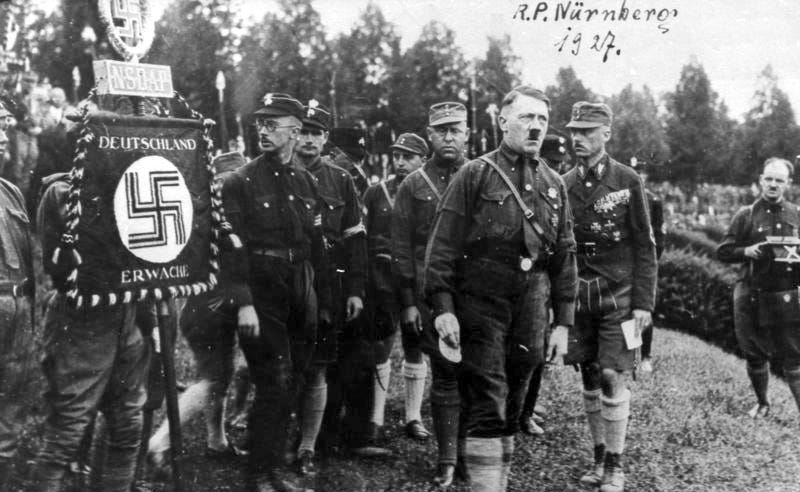

Nazi Ideology
The dull arguments reached those already convinced, but they were unable to incite the masses to fight for racial purity. The fuel to transform pseudoscientific theory into a compelling idea for the crowds was only provided by Theosophy, with its doctrine of the evolution of higher, spiritualized races becoming increasingly attached to matter, and the claim that Aryans are the inheritors of the Atlanteans. Blavatsky and her successors offered everyone the chance to discover the divine spark within themselves, thereby enabling humanity to rise above all divisions, veer away from the path towards decline, and achieve a state of brotherhood.
German occultists interpreted the secret doctrine in a completely different way. Since the Aryans were the creators of all great civilizations, they should have control over the world. Other races were subhumans who must submit to them. German esotericists at the turn of the century adopted from ancient Gnostics a dualistic vision of eternal struggles between good and evil, light and darkness, spirit and matter — identifying these forces with the Aryan race and the opposing Semitic race, and the mystical power of the Aryan people with blood. The victory in the ultimate, world-encompassing war, on which the purity of this blood depended, was supposed to herald the coming of the millennial kingdom of peace and justice: the Thousand-Year Reich, as proclaimed in the Apocalypse.
Attention all readers!
As content creators on Medium.com, we face minimal compensation for our hard work. If you find value in my articles, please consider supporting me on my “Buy Me a Coffee” page. Your small contributions can make a big difference in fueling my passion for creating quality content. Thank you for your support!

