avatarErik Reich, DC

Free AI web copilot to create summaries, insights and extended knowledge, download it at here

2325

Abstract

cesses of the spine, and are not themselves sources of pain. In the same way wrinkles on your face and grey hair are not painful, most “disc degeneration” is not painful.</p><p id="7cb3">So different yes, but older doesn’t equate to worse. In fact, if these changes were causative for spinal pain you would expect people to have more back pain as they age, but the peek ages for back pain are between 35 and 55 years old. Back pain from age 55 to 80 actually decreases¹.</p><p id="0efc"><b>Then we come to another definition of slip, further down the line.</b></p><p id="f735">4. Escape or get loose from (a means of restraint).</p><p id="9ff8">This definition you can almost make a case for if you are specifically referring to a disc herniation, extrusion, or sequestered disc material. Except spinal discs are more complex than the material which comprises the nucleus pulposus alone.</p><p id="4c0a">So yes, sometimes the jelly can escape out of the donut. I’ve used this analogy before with patients, it’s easy to understand. It also fails spectacularly in conveying how robust your spinal discs actually are, which is why I don’t use it anymore.</p><h2 id="66e9">Discs are not doughnuts.</h2><p id="1465">The tough connective layers which make up the outer rings of the disc have as much in common with pastry dough as silly string does to steel cable. There is no comparison. The gel like material inside the disc is also much tougher than strawberry jam. Doughnuts are also not bound top and bottom by extremely tough cartilaginous and bony endplates. Also, there is no natural force acting on a doughnut whereby leaving it alone on a plate for 6–12 months with a glob of jelly hanging out the side will cause the jelly to spontaneously resorb back into the doughnut.</p><p id="2f2a">Spinal discs heal. If we’re going to use the term “slip” in this capacity to describe a disc herniation, then discs can also “unslip” so let’s just agree that slip is a terrible way to describe what may be happening to cause your back pain.</p><figure id="a8e4"><img src="https://cdn-images-1.readmedium.com/v2/resize:fit:800/0*Wk5Vymkfbu6PIe5M"><figcaption>Discs don’t move easily unless you’re playing Mortal Kombat or watching Predator. Photo by <a href="https://unsplash.com/@neonbrand?utm_source=medium&amp;utm_medium=referral">N

Options

eONBRAND</a> on <a href="https://unsplash.com?utm_source=medium&amp;utm_medium=referral">Unsplash</a></figcaption></figure><h2 id="0c63">Final Thoughts</h2><p id="3936">Your spine is incredibly strong, adaptive, and complex. While simple analogies have a place in breaking down complex subjects, they can also reinforce perceptions of fragility and weakness, which prolong or worsen outcomes in patients who may already be dealing with fear, anxiety, and uncertainty around their back pain.</p><p id="0174">Practitioners and patients must be aware of, and avoid falling into narratives and descriptions which may worsen outcomes. Discs are strong, and they heal, and the human body is not fragile.</p><p id="b0b8"><b>Works Consulted:</b></p><ol><li>Hoy D, March L, Brooks P, Blyth F, Woolf A, Bain C, Williams G, Smith E, Vos T, Barendregt J, Murray C<b>, </b>Burstein R, Buchbinder R. <b>The global burden of low back pain: estimates from the Global Burden of Disease 2010 Study</b>. <i>Annals of the Rheumatic Diseases</i>. 2014 Mar 24.</li></ol><div id="9e80" class="link-block"> <a href="https://readmedium.com/self-sabotage-after-spinal-injury-8a251028df4"> <div> <div> <h2>Self Sabotage After Spinal Injury</h2> <div><h3>If you want to optimize your chances for the best possible recovery, avoid this activity.</h3></div> <div><p>medium.com</p></div> </div> <div> <div style="background-image: url(https://miro.readmedium.com/v2/resize:fit:320/0*-Su2IKvB3DJFtUox)"></div> </div> </div> </a> </div><div id="d079" class="link-block"> <a href="https://readmedium.com/do-lumbar-disc-herniations-heal-without-surgery-bd69ca4ae6a2"> <div> <div> <h2>Do Lumbar Disc Herniations Heal Without Surgery?</h2> <div><h3>A recent systematic review and meta-analysis offers some evidence.</h3></div> <div><p>medium.com</p></div> </div> <div> <div style="background-image: url(https://miro.readmedium.com/v2/resize:fit:320/0*v-wieI38FYw4K5X7)"></div> </div> </div> </a> </div></article></body>

Spine Health

Spinal Discs Do Not “Slip”

These common terms such as “slipped disc” may be making things worse.

IF you or a loved one have ever suffered back pain, you may have come across the term “slipped disc” as a convenient way to label what is thought to be occurring at the presumed site of your pain, the intervertebral disc.

Here’s the problem, spinal discs do not slip.

Look up slip in a dictionary. It’s a stretch to apply any of the agreed upon definitions of the word to the discs in your back.

Discs do not:

  1. Accidentally slide or move out of position.
  2. Fail to grip or make proper contact with a surface.

Now, one could argue that this may occur:

3. Pass or change to a lower, worse, or different condition, typically in a gradual or imperceptible way.

Let’s discuss why this is not the case.

As a normal process of aging spinal discs are frequently described as “degenerating” such as on a radiologist’s report of imaging findings. Is this a lower, worse, or different condition? Different sure, but worse, likely not.

Spinal disc degeneration is a combination of factors picked up on imaging such as narrowness of the disc space, desiccated appearance of the disc material, and bony changes around the disc site often referred to as osteophytes or “bone spurs” — this can all be scary sounding stuff.

However, more often than not these changes are due to the normal aging processes of the spine, and are not themselves sources of pain. In the same way wrinkles on your face and grey hair are not painful, most “disc degeneration” is not painful.

So different yes, but older doesn’t equate to worse. In fact, if these changes were causative for spinal pain you would expect people to have more back pain as they age, but the peek ages for back pain are between 35 and 55 years old. Back pain from age 55 to 80 actually decreases¹.

Then we come to another definition of slip, further down the line.

4. Escape or get loose from (a means of restraint).

This definition you can almost make a case for if you are specifically referring to a disc herniation, extrusion, or sequestered disc material. Except spinal discs are more complex than the material which comprises the nucleus pulposus alone.

So yes, sometimes the jelly can escape out of the donut. I’ve used this analogy before with patients, it’s easy to understand. It also fails spectacularly in conveying how robust your spinal discs actually are, which is why I don’t use it anymore.

Discs are not doughnuts.

The tough connective layers which make up the outer rings of the disc have as much in common with pastry dough as silly string does to steel cable. There is no comparison. The gel like material inside the disc is also much tougher than strawberry jam. Doughnuts are also not bound top and bottom by extremely tough cartilaginous and bony endplates. Also, there is no natural force acting on a doughnut whereby leaving it alone on a plate for 6–12 months with a glob of jelly hanging out the side will cause the jelly to spontaneously resorb back into the doughnut.

Spinal discs heal. If we’re going to use the term “slip” in this capacity to describe a disc herniation, then discs can also “unslip” so let’s just agree that slip is a terrible way to describe what may be happening to cause your back pain.
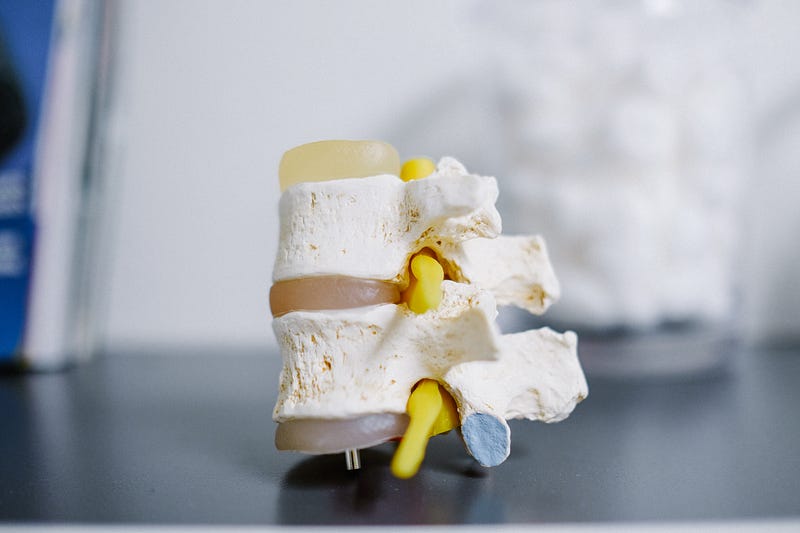
Discs don’t move easily unless you’re playing Mortal Kombat or watching Predator. Photo by NeONBRAND on Unsplash

Final Thoughts

Your spine is incredibly strong, adaptive, and complex. While simple analogies have a place in breaking down complex subjects, they can also reinforce perceptions of fragility and weakness, which prolong or worsen outcomes in patients who may already be dealing with fear, anxiety, and uncertainty around their back pain.

Practitioners and patients must be aware of, and avoid falling into narratives and descriptions which may worsen outcomes. Discs are strong, and they heal, and the human body is not fragile.

Works Consulted:

  1. Hoy D, March L, Brooks P, Blyth F, Woolf A, Bain C, Williams G, Smith E, Vos T, Barendregt J, Murray C, Burstein R, Buchbinder R. The global burden of low back pain: estimates from the Global Burden of Disease 2010 Study. Annals of the Rheumatic Diseases. 2014 Mar 24.
Health
Wellness
Spine
Back Pain
Pain
Recommended from ReadMedium