
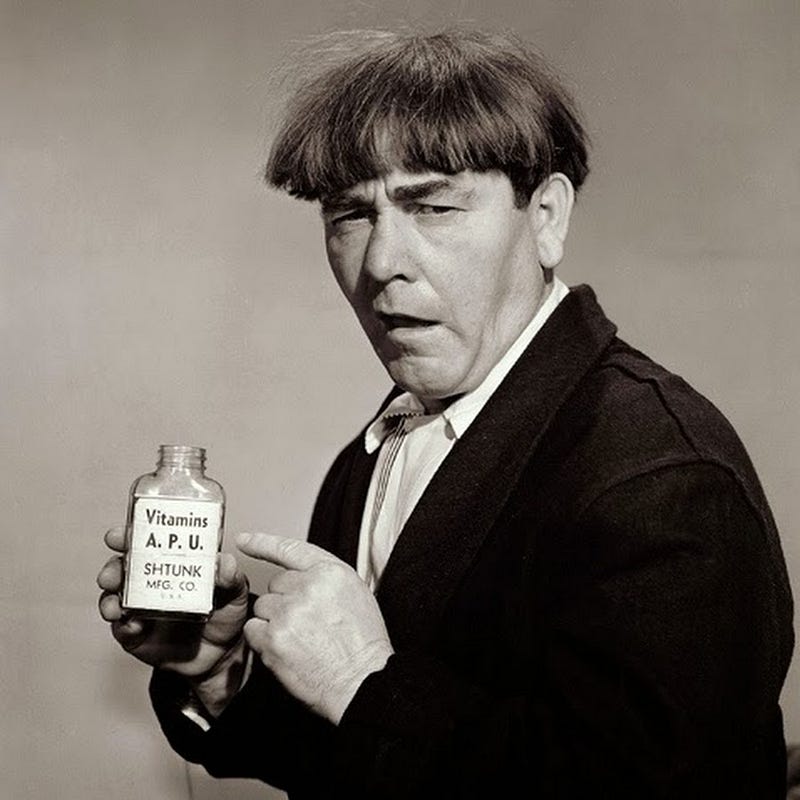
Speak to me, kid, say a few syllables! Paging Moe Howard of the Three Stooges
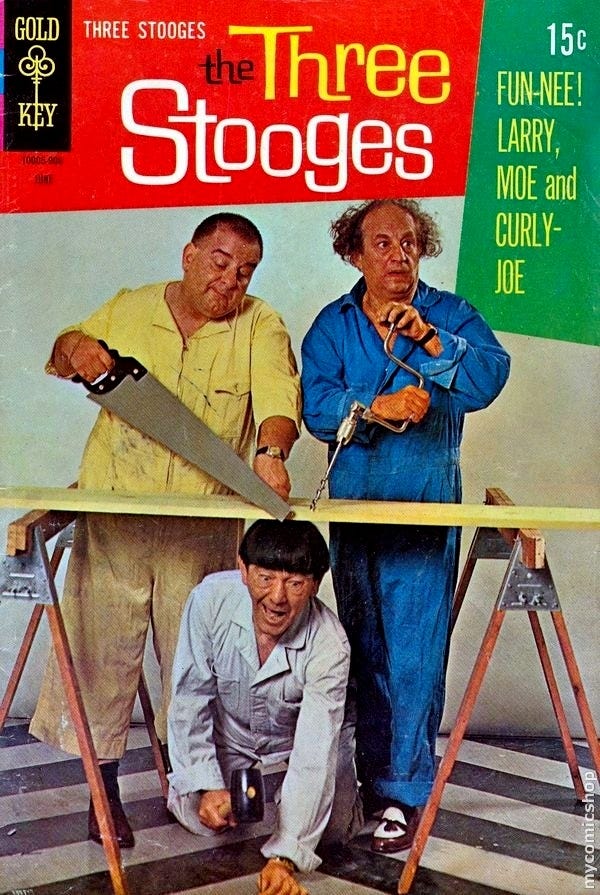
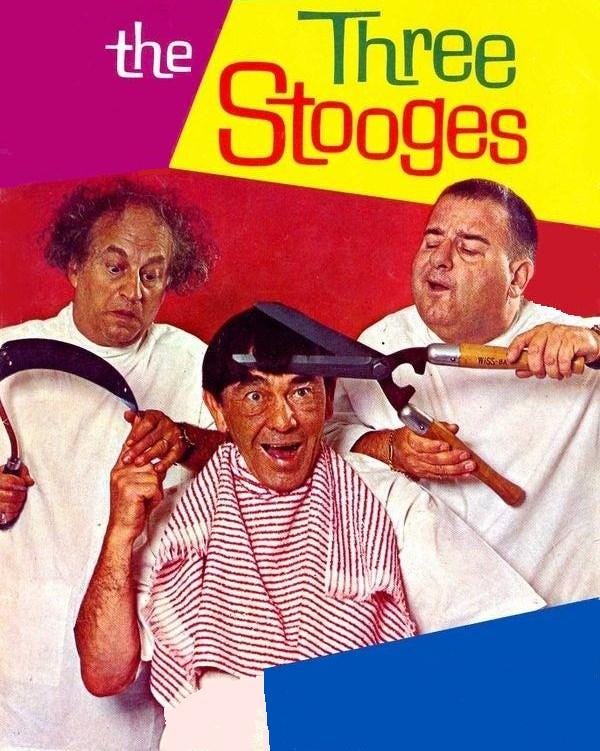
The Three Stooges will never win an armload of awards from the critical elite. So then why does the trio’s brilliantly timed comedy routines continue to age like vintage red wine and seduce millenials? Moe Howard, with his jet black hair styled downward in a ghastly bowl cut, was the take-charge, no bullshit, often naive leader. Younger brother Curly Howard possessed improvisational genius and uttered numerous catchphrases with abandon (e.g. “Nyuk, nyuk” and “I’m a victim of coicumstance!”). The frizzy-haired Larry Fine was caught somewhere in-between, often receiving the brunt of Moe’s slaps and eye pokes.
In a six-decade career finally extinguished by Larry’s first massive stroke in January 1970, the team ultimately transcended the Marx Brothers, Laurel and Hardy, Abbott and Costello, and Martin and Lewis.
The Three Stooges were intrinsically funny and honed their craft in vaudeville. Directors — e.g. Edward Bernds and Jules White-pre 1952 — and writers — Felix Adler and Elwood Ullman — with little affinity for extraneous scenes ensured fast-paced, quality shorts. Although parents criticized their violent tendencies — usually instigated by Moe — the boys never did it maliciously. All would be forgotten and forgiven within a few frames.
Distributed by Columbia Studios and spanning 1934 to 1958, the trio’s 190 shorts averaged 16 minutes in length. When the three major television networks were beamed at maximum velocity into millions of homes in the late 1950s, local stations pounced on these mini movies. A new generation was introduced to the act which Curly and Shemp criminally did not live long enough to savor. The team’s ubiquitous 1960s golden age was solidified by a comic book series, comedy albums, a cartoon series, and feature length films. Moe, Larry, and Curly Joe DeRita — the successor of Curly, Shemp, and the ill-suited Joe Besser — accumulated scores of personal appearances across the nation.
Curly overshadowed his older brother, but Moe was an essential element of the team adept at constantly reigning in Curly’s zany antics or Larry’s flakiness even if naivety colored his better judgement. One of Moe’s recurring lines was “Remind me to murder you later,” and Larry or Curly would always exclaim, “I’ll make a note of it!”
Married 50 years to Helen Schonberger, Moe was a devoted father to kids Joan Maurer and Paul Howard. He cherished down-to-earth, Hollywood-eschewing hobbies such as cooking, gardening, gin rummy, and ceramics. Forever a shrewd businessman, Moe outlived his comrades — except Curly Joe — succumbing to lung cancer in May 1975 at age 77.
Paul embraces his Stooge heritage wholeheartedly after decades of shunning the limelight and gamely consents to an insightful, affectionate tribute examining America’s most instrumental comedy team debuting below.
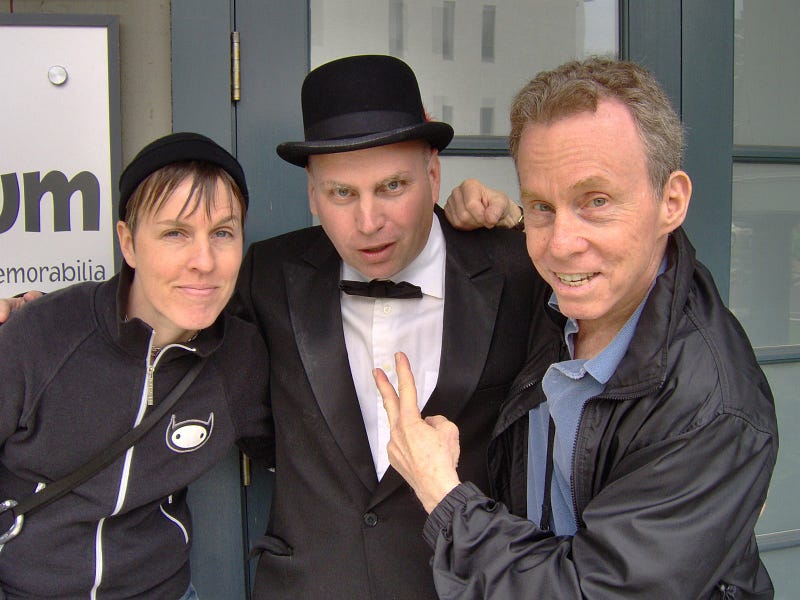
The first time Paul entertained the notion of speaking was in 1983 at Northern Illinois University during its comedy week. Retro Hollywood scribe Steve Cox, guilty as charged for the laudable One Fine Stooge: Larry Fine’s Frizzy Life in Pictures, graciously recalls how it all came together.
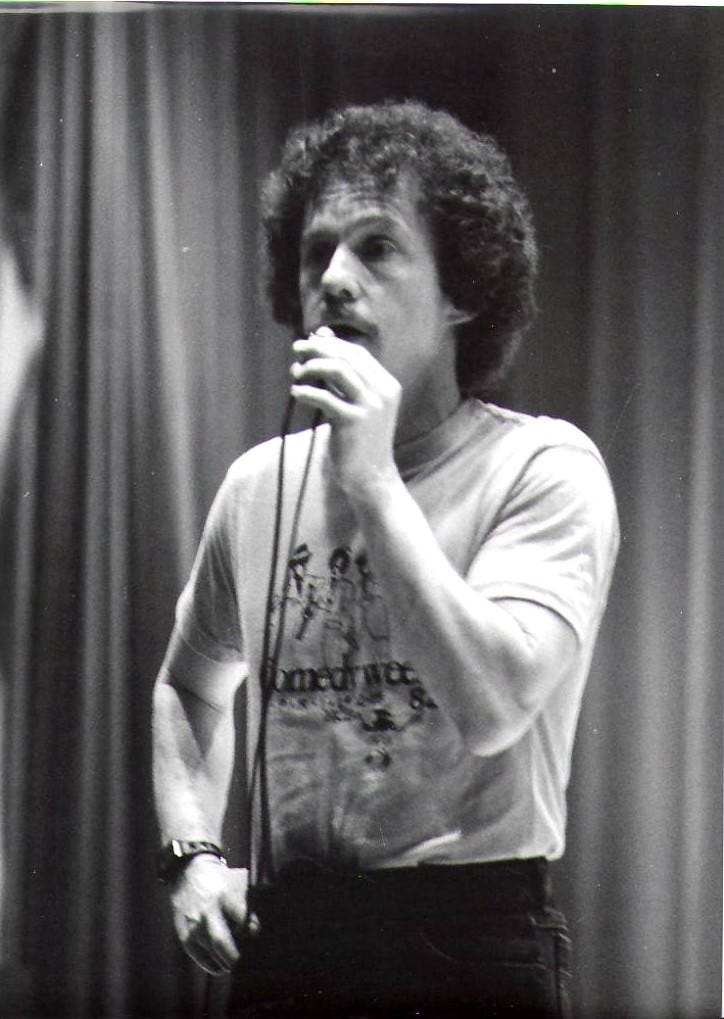
“Paul was one of the featured guests at Northern Illinois University’s ‘Comedy Week’ back in 1983 I think it was, and I’m happy to say I was a part of that appearance,” says Cox.
“I was helping one of the organizers of that event, even though I didn’t attend NIU. Emil Sitka, the Stooge’s longtime costar, was supposed to make the appearance but bowed out for some reason just weeks prior to the event. I suggested Paul Howard as a possibility. Paul was contacted in New York and agreed to do this even though he’d never done this type of thing before.
“On the night of the film festival, the auditorium at NIU was jam-packed with screaming Stooges fans waiting to see the shorts on the big screen. When the lights started to dim, the crowd started chanting and expecting the familiar theme song to start.
“Then, all of a sudden, Paul Howard’s voice broke through the darkness on the speakers and he calmly welcomed them to Comedy Week and without introducing himself, he said: ‘I can’t wait to tell you a few stories about my Uncle Curly, Larry Fine, and my father, Moe…’
“The crowd became unhinged, yelling and applauding. His intro was so perfect. They wanted to see this guy, Moe’s son, and they did. The audience of college age related to Paul beautifully.
“Paul had an excellent time at that appearance — something his father had done a decade earlier with much fanfare. I also think it surprised him in a delightful way and may have illustrated to him first-hand just how popular his old man still was — and still is.”
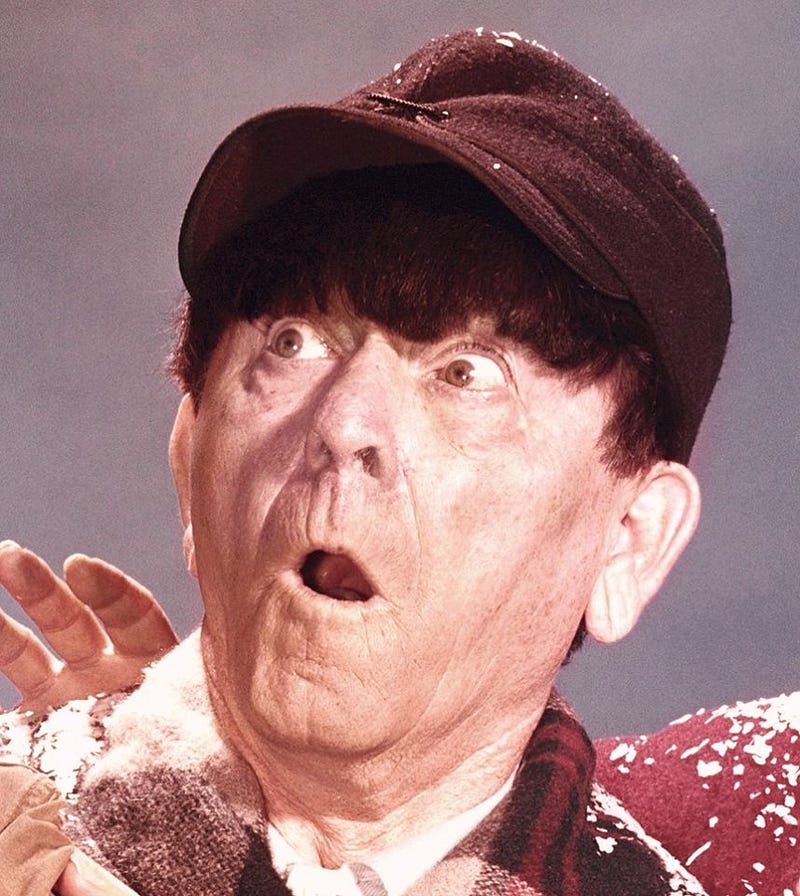
The Paul Howard Interview
How did your parents serendipitously stumble upon each other?
On the beach in Brooklyn. As I understand it, Dad and his childhood pal Ted Healy, later to become his straight-man, were singing a ukulele duet when my mother appeared. It is said that when he first gazed upon her, he uttered, “Wow, what nice legs!”
What type childhood did you experience?
In 1935, I believe my dad and the team had already moved to Los Angeles. He had an engagement in New York, and my mother was pregnant with me and wanted to come along with him. So I was born in what was then The Doctor’s Hospital, an upscale facility in the Upper East Side of Manhattan. I now happen to live three blocks from that location.
I essentially grew up in a beautiful three-bedroom custom-built home. It was located in the Toluca Lake area of the San Fernando Valley, just north of Hollywood. In 1947, my sister, Joan, married Norman Maurer in our back-yard. Real lily pads were floating in the swimming pool, and a portable dance floor covered our badminton court.
Dad spent a lot of his rare spare time tending to his vegetable and flower gardens. He would become totally relaxed when he was behind one of his two barbecues. There was also room for birthday parties, my Cub Scout tent, and Dad’s chicken coops.
After Dad returned from shooting a comedy, we’d play catch just before the sunset. Although Dad was anxious, impatient, incredibly concerned with the act, and had problems communicating on an emotional level, I always knew that he loved me. Now and then that was a challenge to our relationship.
My young pals were normal kids, and my parents’ close friends were not Hollywood types. We spent fifteen very happy years in that home. We were a happy family.
When your “son of Moe” cover was blown, what were your friends’ reactions?
Until I was in my thirties, I kept my “heritage” a secret. If the kids did know, often they didn’t say anything. But I could tell they knew by the strange look in their eyes. They’d look at me like I was a Martian!
And on the occasion that they did say something, it was basically, “Wow! If my father was Moe, I’d tell the world!” That reaction I just didn’t understand.
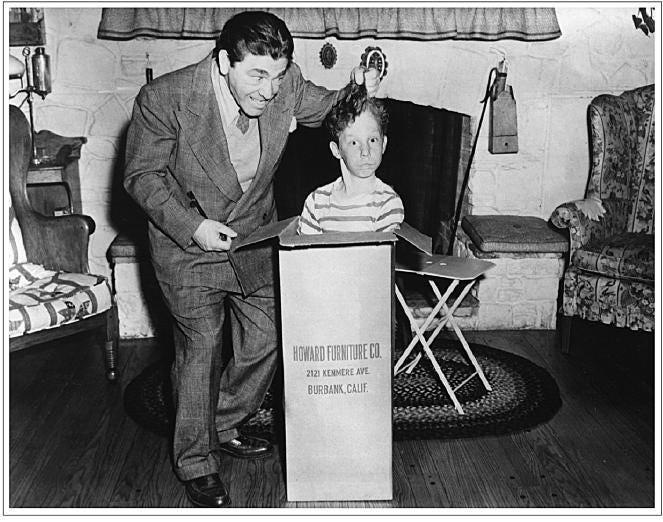
Did you ever officially work for your Dad?
I just pulled weeds, skimmed leaves from the pool, tried to keep the back-yard neat, watered the flowers, fed the dog and attempted to keep him from peeing on the lawn, which burned the grass.
My allowance for helping out earned me five cents an hour. Yes, five pennies per hour, but this was in the 1940s. Maybe my Dad was trying to teach me the value of a dollar. I didn’t complain.
What kinds of activities did you and your dad do together?
When he had the time, we did many father-and-son activities together. We played baseball, we went on the half-day fishing boat off the Santa Monica Pier, we went camping in the Sierra Nevada Mountains, Yosemite, and Lake Tahoe. He even let me take one of my buddies along.
Was the Howard family close-knit?
Overall, yes. Of the five Horwitz brothers, the oldest, Irving, tragically died of a burst appendix as a relatively young man. I never knew him. The second oldest, Benjamin “Jack,” was also an insurance agent. The rest of them were close-knit.
Dad, Shemp, and Curly all lived within three blocks of each other. Sunday afternoon barbecues at our home very often included them all together. And Larry, not related, was often socially included — he seemed almost a part of the family.
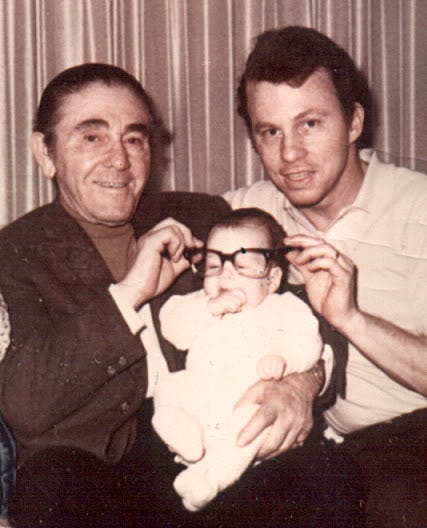
Tell us about Jack Horwitz. Was your uncle interested in joining the Stooges?
Uncle Jack was an insurance agent for Met Life for almost 50 years and was recognized and very skilled at his career. When I was fairly young, my dad bought a couple of policies for me from Jack.
He was not particularly funny. He was a basic straight-shooter kind of person. But I liked him a lot. I don’t think Uncle Jack was interested in joining the act. I would say that he didn’t have that outrageous personality to be a Stooge.
Until later in the Stooges’ careers, their mother believed that Irving and Jack were her “successful” sons. She felt that Shemp, Dad and Curly were not taking their careers seriously. Uncle Jack lived until the early 1980s, I believe.
How was each Stooge unique personality-wise?
- Curly — It’s said that he was a wild teenager, emotionally. I knew him differently. Whenever he’d see me he’d say, “Ha’ja doin’, Pauly-boy?” He was always friendly to me. When he came over to our home, he was very low-key. Pretty quiet. Very different than his on-camera, on-stage character. One exception was demonstrated on our wonderful family color films. He is shown at our backyard swimming pool, standing on the end of the diving board, dropping down and hitting the end on his butt, then flying up in the air again and landing in the water, on his face. This was “on-camera Curly” doing his spontaneous creative act in our back-yard pool.
- Larry — Like Curly, Larry was a devil-may-care kind of personality. Very easy-going. Unlike Curly, he was more of a family man. But both of them didn’t watch their finances. The most inspiring aspect of Larry was that after he had a stroke, he learned to draw quite well with his “other hand,” and he welcomed sharing his memories with visiting fans during his final years [Author’s Note: “Caught in the Middle: Author Steve Cox Salutes Lovable Three Stooges Porcupine Larry Fine,” an extensive interview with Larry’s biographer Steve Cox, is also available].
- Shemp — Shemp was somewhat different than Curly and Larry. He was a stable family man. He was devoted to his wife, “Babe” and son, Mort. He loved the racetrack and the prizefights. His challenge was that he was a “fraidy-cat” and a hypochondriac. He was afraid of most everything, but he was a magical entertainer with the kids.
- Moe Howard — Dad was a devoted husband and father. He was like “Practical Pig” of the Three Little Pigs. He built his life with bricks instead of sticks — with the strength of dedication. At times, Dad had trouble with communication on a personal level, but in between his commitment of touring the country and making eight “shorts” a year, he always found the opportunity to spend time with all of his family.
- Joe Besser — Unlike Curly Joe, for me Joe Besser had a very distinctive shtick. His “Stinky” character in burlesque and TV was very funny. But as a Stooge, there was something missing. But overall, he was a nice guy.
- Curly Joe DeRita — During the Curly Joe era, I had graduated from professional art school and moved to New York City. I didn’t get to know him well. But with my limited contact with him, I found him to be humorous and a gentleman.
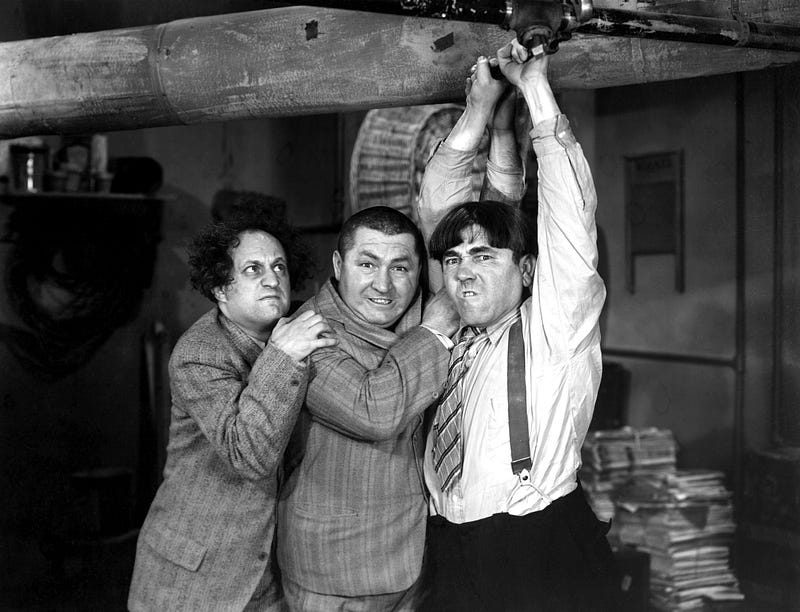
Did you have many intimate moments with Curly?
Curly didn’t spend much time around our house. And I rarely went to his, even though he lived right around the corner. Off-camera, he seemed to gravitate more to adults than to kids. But when we did interact, he was quite friendly to me.
How did Curly’s personality adjust post-stroke?
By my observation, Curly was like any extremely talented performer who had had a stroke. Before the stroke, on-stage he was outgoing and wild. Keep in mind that even when he was an active performer, off-stage he was a laid-back guy.
After the stroke, Curly was withdrawn and fairly incapacitated. But after his fourth — and truly successful — marriage, he lost weight and improved…then had a relapse.
I visited Curly after he became ill, but not often. An event I’ll never forget: Curly was near the end of his life, and I was about 16. I visited him in the hospital. He was severely affected by the stroke.
When I walked into his room, Dad was tending to him like a nurse. Curly turned his head and when he saw me, he tried to say something but couldn’t. Tears just rolled down his cheeks. It was a sad moment in the short life of a very talented man.
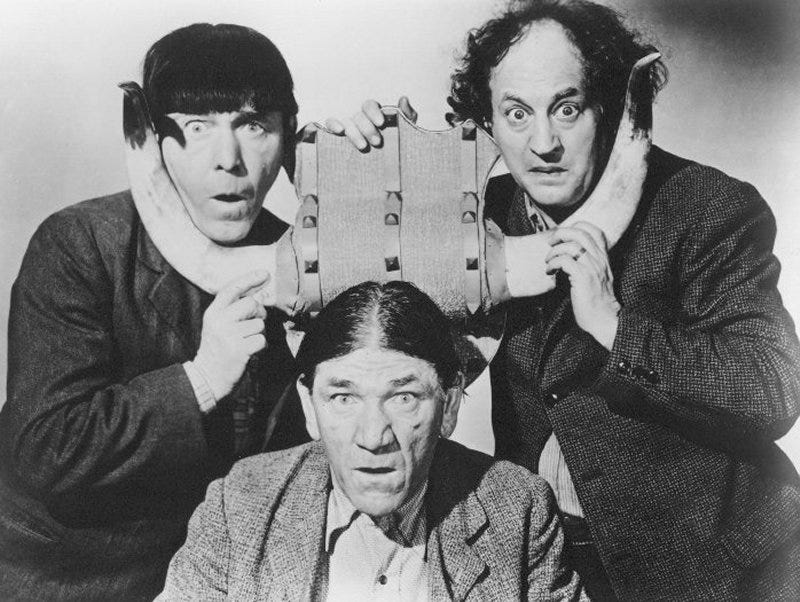
Which Stooge besides Moe were you closest with?
Shemp. He combined a rubber-faced friendliness with just being a nice guy, especially to kids. He could tell stories that fascinated me as a boy. And I’d bring my friends over, and he’d allow them to listen to his tall tales.
I remember one of his stories quite well. Uncle Shemp was in the US Army during World-War One. He once told me about a combat skirmish he was involved in with a German platoon in France. A “Kraut” bullet ricocheted off a rock and struck him on his shin.
It lodged there and was never removed. He wanted to keep it there to remind him of the dangers of combat and a symbol of his survival.
The reality was that it was a peanut-shell-sized cyst attached to his shin that he was born with, and he was too afraid to have it removed. Furthermore, Uncle Shemp’s active duty time was very short. He was discharged for being an uncontrolled…bed-wetter!
Uncle Shemp also couldn’t sit still in front of the TV while watching a prizefight. He’d bob and weave, grunt and groan when a boxer got hit. His greasy hair would fly when he received an imaginary punch. He was out-of-control, but boy, was he fun to watch!
Were you on the set during the shooting of any Stooge shorts or films?
Yes, a few times, as a kid. Once, when I was eight years old I was watching one particular scene where the Stooges were sailors, as spies on a Nazi ship [Back from the Front, 1943]. Suddenly a torpedo crashes through a wall and water splashes all over.
Curly says something like, “Oh, a shark!” and hits it with a sledge-hammer. The director called, “Cut!” The studio crew cleaned up and the same thing happened again. And then again. As an eight-year-old I couldn’t understand this “repetition.”
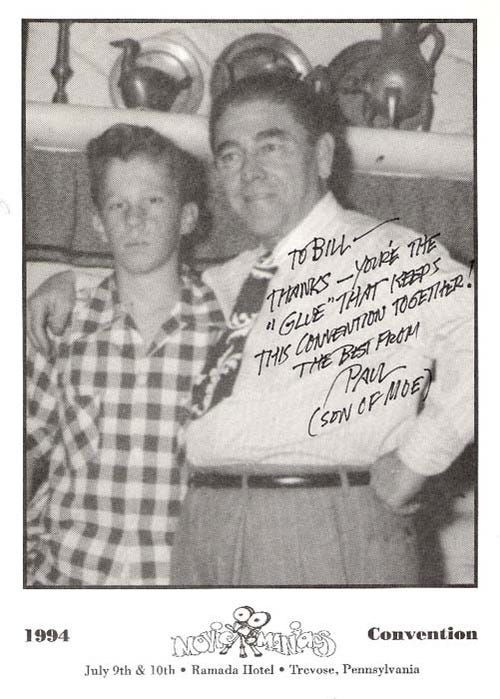
Did you travel any with the Stooges?
Once. In 1946, during summer vacation, I went with them to Chicago while they performed at Colosimo’s Restaurant. The most exciting part of that trip was that Shemp’s wife, “Aunt Babe,” went to the track and won the Daily Double and gave me $50! Can you imagine what $50 meant to an 11 year-old over 70 years ago!?
Who influenced your career path the most?
Dad wanted me to be in the movie industry, but I wanted to cut my own path. My late brother-in-law, Norman Maurer, a world-renowned cartoonist, illustrator, and comic book artist, influenced me greatly. In the 1940s and 1950s he illustrated crime comics and comic books which featured the characters “Iron Jaw,” “Crime-buster” and “Daredevil.”
Norman was a real renaissance man. Just one of his many diverse, successful careers was producing the last Stooges’ feature films. I was influenced by his brilliant technique of selling his Stooges movie concepts to Columbia Pictures.
Norman would not only come up with the idea for a Stooge feature, but he would beautifully illustrate — in one drawing — the central theme which captured the idea of the film. His selling the idea verbally and visually really helped seal the sale.
After UCLA, I attended a professional art school named Art Center College of Design and became an art director in Manhattan advertising agencies.
So, what are you doing today?
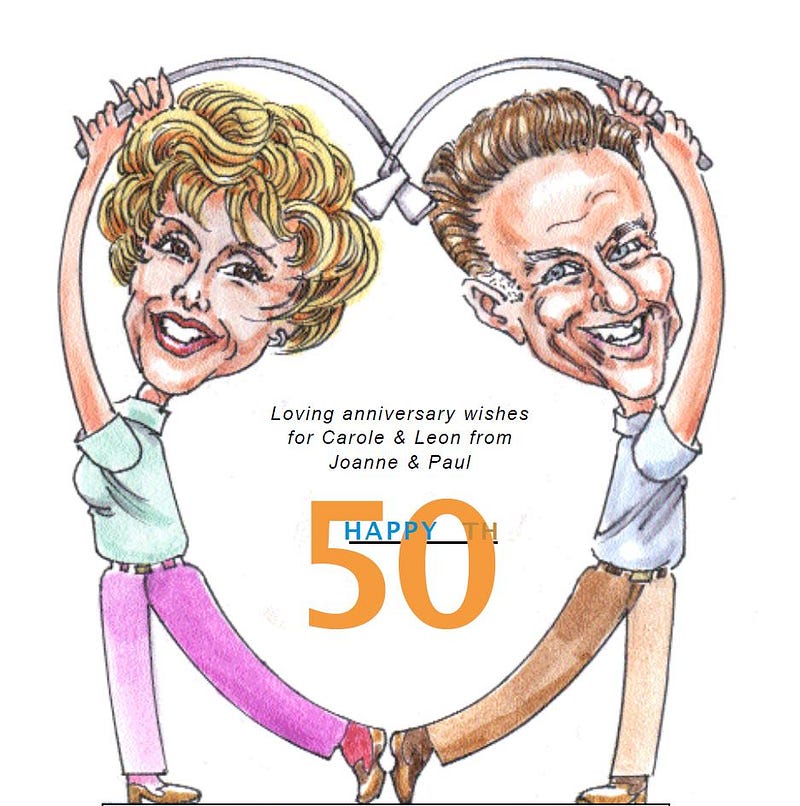
Although my eyesight is failing, I am a lifelong caricaturist with a penchant for drawing humorous likenesses. I do them from my office where clients send me their photos. I actually completed a caricature for a film director living in China.
One of my favorite caricatures that stands out was done for a couple of golfing fanatics celebrating their 50th wedding anniversary. I’ve done a couple of caricatures of all the Three Stooges in the past, but because of the control of C3 Entertainment, I prefer that these images remain in my files.
Did you see Mom and Larry perform with Curly Joe?
Yes, it was in the mid-1960s in Providence, Rhode Island. They were performing in a public park. It also was the first and last time I saw them doing their act on-stage. During their brief promotional tour in NYC, I couldn’t break away to see them, but I read about it in my dad’s autobiography. The photographs taken during that tour happen to be some of the best I’ve ever seen.
Anyway, at the end of the act, the Stooges approached the audience directly and spent about five minutes asking the kids not to do the hitting and poking that the Stooges did to each other. “Even we hurt each other sometimes,” they admitted.
What kind of hobbies did your dad have, and is it safe to characterize Moe as a homebody?
Gardening, ceramics, and cooking/barbecuing. Since he was a teenager, Dad loved growing vegetables and flowers. Actually, in their teens, Dad and his brothers lived on a farm for three years. Years later, in our backyard we had a vegetable “Victory Garden” and a flower garden. Even the chicken coops had windows…with curtains!
And when Dad wasn’t on his hands and knees weeding his gardens, he cooked cuisine, everything from ethnic recipes to his special marinated steaks on his barbecue grill. Many years ago he gave his special Chicken Cacciatore “Hunter Style” recipe to a Beverly Hills Italian restaurant owner. Soon after, it became “Chicken A La Moe” on their menu!
I would say that Dad was basically a homebody. Of course, he was comfortable around his fans wherever they intercepted him, but on the weekends, during the day, the back-yard was his playground. During the evening, he and Mom very much enjoyed playing Gin Rummy with their close friends.
How did Larry’s death hit Moe?
For him, it was like losing a member of the family. As far as I know, he didn’t discuss it. I would guess that this issue was touched upon in interviews with my father. During that period I was living on the East Coast. When I saw my parents that topic never came up.
However, Dad did not quit entertaining. He went on the college circuit to share his career memories and was beloved by the students. The only thing that eventually stopped him was emerging health issues.
When was the last time that you spoke with your dad?
Dad was quite ill, and I was in Los Angeles on a business trip. When the cab pulled up in front of the front door to take me to the airport, Dad and I hugged and kissed! That was very unusual for us. Perhaps we both sensed that this was our last get-together.
I was in Manhattan when I learned he had passed away. It was not unexpected. Having smoked for 50 years, he succumbed from lung cancer.
Today, when I see people smoking, I have a feeling of sadness and anger. Sadness — because they’re shortening their lives. They can’t stop or won’t stop. Anger, because the tobacco industry continues to kill people and make them suffer like my Dad did in his last year.
What are your favorite Stooge shorts?
Until my forties, I had no interest in following the Stooges’ careers. But two stand out for me, and I am biased about them. The first is “Punch Drunks” [1934], because my dad created the story treatment.
My second favorite is “Hoi Polloi” [1935], because my mother created the story concept. It was inspired by “Pygmalion,” which in turn inspired My Fair Lady. And bias notwithstanding, they were simply great shorts.
As far as Shemp is concerned, I liked his performances but had no real interest in analyzing them. They all seemed the same — and good — to me. I don’t think of him as better or worse than Curly. His persona, his talents were just different.
What are your thoughts on the Farrelly Brothers’ 2012 Three Stooges homage?
Most hard-core fans that I know aren’t that crazy about it. “It’s either the original Stooges or nothing!,” they seem to say. However, my feeling is that any Stooges recreation that’s tasteful, respectful — and, of course, funny — is fine. Anything to keep the Stooges being watched and loved is great.
Why does the iconic team remain in the public consciousness 50 years since their final onscreen appearance, and what is your dad’s legacy?
The Stooges remain popular because their category of comedy — farce, not slapstick — and their formula — the upsetting of dignity — could be identified with by so many fans. They were champions of the underdog. They were live cartoons that young and old adored.
Dad’s legacy was being a partner in the world’s funniest comedy team, and leaving a trail of laughs and love wherever he and his partners were seen.
[Author’s Note: Much like his character on-screen, Larry Fine was a happy-go-lucky guy who didn’t worry about keeping money for very long and always found time to meet with his fans. Biographer Steve Cox usually maintains an extremely low online profile but fortunately agreed to speak at length about his fascination for the Three Stooges in “Caught in the Middle: Saluting Lovable Three Stooges Porcupine Larry Fine”].
© Jeremy Roberts, 2011, 2017. All rights reserved. To touch base, email [email protected] and mention which story led you my way. I appreciate it sincerely.


