
Spain’s High-Speed Train Has Ruined Flying for Me
I never want to go to the airport again

Train travel is having a moment in Europe right now, especially in Spain.
Thanks to massive public and private investment in new high-speed rail lines, increased competition (aka “lower fares”), and superior sustainability compared to flying, more Europeans than ever are choosing to travel by train instead of by plane.
Including me.
And while it’s nice to feel smug about lowering my carbon footprint by taking a train instead of flying, that’s not the main reason I’ve replaced nearly a dozen flights with train tickets this year.
The simple truth is that high-speed trains are just plain better than flying.
No, really. Taking a train is faster, cheaper, easier, more comfortable, and way less stressful than flying 95% of the time. And once you experience the joys of traveling by high-speed train, you’ll never want to fly again.
Train Travel is Way Easier than Flying
Americans don’t take a lot of trains.
Aside from railroad enthusiasts, it’s not how most of us plan trips or get around. So you can imagine my delight when I started taking high-speed trains after moving to Spain in January 2023.
Because Spanish trains kick ass.
I’ve taken high-speed train routes from Galicia to Madrid, Barcelona, and Valencia — and I have plans for several more train trips next year. And a big part of that is how easy it is to travel by train.
When you take the train you don’t have to worry about checking a bag or getting to the airport 2 hours early to deal with crowded security lines.
I just walk to the train station in my town (20 minutes), breeze through security (less than 2 minutes), and wait on the platform for the train to arrive. I usually get to the station about 15 minutes early and board with plenty of time to spare.
That’s not to say trains are perfect.
The train is usually punctual, but it was about 30 minutes late one time. And while that sucked, Renfe, the main Spanish train company, reimbursed me for the full price of my ticket thanks to their “Punctuality Commitment.”
Yup. You read that right. I got my money back because my train was a little late.
Can you imagine Southwest Airlines or RyanAir doing that?
The point is that, unlike airports, trains make traveling a breeze — not a slow-motion panic attack. And the benefits of train travel don’t stop with the easy check-in and boarding process.
Train Travel is Way More Comfortable than Flying
Once I board and find my assigned seat, I put my bag in the massive overhead storage rack. There’s no fighting for a spot or paying for upgrades to get a good “boarding group.”
Even the cheapest economy seats are spacious and comfortable with ample legroom and everyone has tons of room overhead to store their bags, as well as racks in the baggage area for larger wheelie bags.
I usually zone out and take a nap on our train trips, but it’s also soothing to sit and watch the Spanish landscape unfold as you actually get to see the places you’re traveling through instead of just looking down at them. I’ve even pinned several spots I’ve seen from the window on Google Maps to investigate and explore later.
Speaking of using your phone, I have cell service on most train routes most of the time (except when we go through a tunnel) which means I can tether to my computer to get work done, respond to important texts and messages en route, or stream videos or whatever else I want without paying for onboard wifi (although that is an option if you want it).
Many Spanish train routes also feature designated “silent cars” for travelers who want to travel in peace. In silent cars, you can’t listen to music, talk on the phone, or disturb other passengers. They don’t even allow pets. It doesn’t even cost any extra to book one of these cars, and I’m a big fan.
And if you want to get up and take a stroll, you have plenty of room to walk around, go to the (bigger) bathrooms, or even visit the dining car for a glass of wine, coffee, or even a snack or light meal.
Honestly, taking the high-speed train feels like flying first class in the 1960s, and it’s been one of the biggest differences I’ve experienced since moving to Spain.
High-Speed Rail is as Fast (or Faster) than Flying
“But trains are slow,” I hear you saying to your screen.
And to that, I say, “No, they’re not.”
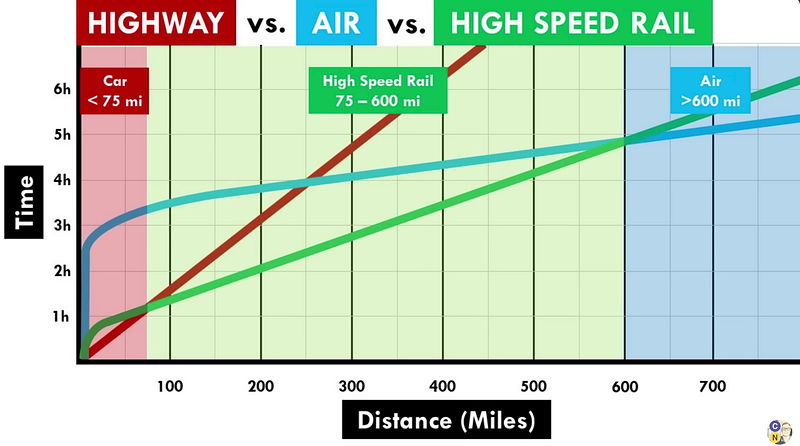
High-speed rail is almost always the fastest choice for trips between 75–600 km (50–400 miles). That’s roughly the distance from L.A. to San Francisco, New York to Toronto, or basically Madrid to anywhere in Spain.
And that’s the whole point. I can get (almost) anywhere in Spain on the train faster than flying.
For example, the high-speed train line from Madrid to Barcelona takes about 2.5 hours. And the flight time between Madrid and Barcelona is 1 hour and 8 minutes.
So flying seems faster, right?
Wrong.
That time frame doesn’t include getting to and from the airport, not to mention arriving early enough to check a bag, get through security, and still make your flight.
Plus, most budget airlines operate out of airports that are miles from the cities you actually want to visit, which means long (and expensive) transit times. When you add all that up, traveling by train in Spain is just plain faster door-to-door.
And that’s a huge time (and money) saver.
Yes, flying is still the faster option for long-haul trips and transatlantic flights. But high-speed rail can handle a lot more destinations than you think.
Train Travel is Cheaper than Flying
So taking the train is faster, easier, and more enjoyable than flying. But what if I told you it’s also cheaper?
Budget airlines like RyanAir, Vueling, and EasyJet are famous for dirt-cheap tickets connecting major European hubs, like Rome, Paris, and Madrid.
But they’ve got nothing on train tickets.
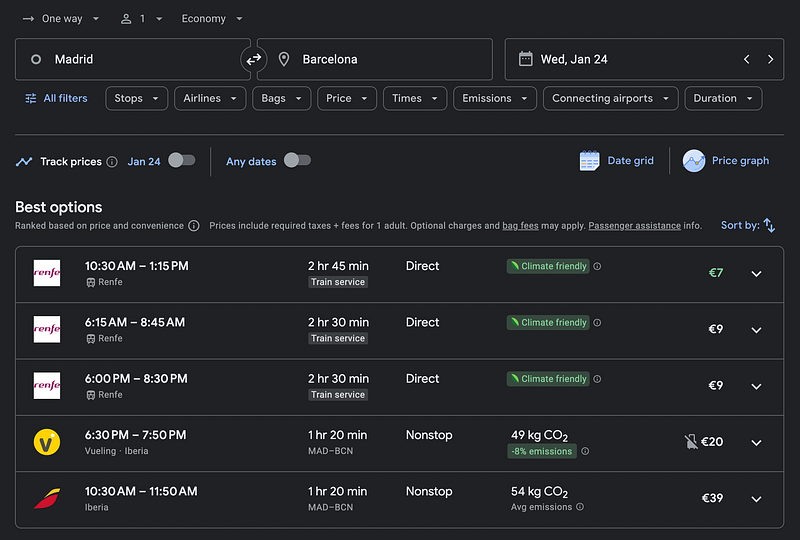
Look at that screenshot above. Using Google Flights “Explore” feature, I found flights and train options from Madrid to Barcelona.
Which one is cheaper?
Flight prices have gotten absurdly low, but they also rarely include the extra price of airport taxes, additional checked (and carry-on) baggage fees, and additional upgrades like boarding groups or comfortable seats.
And remember, the price of the flight doesn’t include the cost of getting to and from the airport, which is often more expensive than the actual flight!
All told, the price of a “cheap” flight is almost always more expensive than a train ticket, with extra hoops to jump through along the way.
Train Travel is Way Better than Flying

Over the past year, I’ve become addicted to fast, efficient, affordable high-speed train travel — and I don’t think I can ever go back.
Train travel is not only a more environmentally friendly way to get around, it’s better for your mind, your body, and your budget.
So the next time you’re looking at cheap flights around Europe, consider taking the train instead. You’ll be glad you did.
Shawn Forno is a very left-handed travel writer with 15+ years of experience writing for Lonely Planet, Matt D’Avella, and Tortuga Backpacks. Sign up for his newsletter or check out his very cool YouTube channel, Days We Spend, for videos about travel, packing, and life in Spain.


