avatarErika Burkhalter

Free AI web copilot to create summaries, insights and extended knowledge, download it at here

3622

Abstract

://cdn-images-1.readmedium.com/v2/resize:fit:800/1*hc-GAXi5YBuTBQa80fCFqA.jpeg"><figcaption><a href="https://en.wikipedia.org/wiki/Encelia_californica">California Coast Sunflower</a>. Photo ©Erika Burkhalter</figcaption></figure><p id="79d2">No two of these flowers ever look the same, due to the intricate patterns of the pollen-laden stamen in the center.</p><figure id="fc25"><img src="https://cdn-images-1.readmedium.com/v2/resize:fit:800/1*a1i-R2elyM0LqcjRKBjb7A.jpeg"><figcaption><a href="https://en.wikipedia.org/wiki/Encelia_californica">California Coast Sunflower</a>. Photo ©Erika Burkhalter</figcaption></figure><p id="6cc5">The delicate fringed lianthus flutters on the soft spring breezes. Also, a native to California, it resembles a poppy.</p><figure id="3096"><img src="https://cdn-images-1.readmedium.com/v2/resize:fit:800/1*-cvsRF0k9T3JMm58Z-eO0g.jpeg"><figcaption>Fringed lianthus. Photo ©Erika Burkhalter</figcaption></figure><p id="0d2b">Here, they are spreading low beneath a <a href="https://en.wikipedia.org/wiki/Opuntia">prickly pear cactus</a>. I lived in Tucson for many years when I was young, and I will always have a soft spot in my heart for the cacti.</p><figure id="4b33"><img src="https://cdn-images-1.readmedium.com/v2/resize:fit:800/1*iIEmxoetlZWth4AfyQ0O6g.jpeg"><figcaption><a href="https://en.wikipedia.org/wiki/Opuntia">Prickly pear cactus</a>. Photo ©Erika Burkhalter</figcaption></figure><p id="42a9">The desert wishbone-bush, or <a href="https://en.wikipedia.org/wiki/Mirabilis_(plant)">mirabilis</a>, are from the genus of plants known as “four o’clocks” or “umbrellawarts.” I love how their yellow stamen just pop against the purple petals. And the fuzz on the flowers before they open up adds an interesting textural element.</p><figure id="4a24"><img src="https://cdn-images-1.readmedium.com/v2/resize:fit:800/1*ZGXIPpZo1iDLTTSnBUTVOQ.jpeg"><figcaption><a href="http://mirabilis">Mirabilis</a>. Photo ©Erika Burkhalter</figcaption></figure><p id="f09e">Another of my beloved cacti is the <a href="https://en.wikipedia.org/wiki/Cylindropuntia">cholla</a>. In these photos, you can also see the looming clouds before one of our recent rainstorms.</p><figure id="c32a"><img src="https://cdn-images-1.readmedium.com/v2/resize:fit:800/1*9eP1Dh5T9d4tjHsgreDuiw.jpeg"><figcaption><a href="https://en.wikipedia.org/wiki/Cylindropuntia">Cholla</a> and rainclouds. Photo ©Erika Burkhalter</figcaption></figure><figure id="c049"><img src="https://cdn-images-1.readmedium.com/v2/resize:fit:800/1*crRnR_11JazIyil91abNuA.jpeg"><figcaption><a href="https://en.wikipedia.org/wiki/Cylindropuntia">Cholla</a>. Photo ©Erika Burkhalter</figcaption></figure><p id="39fd">The popcorn flower, or <a href="https://en.wikipedia.org/wiki/Plagiobothrys">plagiobothrys</a>, are small herbaceous plants that really do resemble popcorn.</p><figure id="309d"><img src="https://cdn-images-1.readmedium.com/v2/resize:fit:800/1*BQX2OKnElcCczlplapz6Ag.jpeg"><figcaption>Popcorn flower, or <a href="https://en.wikipedia.org/wiki/Plagiobothrys">plagiobothrys</a>. Photo ©Erika Burkhalter</figcaption></figure><p id="ec16">Another native species, <a href="https://www.laspilitas.com/nature-of-california/plants/612--salvia-mellifera">black sage</a>, likes sandy soil.</p><figure id="37c5"><img src="https://cdn-images-1.readmedium.com/v2/resize:fit:800/1*77GOaM80mxDP0j2CBkrZXw.jpeg"><figcaption>Gray skies and <a href="https://www.laspilitas.com/nature-of-california/plants/612--salvia-mellifera">black sage</a>. Photo ©Erika Burkhalter</figcaption></figure><p id="c1dc">I’ve spent a lot of time in India, and I

Options

remember driving through fields of mustard there and realizing that the yellow flowers which cover the hillsides in California were also mustard. It is everywhere this time of year and can grow taller than me. When I am out on my mountain bike, riding through these fields of <a href="https://en.wikipedia.org/wiki/Mustard_plant">mustard</a> is like being in a cloud of yellow.</p><figure id="ddd3"><img src="https://cdn-images-1.readmedium.com/v2/resize:fit:800/1*aOy9d2l-hiuUrxhzMCWzwA.jpeg"><figcaption>Wild <a href="https://en.wikipedia.org/wiki/Mustard_plant">mustard</a>. Photo ©Erika Burkhalter</figcaption></figure><p id="586b">And the hardy <a href="https://calscape.org/Eriogonum-fasciculatum-(California-Buckwheat)">California buckwheat</a>, also native to California, grows into a thick shrub. I love how the flowers look like candy-striped confetti.</p><figure id="de20"><img src="https://cdn-images-1.readmedium.com/v2/resize:fit:800/1*pmoespiJRKhPjOVCLCHs0w.jpeg"><figcaption><a href="https://calscape.org/Eriogonum-fasciculatum-(California-Buckwheat)">California buckwheat</a>. Photo ©Erika Burkhalter</figcaption></figure><p id="f8fb">We are still experiencing a lot of rain in Southern California and are feeling like the earth is finally quenched again. It is still early in the spring, and we have a couple more months of prolific wildflowers ahead of us. I’m looking forward to the rest of the show.</p><p id="0f76"><i>Erika Burkhalter is a yogi, neurophilosopher, cat-mom, photographer, and lover of travel and nature, spreading her love and amazement for Mother Earth’s glories, one photo, poem or story at a time. (MS Neuropsychology, MA Yoga Studies).</i></p><p id="3327">You might also enjoy:</p><div id="198b" class="link-block"> <a href="https://readmedium.com/a-prayer-to-gaia-and-to-hummingbirds-d51876cbd373"> <div> <div> <h2>A Prayer to Gaia and to Hummingbirds</h2> <div><h3>A rising song composed of light</h3></div> <div><p>medium.com</p></div> </div> <div> <div style="background-image: url(https://miro.readmedium.com/v2/resize:fit:320/1*GIm_Ek8fFPrvo7XgJLEomQ.jpeg)"></div> </div> </div> </a> </div><div id="53b5" class="link-block"> <a href="https://readmedium.com/a-hummingbird-named-agave-8da9df31e760"> <div> <div> <h2>A Hummingbird named Agave</h2> <div><h3>“Big Red”, our dominant male Allen’s Hummingbird, has a new rival</h3></div> <div><p>medium.com</p></div> </div> <div> <div style="background-image: url(https://miro.readmedium.com/v2/resize:fit:320/1*wDpr4it9UCdow9kCbX7j2A.jpeg)"></div> </div> </div> </a> </div><p id="868e">If you enjoyed this piece, you might consider <a href="https://erikaburkhalter.medium.com/subscribe">subscribing to my stories</a>. You’ll get an alert whenever a story gets published. While I do normally post my stories with free “friends” links on social media, if you enjoy reading on medium, you can help the many talented writers here by <a href="https://erikaburkhalter.medium.com/membership">joining</a>. It helps to support the arts and to keep us writing!</p><p id="9f56">And, because I’ve had a few people asking lately, if you’re ever interested in purchasing a photo, just leave me a note.</p><p id="6878"><i>Photos and story ©Erika Burkhalter. All rights reserved.</i></p></article></body>

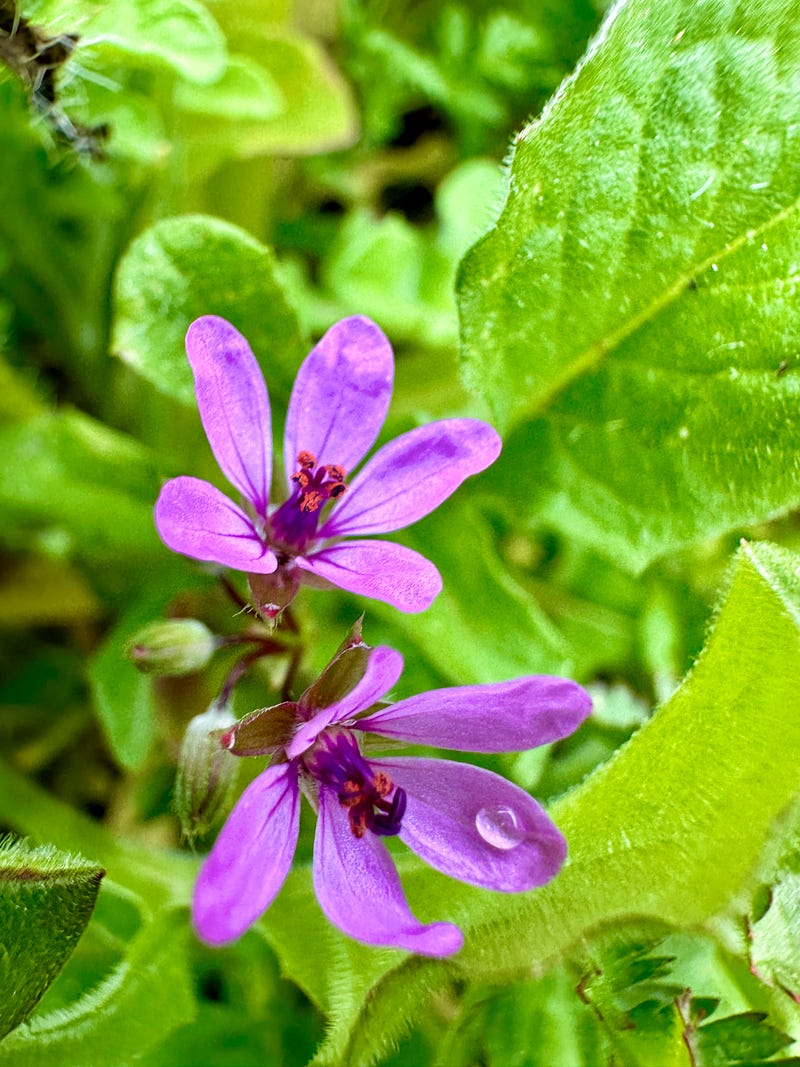
Common Stork’s Bill.” Photo ©Erika Burkhalter. All photos were taken with an iPhone 14 Pro Max.

Flowers, Nature, Photography

Southern California Spring Wildflowers

After the rains, Mother Nature is putting on quite a show

After several years of severe drought conditions, Southern California has been deluged by rain this winter. You can almost feel the earth sighing in relief. The reservoirs have re-filled to the point that water has had to be released. And the hillsides, which had been baked to brown, are as emerald green as Ireland or England.

We normally do get a bit of a “wildflower show” here in the spring. But, after the deluges we have had, Mother Nature is putting on a full pageant.

On a recent hike through nearby Peter’s Canyon Regional Park I just couldn’t stop snapping photos of the flowers bursting from the earth. The top photo is of Common Stork’s Bill, a plant which hugs the hillsides and thrives in sandy conditions.

Perhaps my favorites though are the lupine and the California poppy. My first memory of seeing lupine is from Crested Butte, Colorado, a high-elevation mountain town, where the wildflowers explode across the meadows for a brief month or so. So, every time that I see them here, I am a bit surprised that they also grow along the coastline. But they are ubiquitous. And they always bring a smile to my face because they remind me of being in Colorado with my dad when I was younger.

And the California poppy, well they are sort of an iconic flower.
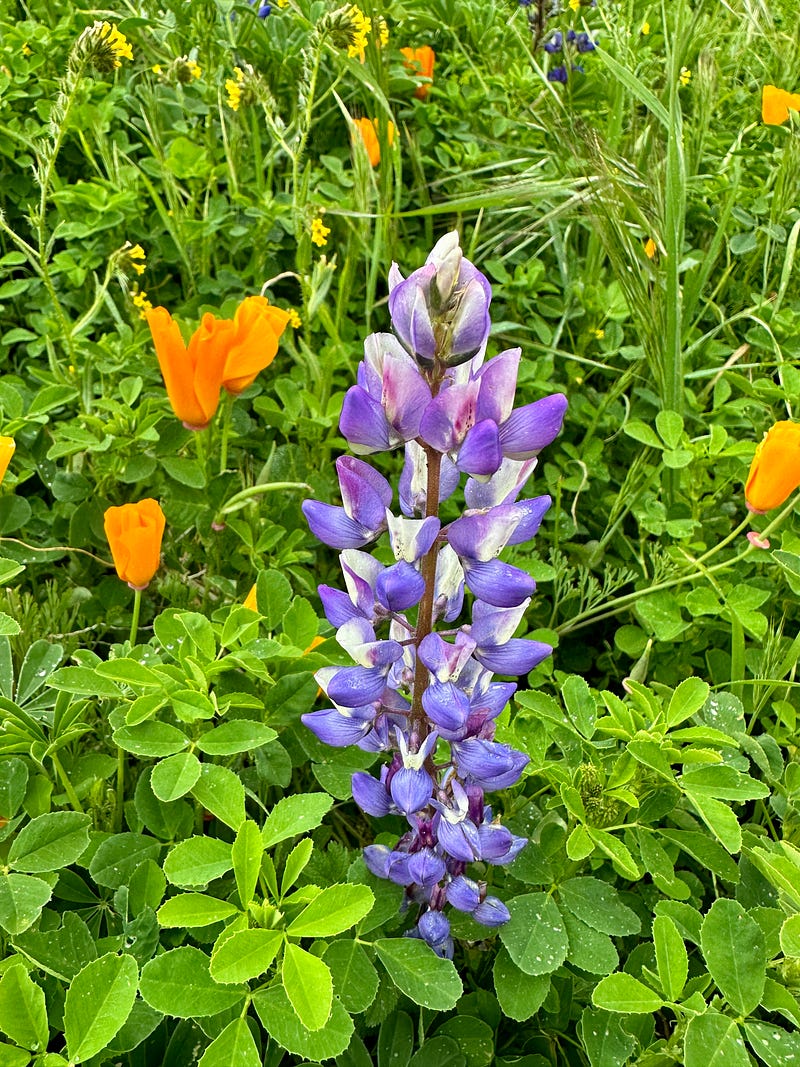
lupine and California poppy. Photo ©Erika Burkhalter

This time of year, they represent spring for Californians. While we have many invasive species here, the California Poppy is a native plant.
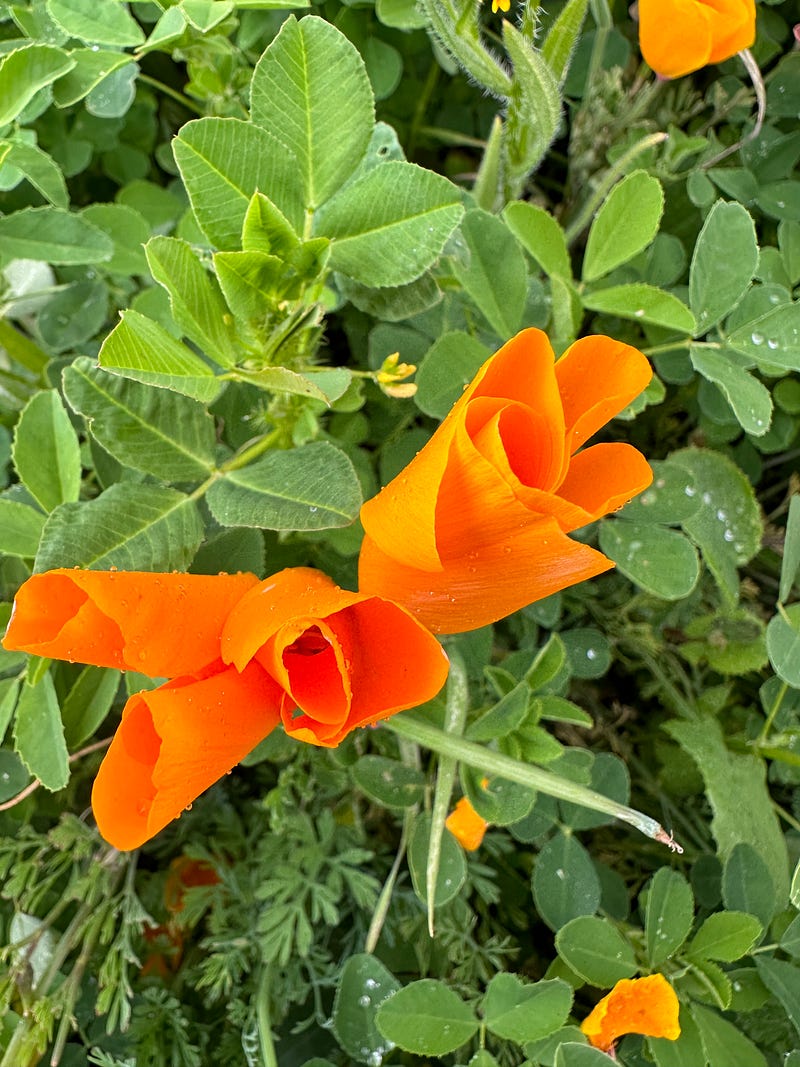
California poppy. Photo ©Erika Burkhalter

Dipterostemon, an herbaceous perennial, is also a native plant to the area. The deer, rabbits and gophers love these tender flowers.
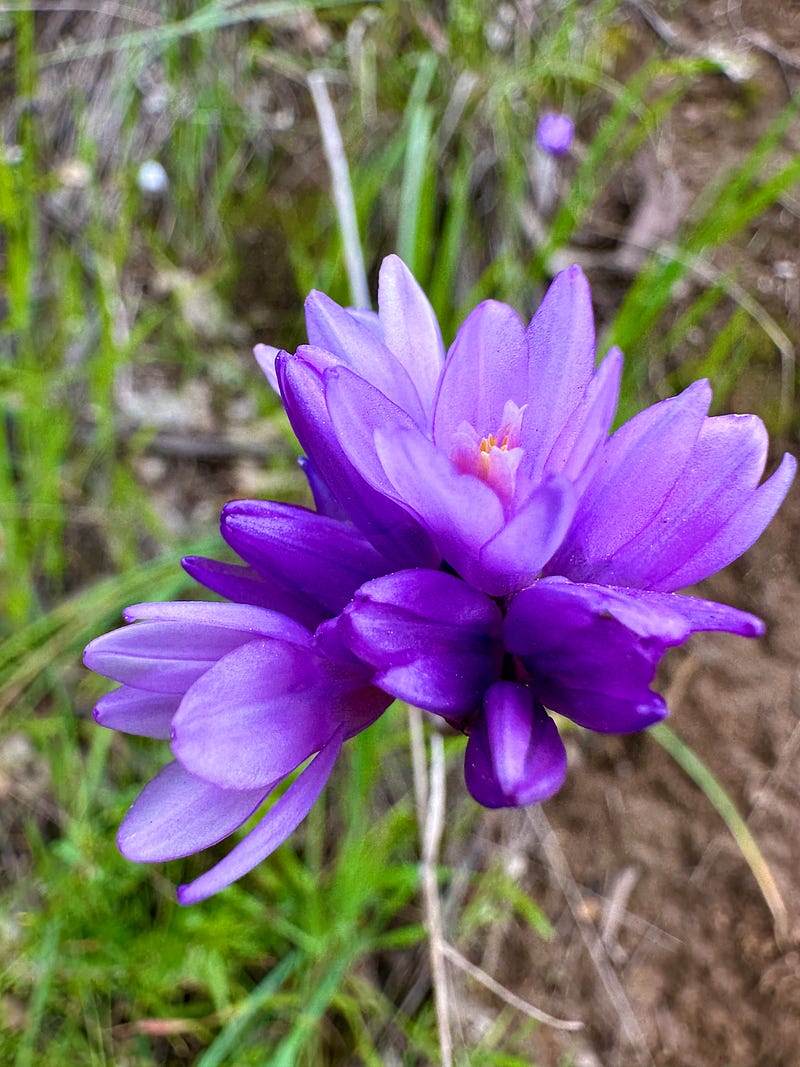
Dipterostemon. Photo ©Erika Burkhalter

One of my other favorites is the California Coast Sunflower, or California Brittlebush.
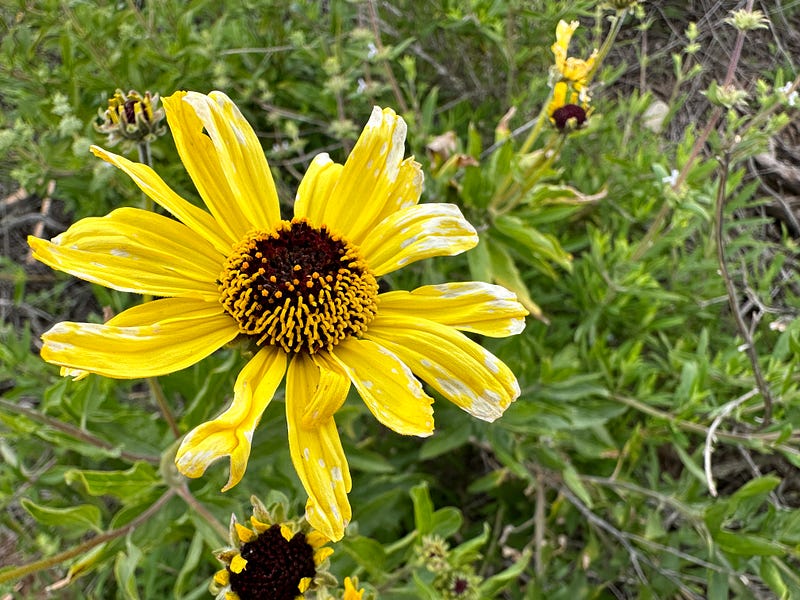
California Coast Sunflower. Photo ©Erika Burkhalter

No two of these flowers ever look the same, due to the intricate patterns of the pollen-laden stamen in the center.
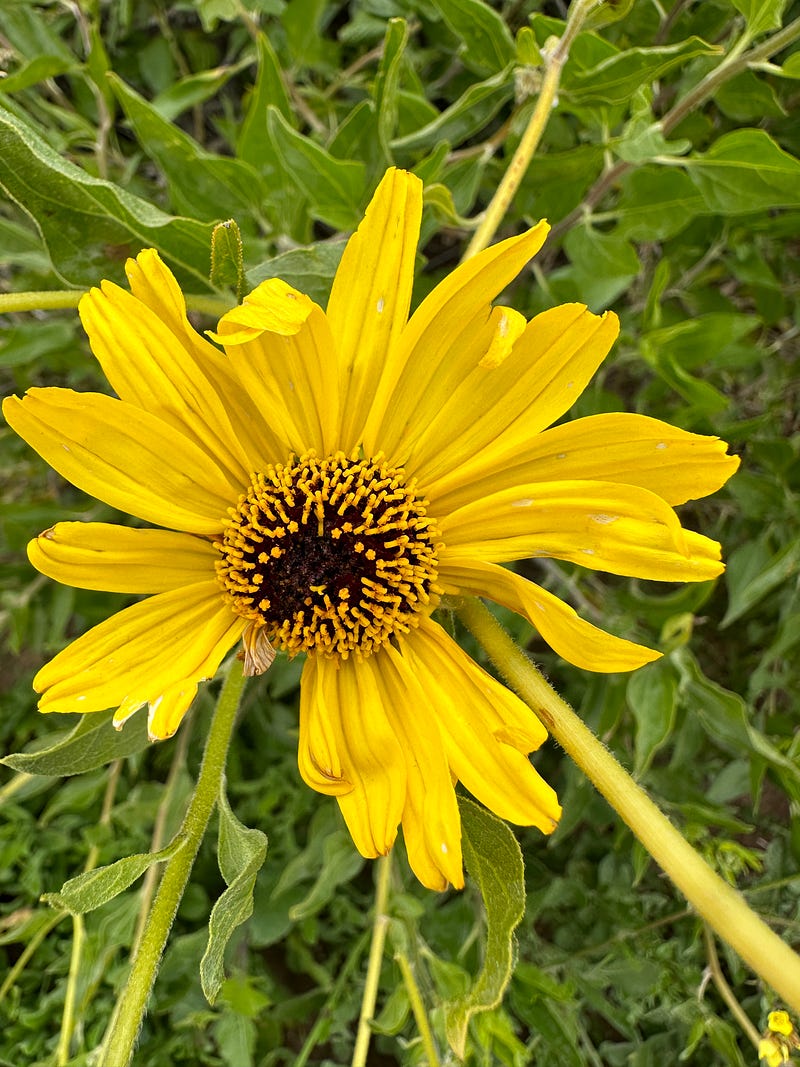
California Coast Sunflower. Photo ©Erika Burkhalter

The delicate fringed lianthus flutters on the soft spring breezes. Also, a native to California, it resembles a poppy.
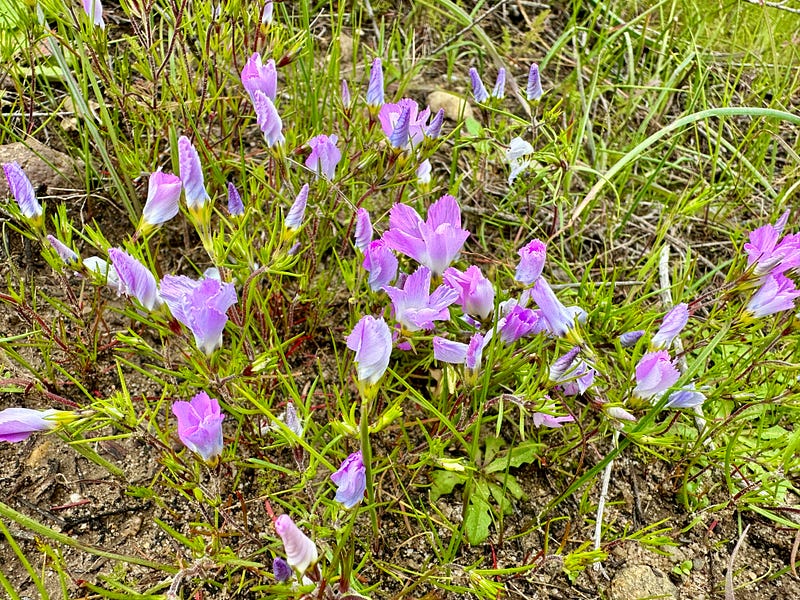
Fringed lianthus. Photo ©Erika Burkhalter

Here, they are spreading low beneath a prickly pear cactus. I lived in Tucson for many years when I was young, and I will always have a soft spot in my heart for the cacti.
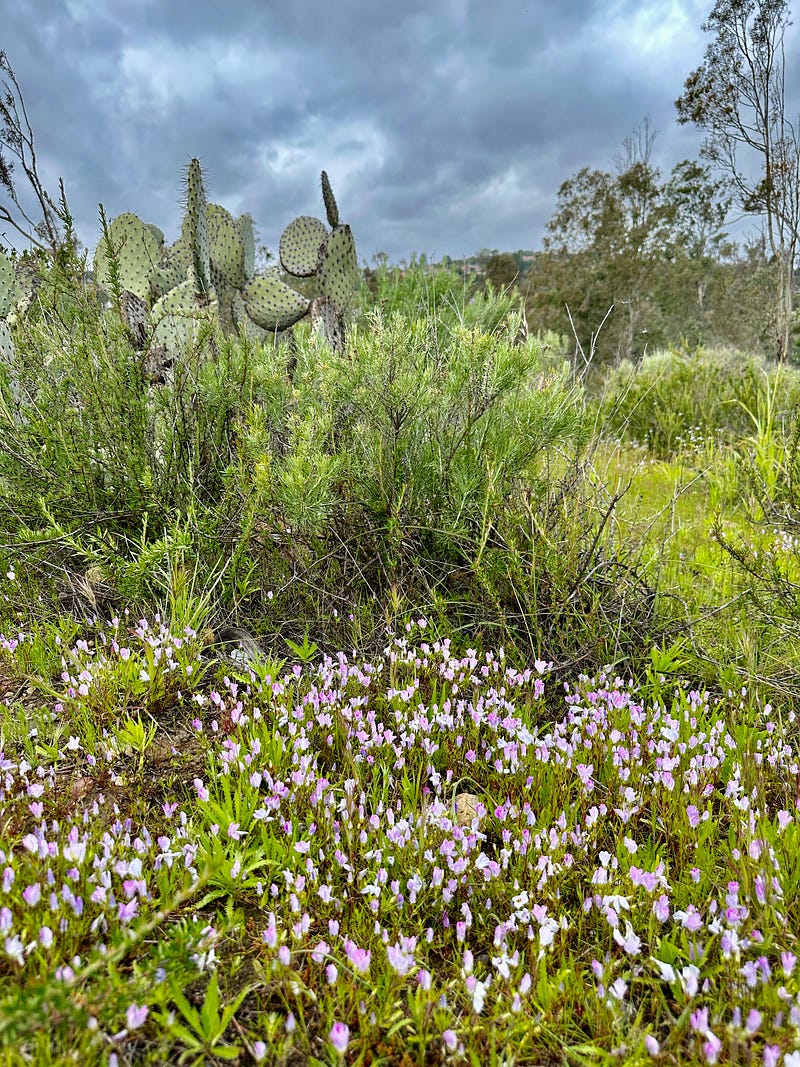
Prickly pear cactus. Photo ©Erika Burkhalter

The desert wishbone-bush, or mirabilis, are from the genus of plants known as “four o’clocks” or “umbrellawarts.” I love how their yellow stamen just pop against the purple petals. And the fuzz on the flowers before they open up adds an interesting textural element.
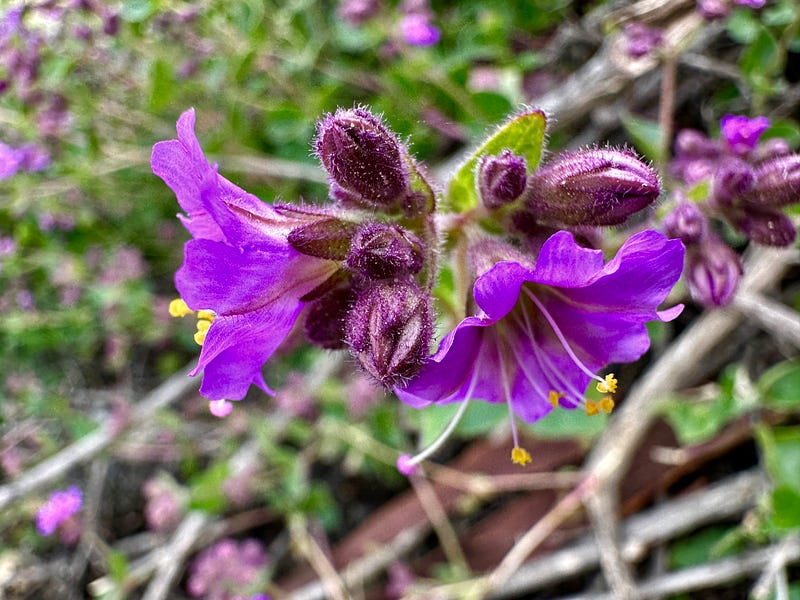
Mirabilis. Photo ©Erika Burkhalter

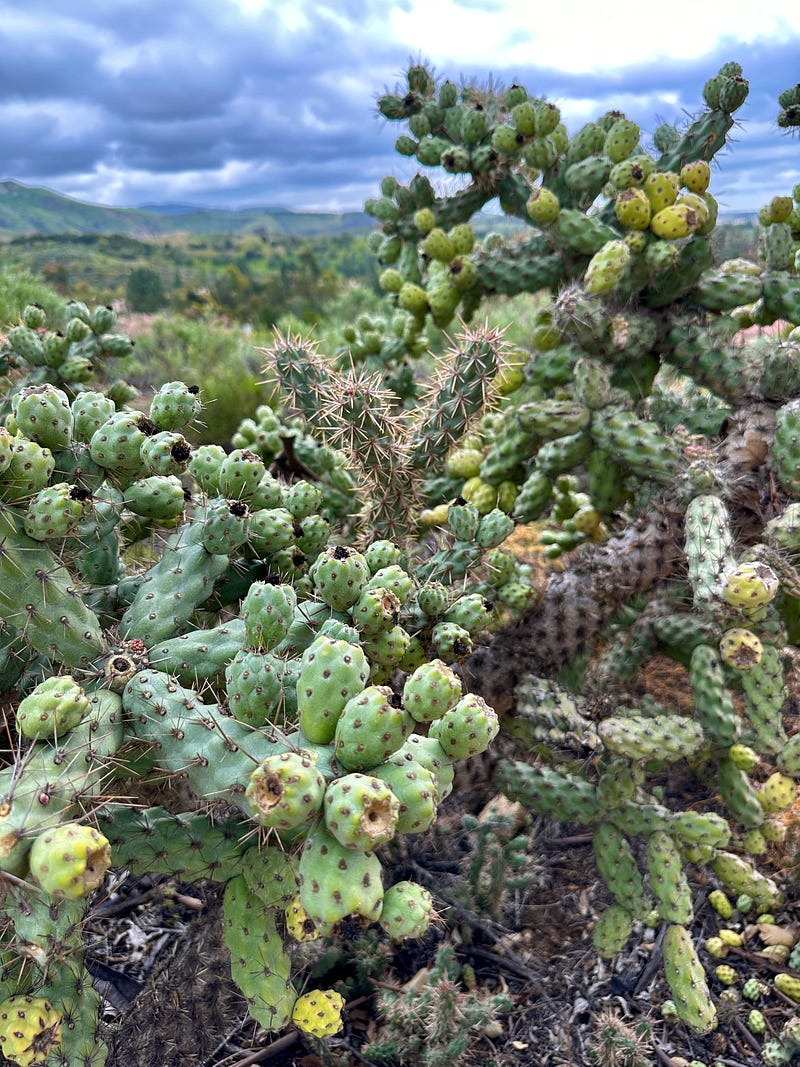
Another of my beloved cacti is the cholla. In these photos, you can also see the looming clouds before one of our recent rainstorms.
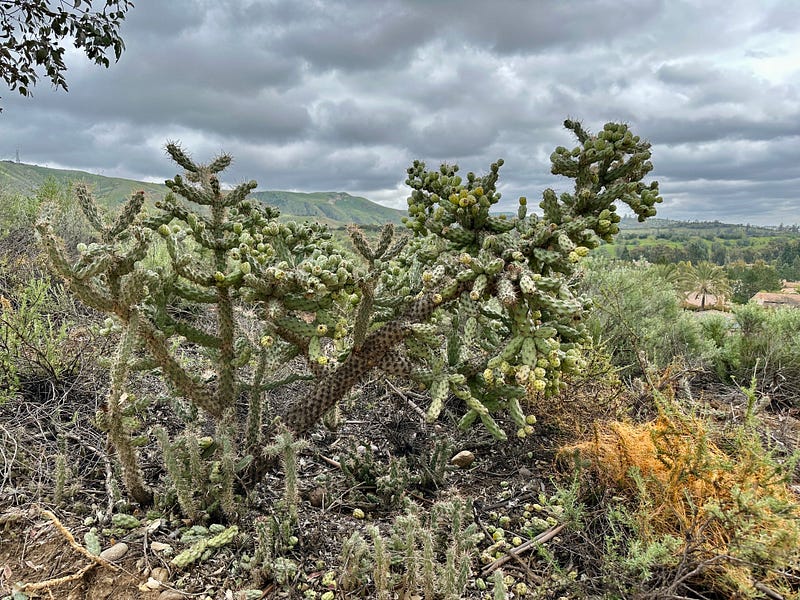
Cholla and rainclouds. Photo ©Erika Burkhalter
Cholla. Photo ©Erika Burkhalter

The popcorn flower, or plagiobothrys, are small herbaceous plants that really do resemble popcorn.
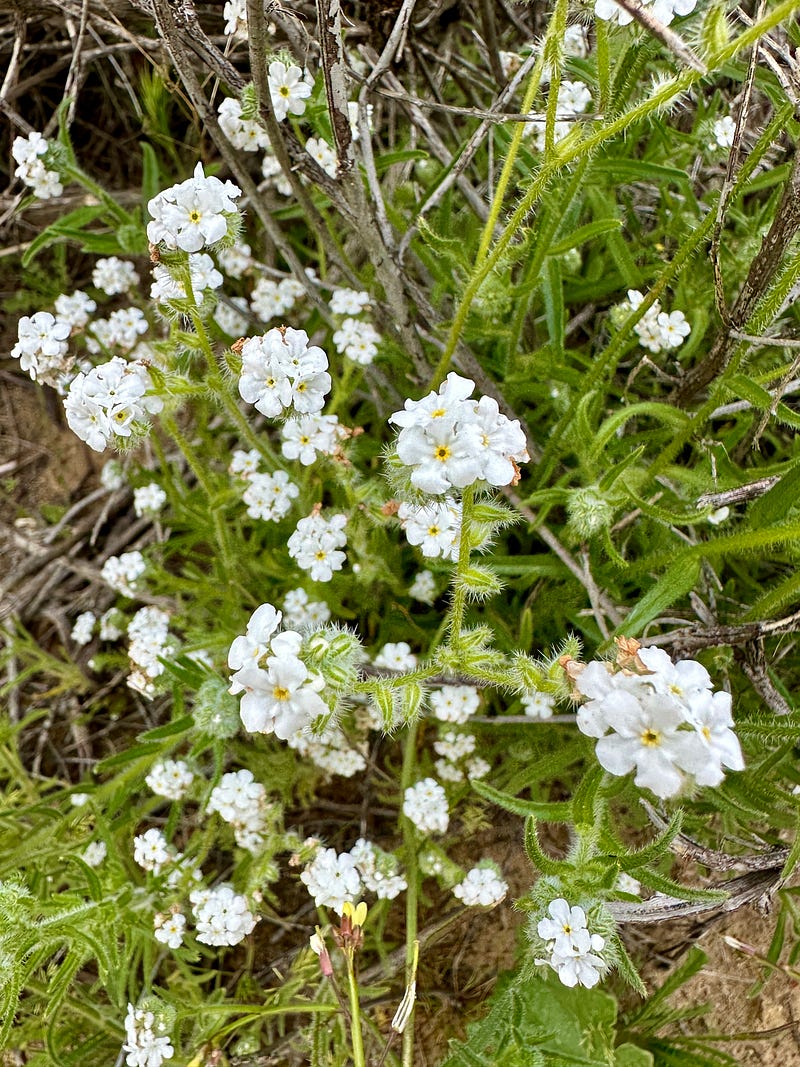
Popcorn flower, or plagiobothrys. Photo ©Erika Burkhalter

Another native species, black sage, likes sandy soil.
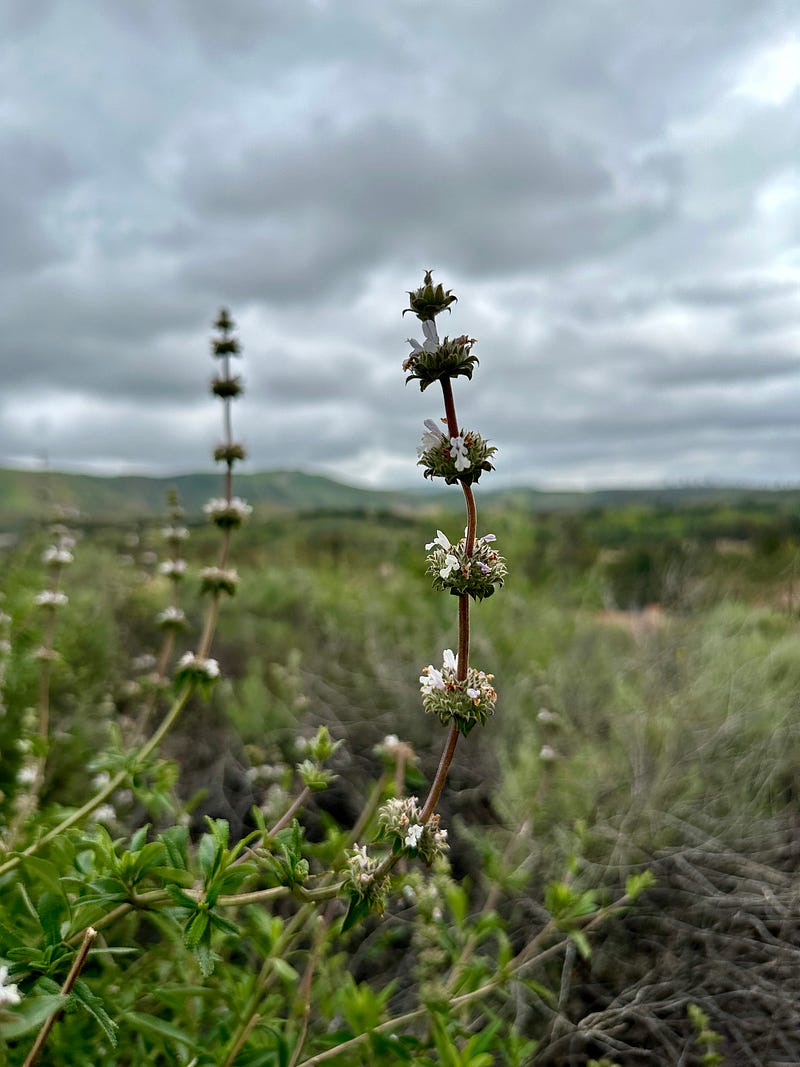
Gray skies and black sage. Photo ©Erika Burkhalter

I’ve spent a lot of time in India, and I remember driving through fields of mustard there and realizing that the yellow flowers which cover the hillsides in California were also mustard. It is everywhere this time of year and can grow taller than me. When I am out on my mountain bike, riding through these fields of mustard is like being in a cloud of yellow.
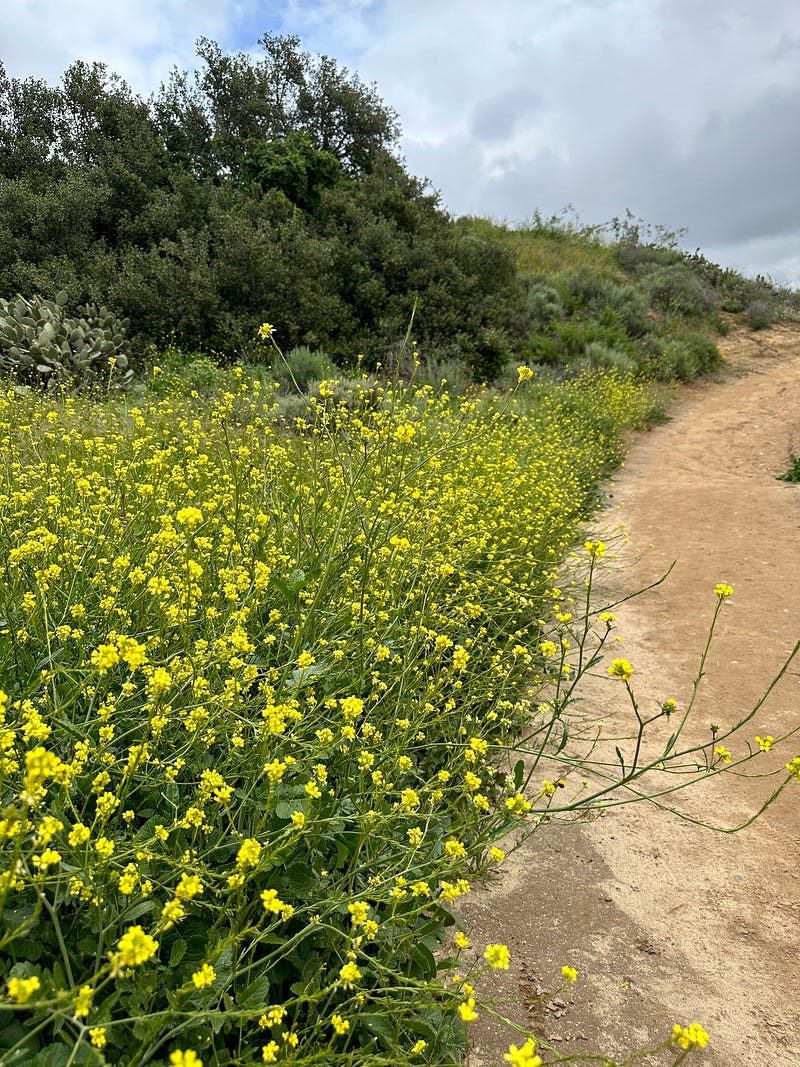
Wild mustard. Photo ©Erika Burkhalter

And the hardy California buckwheat, also native to California, grows into a thick shrub. I love how the flowers look like candy-striped confetti.
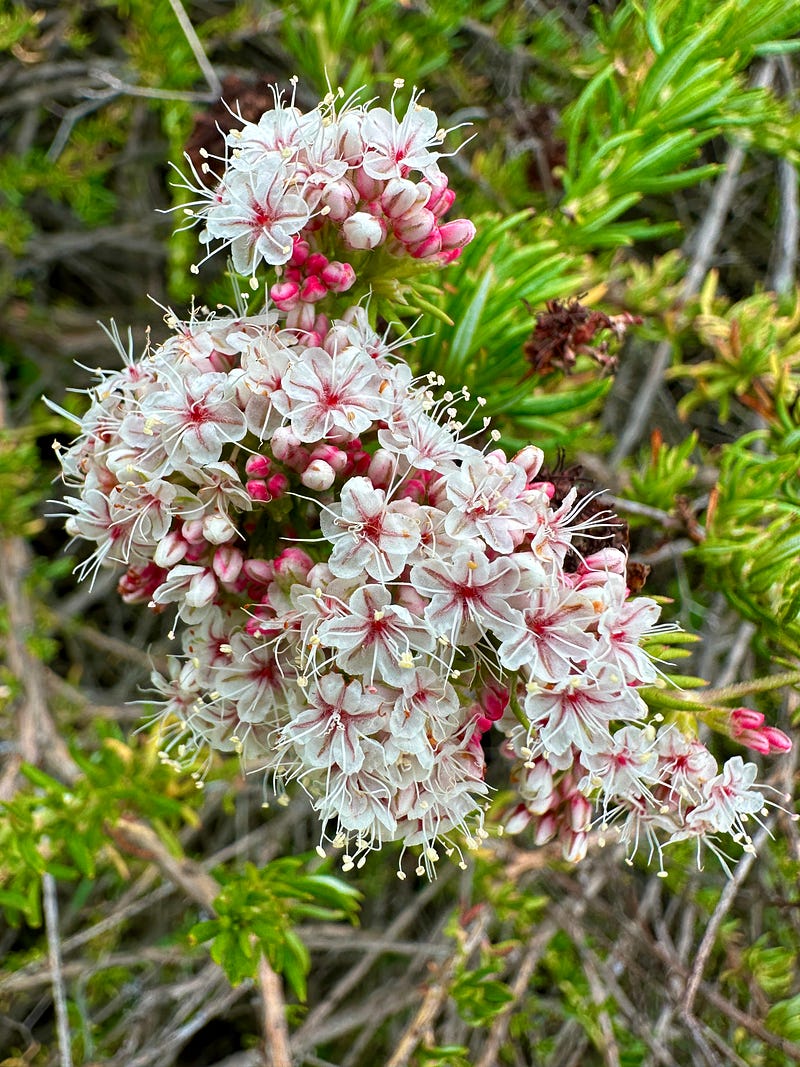
California buckwheat. Photo ©Erika Burkhalter

We are still experiencing a lot of rain in Southern California and are feeling like the earth is finally quenched again. It is still early in the spring, and we have a couple more months of prolific wildflowers ahead of us. I’m looking forward to the rest of the show.

Erika Burkhalter is a yogi, neurophilosopher, cat-mom, photographer, and lover of travel and nature, spreading her love and amazement for Mother Earth’s glories, one photo, poem or story at a time. (MS Neuropsychology, MA Yoga Studies).

You might also enjoy:

If you enjoyed this piece, you might consider subscribing to my stories. You’ll get an alert whenever a story gets published. While I do normally post my stories with free “friends” links on social media, if you enjoy reading on medium, you can help the many talented writers here by joining. It helps to support the arts and to keep us writing!

And, because I’ve had a few people asking lately, if you’re ever interested in purchasing a photo, just leave me a note.

Photos and story ©Erika Burkhalter. All rights reserved.

Nature
Photography
Nature Photography
Outdoors
Flowers
Recommended from ReadMedium
avatarDr.Anannya Mondal
Late

Am I really?

2 min read
avatarDeborah-Wildlife Photographer
Processing

Life Experiences

3 min read