
Sometimes, Growth Can Be Deceiving
A reflection on perceptions vs. actual experiences
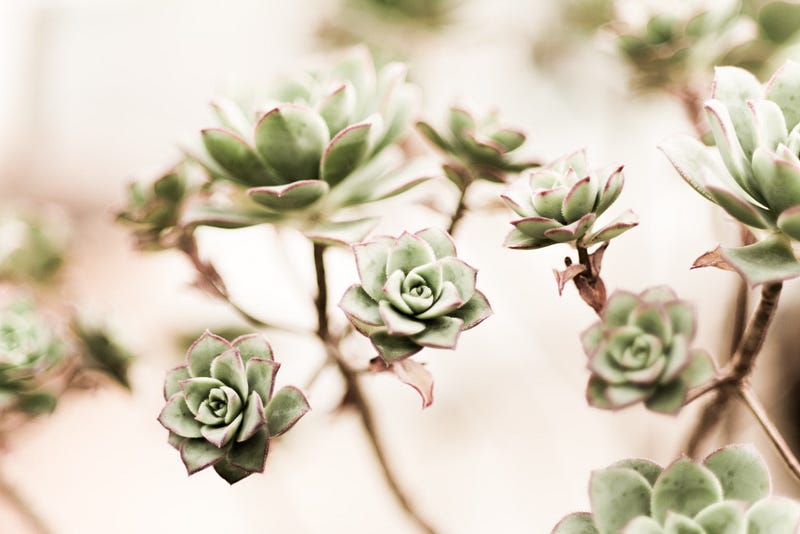
Just days before the most recent lockdown in my region of the world, I ventured out into the world and bought myself a cute little succulent.
Numerous Pinterest boards and Instagram explore pages sold me on the idea that a tiny plant with bulbous leaves would bring me joy. I can’t have pets per my apartment lease and my only companion this entire pandemic year-and-a-bit has been a Roomba that has two googly eyes glued onto the top surface strategically to form a face.
Yet, the downside to all of this is that my Roomba is not alive. Despite his cute face and his puppy googly eyes that bounce whenever he accidentally navigates into an object, he does not grow.
My tiny succulent did.
My succulent baby came to be no bigger than the diameter of a toilet paper roll. In fact, when I was looking for a dish to put under the pot to prevent staining my window sill, I used a plastic soy sauce bowl — the ones you get with sushi when you buy the whole platter instead of just a roll.
To my surprise, this resilient plant grew, and it grew fast. It sat on my windowsill with my other potted plants. While the rest of the windowsill plants barely grew a millimeter (0.04 inches), my succulent grew from being barely 1cm (0.39 inches) tall to now being 8cm (3.15 inches) tall.
I celebrated, showing off my thriving plant to my boyfriend. He taunted me about killing off the orchid plant he gifted to me the Valentine’s Day before the pandemic started.
I thought I was doing so, so well.
The truth is that it’s not supposed to grow this tall, this fast. It’s actually a sign that the succulent isn’t getting enough sunlight and is growing rapidly towards the sun in an attempt to get the sunlight that it needs.
When I learned this, I felt shame. I felt guilt.
I felt so strongly about not getting a pet as some of my peers have, somewhat suddenly during the pandemic. Internally, I may have been judgmental about their statements of just wanting companionship in the present moment and not caring about what happens after. To me, I fear the day we return as pandemic pet companions are abandoned because pet owners no longer have the time for them.
Yet here I am, without doing the full research on a plant before purchasing it. Sure, succulents aren’t sentient and shouldn’t be discussed on the same plane as living, breathing, loving pets. All the same, I rushed myself into a rash decision without truly considering whether I could genuinely care for this plant.
I had this optimism that one day, if I kept trying, that I would not kill the plants that I brought home. I still believe in this, but I think the right research is needed to boost that likelihood.
No matter how hard I try, a succulent needs a lot of sunlight and would never thrive in a basement apartment. I know that much now.
My unnamed succulent taught me far more than the basics of thinking ahead.
The plant’s burst in growth that I praised as resilience and strength eerily reminded me of myself. Its lack of fit to its surroundings yet trying its best to survive, against all odds, also reminded me of myself.
I had a rough childhood, but what adults saw outwardly in my life was a stellar student, diligent and hardworking. They praised my efforts, but more importantly, praised my parents who seemingly did all the right things when it wasn’t necessarily true. Unloved at home, I went to school to be loved. I thought the support that I got when I got a grade was love. I merely did what I had to in order to survive despite my environment.
With the pandemic impacting my Ph.D., there’s been so much praise on how I’ve continued to adapt and improve. There are assumptions that I’ve had all the adequate resources I needed and should be refused help or support on the basis that I have made some progress. I merely took one step at a time, trying to make do with what I had despite the obstacles.
The assumption that just because something is surviving by some metric means that it's getting adequate support may sometimes be false. In humans, it’s so common and often quite valuable to place weight in individual autonomy, grit, and resilience. I still believe in this.
But I also reflect on a conflicting but co-existing idea: that personal choices, grit, and resilience need to be evaluated against resources and support. Individual characteristics can vary depending on whether the environment is nurturing or not.
Even a strong, resilient plant using its every last tactic to survive may die when the conditions are not adequate.
In the end, my succulent is actually surprisingly still alive. I’ve since moved it to an even sunnier windowsill, but realize that this statement doesn’t hold much weight given that all of these windowsills are basement windows.
I’m watering it on a schedule that might foster a deeper, healthier root system.
I’m holding back on celebrating its growth until I start acknowledging the environmental factors that might be holding it back.
I can only focus on what I do to truly check in on others to ensure that academic productivity isn’t at the cost of mental health or other basic needs.
I can only hope that the assumptions made about me, about how well I’m doing, about how that disqualifies me from adequate support are re-examined from this lens.