
Some Days Are Like That
On writing when the words won’t come

Some days, it is easier to show up to the page than on others.
Yesterday was not one such day — I struggled. I sat down to write, got a page in, and promptly realized I did not resonate with what I’d written. I had no desire to continue with the piece. I felt crunchy, agitated like I was writing in someone else’s voice. So, I stopped. I placed the document in a folder I’ve named ‘Kindling’ for moments just like these and, after stewing in my frustration for a few minutes, I moved on to another task. I told myself I could come back to the keyboard later; if not later today, tomorrow.
Some days are just like that.
In retrospect, I understand why. A few days ago I committed to a big decision I’ve been sitting with for a while without knowing how exactly I plan to follow it through. I only knew that where I’ve been no longer feels right and I needed to get myself moving. Sometimes we need to give ourselves a little nudge, so I did that. The thing is, taking action doesn’t always feel good — even if some part of you knows it’s right, those steps can be a jolt to the system the moment you take them.
The moment after I sent the text, I felt the shock of it in my body: I grew nauseous, my muscles coiled tight, and I was struck by the peculiar sensation of being slightly disembodied. Not a full-on dissociation, just enough that nothing quite felt real. I couldn’t believe I’d done it. I’d sent the words I’d been sitting on for weeks and there was no turning back now.
Navigating the stories within
I often find it difficult to write when I am disconnected from my body. It’s funny, I know since many writers tend to live up in their heads, but for me writing is a full-body experience. It seems as though almost everything I do is.
I live a very embodied life, so when I lose that connection, I immediately feel ungrounded, untethered from my spiritual self and all the energy that would normally guide me. I think I lived this way for a long time, but now that I know what it’s like to be in-body, I no longer like to hang out in a disembodied state. These last few years have been a process of learning to reconnect every time I ‘leave’ my body, so at this point, I’ve had a fair amount of practice. I sense when I’m checked out. I’ve learned what I need to do to ‘come home’ and can do it with far less time and greater ease than I used to.
Last night, I returned to those practices, and today, I feel entirely different. There were a couple of patterns that had surfaced amidst the chaos of uncertainty, and I had to do some processing before I could return to the page.
Processing uncertainty
One pattern, of course, was around the uncertainty itself. I am, as a human, generally not the biggest proponent for change. There are times when I will advocate for it, where I crave something different or exciting or new, but anyone who knows me well knows I have my routines and patterns and foods I eat that make me feel safe. This is not to say I never step outside my comfort zone — I am very well-acquainted with doing things that are uncomfortable or ‘brave,’ but when it comes to my day-to-day life … I appreciate a certain level of stability. Disrupting that can be quite triggering.
Many things in my life are changing at the moment, and after the uncertainty of the past two years, I think my nervous system is not particularly a fan. Even if these changes have the potential to be incredibly positive ones, it doesn’t see that yet. It only sees *change* and associates that with *danger* so I am in the process of holding space for the part of me that feels this way, holding her hand as we go through this together.
I’m reminding her that I won’t abandon her if things get sticky — I’m in it for the long haul, and I’ve got her back.
Still, that doesn’t mean it’s particularly easy to navigate these feelings, but I’m doing it the best I can. Poco a poco, as my family likes to say. Little by little, we’ll get there.
The second pattern that reared its head is a little more personal. It pokes at the heart of my work: my writing. I’ve been in the creative fields for long enough to track certain triggers within myself. Namely, I seem to struggle with the concept of success.
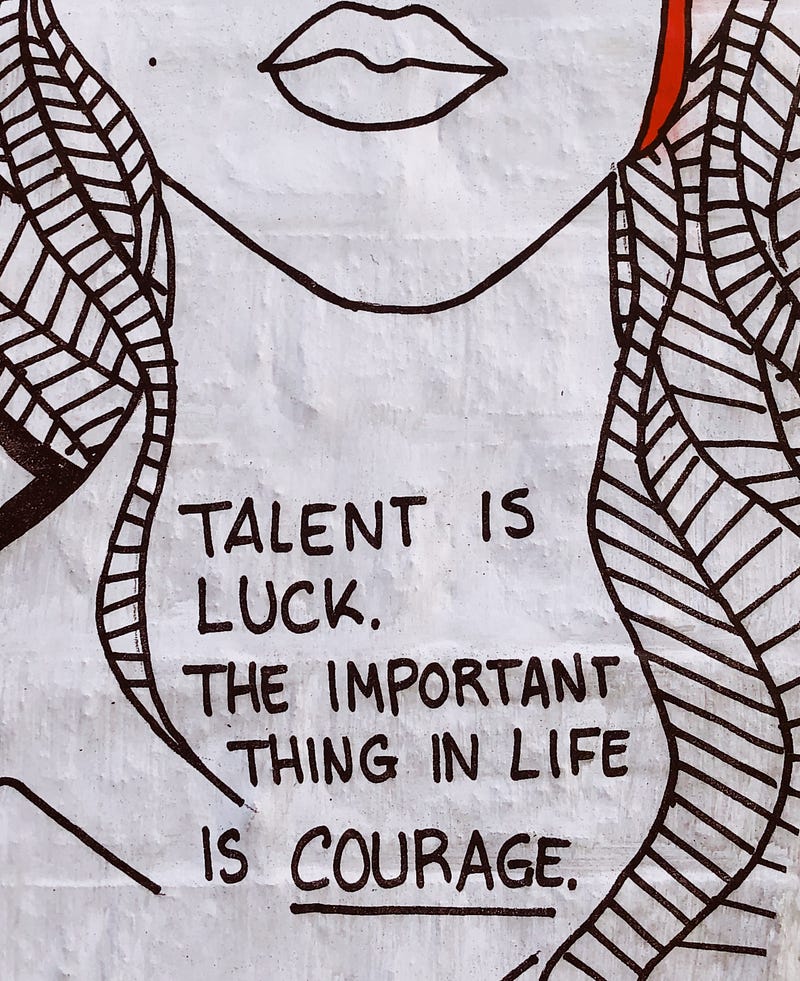
When the inner perfectionist becomes the inner tyrant
It’s happened enough times now that I can see it coming: the moment I begin to gain traction in something — be it circus or dance or writing online — the moment I sense people have begun to sit up and take notice, there is a part of me that wants to run away, stick her head in the sand and hide. She’s terrified of the attention, terrified of letting people down or being judged as ‘not good enough.’ More than anything, she’s afraid she’ll lose her ability to perform her craft — that she’ll get stuck, that she’ll get worse at what she does and disappoint someone. That she’ll disappoint herself.
The irony is that often, few things have changed. The process remains the same: show up and do your work. Create honestly, because that is what people are resonating with. And yes, sometimes I will make something that won’t be as ‘good’ or won’t hit home with as many people, but that doesn’t make it any less valuable. It’s all part of the process. The most important thing is that I keep showing up.
But. My inner perfectionist can be something of an inner tyrant sometimes. She comes screaming at me the moment she feels the slightest shift in the air. “We have to be perfect or else no one will love us and we’ll end up all alone and die! Do you want that?” She yells, “DO YOU WANT THAT?”
Really, she’s just afraid. Fear whispers, “Do you really think you can do this?”
“You might mess it up,” Doubt agrees.
All of this creates a war inside my mind and honestly, I’m tired of it. To be on the receiving end of ones’ own inner tyranny is incredibly draining.
Learning to trust the process
As I write these words, I have to smile slightly. I’ve been creating for most of my life, yes, and in many different forms. But one thing I know is that writing has always been there for me. She’s seen me through some of the most challenging times of my life.
There have been moments in the past when my inner tyrant won and set fire to the life I’d created. In retrospect, those paths weren’t mine to follow, so it’s okay — but writing is different. For me, language is one of the most intimate parts of my being.
Story is life and life is poetry, writing and living inextricably intertwined.
Because I’ve had this relationship with writing for almost two decades now, because I’ve kept showing up through the highs and lows, I think I can trust we’ve cultivated a certain level of resilience. My logical side can see that. Writing isn’t just going to disappear because I’m having a bad day. She’ll be there, waiting, probably smiling that smile that says, “My dear, silly friend — you’ve been doubting yourself again. Are you ready to come home yet? Are you ready to create something?”
Still, it might take me a while to really trust that she’s not going anywhere. It might take me even longer to trust myself.
But that’s okay. Some days are like that.
I can always try again tomorrow.
Thank you Trista Signe Ainsworth, Sharing Randomly and Ellie Jacobson for all that you do for Thank You Notes — I appreciate you!
Here is a piece by writer Analee that I thoroughly enjoyed this past week, it made me smile. If you’re looking for a way to reframe Mondays, I encourage you to give it a read.
As a poet, writer, and artist, Maia Thom works with words to create spaces for people to breathe and come home to themselves. In 2020, she published her first anthology, Kitchen Table Talks: Simple Reminders + Thoughts on Life. You can find her on Instagram as @maia.thom where she shares poetry, art, and practical wisdom to offer daily moments of calm.