
I Will Never Not Be Writing
I’ve often said I write because it’s the one thing I can’t not do
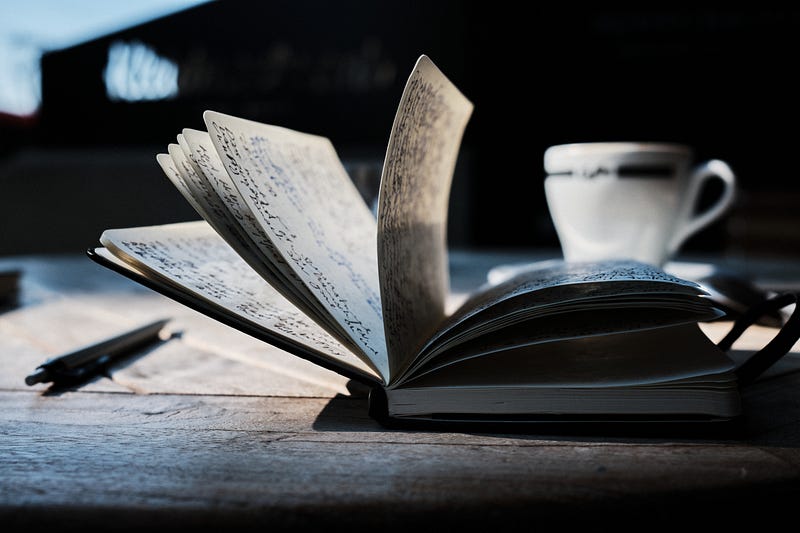
I’ve often said I write because it’s the one thing I can’t not do.
This, in many ways, is the truth.
I’ve studied many creative forms over the years. A few things have stuck, but of all the forms I’ve had the chance to explore, writing has been the stickiest. I can’t remember a time when I didn’t bleed poetry, when stories weren’t constantly building up in my brain just waiting to be put down on paper.
When I was little, I had several imaginary friends — my mom likes to tell this story of one time when we were getting back in the car after a shopping trip and I stopped her from closing the door because, “Laura still has to get in!”
There were eleven of them, my imaginary friends. To be honest, I can’t say my life now is all that different. Now, there may be more ‘seriousness’ shrouding my creative process but I still spend my days sitting with the ethereal, building worlds out of nothing and speaking characters into existence.
This is the life of a writer.
How it all began
I was four years old when I ‘wrote’ my first story. My mom had to be the one to transcribe it onto paper because I hadn’t yet learned how to write the alphabet, so she pulled out a notebook and wrote out the words while I filled the pages with small illustrations. It was the story of a volcano and a daisy who became best friends — now I think my young self was so wise. If a daisy and a volcano can be best friends, what excuse do us humans have?
I still remember that story, how it popped into my head. How, in those days, nothing felt impossible.
In second grade, we had a class each week called Writer’s Workshop — this was any young writer’s dream. During this two-hour period (time feels infinite when you’re seven years old) we had the chance to write our own stories, edit them with our teacher, then make them into real live story books. By hand, of course. I was making books before I even had a notion of what it meant to be a writer.
The irony is that if someone had asked me back then what I wanted to be when I grew up, I don’t think I ever once told them I wanted to be a writer.
Truth be told, I don’t remember what I said. There was a while when I thought I wanted to be an architect, probably because I loved watching home shows with my father (HGTV was my jam) and any time I said that’s what I wanted to be, his face would light up. Adults were always impressed by architects. No one I knew at that age was a writer — I just knew I would always be writing. There was never a question about that in my mind.
An Initiation
When I was eight, I wrote my first poem. It was the first day of third grade and my teacher, Mr. Krahn, handed out a series of Dollarama notebooks, far fancier than the thin scribblers we’d been given up to that point. He told us these would be our Writer’s Notebooks. We were to write in them every day, for English class or any other random thoughts we had, anything we wanted to record from the world around us. This was our space. He gave us twenty minutes and during that time, I wrote a poem about the elements. It was my new favourite thing.
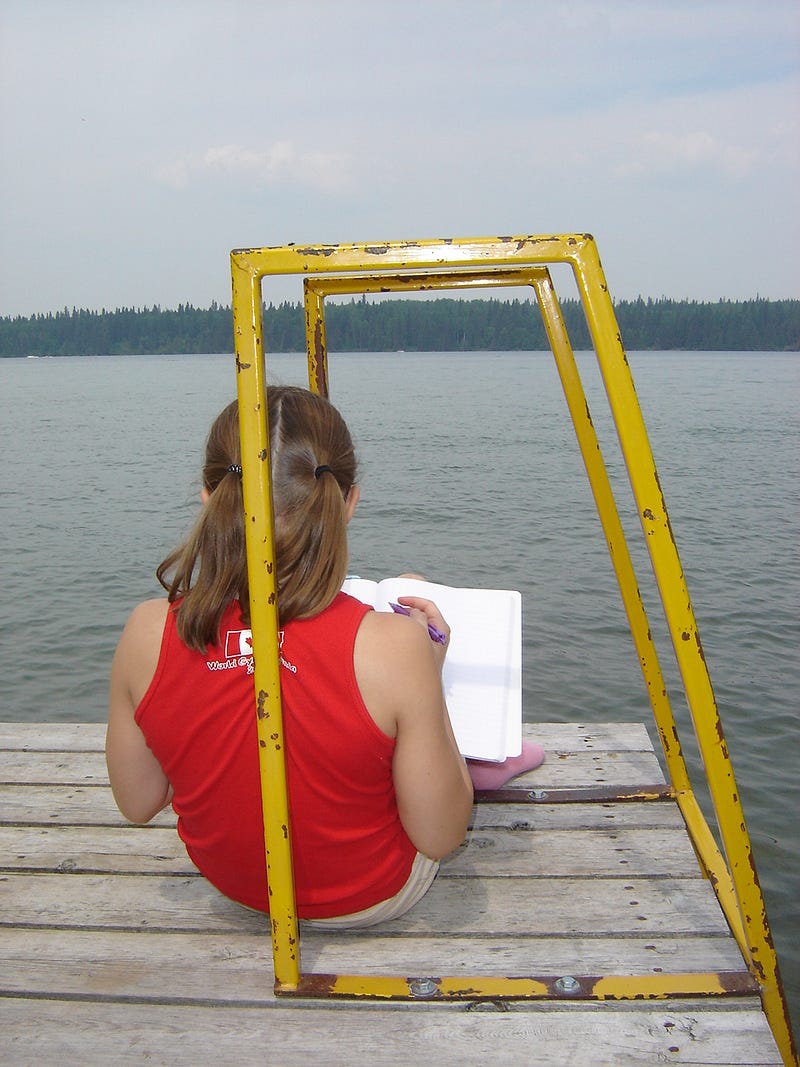
My first poetry book was born around that time: I wrote a short poem for every letter of the alphabet. A is for Apple, high in the tree, won’t you come down and play with me? It took me a year to finish, and when I did, I was already thinking about publishing. I could imagine these poems somewhere on a shelf in a bookstore, published for real this time.
I possessed a certain self-assuredness around my writing back then. Nothing could phase me. I never spent time overthinking how a certain sentence might be portrayed, wondering if people would understand what I meant, wondering if they would like it. I liked my writing and that was good enough for me. I didn’t need anyone’s approval to keep writing.
Consistency is key
I was fourteen the first time I participated in NaPoWriMo — that’s National Poetry Writing Month, for the uninitiated. Every April, poets around the world commit to writing a poem per day for each day of the month. There are prompts, if you choose to follow them, but I mostly did it for myself. This grew into a phase where I wrote a short poem every night for more than a year, usually in my head while I was in the shower at the end of the day. I would towel off and hurry to get the words down on a sticky note before they could slip away.
I’ve probably written thousands of poems at this point in my life — it would be impossible to count. Twice, I completed the 100 Day Project, a global movement started by artists elle luna and Lindsay Jean Thomson. Similar to other writing challenges I’ve participated in, you create something every day for one hundred consecutive days, however big or small it might be.
What I loved about this challenge was how simple it was. I set myself the goal to hand letter something every day for one hundred days, whether that be a quote or an original poem. I set the bar low and far exceeded my own expectations. This, in fact, was what led me to publish my first full-length poetry anthology.
Just show up
Over the years, I’ve made countless other forays into writing: when I was sixteen, I wrote 50 000 words in a month during National Novel Writing Month (NaNoWriMo) in an attempt to write my first novel. I’ve started a few blogs, published several personal essays online, and completed an in-depth writing course.
If there’s one thing I’ve learned, it’s this: show up. If you want to be a writer, just start writing. It doesn’t have to be good. I promise, no one has to read your journals if you don’t want them to — but you have to start somewhere.
Take the pressure off yourself. You already have what you need to begin.
When things fall apart
In spite of how instrumental writing has been in my life all these years, I never gave myself permission to pursue it full-time — until the pandemic hit in 2020 and everything else got stripped away, I was convinced writing would only every be the thing I did on the side.
Funny, how it all unfolds.
When the lock downs hit, I was in the middle of my third semester of a four-month professional training program for contemporary dance. I’d completed the program twice already; I’d signed up for a third round because I didn’t know where I was heading next and I thought it would be a nice container to hold me while I got my footing.
I’ve been training in the movement arts all my life — first as an artistic gymnast and circus artist, then as a dancer and choreographer. I thought this was what I was going to do with my life, that this would be my main thing. Honestly, I couldn’t imagine myself doing anything else. I’ve always known I would be going into an artistic profession and this path felt like the most natural extension of my life up until that point.
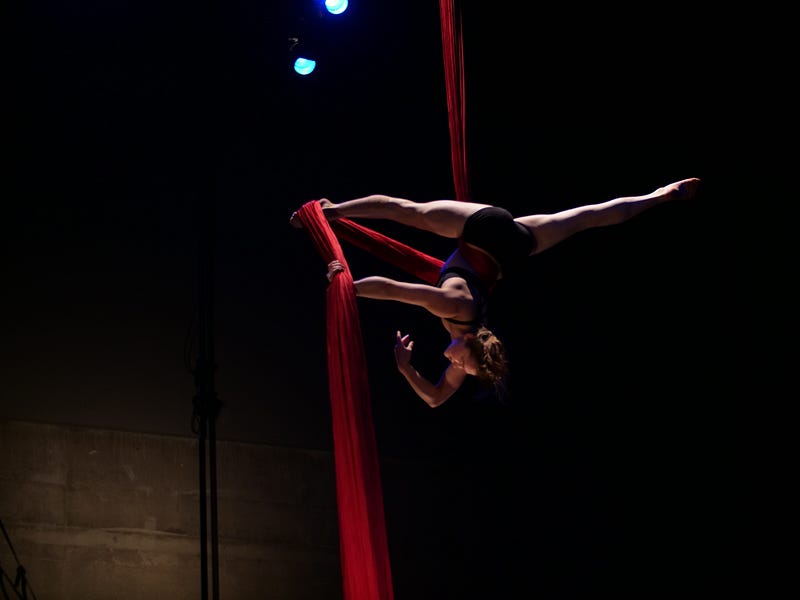
What I didn’t realize is that we are each better suited to some lifestyles than we are to others. The life of a performer is one of heightened uncertainty. You are constantly touring, rehearsing, and travelling all over the world, much more at the mercy of whichever companies wish to hire you. Until the pandemic hit, I didn’t realize how much of a home body I actually am.
While I will always be performing and creating with movement, I realized I am actually much more suited to the life of a writer: I love to wake up in the morning and follow a quiet morning routine before sitting down with my laptop to work with words for hours.
Writing was the thing that grounded me while the rest of the world fell apart.
Permission to commit
I think, deep down we all know what we truly love.
Somewhere beneath the trauma and layers of childhood conditioning, there lies something that lights you up more than anything in the world. We don’t always give ourselves permission to commit to this thing, though, because it seems scary. I know — for me, I was always scared to commit my life to writing because I was afraid that commitment would suck the joy out of it. My relationship to writing is the most intimate part of my being, and the thought of losing that relationship? It’s truly unbearable.
Our fears will always be something we have to contend with. The question is whether or not we will let them dictate our actions, whether we will let them stop us from doing the things we love.
There is a flip side to fear when we slow down enough to see it: we have agency in how we go through life. We get to choose how we want to feel when we engage with different activities, different parts of our day-to-day.
If I have this awareness of what I fear in committing my life to writing, I can choose to cultivate habits and practices that will serve to safeguard my love and joy.
I can choose to trust in the resiliency of my relationship with this thing I love so much. I can remember that there have been times in my life when writing and I haven’t been such good terms and still: I’m here.
I’ve kept going.
Courage to create
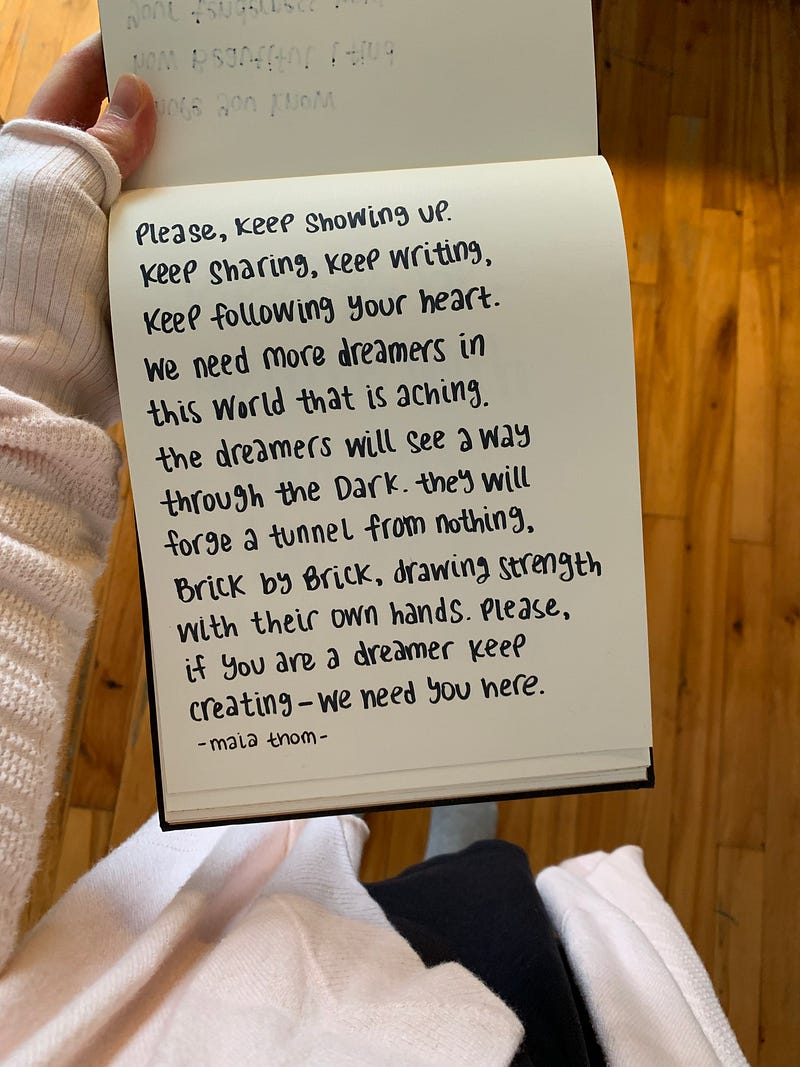
I’ve heard many say the creative life is not for the faint of heart. This may be true — all I know is that for me, there has never been any other option. I write because it’s the thing I can’t not do. I share my writing because maybe someone out there has experienced something similar and my sharing my words will let them feel a little less alone as they journey down their own path.
Maybe you want to commit your life to a creative endeavour, maybe you don’t — there is really no right or wrong answer here. Only you know what is truly right for you.
But wherever you are on your creative journey: know it’s never too late to begin again. Remind yourself why you started. Remember that young artist who created simply for the fun of it, who couldn’t be phased by anything.
Remember, then begin.
Shoutout to Carmellita who inspired me to reflect on my own writing journey with her piece, Carmellita in the Making. I highly recommend you to go check it out.
As a poet, writer, and artist, Maia Thom works with words to create spaces for people to breathe and come home to themselves. In 2020, she published her first anthology, Kitchen Table Talks: Simple Reminders + Thoughts on Life. You can find her on Instagram as @maia.thom where she shares poetry, art, and practical wisdom to offer daily moments of calm.


