
Social Network Analysis
Clustering Series
This is my second post related to clustering, you can read the first post here.
In this post, I tried to summarize the social network analysis.
This story was written with the assistance of an AI writing program.
Social network analysis is the study of the relationships that exist between persons or organizations within a social network. It entails applying graph theory and other analytical methods to comprehend the structure, dynamics, and evolution of social networks.
Individuals or organizations are represented as nodes in a network, while their relationships are represented as edges. These edges can indicate a variety of relationships, including friendship, collaboration, and influence.
Social network analysis can be used to a variety of social systems, such as online communities, social media networks, professional networks, and interpersonal networks. It can be used to detect patterns and trends in data, such as the formation of subgroups or the transmission of knowledge or influence across the network.
Social network analysis can also be used to forecast future trends or behaviors within a network, as well as to identify key persons or organizations that play important roles in the network. It can be a useful tool for understanding the dynamics of social systems and tackling issues such as disease transmission and disinformation.
Social network analysis is the study of the linkages and connections that exist between persons or organizations within a social network. Clustering is a data mining approach that seeks to break down a huge dataset into smaller, more homogeneous sections, or clusters.
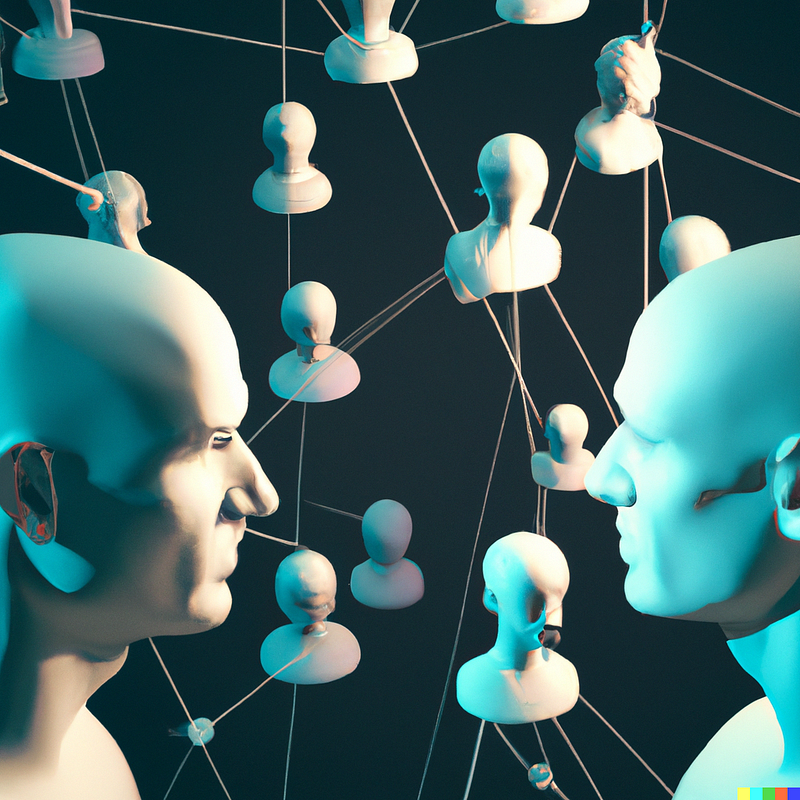
In the context of social network analysis, clustering can be used to identify and analyze the structure and patterns of relationships within a social network. This can be useful for a variety of purposes, such as identifying influential individuals or groups within the network, understanding the spread of information or ideas within the network, or predicting future behaviors or outcomes based on network structures.
Social network analysis can also be useful for identifying clusters within a network. For example, if a social network is divided into several distinct clusters, this could indicate the presence of subgroups or communities within the network that are more tightly connected to each other than to the rest of the network. Identifying these clusters can help researchers or practitioners understand the dynamics and structure of the network, and can inform strategies for communication or intervention within the network.
Overall, the use of social network analysis and clustering can provide valuable insights into the relationships and structures within social networks, and can be applied in a variety of contexts, including business, political science, sociology, and public health.
How?
Construct the network
After collecting and preparing the data, the following stage is to build the network. This entails identifying the data’s nodes (individuals or organizations) and edges (relationships) and generating a network graph.
Analyze the network
After constructing the network, the next step is to examine it using various analytical approaches. These may include centrality measurements (such as degree centrality or betweenness centrality) to identify prominent individuals or organizations in the network, as well as community detection methods to identify network subgroups.
Visualize the network
Visualizing the network can help you comprehend its structure and dynamics, as well as explain the analysis results to others. There are several tools and software packages available for visualizing social networks.
Interpret and communicate the results
The analysis process concludes with the interpretation and communication of the results. This could include drafting a report or presenting the results to others in a clear and straightforward manner. The ramifications of the findings, as well as any limitations or biases that may have influenced the investigation, must be carefully considered.
This was all from my side about social network analysis. If you found this article useful, please give it a clap and share it with others!
Take care!