
Social Media Marketing for Authors
All you need is a content compass and a simple calendar

I wrote a children’s book about growing up and I’ve been promoting it for over three months. Last time, I shared my knowledge on how to promote your book with content marketing.
Here is a short reminder about what I discussed in that article:
First, you make a new Wordpress site and organize the content.
Then, you create the topic cluster — blog posts connecting to a pillar page.
After that, do the content audit — check what old content you could use to write new posts.
Then create a content offer — something useful to readers, like a free eBook about what they need in exchange for their email addresses.
In the meantime, define your buyer personas. I started with a mom who Googles problems of growing up.
Do an event-based audit for the next three months to see what campaigns and themes to focus on.
Define your SMART goals. They are specific short-term goals that make content marketing more effective such as, Decrease the bounce rate from 77% down to 61% in the next three months.
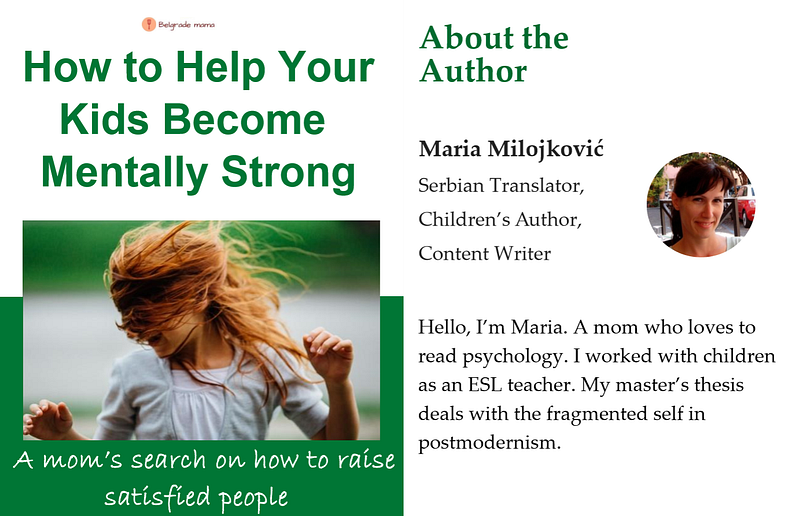
Having finished all this, I started planning the promotion. This is what it looks like in the beginning:
Try Different Types of Content Promotion
They say you should spend 40% of your time creating content and 60% promoting it (even 80% if you’re very skillful). Readers are everywhere, and your content has to grab their attention among millions of internet pieces.
So, be sure to promote your posts on different social media and in different formats. This type of content recycling saves you time and makes your message more effective.
There are two types of content promotion: organic and paid promotion.
A) Organic promotion
You don’t pay for it and there are several ways to do it:
Do your website SEO: I wrote about SEO basics in the previous post (see the link at the top).
Email marketing: It’s much more effective to get new customers this way than by social media.
Social media: You reach new people on networks and create a community with similar values. If you play your cards right, they’ll become your future advocates.
Live promotions: There you get new opportunities and maybe even create future relationships.
Influencers: If the real influencers say a few kind words, their followers could become interested in you.
Word of mouth: Ads are everywhere, and people would rather believe someone they trust than a commercial. Get to know those people.
You can’t do all of these things at the same time if you’re doing the promotion all by yourself. So, focus on a few for each campaign and think about trying out the rest in the future.
B) Paid promotion
By paying a few bucks, you get to a new, highly-specific audience who might be more interested in what you offer than those you reach by organic promotion. These are the ways to do it:
- Search engine ads on Google, Yahoo, or Bing,
- Social media ads on Facebook, Instagram, Twitter, or LinkedIn.
Each platform has a different audience. They all prefer different types of content and consume it in different ways. Instagram is full of filters, everyone’s beautiful and livin’ la vida loca. On Facebook, the focus is on family and friends. On LinkedIn, they’re all hard-working but ethical. However, there are many exceptions, such as the growing popularity of personal stories on LinkedIn.
Experiment with those platforms, customize the tone for each channel, and measure the results afterward to see what goes well. Always keep your buyer persona in mind when deciding what to promote (like I’m always thinking about what interests a mother, not a woman without a family because the latter won’t buy my children’s book).
To be successful with conversion (i.e. how many visitors become your new leads, and how many leads turn into your customers), optimize. Write a clear, powerful CTA and include a link to your landing page.
Before you start the promotion, organize your initiatives.
Create a Content Compass
A content compass is an Excel sheet that includes all the pieces you’ve planned so far: your SMART goals, the overall theme, keywords and topics for your blog posts, the inbound marketing campaign (all the marketing efforts focused on one goal), external events that can influence your promotion, and your activities on social media.
This is what a part of my content compass looks like:
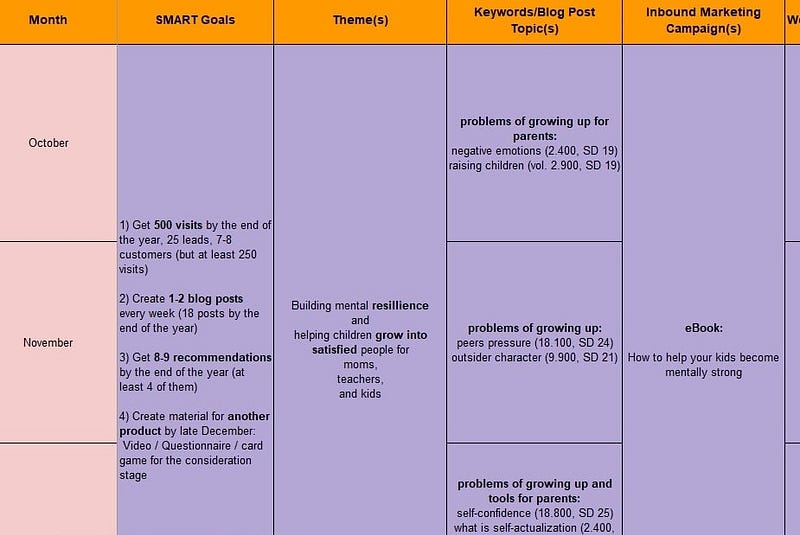
The content compass helps you organize content creation for the next three months. It also connects the themes you’ve chosen to a specific month — you can have one for each month or a single theme for the whole three-month period.
Don’t make a content compass for more than three months because you have to be able to adjust it if your circumstances change.
Create a Facebook Page as an Author
Many people post only their own content, but I don’t think this is a good decision unless you have at least 200k fans. It looks too promotional and self-absorbed.
When I thought about creating an author’s page, I wanted to post both in English and Serbian. I’m a translator. I wrote a bilingual book. I have two different audiences and articles in both languages.
This turned out to be a bad idea. In a Facebook group, a majority of people (Serbs) usually read only the posts in their mother tongue. They get confused by English although they understand it.
I chose a bilingual Facebook page — to write a post in English, and then provide the Serbian translation for it before I press publish. You can do it if you go to Settings (at the top right-hand corner of the Facebook page) and choose the option Post in Multiple Languages, click on the checkbox, and click Save Changes.
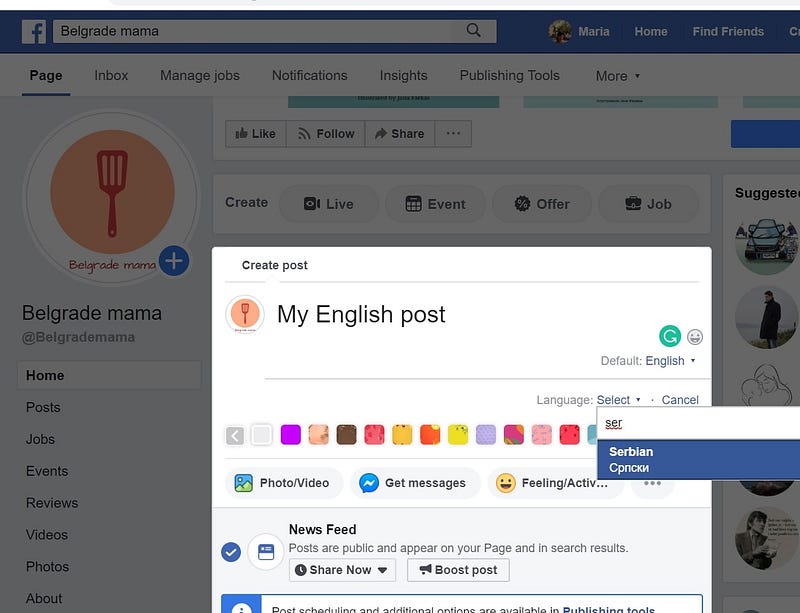
A word of warning to bilingual authors: The bilingual Facebook page isn’t a good solution. When you post your article on Facebook, you can put only one embedded link (in one language). If you want to create one post in two languages, then you put the first URL in one language, and the second URL in the translation of the same post. These two URLs can only be a part of the text and not embedded. Now you need a picture at the bottom of the post to tie up both languages.
This isn’t a good idea. People generally click on the picture, but it doesn’t lead them directly to the article in that specific language. Because there’s too much work for an average user to do, many won’t go on clicking.
Because I had only three followers who didn’t speak Serbian, I switched to a monolingual Facebook group (in Serbian).
After you make a content compass and decide what social media channels to use, create a social media calendar for the first month.
Make a Social Media Calendar
This is an Excel sheet with a plan for what to post on what day.
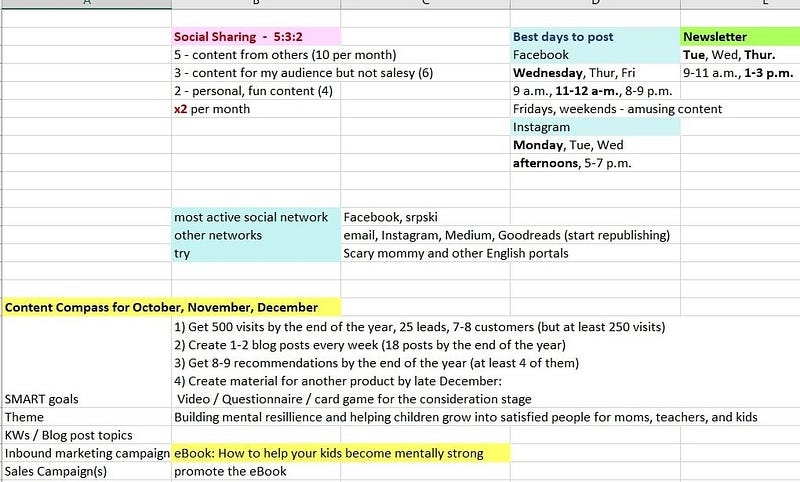
To have the most important items in mind all the time, I pasted them here (SMART goals, theme, inbound marketing campaign, sales campaign).
I also wrote the 5:3:2 rule of social sharing — you post five pieces of content from others, your three pieces that aren’t too salesy, and two pieces of personal fun content. Authors generally don’t do this. Still, my Facebook group has been gaining more visitors since I started posting valuable content that isn’t mine. I usually retell the short version of it and add the source at the bottom.
On this sheet, I put the information about when to post on each platform (test them all out, they may not work for your niche and region).
This is how it looks:
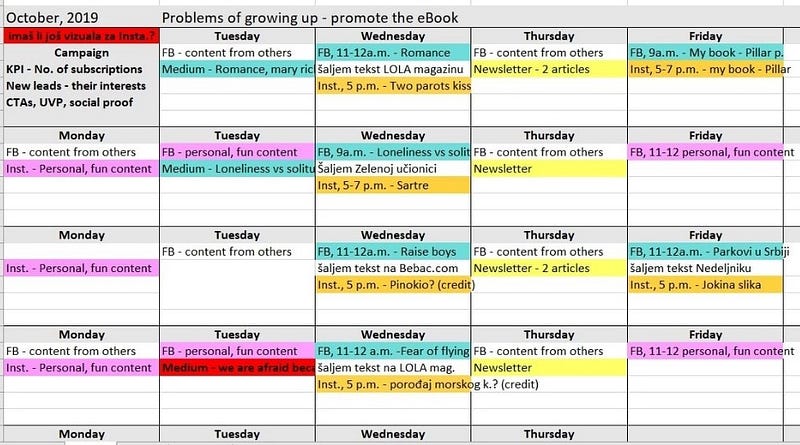
Then I determined what article to promote on what day, and this is how I created my social media calendar for the first month.
I left Saturdays and Sundays free because you never know what can happen during the week.
What you’ll see below is my first version for the month of October. In practice, I did half of it. I lacked experience. You just can’t predict some changes. The kids are sick, so I postpone all the work for a couple of days. I’m not satisfied with the quality of the article, so I take more time to fix it. And I made this mistake — no research.
So…
Find Publications You Can Send Your Articles to BEFORE You Start With the Promotion
The portals I used to send my articles to don’t want to publish my content anymore —one rejected the work, the editor of another didn’t communicate well. The editor of the third saw an article as too complicated. The forum of a great political magazine I wrote for doesn’t exist anymore! Therefore, I decided to stick to only one Serbian portal for the first round of promotion and promote the articles on my Facebook group.
I already said it in my previous post about writing content for book promotion — if you post your article on your website and want to send it to someone else, wait at least 14 days between these two actions (because of the SEO). If 14 days have passed but you didn’t promote it yet on social media, don’t wait for the portal to post it first. Publish it in on your author’s page and then send it to the portal. You can never tell what day the portal is going to publish your article.
One article of mine didn’t get much engagement on my (then 75 member) Facebook page, but it went viral on a 245k member parenting portal. “Leave the boys to grow up in peace” got more than 1,400 likes and shares in a week. Not so bad for a small country.
In the beginning, I posted an article for the sales qualified lead on my Facebook group once every two weeks. Although it was too early, my friends were so curious about my book, I wanted to keep their interest.
It also took me weeks to find a parenting publication on Medium. I would get a few claps because nobody reads your articles when they’re self-published. Then I found a parenting publication and I was gaining some traction but the editor announced she has to take a timeout, so I’m back to nothing on Medium again.
But I’m not giving up even though most of the audience on Medium isn’t interested in the problems of growing up.
After you have done all this planning, then it’s time to start posting your content on social media.
If you liked the article, check out these:


