
How To Promote Your Book With Content Marketing
A detailed, step-by-step plan that leaves room for improvisation

I wanted to become a better storyteller and marketer. So, I wrote a book and planned a content marketing strategy to promote it. It’s only when you go from reading information to implementing it that you really learn.
How to Improve Your Storytelling and Marketing
Early this year I finished HubSpot’s content marketing course. It’s awesome. In only four hours, it explains nine factors of the content marketing process:
- Storytelling
- Content ideas
- Content strategy
- Framework for content creation
- How to become an effective writer
- Repurposing old content
- Promotion
- Analysis and measuring the results
- How to develop a growth marketing mentality
Right now, I am in the process of content promotion.
Before the course, I wanted to improve my storytelling, so I wrote a children’s book. (Is there a better way to tell stories?) I gave it hesitantly to beta readers. They loved it!
A child psychologist from the Serbian Institute of Mental Health said it’s “interesting, dynamic, brings up numerous questions, inspiring.” Aaaaaaa! I was elated!

Then it was time to promote it.
I Created a New WordPress Website
I’m not too keen on parenting articles, but I need to write them now. My buyers are interested in child development and the problems of growing up.
My partner and I created a new bilingual website, “Belgrade mama” (I’m a translator from Serbia, Europe). I didn’t want to devote it to parenting only, so I split it into two parts:
- Writing and Digital Marketing
- Parenting
I knew this decision is “wrong”: The niches are very different, it’s bad for the SEO, it confuses the visitors, and I’d have a big bounce rate … And that’s all correct. Moreover, writing everything in two languages is time-consuming.
But this is a way to do my personal branding; I’m both an English-Serbian translator and a Medium author, I wrote a children’s book, and I do native ads. Above all, I’m a mom interested in psychology and marketing, sharing my own experience, and citing credible sources.
I tried to make my site pleasing to the eye and not too busy. I chose a white minimalist theme with big pictures and a nice font. The icons to my social media are in the top right corner for better user experience, and share icons are below the text.
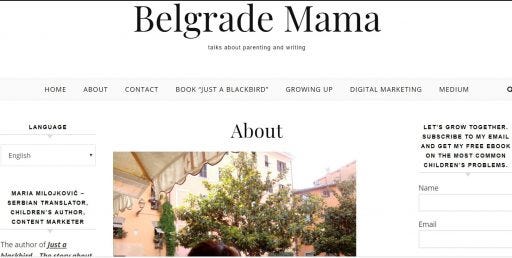
The About page
On the left, you can see what I do: Serbian translator, children’s author, content marketer. On the right, there is a CTA for an email subscription, as well as on every other website page. Below the photo, there is a short bio with my skills, work experience, and what magazines I’m a contributor to.
The posts
All the posts are formatted the same way: an appealing featured image, a couple of sentences for introduction, H2 for subtitles, two to four lines per paragraph, illustrations every 400–500 words, bullet lists, bold for key sections, italics for quotations. Also, there are no big chunks of text.
SEO
In each blog post, I stick to the basic SEO. I do Alt tags for every picture in my blog posts so that people can also find me if they google images instead of text.
Also, I choose five tags that I created in my Wordpress, such as “outsider,” “children,” “parenting,” “negative emotions,” “growing up,” etc. Each post belongs to one of several categories: Parenting, Digital marketing, Medium, my book “Just a blackbird,” etc.
I check my keywords on Ubersuggest. For more information, see the “Event-based audit” section.
Special plugins
Since this is a bilingual site, I use the plugin Polylang. But I have to deactivate it every time I do the tagging because it won’t save any tags. Sometimes not even then! And then activate the plugin again, which is a pain.
I also use the Antispam Bee to protect me from people who try to advertise Amoxycillin on my website (if I only had known someone would spam me).
Now, let’s talk about how to do the website content.
Do the Topic Cluster: Subtopics and the Pillar Page
Just the keywords mean nothing to Google’s algorithms. For better SEO, I’ve created a topic cluster and a pillar page about growing up. I’ve tied them all together. This way search engines can more easily recognize what my new website is about.
My topic cluster consists of eight blog posts about the most frequent problems children and teenagers face:
- Self-confidence
- Negative emotions
- Stress and frustration
- Loneliness vs. solitude
- Being an outsider
- Peer acceptance
- Self-actualization
- Love
One separate blog post for each topic.
All the posts connect to the core topic (the pillar page) and each other as well. Hopefully, this will rank me better in the parenting niche among children writers and mom blogs.
I chose the moral of the story for the topic of my pillar page: Life is uncomfortable, unpredictable and rewarding. It states that we should give our kids a spoonful of realism every day so they can grow into more resilient people. All the posts about children’s problems in the topic cluster support that idea.
When I wrote about the problems of growing up, I mixed expert advice with my own impressions. I wanted to write as a mom who tries to solve a problem, not a self-proclaimed expert. You can’t be authentic with somebody else’s voice and knowledge.
As I educate readers by giving them good sources, I get new leads. I don’t churn out content but try to write as high quality as I can. This means it will take me more time to get big traffic to my website (the more content you have, the more visits to the website you get).
Still, I’m a firm believer that quality pays off over time. And I write evergreen, so it won’t get outdated soon.
Do Content Audit and Content Offer
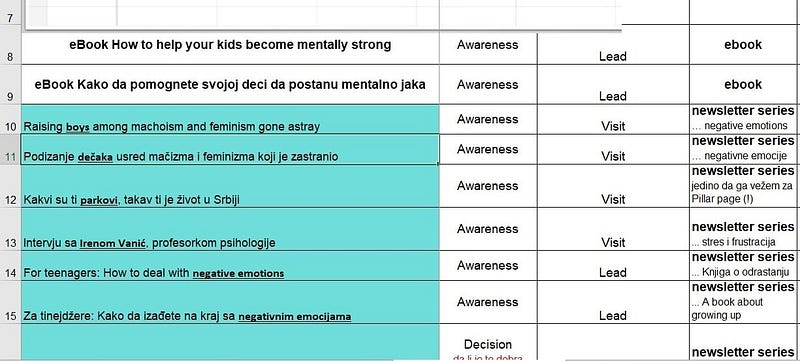
After I created the new website and migrated the posts from the old one, I did a content audit. I listed all the articles I had written before. Then I tried to find what I can use for my new topic cluster. I also determined what stage of the buyer’s journey the posts refer to, their format, and buyer personas.
My children’s book has three editions: English, Serbian, and bilingual. Some of my posts are in English, others are in Serbian, some are in both languages. I want to test both the Serbian market and the English-speaking world, so the topic cluster is in both languages.
I know, two completely different markets, but the content is evergreen, and millions of Serbs and their descendants live abroad. There is surely someone who doesn’t want their children to forget their mother tongue.
This is how the content audit looks: There are columns for the title of the post, stage in the sales funnel and the buyer’s journey, the type of content, a buyer persona it refers to, and the topic.
I knew parenting wouldn’t go well on Medium because the readers are mainly 25–35 years old. My most popular articles are about writing, not parenting. However, Medium gives you exposure, and I need it.
I joined all eight articles in a Word document, shortened them, and created a PDF ebook How to help your kids become mentally strong. You need something of value so that the readers give you their email addresses in return. So, this is how I created my content offer. Also, I repurposed my content and saved time for more content creation and promotion.
Then I created a landing page where I offer my eBook. On it, I address parents’ worries, give my credentials, and present the contents of my eBook. I didn’t want the landing page to be long—many of us (especially millennials) expect a concise read. The eBook is also concise—it takes 30–45 minutes to go through it all.
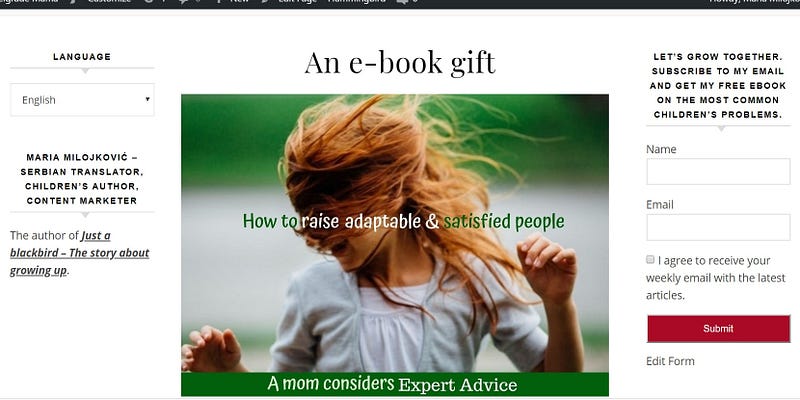
I made a big mistake the first time I created the landing page—my featured image contained too much text. This is a bad practice in general because when you want to boost your post on Facebook, they won’t accept it. (Yes, I promoted my landing page like a regular blog post and it worked.) So, I made a new featured image in Canva, and this is how it looks:
Define Your Buyer Personas
A Buyer persona is an imaginary character. It’s like an avatar that resembles the ideal person you would like to attract with your content. It contains real human characteristics and behavior, such as the background, demographics, goals, challenges, and identifiers of people you see as your possible readers.
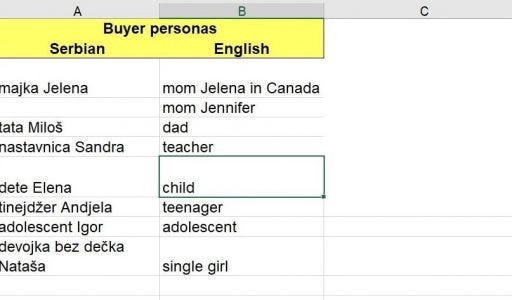
Since I wrote a book about growing up, I decided to promote it to those who mainly buy children’s books. So, my buyer persona №1 is a Serbian mom Jelena. She is a 30–40-something devoted mother from the city. She wants to help her child become more independent and resilient, so she googles the problems.
I wrote down all the buyer personas in Serbian and English and gave them names and ages. Then I polished my first buyer persona (Serbian mom Jelena):
During the content audit, I also jotted down the list of parenting portals and women’s magazines to send my articles to. I wrote their names and Alexa rank. By republishing my posts outside my website, I can repurpose my old content, get new exposure and more leads, and save more time in content creation.
Note: When republishing content elsewhere, wait at least 14 days since you posted it on your website. And put a canonical tag, so that search engines can register the content on your website as the original and not penalize it for duplication. It looks like this:
<link rel="canonical" href="https://your page" />
Before I started social media marketing, I had a very ambitious plan: to modify and send the portals an article or two per week while promoting the posts on my own Facebook page. But it’s time-consuming and doesn’t stick to my social media calendar. Instead, I just opted to post on my Facebook author’s page, on Medium, and on the largest parenting portal in Serbia (245K Facebook followers) for the first round of content promotion.
Having the audience and content defined, it is time to define the first campaign.
Do an Event-Based Audit for the Next Three Months
This helps you focus on the following period: according to your plans, what content to create for the next three months. You tie it all together into one theme: a single campaign. The campaign is connected to your readers’ stages of the buyer’s journey:
- Awareness (A buyer persona knows they have a problem and tries to find a solution.)
- Consideration (A buyer persona considers what solution to choose.)
- Decision (You can offer them your product because you gained their trust.)
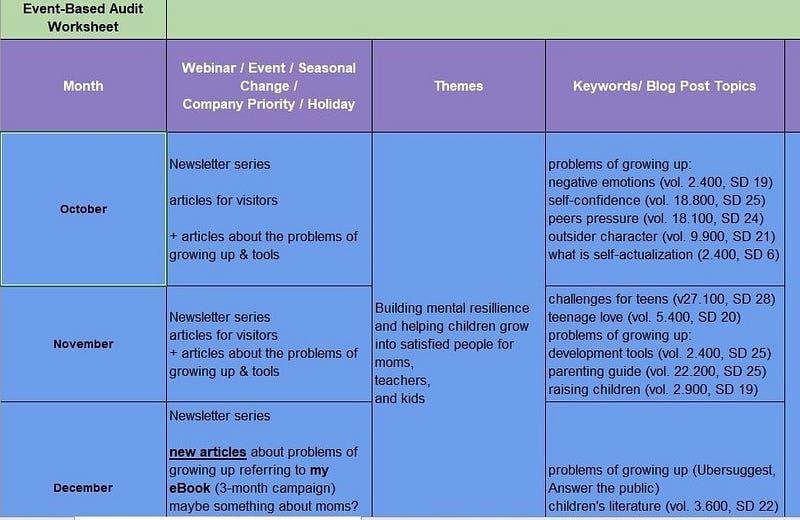
My first event-based audit is from October through December. My first inbound marketing campaign, called Building mental resilience and helping children grow into satisfied people for moms, teachers, and kids, promotes my eBook. It addresses the readers’ awareness stage: They google solutions for their children’s problems.
Let’s take a look at the basic SEO I did:
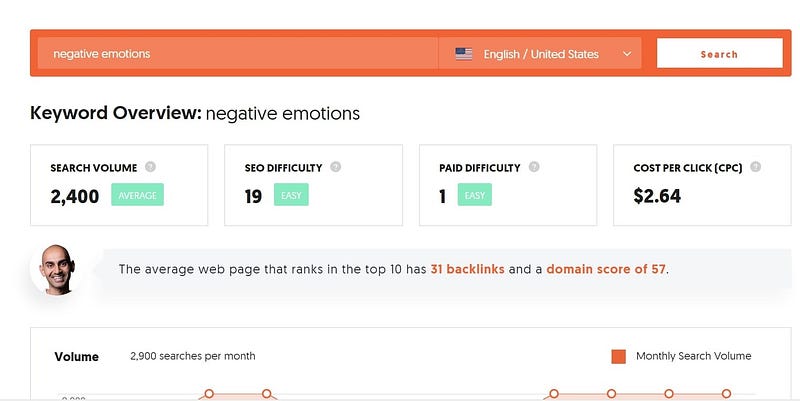
In my event-based audit, I decided on blog post topics and what keywords to use. As I mentioned, I use Neil Patel’s Ubersuggest; the volume of the word (the first number) must be as big as possible but the SEO difficulty (the second number) as low as possible.
Of course, I was too ambitious with the audit because I was clueless, so I put too much stuff for these three months, especially keywords. But this was just my first version; you change it as you learn along the way:
Define Your SMART Goals
A SMART goal helps you achieve concrete results with your content marketing. These goals are very specific, and the abbreviation stands for:
- S—specific (Your goals are clear and concise.)
- M—measurable (There are numbers/percentages you must achieve.)
- A—attainable (A goal is a challenge, but you can achieve it.)
- R—relevant (Your goals refer to your overall plan.)
- T—timely (There is a definite time when a goal finishes.)
A good example of a SMART goal would be Get the first ten leads in one month.
My SMART goals for the first three months of my campaign:
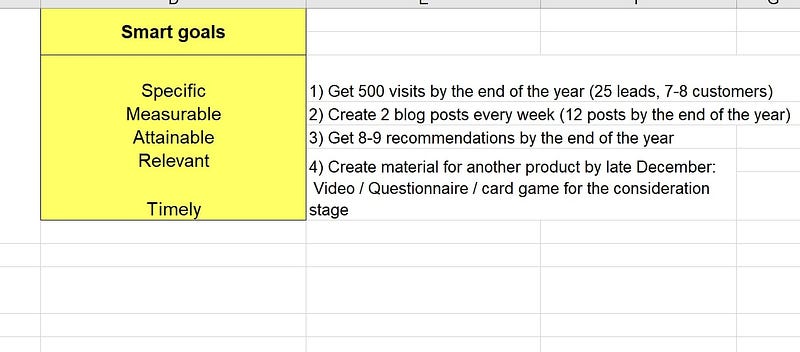
I specified the SMART goals I wanted to reach within the next three months:
1. Get 500 visits (did that in a month).
2. Create one or two blog posts a week (possible if I rewrite the old ones and sometimes add a new one because I try to write high-quality).
3. Get eight or nine recommendations for my book (you have to ask people a few times to get one; I haven’t been active much).
4) Use the website content for another new product by late December (I have an idea for a checklist).
It took me months to write the eight articles in the topic cluster. Now that it’s time to promote them on my website, I see they need extra polishing. Also, I post them on my social media, change them some more to promote their different versions on other websites (they can’t be the same as original), and I’m planning to create new material for another product by late December. So, I’ve been busy.
Again, you don’t know what you’re doing when you do it for the first time. My first SMART goal was to have 500 visits in three months. Just in the last 30 days, I had 424 users coming to my website. There were 229 organic searches (it’s neither referral nor from social media, but people google me or the words I used in my articles). Therefore, my SEO is not that bad for a beginner.
However, I did not get 25 leads until I did my first Facebook campaign. I have two explanations for this:
1. Most people from Medium come to my website looking for advice in writing. I haven’t developed that part of the website yet. They are not interested in parenting, so they go away from my landing page. That’s why the bounce rate is too high: 81%. The average time readers spend on my website in 30 days is too small: only 1.5 minutes per page.
2. On the Serbian parenting portal (where my articles go well), below my article, there is just my name and the name of my book with a hyperlink to my website. There is neither my author’s bio nor my social media addresses. Although some of my articles went viral there, I don’t have enough traffic coming from the portal. I am currently fixing that.
In a nutshell, I learned a lot in these two months although there was little traffic to my website. But then things exploded when I boosted my post on Facebook for the first time. In the next article, I’ll tell you about how to start doing content promotion for your book on social media.
If you liked the article, check out these:
Originally published at https://mariamilojkovic.com.