
5 Ways You Can Help Reduce Ocean Plastics without Compromising your LifeStyle
So now that we know how Plastic Pollution is impacting us in the city — hopefully it answers the “Why should I care” question.
The next step is “I understand, plastic pollution is serious and we’re not aware of the impact. So, what can we do? I don’t want to live a nomadic lifestyle in a cabin — I’d like to continue living in the city.”
This is perfectly reasonable. Nobody’s expecting the entire human population to leave the cities and go live in tents and little self-built cabins in mountaintops and valleys. Well, ok maybe let’s not go there, there are people who would vote for that too I’m sure. But that’s not the point. Realistically there are ways that we all can make choices to reduce our own personal contribution to this increasingly worrying problem.
First let me clarify one point. Making these changes — is not going to SOLVE the plastic pollution problem. The underlying issue is deeper and wider — and that will be the following posts in this series. However, it will make an impact into the future state. You and me = 2, and if our neighbors joined = 1,000 and if their friends joined = 2,000 and their friends = 4,000+ and it grows very quickly. But more important than solving the problem, you and me taking action, refusing plastics, etc., raises awareness in those we come into contact every day. In the city that is not a small number. It raises curiosity for even the store owners — “why didn’t she want to use the straw?” “This is the nth person coming in this morning using their own cup” etc. Many experts agree that the leading issue is awareness and education on the topic.
Just because we strive for change doesn’t mean we’re naive. The problem is rooted deep in the system and needs to be solved by the sum of the parts — not just one person or one part. Using a bottom up approach though, from consumer up to government, we are able to make our own choices count. Lucky for us, most of us have many options — we don’t HAVE to use bottled water or straws, etc. Let’s make those options get to work for us.
1 — Refuse single-use plastics
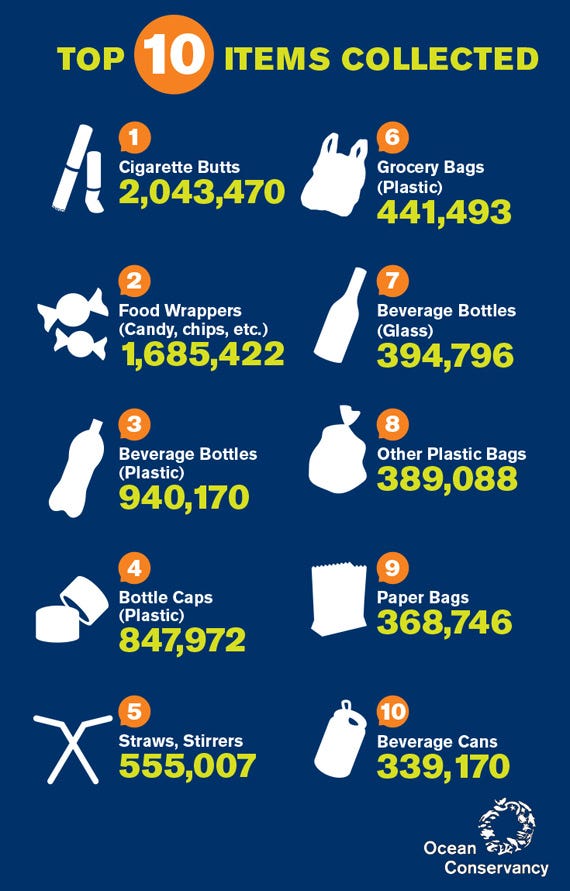
This is the big one. It’s simple, not necessarily easy at the beginning as you will need to remind yourself. But it is simple and the impact is considerable. Take a look at this chart by the Ocean Conservancy showing the top items that were found during the ocean clean-ups in 2015:
Straws — just purely, surely, absolutely say no. Every time I order a drink now I always say “no straw please”. IF I’m going to have to use a straw for whatever reason then I have a stainless steel or a glass straw that I carry with me, and will use that. But otherwise: No, thank you.
Cups — everybody, absolutely everybody must have their own coffee cup by now. Really. Be sure that it is insulated stainless steel or glass and not coated in plastic for better tasting coffee and healthier option. If you don’t have your own coffee cup, take a break. It will take you less than 10 minutes to enjoy a cup of coffee “for here” in a proper mug.
Coffee cup lids — Ok. If for some reason you don’t have your own coffee cup — life happens, sometimes we do get caught unprepared — — at least PLEASE ask the baristas not to cover your coffee with a plastic lid. Ask them to put the coffee in a bigger cup instead if you’re worried about spilling.
Plastic Utensils — There are plenty of reasons why these things should be outlawed, but just simply carrying a bamboo utensil set is so much more easier and healthier for you and the planet, including our amazing oceans. When ordering take-out or delivery — be sure to indicate that you don’t want plastic utensils, if you’re eating at home, you have everything anyway.
Plastic and Foam Containers — When ordering out or for delivery — simply request the restaurants to provide your food in aluminum containers rather than plastic. Again, if they don’t they will after a few times of asking. It is not a difficult change and another way to make more people aware. If ordering take-out rather than delivery — it’s easy enough to take your own container to have them place your order into. It’s more sanitary and easier on the environment too.
Plastic Bags — this one is a no brainer. Everybody and I mean at this point every single person on the planet should have their own reusable bags. They are easy to carry (most are foldable into themselves and fit into pockets, backpacks and purses easily), they are easy to clean and maintain and are usually made of pure cotton or canvas. Not to mention more convenient to carry around without the possibility of the handles breaking apart.
If you DO end up having to use ANY of the above — please be sure to recycle them appropriately. But know that recycling isn’t a long term solution, it just delays the process. More on that in my next posts.
2 — Be a Mindful Shopper
Avoid buying things that are wrapped in plastic. This will be good for the environment — more importantly, this will lead you to have a better lifestyle. Once you make this rule — you tell yourself you won’t buy anything in a plastic container or wrapper — you end up having to buy healthier, more natural items — like produce or local cheeses, etc. Which brings me to the next item: when grocery shopping, try to have 1 or 2 mason jars with you to use for bulk items.
Find shops that sell items in bulk and without packaging. Again most of these shops are all natural, organic and local products — this rule helps you keep a healthier lifestyle. It might be more expensive than the 99cents chemical infused soap bar at the pharmacy but it will smell better, make you feel better AND last longer. Guaranteed!
Find brands who’s items are sustainably manufactured. For clothes items that are made from 100% cotton, linen, rayon, bamboo etc-should be preferred over high-impact polyester and nylon products that are made of petrochemicals.
Next in the series I will be providing a list of businesses who provide eco-conscious options for various needs — from groceries to sunglasses too. Stay tuned.
There are multiple stores in practically every city and town now whose sole purpose is to provide bulk items. You can search them in your local business directory or just in Google Maps.
Make a comment to your shop owners (please be kind)
When interacting with the shops you are allowed to ask them for “non-plastic” alternatives. Let them know that you’re not using plastics. Most, and definitely not all, owners will be curious and ask you about it. At the least if they don’t have an alternative they will be curious to know “like what?” Easily explain that there are paper, aluminum, bamboo or even bio-degradable options nowadays.
3 — Install a high-end water filter
Plastic Bottles are surely one of the biggest polluters of our planet (refer to the chart above). Americans use about 1200 plastic bottles per person per year! That is less than 3 a day. Think about how many plastic bottles you come across when traveling — whether for water, sodas, condiments or other items. If you install a high-end water filter (cost at about $300) you will be eliminating your need to purchase water bottles.
There is an entire list of risks associated with drinking bottled water that these filters remove out of your life. The reason to go with high-end filters rather than the cheaper versions is that they get rid of more harmful bacteria and minerals — the best ones even filtering out lead. Now THAT is a good deal.
4 — Don’t buy things that are in plastic containers — leave plastic bags at the store
When at the store and buying produce or other items, if they are all packaged in plastics, just leave the plastic wrappers at the store. This way you’re making the discarding the store’s problem, and if they ask you at the register — which 9 out of 10 they will — you can let them know you don’t use plastics and they need to be discarded properly. Most stores are quick to respond to this action as they don’t want to deal with this additional task.
5 — Reduce (or preferably avoid) Seafood
This is so you’re not consuming fish that are already filled with plastic toxins. When you do want to have fish you can just ask the waiters if the fish are line caught and where they come from. This way you know that the place you’re eating from is serious about keeping it healthy for the consumers and aware of their choices. If they don’t know the answer to these questions, that should be a reason to look for another place to eat. If you don’t know where the meat is coming from, why would you want to feed that to others? And for us consumers, why do we need to put that into our bodies?
But always, and I mean always, remember to have a positive attitude about it. I know first hand how difficult this might get at times, especially when you’re trying to explain to people closest to you, who you’d “expect” to understand and just “get it”. We, as the ones who do, are really in charge here. We need to be the leaders to lead by example and remain focused on the target. Our purpose is clear. Our direction is right. Our eyes on the target we take one step at a time and continue on our path.
Did you find this article helpful? If so, please like and share. If you have any comments please leave them here and lets discuss. I would LOVE to hear from you!
Thank you for reading.


