SnOMG!
To close or not to close…with frozen precipitation, school district decisions often put to the political test
I woke up Sunday morning with visions of snow days dancing in my head.
Yeah, it was a cold, driving rain down here in the Central Piedmont. But when I rolled over, picked up my phone and saw all the snow pix scattered across social media in the D.C. area, I immediately had two thoughts lodged in the recesses of my Permanent Teacher Brain: “Snow day!”, followed by “No school!”
It didn’t matter that this was a Sunday. Or that I’ve been retired for three years. I was thinking down the road to what meteorologists — and weather “personality” Al Roker — call the “long-range forecast”: It just might snow through Tuesday in the D.C. area.
Then I roused myself from my comfy covers and cracked the bedroom blinds. Rain, rain, then more rain. Cold rain. Nasty rain. Raining sideways, sloshing against the house. Buckets. Not a snow plow in sight. As I woke up a little more, clearing the cobwebs that had settled in overnight, it dawned on me. I live in the more temperate zones of North Carolina now. The place where folks wear lumberjack hats with ear flaps when the temps plunge below 60 degrees. No accounting for taste — or internal thermometers — during a southern-style winter.
And even if I still were in suburban D.C., what would it matter? I haven’t had to do the drill since 2017. And we’re all online now, because of COVID Times and all. Are “snow days’’ — the precious time away from the grind — still built into the school schedule? I looked it up, and apparently schools still close during inclement weather in my old district— something about all the other things educators and education are “tasked” with these days (I know, “Yuck List” — sorry!) besides the actual act of learning itself.
But I also wondered, more to the point — what will become of kids who go to school online and therefore miss those great swatches of time away from the classroom, frolicking in the crystalline water droplets that deigned Sunday— for the first time in about two years up there — to stick to the ground in quasi-large quantities?
Going over to the elementary school or the church to sled down the hill. Taking the ol’ toboggan or two to the real promontory in D.C. — the West Front of the Capitol. Hot chocolate and the absence of homework — sometimes, for days. I blame the InterWebs for a lot — especially making it easier to “deliver” (“Yuck List”?) lessons to students, thereby ruining sacred traditions like getting out of school to make snowmen and snow angels and becoming one with our inner kid again.
Snow is a big deal in the Mid-Atlantic, of which the D.C. suburbs are a very large part. We’re usually stuck in the infamous “Snow Hole”, which means the frozen stuff goes up and around our Nation’s Capital these days — a phenomenon best explained by proximity to the Blue Ridge Mountains to the west and the Atlantic Ocean to the east, with a little global warming thrown in for good measure. Not sure how it works, but the elements most definitely (“Yuck List,” Number 5) conspire to deprive us of our due diligence when it comes to frozen precip.
It used to snow gobs in D.C. — enough to delay buses and keep students trapped in schools and on the Big Yellow Cheese when those in charge failed to make the proper “call”. This means risking life and limb because the administration — those at the top, way above a teacher’s pay-grade, but with no more sense than a gnat drowning in a vat of apple cider, as my Nana would say — were afraid to declare a snow day. Or, as recently as 2010, enjoying multiple days, weeks, almost a month — but not consecutively — off from school because of the white stuff. The snow during January through March of that year flummoxed even the best at wrangling plows and piles of salt and sand. By the end of that school year, D.C. had alternately suffered and enjoyed more cubic feet of snow during its extended Snowmaggedon than Moker’s homies back in the Frozen Tundra of Wisconsin.
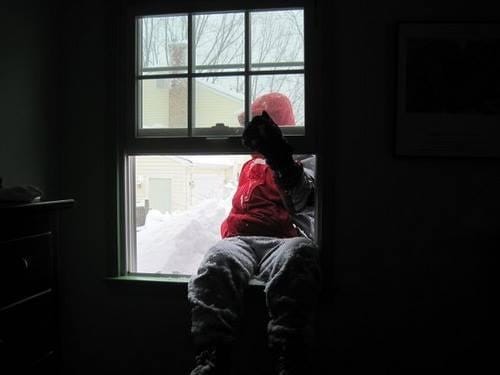
That was the time my Hubby took matters into his own hands when the frozen stuff destroyed the reception on our TV dish. He suited up in proper attire — including boots and what I would only call “avalanche gloves”— and climbed out the bedroom window to knock a substantial accumulation off the satellite contraption poised just out of reach. Conditions necessitated my not-so-tiny man to scoot out the window, scale the roof and then slide on back into the house, all while balancing precariously in the face of blizzard-force snow and wind. Televised sports resumed in our house that day. All was right with the world.
You see, “snow days”, that precious last vestige of a childhood that families still share — unless you have one of those crusty old MeeMaws who “walked to school uphill, barefoot both ways, even in a blizzard” — are nothing but a political proposition when you think about it. The state requires a certain amount of what they call “seat time” for students each school year — the odd term employed by those of an administrative bent for classroom instruction hours. So damn the torpedoes and full speed ahead in the face of too many weather-related closings. Of course, those at the top of the administrative pyramid often find themselves in one of those “damned if you do, damned if you don’t” situations on whether to close schools any time any form of frozen precipitation hits the ground. So they approach the job halfheartedly, at best, attempting to offend no one and thereby perturbing everyone.
I could tell you tales of “snow days” called late, or never called at all. Of buses in a ditch because of an errant call, or the decision to send us to school, only to send us all back home again after the storm had already started to blow and road conditions had deteriorated so drastically that we prayed for the bus drivers detailed to drive in that slop. In case you were wondering, a “traditional” school bus — which can hold up to 80 students, depending on its length — weighs in at about 15 tons. That’s hella lot to try to negotiate a slippery slope generated by snow-packed roads.
It’s the sticky wicket, or someone stuck between a rock and a hard place or greasing one palm to…oh, never mind. Safety should rule the school, but “seat time” often wins out. And that’s only the tip of the political iceberg that lands right on top of any decision to close for a snow day.
The point — about calling “snow days”, deciding on who goes home from school when, and whatnot — became moot, I believe, after January 6, 2015. That was the Day We Almost Died in the Storm That Wasn’t Forecast. Or some of us, anyway.
Like most public school districts, we had a system for closing buildings because of bad weather. There’s an online alert system; the school district also has a Twitter account that announces closings, and there’s always the old-fashioned backup — tuning into the local TV to see who has decided to shut their doors that day. Some of these decisions are sometimes made the night before — the funniest being the times the district decides to close 12 hours in advance and then there is no snow, or only rain to contend with — but most of these snow day decisions are made around 4 a.m. It takes time to get a 187,000 student/13,000 teacher school district either on the road or keep them in their beds because of the nature of Mother Nature on any particular winter morning.
On the January 6 in question (January 6 — a distinctively unlucky day, in my estimation), I woke up at my customary 5 a.m. (don’t ask — I did it for 23 years), ate breakfast, popped in the shower and then readied myself to face the day. No online alert, no Weather Dude’s ominous forecast, no hint at all that bad weather intended to visit. I put my Bean Boots in the car just in case — never say never during a D.C. January — backed out of my driveway and headed to the highway that would take me 14 miles on down the road to my destination.
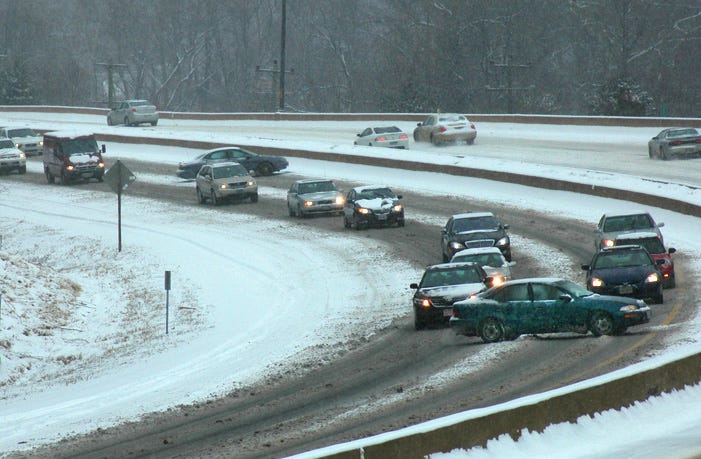
I had just merged onto the Capital Beltway — the 64-mile, 10-lane Interstate that hugs the City of Washington like a belt — when the unexpected Snow Gods struck, with a vengeance. Rain, then sleet, then ice, then snow — not necessarily in that order, and alternating quickly from one to the other, then back again — pelted my car. Can you say “accumulation”? Precipitation of the frozen variety started piling up and didn’t seem to want to stop, until I couldn’t really see much except for the single lane on the Interstate that had been carved by hundreds of cars all going before — commuters, like me, who’d been certain enough when they launched their journey to their jobs that they’d joined the gobs (a couple hundred thousand vehicles travel the Beltway per day, so you can do the math) who were trying to power through this sudden and odd little storm that had such a big impact.
I guess I had a few choices. Pull over, and with my Texas sensibilities about driving in the snow/ice, get stuck for an eternity. Take the next exit, then wait out the storm or turn around and try to make it back home. Either way, I’d be shirking my duties — no one in the educational hierarchy had declared a snow day, so I was legally required to report for duty — so I soldiered on. I called school a couple of times to say I’d be late, but no one was picking up.
OK, I did my due diligence by leaving a message explaining my predicament and assuming dozens of colleagues were in the same scrape. I decided heck, I’ve made it this far — I might just get lucky after I showed up if the powers-that-be just told us all to call it a day and get ourselves on home.
Seriously, I wanted to see what fresh hell would greet me on the other end of my commute. The snow started to come down in earnest, and I kept up my soggy slog to school.
I guess you can guess what I — and dozens of my fellow educators who bothered to show up — found. A mostly empty school, with an assistant principal wandering around in an apparent daze, checking to see who had shown up where. I ran into her on the staircase as I approached Room 215.
“Did they close schools today?”
“Nope.”
“Are they considering closing schools today?”
“I don’t know.”
“Who’s here?”
“I don’t know. And I’m starting to think, at this point, that I don’t care.”
I had a 1st-period class, so opened my classroom door, turned on the lights, and waited.
We didn’t start AP Nelson on time that day, but pretty darn close. One student came in about 10 minutes late, with quite a story to tell. A couple of other kids straggled in a few minutes after her. They all had tall — but true — tales to tell of their morning commutes. Sounded pretty harrowing, considering they only lived a couple miles from the school and it took some of them an hour or two to make it. A lot of these students are from military families, so their parents were prepared — and started them early on their journeys that morning.
I ended up with about six high school juniors in class that morning. A few more in my next class, and a smattering more in the class after that. But I never had anything close to a full roster that day. We all learned a lot, though. Mostly about the mammoth incompetence of those in charge and the crazy things that happen when one tries to show up on time while battling the elements. The gal who taught next door to me for several years lives about three miles from the school. It took her more than four hours to get there. So much for a convenient commute.
The superintendent of our district apologized to all of us that day.
“It is clear that our decision to keep schools open today was the wrong call given the intensity of this weather system,” she said.
Ya think?
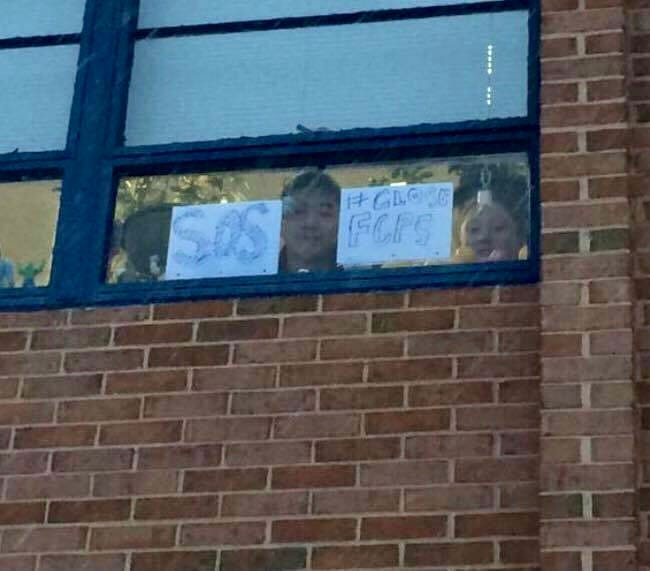
We all became a little bit more familiar with how grown-ups sometimes drop the proverbial ball and how kids can make up for it. At that time, I still wasn’t all that familiar with the phenomenon of “going viral”. Room 215 and a few of its occupants — OK, my student who went outside in the storm to take the photo and the two who are featured in it, gazing forlornly out of my classroom window — went viral that day, and it was a hoot-and-a-half, as my Nana would say.
Take a gander at the two kids below and their signs, which read, “SOS” and “#Close FCPS”. That digital snap went ’round the world on January 6, 2015, and generally did a lot to not only publicize our plight, but to convince the superintendent and her henchmen to grant us a free “day off” later in the year to make up for our trouble.
I’m pretty sure if you do a little digging on the InterWebs with the tag #CloseFCPS, you’ll still find this pic around. Almost as weird as the day in January six years ago when we should have been out frolicking in the snow.