Will Smith’s Slap Shows That White People See All Black Violence As Political
White analogies serve to move Smith’s interpersonal violence into the realm of policing and political oppression. It’s an old move in the playbook of whiteness that centers their political anxieties.
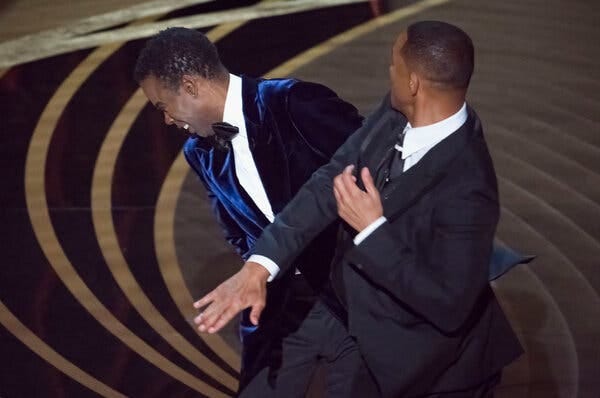

As of the morning of April 9th, 2022, my writing on Will Smith slapping Chris Rock has earned me 3,300 views, 2,000 reads, and about $34 in royalties on here.
My argument hinged on the following claims — that all cultures have codes that dictate engagement of interpersonal violence; that the Black community recognized Smith slapping Rock as having met the arrangement of corrective interpersonal violence; that the primary debate within my community was the setting in which the Slap took place; that white people had a view completely different from Black personhood; and that white opinion differed from Blackness is because it regards all Black violence as political, and thus something that must be controlled, punished, and imprisoned due to their lingering historical anxiety from slavery, colonialism, segregation, convict leasing, redlining, lynching, and mass incarceration. They fear Black violence may one day be redirected toward them.
I know that is a mouthful. It is probably better if you read the original article.
Over on the Book, my Black friends laughed and debated the Slap, mainly on where Smith decided to deliver it. One of my associates of South African ancestry, but raised in America, posted that her father said in Zulu “umshaylile kancane,” which she posted translates to “he only hit him a little bit.”
Their analogy would have me be Will Smith before March 27th, 2022. I cannot be their Negro.
Two of my white former co-workers also reached out to protest the story’s central argument. We were teachers. One of them commented on a Facebook post I made:
I would be curious to hear you run an analogy with one of your students getting up to slap you for being rude to them. I know I’m being another white guy with another analogy here but it seems like there are some similarities that might be worth exploring: ie breaking a norm of a space, how our expectations of impulse control change over time, if a teacher was rude about someone in their family what would be a justifiable response from the student, a history of classroom spaces being used to exert power and also another that space that was at least originally defined by whiteness, etc. I would be curious what you think would be the right way to handle it on your own turf and what makes that space similar/different etc
Another DM’ed me a day later:
Just reread your article to make sure I’m not tripping. I double down on my point that Will Smith just committed assault and made the whole world watch. To call that “doing culture” makes me wonder why you broke up fights as a teacher. We had a good laugh one time about a fight you and [a co-worker] broke up. Was she acting on her natural white impulse to police black bodies? Were the two of your interrupting an expression of black culture?
No. You were stopping someone from getting hurt and sending a message to our students that violence in a shared space is completely unacceptable.
Both used analogies to our previous professions. The first had his judgment embedded in his curiosity; the second made his disagreement with me plain. I had also noted in the original article about the white tendency to use analogies to explain their serious view of Smith’s slap on Twitter. As the days went by, white analogies dominated one side of America. On the Black side, we made fun of their tendency to try to make Smith’s slap something else.


The white need to analogize the Slap is the evidence point that all Black violence is political to them. The philosophy of Afropessimism clarifies the why. It gives us the freedom, as Frank Wilderson III wrote, “to say out loud what we would otherwise whisper or deny.” Afropessimism argues that Black suffering, and political violence toward Black personhood, is a “health tonic for everyone who is not Black; an ensemble of sadistic rituals and captivity that could only happen to people who are not Black if this broke this or that ‘law.’” It explains Blackness’ political relationship in the world that does not focus on solutions or white redemption.
White supremacy uses analogies whenever they confront Black situations that confound them. It is a segregation. Spiritually, it considers us forever trapped in the hold of the slave freighter. Their analogies keep us there. Wilderson argued that white analogies are designed to keep Black though in the hold of the slave ship;
It provides a theoretical apparatus that allows Black people to not have to be burdened by the ruse of analogy — because analogy mystifies, rather than clarifies, Black suffering. Analogy mystifies Black people’s relationship to other people of color. Afropessimism labors to throw this mystification into relief — without the fears of the faults and fissures that are revealed in the process.
Black culture is like all other cultures in the world in which there are rules, rituals, and signals of interpersonal violence. I can put that argument out because I am no longer concerned with respectability. I do not care anymore if white people say what I write is a betrayal of MLK’s belief in non-violence or make analogies concerning how I conduct myself professionally. White analogies concerning a slap are not about Black suffering, but their political anxieties. If Black people have rules about engaging in interpersonal violence, are they justified to behave violently after 400 years of oppression? What are the rules, and do we know them? An analogy is a bridge to that anxiety, a path to turn interpersonal violence political and thus into something they can control. They cannot have their health tonic coming back up their throats to soil them.
The white world is incurious and intolerant of Black mystery, which constitutes the bulk of Black personhood. Our dealings with each other in a segregated society mystify. It doesn’t know, as Nasir Jones quipped, that some beef is ill, and we have codes to sort an insult’s ranking. It knows about Tracee Ellis Ross, but not enough to have given her the Emmy she deserved for Girlfriends. It knows about Eminem and tries to proclaim him the greatest to pick up a mic without knowing the rappers who were the progenitors of his style. It knows about “The Wire,” but not enough about AAVE to where it needs to watch the show with subtitles or that Sunday truces don’t exist (again — beef is ill). It knows we joke and say the word “chile,” but pronounces it either like a foreign nation or a spice if they lack a linguistic tutor. White supremacy is gleefully open in actively keeping Black personhood under its feet and taking our bodies, spirits, and creations for profit and psychological restoration. But your average white person who, while not an avowed white supremacist, still does not understand the beauty and complexity of Black culture. We are so much more than a survival mechanism against oppression. Our culture reflects not just our survival but our aching to thrive.
White folks do not understand this. Thus arises the analogies to justify their thoughts and to police Black behavior that confounds them.
Will Smith’s slap mystified many white people into disappointment. They thought he was their Negro. My white former coworkers, in their disappointment, reached out to me and asked me to translate Smith’s actions into a context where we were still teaching civics, English, and drama at the same school. In not trying to make their analysis about race, they miss the political context of our employment. During our tenure, the school’s executive director was white. The board of directors was mainly white. My principal was white. My immediate supervisor, who I broke the fight up with, was white. About half of my school’s teaching staff was white. Out of 230 students, we had four white students. The rural town we taught it was and still is racially segregated, where very few white people living amongst the Black folk. Their imagination and analogy would have me act as a rule-maker and enforcer in a Black world separated and dominated by whiteness. Their analogy would have me be Will Smith before March 27th, 2022. I cannot be their Negro.
White analogies concerning a slap are not about Black suffering, but their own political anxieties.
I am in a professional, personal, financial, and spiritual place where I refuse to engage in any more mystification or analogies. I want to clarify Black suffering. I seek to write how, within our ghettoes and segregated towns, Blackness responds to slights and insults that harm. And I now can do so without worrying if what I write will make white people think Black people are inherently or psychotically violent, understanding that white supremacy teaches the world that regardless of what I say or write. By denying Black personhood both the complex and straightforward motives of interpersonal violence, it can politicize and punish our behavior without having to look our suffering in its tired and sparkling eyes.
Jada Pinkett Smith has a publicly fraught marriage with Smith. She has admitted to infidelity, and the Internet made a meme of his suffering. She is suffering from alopecia and has, for years, talked about the impact it has had on her self-esteem. Chris Rock is a comedian who cheated on his wife for years, has made hella misogynoir jokes punching down on Black women, and has produced a documentary where he examines Black women’s relationship with their hair. He should have known the GI Jane joke was of poor taste — but probably did not or did not care, given that his comedy punches down.
Black folk considers that Smith was right to hit him a little bit.