
Personal Development
Skills That Are Safe in the Future AI World
Because what’s important is the human touch.

Automation, in tandem with the COVID-19 recession, is creating a ‘double-disruption’ scenario for workers.
And also for business owners.
No matter if you are currently employed, looking for a job, already have a start-up or a side hustle or you’re just going through some ideas — your skills are an investment. And like any other asset, it requires thorough research and a peek at the future.
It will allow you to see the current situation in different industries, the experts’ predictions, and the potential gaps. This knowledge might give you a better understanding of how you can fill in those gaps with your product or service.
According to PwC’s report: Will robots really steal our jobs, the top 3 industries that are at the highest risk of automation are transportation and storage, manufacturing, and construction. The next 3 sectors are administrative and support services, retail, and public administration.
Despite the recent developments in medical AI and teaching AI, the graph (Figure 1.2 from this report) shows that healthcare and education have the lowest automation risk rate. This proves that while some sectors would be fully or almost fully automated, many professions would require to learn how to collaborate with AI.
Which jobs will not be automated?
Creative professions will not get automated.
Why?
Because even though technically AI can learn creativity (like a code), it (creativity) is still subjective.
Apart from widely accepted societal norms, the concepts of the good, the bad, ugly, beautiful, and similar are entirely subjective.
There are many projects that prove that AI can be composers, teachers, painters, DJs, and similar. But in these cases, AI is creating new data from the old data and forms opinions based on formerly submitted data.
But it cannot form its own opinion on what is beautiful, ugly, comforting, or distracting. This means that AI cannot be subjective.
AI would not affect professions connected to science, management, psychology, or the care of other people. But it will help specialists from these fields in assorted tasks.
Yes, AI can perform creative tasks. It can draw, create music, play music and write. But it could not replace the human touch.
Human touch is and will be important. For instance, today, the leading European countries are progressively focusing on the growth of cultural values and the blooming of the creative cluster.
Which skills would be more important in the future AI world?

➡ Emotional & Technological skills.
According to McKinsey report: “Soft skills for a hard world”:
Social, emotional, and technological skills are becoming more crucial as intelligent machines take over more physical, repetitive, and basic cognitive tasks.
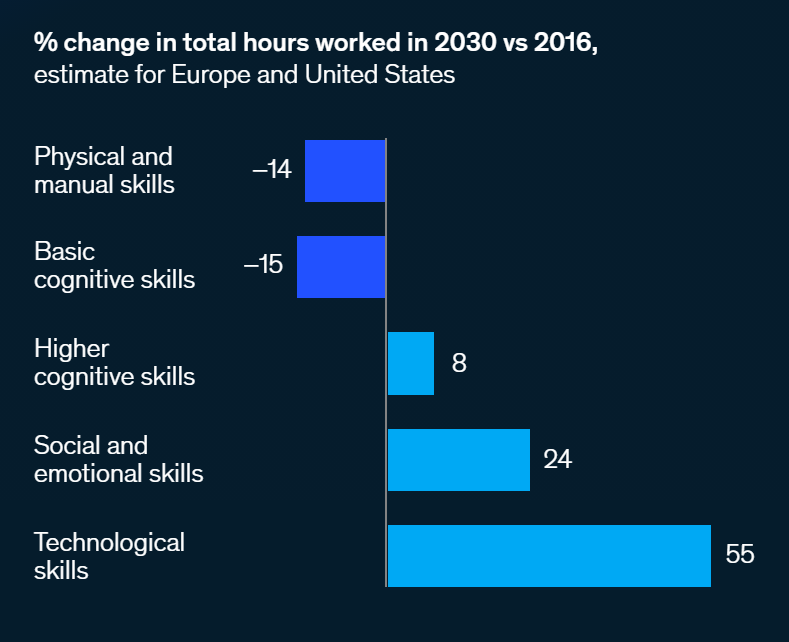
As it can be seen from this screenshot, there will be a drop in the number of hours worked that require physical, manual and basic cognitive skills. However, there will be a significant rise in the demand for social, emotional and technological skills.
The report from World Economic Forum (2020) can further prove this estimation by presenting the 10 skills that will be sought after already in 2025:
- Analytical thinking and innovation
- Active learning and learning strategies
- Complex problem-solving
- Critical thinking and analysis
- Creativity, originality and initiative
- Leaderships and social influence
- Technology use, monitoring, and control
- Technology design and programming
- Resilience, stress tolerance and flexibility
- Reasoning, problem-solving and ideation
Automation will cause a higher value of particularly human skills and qualities.
Unlike any other industrial revolution, where hard skills were the most sought-after, in 2025 and later, it will be another way around. In the near future, soft social skills and originality will be more important, as they cannot get automated.

There’s been some recent analysis in the U.S. that says AI will get rid of something like 1.9 million jobs. But it will, in fact, create 2.3 million jobs because what AI is doing is it’s processing data that is physically impossible for human beings to process anyway. So the volume of data that we have today, 90 percent of it has been generated in the past two years. So it does mean the job landscape will change.
AI is creating industries. It’s creating jobs. And it’s creating more jobs and more industry than it’s getting rid of.
So, I think it’s safe to assume that new opportunities and even new industries will appear at an unprecedented speed, starting already now.


