
Six Ways We ALL Connected to the Internet Way Back in The 90s
Before Web 2.0 we had Web 1.0 — but what was it REALLY like?
People growing up today do so in an era of unprecedented connectivity and online interaction.
Small children expect to go to a computer at school and find anything with the touch of a button.
Young people take it for granted that they can peel the shrink wrap from their new phone and within minutes connect to everyone on the planet.
It’s hard to remember that less than 30 years ago we were struggling to get to grips with this new-fangled thing called ‘the internet’.
A little while ago I wrote a Medium story about some of the social networks and websites that came and went in the early days of the growth of the internet. Check it out!
Since it gained quite a lot of attention — reads, claps, and comments — I thought I’d dial back the clock even further and look at how we connected with the World Wide Web in the 1990s.
And, I’m going to do so without lapsing into geeky tech language that — let’s face it — none of us really understand (including myself).
Let’s kick off with a definition.
We see people talking about Web 3.0 these days — and we have heard a lot about Web 2.0 over recent years. So there must be a Web 1.0. Right?
Wrong.
Whilst you’ll see people talking about Web 1.0, that term only emerged retrospectively. Nobody was talking about Web 1.0 when ‘Web 1.0’ was a thing. The word was retconned into internet lore after the fact.
The phrase Web 2.0 was first coined in 1994, although the concept had been emerging for a good few years before that. Briefly, Web 2.0 is where the web transitioned from static web pages to user-generated content.
A good example of a Web 1.0 site is Encyclopaedia Britannica — whereas the Web 2.0 equivalent would be Wikipedia.
See the difference?
Essentially, with Web 1.0, there was no meaningful interaction. The webmaster created static pages which people then viewed on their screens. All the content creation happened on the server-side.
Basically, viewing a website was like looking at a brochure in a showroom.
The closest to ‘interaction’ we had on websites was through leaving a comment in a “guest book”.
Remember those?
The evolution of Web 2.0 gathered pace when web connection speeds entered the 20th Century.
Who remembers connecting — or trying to connect — to the internet in the 1990s?
- It commandeered the household phone line — meaning no one else in the house could make phone calls, as they weren’t any mobile phones.
- It connected at a painfully slow speed, meaning that pages often took several minutes to load if they had images. I still remember that incredible sense of liberation we felt when 14.4Kb connections upgraded to 28.8KB. To clarify, that really is ‘Kb’ in the last sentence — not Mb or Gb.
- It connected with those god-awful high-pitched beeps and screeches. Don’t remember this sound? You haven’t lived, buddy.
Once we had got our computers connected to the internet — and, believe me, it often took (more than) a few attempts — the next question was how to actually view online content.
Before there was ever Google, YouTube, or Facebook, how did we navigate the uncharted waters of the World Wide Wait (as we often referred to it)?
Here are SIX ways we ‘surfed the web’ in those early days on the internet.
1. Mosaic
When I first connected to the Internet in 1994, the browser most people used was Mosaic. Whilst it wasn’t technically the first-ever browser, it was the first to make it possible to view images within the browser.
Before then, you had to download any images via a provided link and view them in a separate window. Can you imagine having to do that now?
Mosaic was overtaken in the mid-90s by the next browser in this list — and by 1997 it was discontinued.
2. Netscape
The Navigator browser from Netscape arrived in 1994 and quickly overtook Mosaic as the most popular browser. One of its technological advances was that images on pages displayed ‘on the fly’ as the page loaded. Previously, nothing appeared until the entire page loaded — meaning you would stare at a blank screen for minutes on end.
During the mid-1990s, the Netscape browser — named ‘Navigator’ — ruled the web. Many Internet Service Providers and computer magazines gave away disk-versions of Netscape.
Remember that — unlike today — you had to acquire a browser via a disk, as they were too large to download from the web itself. Or at least without leaving your computer on all night, clogging up the phone line, desperately hoping you wouldn’t get cut off and have to start the download again…
Netscape Navigator was the first to successfully integrate email — with Netscape Mail — and also introduced other front page content, pioneering the trend towards a portal-type homepage.
3. Explorer
In the mid-1990s, the early versions of Explorer played second fiddle to Netscape. The game-changer for Microsoft was bundling Explorer with Windows 95 — thus sparking the so-called ‘browser war’.
The easy availability of Explorer — pre-installed on almost every computer purchased from 1995 onwards — meant that there was only ever going to be one winner in the browser wars.
By the end of the decade, there was only one serious web browser in town — Microsoft Explorer. AOL acquired Netscape, and the code from Navigator was handed over to Mozilla — who used it as the base to develop the Firefox browser.
The browser war was over — until Chrome came along later — and Microsoft Explorer stood victorious among the wreckage.
4. AOL
Back in the 90s, the alternative way to connect to the Internet was through a web portal. If the geeks tamed the nascent web browsers, many non-techie consumers headed for AOL — and were happy to pay a premium price for it.
With an aggressive marketing campaign — driven by TV ads and readily available ‘one-month free trial’ — AOL rapidly gained popularity. Rather than wrestling with unreliable web browsers, users signed into the AOL portal where we could handle our email, take part in discussion forums, and view curated content from across the web.
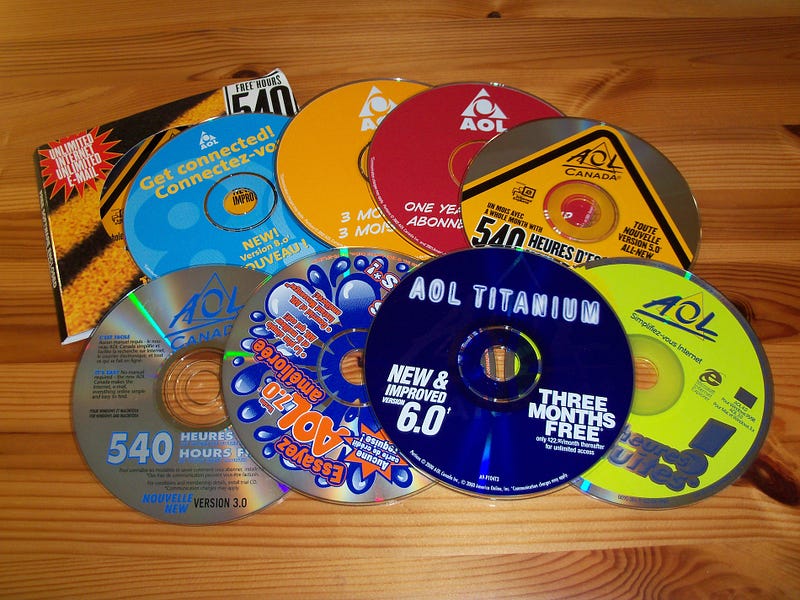
At one point, 50% of the CDs produced worldwide had an AOL logo printed on them — so you can see how omnipresent the brand was.
The ‘problem’ with AOL was how they corralled the content. If you wanted someone else to pre-approve your web browsing — and make sure nothing unseemly permeated through to your screen — then it was a boon.
But as the number of web pages boomed in the second half of the decade, the AOL model soon appeared limiting and archaic. AOL survives to this day, but it is a wafer-thin shadow of the behemoth it was in the mid-90s.
5. CompuServe
People born since the mid-1990s probably won’t have even heard of the name CompuServe — even though a site with that name still exists to this day.
Perhaps CompuServe was AOL before AOL was AOL? CompuServe was the first major internet service provider (ISP) in the late 80s and ruled the roost before AOL supplanted it in the mid-1990s.
I never signed on to CompuServe — or CompuSpend as some cheekily labelled it. It was like AOL in that it had a closed system with email, forums, and curated content — but unlike AOL, it eschewed the flat-rate monthly fee in favour of a metered model.
Paying per minute to view content doesn’t really work when the internet moves at the pace of a glacier — and most of those who didn’t want to navigate the ‘real’ Internet jumped ship to AOL in droves, and CompuServe ended up being acquired by their fiercest rivals in 1998.
6. Prodigy
I’m including Prodigy here for completion’s sake, as it wasn’t really around in the UK.
However, at one point, Prodigy had almost a million subscribers across the States. Most people signed up for its one-price service, and their news and magazine aggregation. Of course, that’s nothing special now. But back then, it was a big deal.
Prodigy garnered a reputation for chopping and changing to compete with AOL. The pricing structures changed regularly, and they dabbled in online censorship. At one point they tried charging extra for e-mail and online chat — each change resulting in thousands of users exiting.
Remember those ubiquitous AOL disks. Prodigy never quite figured out that annoying their user base when everyone had the alternative on a free floppy disk wasn’t the best strategy.
So those are six ways we connected online in the era before Google, YouTube, and Facebook.
Do you remember those days? What are your memories of struggling to get online back in those days?
Here’s the latest story in my Internet Memory Lane series where I look at those amazing 80s and 90s computer games
Medium is an amazing platform for writers. For a small monthly fee, you can read unlimited articles each month as well as write your own. If you decide to join, would you please do so via my link?
It won’t cost you anything extra and I earn a small commission which helps support me and encourages my writing.
Come find me on Medium and find out a bit more about me.
Want to fuel my writing by indulging my coffee habit? Consider buying me a Mocha on the Ko-Fi app. Thanks for reading!


