
Six Sources of Influence — Source 1 Personal Motivation

The Six Sources of Influence is a framework developed by Joseph Grenny and his colleagues in the book “Influencer: The New Science of Leading Change.” These six sources — personal motivation, personal ability, social motivation, social ability, structural motivation, and structural ability — help identify key areas that can be leveraged to bring about rapid, profound, sustainable behavioral change in individuals and organizations.
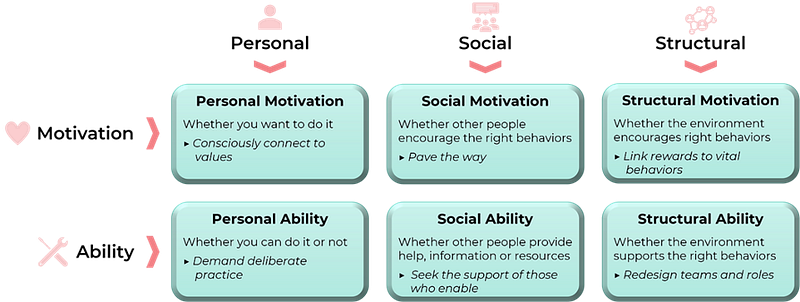
This article focuses on the first source of influence.
Personal Motivation: help them love what they hate.
Make pain pleasurable:
Many changes involve things that people hate to do. We need to overcome our proclivity to employ nag, guilt, or threat to make people embrace such changes, and discard the assumption that people are not motivated simply because of some moral defect or character flaw, like “They’re just selfish.” Influencers understand that forcing people to face their demons doesn’t work — for example, studies show that confrontation actually increases alcoholic bingeing — so they make pain pleasurable to provide motivation.
For instance, Delancey Street is an organization employing thousands of ex-cons who used to be thieves, prostitutes, robbers, murderers, gang members, drug addicts, alcoholics, and homeless people. The vast majority of the employees have eventually earned degrees, become professionals, and changed their lives forever through working for the organization. One of the keys to the miraculous success of these people is that they all find joy in doing the simplest jobs there because the changes required of them to work for Delancey Street help them find back the capability of caring for something in life — they all care for the new opportunity of living a normal life and being respected and valued for what they are doing.
Influencers use four tactics to help people love what they hate:
- Allow for choice:
It serves as the bedrock which the effectiveness of all other approaches to influencing personal motivation relies upon. You can never hope to engage people’s commitment if they don’t have permission to say no because compulsion can only replace motivation briefly before erasing it altogether. The best way to help individuals align their behavior with their deepest motives was to stop trying to control their thoughts and behaviors while replacing judgement with empathy and lectures with questions. When you ask thought-provoking questions and listen well while people talk, they discover on their own what they must do, and they make the necessary changes propelled by their own aspirations and beliefs. “A change of heart can’t be imposed; it can only be chosen.”
2. Create direct experience:
The most powerful way to help people recognize, feel, and believe in the long-term implications of their choices is to get out of their way and let them experience them firsthand. Travel trumps reading; and influencers help people go out into the cold hard world and experience the consequences of their choices.
3. Tell meaningful stories:
When your invitations to “just try it” fall on deaf ears, or when you don’t have the resources or time to create direct experiences, you can tell a meaningful story to create a poignant, believable vicarious experience that not only provokes emotions but also changes minds. Used in combination with other influence methods, storytelling can be a powerful tool in anyone’s influence repertory. Leaders who can build a sense of mission in their organizations are always storytellers — they create vicarious experiences through telling compelling stories.
4. Make it a game:
In order to transform intrinsically unpleasant behavior into something enjoyable, we can turn it into a game. The elements of an enjoyable game include:
- Keeping score: This action produces clear, frequent feedback that can transform activities including highly repetitive tasks into accomplishments that, in turn, will generate intense satisfaction.
- Competition: It imbues the data with meaning. Am I doing better than before? Am I doing better than my peers? Competition, including with oneself, can help people obtain satisfaction from what would otherwise be a mundane task.
- Constant improvement: The actual numbers aren’t as important as the overall slope because what really matters is the trend. You may not be improving at the rate you initially expected, but as long as you are headed in the right direction, time is your best friend.
- Control: Game makers are careful to ensure that all earned points and rewards are in the participants’ control. At work, employees’ personal or team progress is often folded into larger, less successful unit’s overall results, causing them to lose any sense of control over their own contributions. If we avoid this common mistake by creating and recording measures over which individuals have complete control, they will be able to see the impact of their own work, which in turn can create significant motivation.
In short, influencers learn to help others love what they currently hate by allowing them choices, creating direct experiences, telling meaningful stories, and turning the tedious into a game.
Related articles and book:
Six Sources of Influence — Source 2 Personal Ability
Six Sources of Influence — Source 3 Social Motivation
Six Sources of Influence — Source 4 Social Ability
Six Sources of Influence — Source 5 Structural Motivation
Six Sources of Influence — Source 6 Structural Ability
Integrated Business Planning Framework
Agile Leadership Explained: We Can All Be Agile Leaders and Change the World Together! (Kobo)
Agile Leadership Explained: We Can All Be Agile Leaders and Change the World Together! (Amazon)
Collet, B. (2019). Agile leadership. (Online course). https://www.udemy.com/course/agile-leadership/
Sources:
Grenny, J., Patterson, K., Maxfield, D., McMillan, R., & Switzler, A. (2013, May 17). Influencer: The New Science of Leading Change (2nd ed.). McGraw Hill.
Collet, B. (2022, Dec. 13). To Succeed in Change and Transformation, Uncover Why People Behave the Way They Do. Agile Leader Academy. https://www.agileleader.academy/post/to-succeed-in-change-and-transformation-uncover-why-people-behave-the-way-they-do