
Business Model Canvas
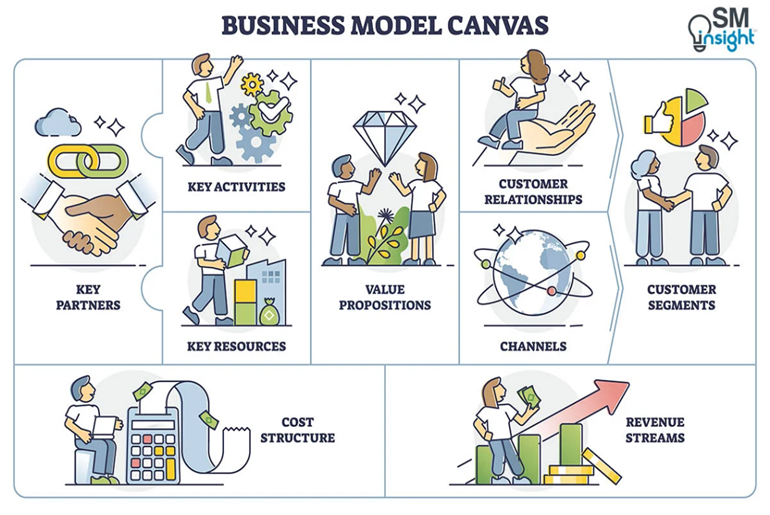
Developed by Alexander Osterwalder and Yves Pigneur, the Business Model Canvas is a strategic management tool used to visualize and design business models. It provides a comprehensive framework for understanding the key components and relationships that drive a business’s operations and profitability by condensing essential business elements onto a single page, fostering a holistic understanding of an organization.
The framework has become widely adopted by startups, established companies, and entrepreneurs alike because of its simplicity and effectiveness.
Nine key elements:
- Customer Segments: Identifies the different groups of customers or market segments that the business serves or intends to serve. This component helps businesses understand their customers’ needs, preferences, and characteristics.
- Value Proposition: Describes the unique value that the business offers to its customers. It articulates the benefits, solutions, or outcomes that address customers’ pain points or fulfill their needs better than competitors’ offerings.
- Channels: Specifies the various channels or methods through which the business reaches, acquires, and serves its customers. This includes direct sales, online platforms, retail stores, partnerships, distribution networks, or any other touchpoints with customers.
- Customer Relationships: Defines the types of relationships the business establishes and maintains with its customers. This can range from personal interactions and customer support to self-service models and automated systems, depending on the nature of the business and customer preferences.
- Revenue Streams: Outlines the different sources of revenue or income streams generated by the business. This includes sales of products or services, subscription fees, licensing agreements, advertising revenue, transaction fees, or any other monetization strategies.
- Key Resources: Lists the essential resources, assets, and capabilities required to operate the business successfully. This includes physical resources (e.g., facilities, equipment), human resources (e.g., skills, expertise), intellectual property, financial resources, and other resources necessary for delivering value to customers.
- Key Activities: Identifies the key activities or tasks that are critical for executing the business model effectively. This may include production, marketing, sales, distribution, customer support, research and development, or any other activities that drive value creation.
- Key Partnerships: Specifies the strategic alliances, partnerships, or collaborations that the business forms with external entities to leverage resources, capabilities, or access to markets. This could involve suppliers, distributors, manufacturers, technology providers, or other stakeholders.
- Cost Structure: Describes the various costs and expenses incurred by the business to operate and maintain its business model. This includes both fixed costs (e.g., rent, salaries) and variable costs (e.g., materials, marketing expenses), as well as any economies of scale or cost-saving measures employed by the business.
Examples of BMC in practice:
Below, I’ve created a sample BMC for a fictional coffee shop business. Here’s a breakdown of each component:
- Customer Segments (CS):
- Coffee Enthusiasts: Regular coffee drinkers seeking quality brews.
- Office Workers: Professionals looking for a convenient morning pick-me-up.
2. Value Proposition (VP):
- High-Quality Coffee: Freshly roasted, ethically sourced beans.
- Cozy Atmosphere: Comfortable seating, free Wi-Fi, and friendly staff.
3. Channels (CH):
- Physical Store: Coffee shop location in a busy downtown area.
- Online Orders: Website and mobile app for pre-orders.
4. Customer Relationships (CR):
- Personalized Service: Baristas engage with customers, remember their preferences.
- Loyalty Programs: Rewards for repeat visits.
5. Revenue Streams (RS):
- Coffee Sales: Espresso drinks, drip coffee, and specialty brews.
- Snacks and Pastries: Additional revenue.
6. Key Resources (KR):
- Coffee Machines: High-quality espresso machines.
- Skilled Baristas: Trained staff.
- Prime Location: Busy street corner.
7. Key Activities (KA):
- Brewing Coffee: Core activity.
- Customer Service: Interacting with patrons.
- Marketing: Promotions and events.
8. Key Partnerships (KP):
- Local Bakeries: Supply pastries.
- Coffee Bean Suppliers: Source high-quality beans.
9. Cost Structure (CS):
- Rent and Utilities: Store expenses.
- Staff Salaries: Baristas and support staff.
- Marketing Costs: Advertising and promotions.
Here are two real world examples:
- Airbnb: CS (Travelers), VP (Affordable accommodations), CH (Online platform), RS (Booking fees), KR (Hosts’ properties), KA (Platform maintenance), KP (Hosts, property managers).
- Apple: CS (Consumers), VP (Innovative devices), CH (Retail stores, online sales), RS (Device sales, services), KR (Intellectual property), KA (Product design), KP (App developers).
In short, the Business Model Canvas is typically presented as a visual diagram consisting of nine components arranged in a grid format, allowing businesses to easily understand and communicate their business model. It encourages iterative thinking, facilitates strategic decision-making, and helps identify opportunities for innovation and improvement in the business model. Additionally, it serves as a useful tool for entrepreneurs seeking to articulate their business ideas, investors evaluating business opportunities, and organizations undergoing strategic planning or business model innovation.
Related articles and book:
Integrated Risk Management Framework
Integrated Business Planning Framework
Four Enablers for Scale-Up of Organizational Innovation
How to Innovate through Successful Experimentation
How to Generate Ideas and Qualify Them for Innovation?
3D Agile Leader Model — Introduction of the Three Dimensions
Agile Leadership Explained: We Can All Be Agile Leaders and Change the World Together! (Kobo)
Agile Leadership Explained: We Can All Be Agile Leaders and Change the World Together! (Amazon)
Collet, B. (2019). Agile leadership. (Online course). https://www.udemy.com/course/agile-leadership/
Source:
Osterwalder, A., & Pigneur, Y. (2010). Business Model Generation. Wiley.
Jurevicius, O. (2023, October 24). Business Model Canvas (BMC): The Ultimate Guide — SM Insight. Strategic Management Insight. https://strategicmanagementinsight.com/tools/business-model-canvas-bmc/