Simplifying ID Lookups from CloudFormation Outputs
ACM.275 Single function to look up IDs and ARNS From CloudFormation Stacks
~~~~~~~~~~~~~~~~~~~~~~~~~~~~~~~~~~~~~~~~~~~~~~~~~~~~~
⚙️ Check out my series on Automating Cybersecurity Metrics | Code.
🔒 Related Stories: S3 Bucket | Application Security | CloudFormation
💻 Free Content on Jobs in Cybersecurity | ✉️ Sign up for the Email List
~~~~~~~~~~~~~~~~~~~~~~~~~~~~~~~~~~~~~~~~~~~~~~~~~~~~~
In the last post I create a VPC with a public and private subnet. The route table associated with the subnet is what makes it public or private.
As I was writing that code I found myself using stack exports to get IDs for resources and once again I found myself writing what felt like duplicate code. I also had to try to remember the export name. Initially when I started this series I was tacking on “Export” to export names for clarity but then sometimes I found myself being inconsistent.
I started thinking that if I could be very consisted I could use one function to get the ID or ARN for any resource.
An ID is an identifier that is used to retrieve or represent an option. For example, in the last post, I was using route table IDs, VPC IDs, and subnet IDs.
Some resources on AWS do not have an ID. They have ARNs or an “Amazon Resource Name.” For example, an AWS IAM Role does not have an ID it has an ARN.
I was trying to think of a resource that has both an ARN and an ID but I can’t think of one. Perhaps there is one. But all I can think of are resources that have one or the other.
If we presume that pretty much every resource has one or the other, and we can give pretty much every resource a Name, then what if create an export for every cloudformation stack — where possible — that returns either the resource ID or ARN for the output with the same name as the resource?
We also have that name in the cloudformation stack name. The stack names are supposed to be in this format (except I may have inadvertently deviated in a few places):
owner profile - resource type - resource nameIf we know that is always the format of the stack and we always use the resource name for the ID or ARN, then we can look at any stack and we know the value to use for the export for that stack. It is the last value after the profile and resource type.
A single function can return the ID or ARN for any stack
If I can keep myself consistent on those points, then I can create a single function to return the ID or ARN for the resource created by any CloudFormation stack.
If I can consistently name stacks and outputs then I can get bunch of a whole bunch of other little functions. Consider this function:
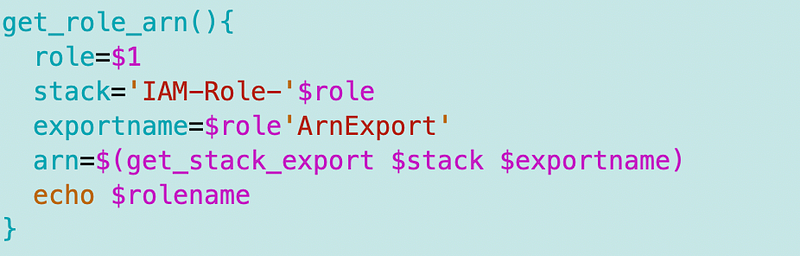
What if I write a function like this instead:
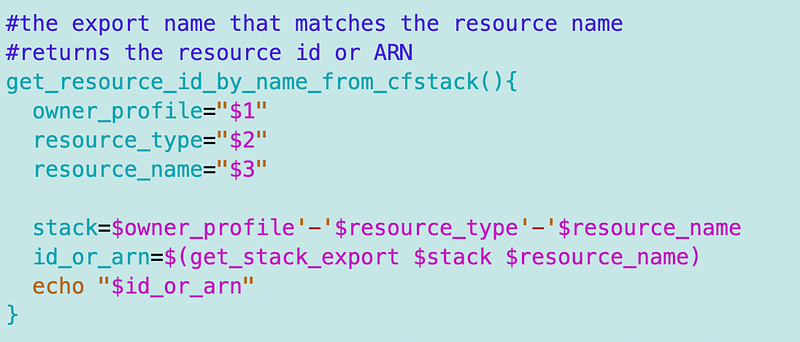
I could modify the get_role_arn() function (which should possibly indicate that it requires a cloudformation stack) to look like this:

But really the above function is so simple now I could replace the line that calls it with the second line in the function above. Now I can use my new function anywhere I need to get an ID or ARN from a CloudFormation stack, presuming I followed my own naming conventions.
Follow for updates.
Teri Radichel | © 2nd Sight Lab 2023
About Teri Radichel:
~~~~~~~~~~~~~~~~~~~~
⭐️ Author: Cybersecurity Books
⭐️ Presentations: Presentations by Teri Radichel
⭐️ Recognition: SANS Award, AWS Security Hero, IANS Faculty
⭐️ Certifications: SANS ~ GSE 240
⭐️ Education: BA Business, Master of Software Engineering, Master of Infosec
⭐️ Company: Penetration Tests, Assessments, Phone Consulting ~ 2nd Sight Lab
Need Help With Cybersecurity, Cloud, or Application Security?
~~~~~~~~~~~~~~~~~~~~~~~~~~~~~~~~~~~~~~~~~~~~~~~~~~~~~~~~~~~~~
🔒 Request a penetration test or security assessment
🔒 Schedule a consulting call
🔒 Cybersecurity Speaker for PresentationFollow for more stories like this:
~~~~~~~~~~~~~~~~~~~~~~~~~~~~~~~~~~~~~~~~~~~~~~~~~~~~~~~~~~~~~
❤️ Sign Up my Medium Email List
❤️ Twitter: @teriradichel
❤️ LinkedIn: https://www.linkedin.com/in/teriradichel
❤️ Mastodon: @teriradichel@infosec.exchange
❤️ Facebook: 2nd Sight Lab
❤️ YouTube: @2ndsightlab