
Should We Just Cancel Pronouns?
This is a linguistic flaw
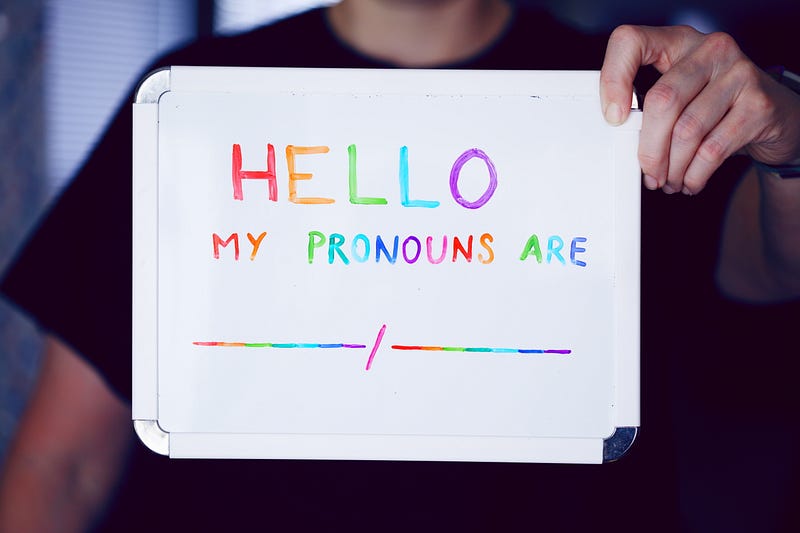
Recently I wanted to show my support to the trans community and I understand I could do this by telling people what pronouns they can use on me, and add that to my social media profile.
Without thinking, I wrote Midori (“She/Her”).
Then Ellen Page is now Elliot Page. He is identified as trans, and asked to be called “He/They”.
Note Elliot didn’t talk about whether he is transexual or transgender. In this article, it’s not about changing the biological sex but gender identification only.
I love Elliot Page, I love his acting, his independence, his talent, his eyes, everything (have you seen this dance with his wife? Epic). I spent the whole day feeling very strange because I suddenly realized I don’t know if I want to be “she/her”.
Let’s dive into my rabbit hole.
Why are we so obsessed with pronouns?
I am Chinese. In written Chinese, there are the “he, she, it” pronouns which are written differently but sound completely the same, which sounds like “ta”.
I moved to the UK at the age of 16 and now I’m 31 years old, when I don’t focus properly, I still get everyone’s pronouns wrong. It wasn’t deliberate, as in I don’t feel this guy is a ‘she’ at all. I am just not used to thinking of addressing a boy as he, they all sound the same in Chinese.
The Latin language family is indeed obsessed with gender. I gave up on learning French for two reasons. 1) the pronunciation fucks up my mouth, and 2) the pronouns. Why is a car a girl? Why is a flower a man? How stupid is this?
In order to overthrow this obsession with binary genders, the non-binary community encourages people to self-identify their pronouns. So we now have female-looking people calling themselves a ‘he’, and genderless people asking to be called ‘they’.
Why canceling pronoun wasn’t a good idea then
We can see how the explicit pronoun-choosing has encouraged the discussion of non-binary gender to the public. Even the older generation is aware that younger people are taking active steps to renounce gender stereotypes now. From an awareness perspective, I think doing pronoun statements has made a great impact.
If we simply cancel pronouns, it will not bring the same level of social change and awareness of gender fluidity. By canceling binary, but without replacement, people will not know what to do, and that means we will revert back to binary.
For example, if I tell my grandma that I don’t identify as a girl, and she shouldn’t address me as ‘she’, my grandma will be confused. What else can she call me? By telling her she can call me ‘they’, she can at least respect this concept and follow the rules. If there’s no replacement, she will definitely get lost and call me ‘she’ again.
What we are dealing with here, is a linguistic cognitive problem.
What’s the alternative?
Given we have successfully raised awareness now, can we take a pause on further identification and seek an alternative to this redundant use of pronouns?
Let’s have a look at the Japanese language. They have pronouns too, he is kare, she is kanojo. But cleverly, they never use these pronouns in everyday conversation. In fact, they don’t even use “you” or “I”, even though those words exist. Benjamin Freeland has also talked about this in detail in this post.
Based on my research (and years of watching Japanese drama), Japanese either omit the pronouns completely so the listener would need to figure out who they are talking about contextually, or they state the name of the person almost constantly.
The conversation will look something like this:
Sam and Anna are talking. Anna: Does Sam have plans for this weekend? Sam: going to the theme park, really looking forward. Anna: That’s great, have a great time!
Chinese is also quite similar in this regard because they belong to the same language family and both are very contextual.
The Chinese use of “TA” to replace all pronouns has become pretty official lately. All China-owned social media platforms, or even Facebook in Chinese, uses “TA” directly. So yes, you will see “TA” as a roman character among a bunch of Chinese words — the degendering of pronouns.
Can we do this too in the west? Just replace everything with TA or “they/them”? Because contextually, it’s not really that difficult to guess whether it’s a singular or plural situation, we honestly don’t need to rely on the pronouns that much to figure out the context.
My pronouns
After Elliot Page’s news, I spent a whole day learning about gender fluidity, transgender, agender, and gender non-binary. This is because I love him and I want to learn about why he is vocal about this and get a glimpse of what he might have gone through.
I have always thought I am a ciswoman because my sex is female and my gender is female. But as I researched more, I can only go so far as saying I agree that my sex is female and my gender is [blank]. It’s not male, not female, not genderless, not both, not sometimes.
“I don’t identify as transgender. But I’m clearly gender not-normal. I don’t think even lesbian is the right identity for me. I really don’t. I might as well come out now. I identify as tired. I’m just tired.” — Hannah Gatsby
You can address me as ‘tired’ too. That makes the two of us on this planet.
I am Chinese and I can’t be bothered with my gender identification. I don’t think if you start calling me “they” or “she” or even “he” will offend me because I don’t feel that strongly about my gender.
Perhaps I’m lucky. I do whatever I want. I wear joggers if I want, I will cut my hair short if I want. I never have long nails, sometimes I put on makeup. I haven’t worn a bra since lockdown begins, but I do like watching Victoria’s Secret show. I talked about how I have maternal instinct but not the urge to be a mum, and I like big tits too (but also penises).
If we are truly embracing gender is a spectrum, then as the gender non-binary conversation continues, we should really find a way to revolutionize languages and cancel pronouns — a historical linguistic flaw in languages. Next time when I join the gay pride, is it ok if I hold up a “cancel pronouns” sign?
I am Midori. Maybe I’m not a ciswoman anymore, but I’m on the gender spectrum. My pronoun is ‘ta’.


