
Should It Be Up to Our Kids to Win the War Against Climate Change?
A longtime friend made the case to me recently that it’s up to our kids to fight and win the battle against climate change . . . .
Related and recent articles
• (Part 1) The 5 Most Important U.S. Economic Events Over the Last 50 Years • Did This Happen by Accident to 89% of America’s Stock Market Wealth? • Pressing Where It Hurts: How to Win Fights That Matter • (Part 1 • Barnacles) Six Behavioral Barriers That Prevent You from Changing the Status Quo • (Part 5 • Smart Man’s Disease) Six Behavioral Barriers That Prevent You from Changing the Status Quo • (Part 6 • Blackballing) Six Behavioral Barriers That Prevent You from Changing the Status Quo
(Subscribe to receive email notifications when I post new articles.)
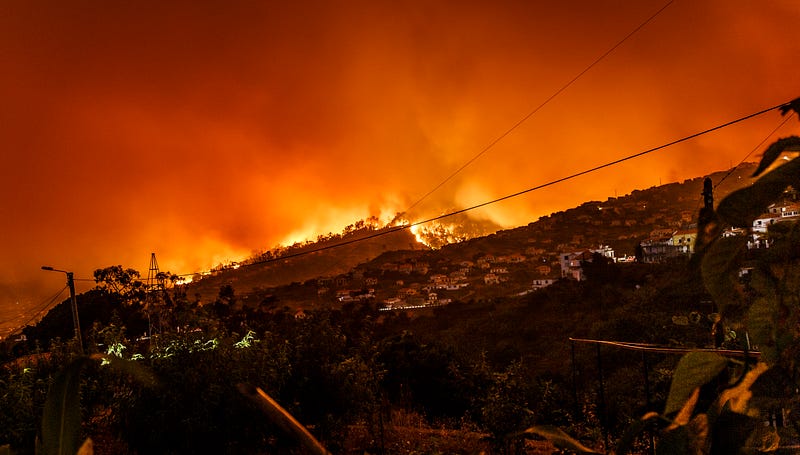
A longtime friend and I had dinner recently and talked about climate change and current efforts by Congress to pass legislation — the “Inflation Reduction Act.”
From what he had read, he was thinking that the new “Inflation Reduction Act” will do what we need it to vis-a-vis climate change. As I probed more, though, it became obvious that he wasn’t really that focused on climate change as a problem and whether this would actually solve it.
If you’re not already up to speed on what Congress did/didn’t do, here are two excellent summaries with objective, insightful analysis. (1) “The New ‘Climate Bill’ Is… About What One Would Expect. It’s a step in the right direction-ish, but some are calling it a climate suicide pact” by Mitchell Peterson, and (2) The “Inflation Reduction” Act of 2022 is a Massive Gift to the Oil and Gas Industries Masquerading as “Historic Climate Legislation” by Al Ronzoni
My friend and I touched on some of the obvious, now-undeniable aspects of climate change, and he didn’t disagree about them or how serious they are.
I walked him through some of the reasons why this new Congressional act falls tragically short of what it needed to be to deal with climate change, but it became more and more obvious as we talked that his attitude was more or less, “Not my problem.”
When I pressed him on it, he quickly boiled it down to, “It’s my daughter’s problem to worry about and solve.”
But . . . should it be his daughter’s problem?
Can we afford the risk that it does end up being his daughter’s problem?
The immediate problem is that we are on a short, unforgiving, inflexible clock with regard to climate change.
In addition, we have a great deal of hard work to do for years to come, and we have an array of corrupt corporations and corrupt politicians lined up to prevent us doing this work.
But the key part for the moment is, we are on a clock.
We have 7 years.
That’s it.
If we keep pumping carbon into the atmosphere at current projected rates, we’ve got 6 years, 10 months, and 30 days (as of this article’s publication date) before we will have pumped the last 291 gigatons of carbon into the atmosphere that guarantee we blow past the 1.5 C target limit of global temperature increase.
Think of this as a carbon budget.
“If we want to limit the rise of average global temperatures to 1.5 degrees, we can emit only a limited amount of CO2. This is the carbon budget.”
If we pump no more than that amount of CO2 into the atmosphere, then we have a real chance of having no more than a 1.5C temperature increase.
BUT, as of August 23, 2022, we are on track to pump the remaining 291.7 giga tons of CO2 left in our “1.5C Carbon Budget” into the atmosphere by July 21, 2029 (Mercator Climate Change Carbon Clock)
This isn’t a 40-year problem for us to solve today.
It might have been a 40-year problem to solve back in 1979 when Exxon confirmed global warming consensus with its in-house climate models. (. . . in-house climate models that Exxon senior management then kept buried internally for the next 3 decades!)
Today? Today it’s a 7-year problem. Deal with it.
If we don’t deal with this in the next few years and get to where we need to be by around mid-2029, then the only backup plan after that is that to deal with it in the decade or two or three after 2029.
And the thing that you have to understand is that it is going to be dramatically more expensive, more difficult, riskier and more costly in every way to everyone to deal with climate change years/decades later than it is if we go at it now.
And that assumes that it is even possible to deal with it if we don't get serious until the 2030s or 2040s or 2050s. It may well not be possible at that point to avoid catastrophic outcomes for human civilization, human beings, and all the other species of plants and animals that share the earth with us and that we depend upon for a myriad of reasons.
I would also say to you that if we don’t have the willpower, the relentlessness, and the fiercest possible sense of urgency to deal with it now, then I flat-out don’t believe any argument a person might make that, “oh, we will get to it later and deal with it then when it’s going to be 5 or 10 or 20 times harder and costlier and riskier.”

Should it be up to our children to fight climate change?
Which generations created the conditions that created runaway climate change?
Which generations perpetuated it?
Which generations hid it?
The generations that brought us climate change and that didn’t address it back when it would have been far cheaper and easier to fix it have a moral responsibility TODAY to do everything they can now to help solve it.

More importantly, even if our kids do have to fly solo and deal with climate change all by themselves in the coming decades, is it EVEN POSSIBLE for them to get that job done over that longer timeframe?
Can it be up to our kids to win the fight against climate change? Is there a chance that it works to leave it up to them?
On the plus side:
- It’s likely that they have “the fire of youth” powering them and the personal sense of “we’re screwed!” driving off-the-charts levels of urgency that would help propel them to get things done NOW.
On the minus side:
- They don’t yet have nearly the skill sets, the life experience, the knowledge, and the wisdom that their parents and grandparents have.
- They’re still at an age where they’re trying to get their careers and adult lives and families going — they just don’t have the free time now to devote to fighting climate change that they would have when they are in their 50s and 60s and above.
- Most importantly, remember that the job becomes exponentially more difficult, costly, and riskier if we don't get really serious about it until the 2030s or 2040s.
If we force our children to have to deal with this in 10 or 20 or 30 years, we are setting them — and all of us — up for a magnitude of failure that most people have not yet thought deeply about.

The only solution that makes sense.
Climate change is an existential problem that we HAVE TO SOLVE.
When anyone suggests that climate change is our children’s problem to solve, that’s basically saying that we have a choice between sending:
- the junior varsity baseball team or
- the World Series professional baseball champions
up against that problem.
I know which team of people I want out there on the front lines.
And it’s not the junior varsity team.
Should the children/young adults be fighting alongside the rest of us . . . and leading where it makes sense for them to?
Yes, of course.
This is an all-hands-on-deck situation, and it will be that way for years and decades to come.
But for all of us folks who are in our 50s, 60s, 70s and on up from there? This is our fight.
We have a moral responsibility to deal with it. That means doing the hard things — confronting the people who are uncomfortable to confront, and holding our politicians, our corporate CEOs, and every other relevant person accountable.
And by that, I mean holding them accountable with an iron fist to ensure we get action in time to get the job done.
Please leave comments and questions below. Thank you for reading, subscribing, clapping, and sharing — I appreciate you sharing your time and attention!
Related and recent articles
• (Part 1) The 5 Most Important U.S. Economic Events Over the Last 50 Years • Did This Happen by Accident to 89% of America’s Stock Market Wealth? • Pressing Where It Hurts: How to Win Fights That Matter • (Part 1 • Barnacles) Six Behavioral Barriers That Prevent You from Changing the Status Quo • (Part 5 • Smart Man’s Disease) Six Behavioral Barriers That Prevent You from Changing the Status Quo • (Part 6 • Blackballing) Six Behavioral Barriers That Prevent You from Changing the Status Quo
(Subscribe to receive email notifications when I post new articles.)
Again, thank you for reading, subscribing, clapping, and sharing — your time and attention are deeply appreciated!